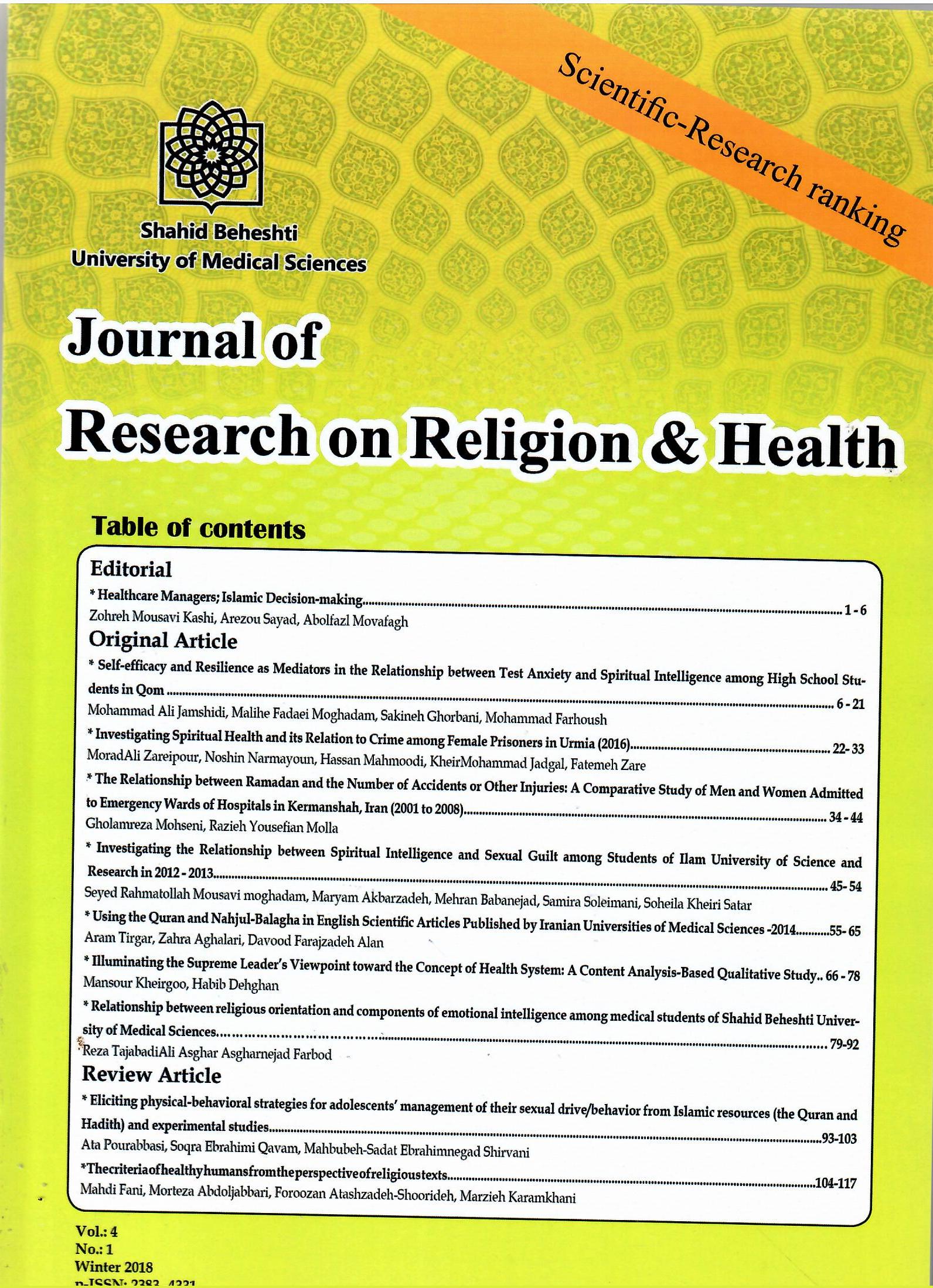
Editorial


Healthcare Managers; Islamic Decision-making

Zohreh Mousavi Kashi , Arezou Sayad , Abolfazl Movafagh

Journal of Pizhūhish dar dīn va Salāmat (i.e., Research on Religion & Health), Vol. 4 No. 1 (2018), 30 December 2017, Page 1-6
https://doi.org/10.22037/jrrh.v4i1.18897

Decision-making is of paramount importance in personal, social, and organizational life, influencing both personal and organizational affairs. Indeed, all human’s life is a chain of decisions made by him (1). In this regard, decision-making in major managements, particularly in health sector where lives of people as well as physical and spiritual health are involved, is of particular importance.

Please cite this article as: Mousavi KashiZ, Sayad A, Movafagh A.Healthcare Managers; Islamic Decision-making. J Res Relig Health. 2018; 4(1): 1- 6. DOI: https://doi.org/10.22037/jrrh.v4i1.18897

Original Article


Self-efficacy and Resilience as Mediators in the Relationship between Test Anxiety and Spiritual Intelligence among High School Students in Qom

Mohammad Ali Jamshidi , Malihe Fadaei Moghadam, Sakineh Ghorbani , Mohammad Farhoush

Journal of Pizhūhish dar dīn va Salāmat (i.e., Research on Religion & Health), Vol. 4 No. 1 (2018), 30 December 2017, Page 7-21
https://doi.org/10.22037/jrrh.v4i1.15402

Background and Objective: Spiritual intelligence is effective in reducing test anxiety which hinders academic performance. Discovering mediating variables in the relationship between spiritual intelligence and test anxiety paves the way for developing suitable training packages in order to reduce test anxiety. The aim of this study was to investigate the mediating role of self-efficacy and resilience in the relationship between spiritual intelligence and test anxiety.

Method: This descriptive study was of correlational type and its research population was all high school students in Qom in 1395 and 1396. Random cluster sampling was used. To do so, three female and three male schools were randomly selected and 380 questionnaires were distributed in some classes and then collected. 269 questionnaires (127 boys and 142 girls) were acceptable. The participants completed test anxiety questionnaire (Sarason, 1997), SQ (Abdollahzadeh, 2009) and Efficacy (Sherer, 1982) and Resiliency (Connor & Davidson, 2003). As for data analysis, Pearson correlation and path analysis based on Baron and Kenny model were used. In this study, the ethical issues were all considered and the authors declared no conflict of interest.

Results: Pearson correlation analysis showed that test anxiety and spiritual intelligence (0/267), efficacy (-0/475) and resilience (-0/330) have a significant relationship (P<0/01). Moreover, the results of path analysis indicated that efficacy (0/17) and resilience (0/09) completely mediate the relationship between spiritual intelligence and test anxiety.

Conclusion: Based on the findings, spiritual intelligence reduces test anxiety through self-efficacy and resilience. Thus, it is proposed that spiritual intelligence training packages with an emphasis on raising students' self-efficacy and resilience be developed to reduce test anxiety.


Please cite this article as:JamshidiMA, Fadaei MoghadamM, GhorbaniS, FarhoushM. Self-efficacy and Resilience as Mediators in the Relationship between Test Anxiety and Spiritual Intelligence among High School Students in Qom. J Res Relig Health. 2018; 4(1): 7- 21.DOI: https://doi.org/10.22037/jrrh.v4i1.15402

Investigating Spiritual Health and its Relation to Crime among Female Prisoners in Urmia (2016)

MoradAli Zareipour, Noshin Narmayoun , Hassan Mahmoodi , KheirMohammad Jadgal , Fatemeh Zare

Journal of Pizhūhish dar dīn va Salāmat (i.e., Research on Religion & Health), Vol. 4 No. 1 (2018), 30 December 2017, Page 22-33
https://doi.org/10.22037/jrrh.v4i1.16011

Background and Objective: Spiritual health is an important aspect of health that can create hope and inner peace in individuals, giving meaning to life. The aim of this study was to evaluate spiritual health of female prisoners and its relation to the type of crime.

Method: This descriptive-analytical study was conducted on 150 female prisoners in 2016. To measure the spiritual health, the Palutzian and Ellison spiritual health questionnaire and a demographic questionnaire including demographic data, type of crime, and sentence length were used. The collected data were analyzed using Chi-square, ANOVA and Scheffe test. In this study, the ethical issues were all considered and the authors declared no conflict of interest.

Results: The results indicated 27 participants (18%) with poor spiritual health, 90 (60%) with moderate spiritual health, and 33 (22%) with high spiritual health. The results also showed that convicts of murder and accomplices in murder and those sentenced to death were at the lowest level of spiritual health. Overall, spiritual health relationship to type of crime and sentence length was statistically significant (P <0.05).

Conclusion: Given the low spiritual health of female prisoners and its relationship to the severity of the offense, it seems necessary that policies promoting spiritual health of the prisoners which are consistent with the evidence be taken so that not only other aspects of prisoners' health are improved but also crimes are prevented from recurring.

Please cite this article as:Zareipour MA, NarmayounN, MahmoodiH, JadgalKhM, ZareF. Investigating Spiritual Health and its Relation to Crime among Female Prisoners in Urmia. J Res Relig Health. 2018; 4(1) : 22- 33.DOI: https://doi.org/10.22037/jrrh.v4i1.16011


Background and Objective: Improving community health is the most important concerns of judicial authorities in every society. Previous research has yielded conflicting results in terms of changes in the rates of social harms in Ramadan (in comparison with the rest of the year). Therefore, the primary objective of this study was to investigate the relationship between Ramadan and the number of accidents or injuries reported by emergency wards of hospitals in Kermanshah, Iran, during a seven year period (2001 through 2008). The study also aimed at examining the possible differences between men and women in this regard.

Method: The current study had a retrospective, quasi-experimental nature. All male and female patients (whose age ranged from 15 to 45 years) who were admitted to emergency departments of Taleghani and Imam Reza hospitals of Kermanshah due to car accident injuries and three other injuries caused by gunshot, fighting, and fall from height during Ramadan and non-Ramadan months of the years 2001 through 2008 were included in our study. Convenient sampling was used for data collection. Kolmogorov-Smirnov test, paired samples t-test and ANOVA were exploited for data analysis. In this study, The ethical issues were all considered and the authors declared no conflict of interest.

Results: For both males and females, a large number of accidents were generally recorded in non-Ramadan months compared with Ramadan (0.001). Nonetheless, no statistically significant differences were found between mean scores obtained for Ramadan and non-Ramadan months in either group (0.743 and 0.773 for women and men, respectively). On the other hand, the mean values of men’s injuries were higher than those of women’s in all cases (0.05 α≤).

Conclusion: The results of this study showed that, on average, the number of accidents and other injuries in non-Ramadan months is greater than that of Ramadan (though the difference is not statistically considerable). Furthermore, the number of injuries in women during Ramadan and other months of the studied years were lower than that of men.


Please cite this article as:MohseniGh, Yousefian MollaR. The Relationship between Ramadan and the Number of Accidents or Other Injuries: A Comparative Study of Men and Women Admitted to Emergency Wards of Hospitals in Kermanshah, Iran (2001 to 2008). J Res Relig Health. 2018; 4(1) : 34- 44.DOI: https://doi.org/10.22037/jrrh.v4i1.16673

Investigating the Relationship between Spiritual Intelligence and Sexual Guilt among Students of Ilam University of Science and Research in 2012 - 2013

Seyed Rahmatollah Mousavi moghadam, Maryam Akbarzadeh , Mehran Babanejad , Samira Soleimani , Soheila Kheiri Satar

Journal of Pizhūhish dar dīn va Salāmat (i.e., Research on Religion & Health), Vol. 4 No. 1 (2018), 30 December 2017, Page 45-54
https://doi.org/10.22037/jrrh.v4i1.16104

Background and Objective: The use of spiritual resources can be effective to solve the life-related problems including feeling guilty. Hence, the aim of this study was to investigate the relationship between spiritual intelligence and sexual guilt among students of Ilam University of Science and Research.

Method: This study adopted a descriptive-correlational design. The population of the study included all students studying at Ilam University of Science and Research in 2012 - 2013. Using Morgan table, 100 students were selected through convenient sampling technique. Mosher’s Sexual Guilt Inventory and King’s Spiritual Intelligence Self-Report Inventory were utilized for data collection. Descriptive statistics, Pearson correlation coefficient and linear regression were conducted for analyzing the gathered data. In this study, The ethical issues were all considered and the authors declared no conflict of interest.

Results: Based on the obtained results, there was no significant association between the overall spiritual intelligence and sexual guilt scores (r=0.192; p>0.05). However, one of the subscales of spiritual intelligence (i.e. Conscious State Expansion) significantly predicted sexual guilt (r=0.401; p>0.01). Besides, there was a statistically measurable correlation between sexual guilt and students’ age. Nonetheless, no significant relationship was detected between students’ scores on the sexual guilt inventory and their gender (r=0.204; p>0.05).

Conclusion: Although no significant connection was observed between students’ spiritual intelligence and sexual guilt, one the subscales of spiritual intelligence had a significant role in understanding and expressing sexual guilt. This role was specifically considerable among older students.


Please cite this article as:Mousavi moghadamSR, AkbarzadehM, BabanejadM, SoleimaniS, Kheiri SatarS. Investigating the Relationship between Spiritual Intelligence and Sexual Guilt among Students of Ilam University of Science and Research in 2012 – 2013. J Res Relig Health. 2018; 4(1) : 45- 54.DOI: https://doi.org/10.22037/jrrh.v4i1.16104

Using the Quran and Nahjul-Balagha in English Scientific Articles Published by Iranian Universities of Medical Sciences -2014

Aram Tirgar , Zahra Aghalari , Davood Farajzadeh Alan

Journal of Pizhūhish dar dīn va Salāmat (i.e., Research on Religion & Health), Vol. 4 No. 1 (2018), 30 December 2017, Page 55-65
https://doi.org/10.22037/jrrh.v4i1.14902

Background and Objective: The Quran Al-Karim is not a book in the field of medicine and public health; however, it contains many verses in relation to health and hygiene. It also explores the root of events relevant to health and disease. Nahjul-Balagha also contains brilliant clues of health and hygiene. Therefore, the present study was conducted with the aim of determining the degree to which these two guidebooks have been utilized in writing medical articles.

Method: The current applied, cross-sectional investigation was conducted by citation analysis; that is, frequency counts were obtained of original English language scientific articles which were published by Iranian universities of medical sciences in 2014. Data was collected using a researcher-made check-list through the survey of all scientific articles and their references. Descriptive statistical indicators were used for data analysis. In this study, The ethical issues were all considered and the authors declared no conflict of interest.

Results: Of 201,071 studied references from 6,907 published articles and in 696 English language scientific journals belonging to 31 Iranian universities of medical sciences, Quran Al-Karim had been cited 218 times (less than 1%). Also, none of the articles had used Nahjul-Balagha as a reference. The most frequently cited Surahs of the holy Quran in published articles were Al-Baqarah, An-Nisa, Al-Anaam, and Al-Isra, in that order.

Conclusion: Although the findings have shown that the Quran was cited as a reference among published articles in the field of medical sciences, its utilization rate seems to be inadequate.


Please cite this article as:Tirgar A, AghalariZ, Farajzadeh AlanD. Using the Quran and Nahjul-Balagha in English Scientific Articles Published by Iranian Universities of Medical Sciences -2014. J Res Relig Health. 2018; 4(1) : 55- 65.DOI: https://doi.org/10.22037/jrrh.v4i1.14902

Illuminating the Supreme Leader’s Viewpoint toward the Concept of Health System: A Content Analysis-Based Qualitative Study

Mansour Kheirgoo , Habib Dehghan

Journal of Pizhūhish dar dīn va Salāmat (i.e., Research on Religion & Health), Vol. 4 No. 1 (2018), 30 December 2017, Page 66-78
https://doi.org/10.22037/jrrh.v4i1.15020

Background and Objective: In today’s society, health is among the top priorities of every state. The importance of this concept can be observed in the economic, cultural and social potential of healthy human resources in each community. This article examines the components and indicators of health and also presents a conceptual model for it based on the supreme leader’s viewpoint.

Method: Content analysis was utilized in this qualitative study to illuminate the concepts, indicators and components of health and wellness based the supreme leader's ideas. The sample included all health-related statements mentioned by Ayatollah Khamenei in his speeches delivered between March, 2001 and March, 2017. These data were retrieved from library categorizations. In this study, the ethical issues were all observed. Additionally, the authors declared no conflict of interests.

Results: In total, 18 key health indicators were identified in the supreme leader’s speeches: national production, progress in work, scientific initiative, development and advancement, preservation of scientific discourse, speed of scientific progress, fulfillment of assigned tasks, risk taking, prioritizing, talent, cultural issues, proper treatment of patients, future-oriented vision, correct attitude, commercialization, education, sports and general health.

Conclusion: According to the findings of the study, from the supreme leaders’ perspective, thre three main elements of health-related subjects are dynamism, self-sufficiency and globalization. Inspired by these statements, we can build a healthier society, which is economically stronger and has a higher level of public satisfaction. Following the supreme leader’s health-related guidelines can eventually lead to having a more powerful and self-sufficient country.


Please cite this article as:Kheirgoo M, Dehghan H. Illuminating the Supreme Leader’s Viewpoint toward the Concept of Health System: A Content Analysis-Based Qualitative Study. J Res Relig Health. 2018; 4(1):66- 78. DOI: https://doi.org/10.22037/jrrh.v4i1.15020

Relationship between religious orientation and components of emotional intelligence among medical students of Shahid Beheshti University of Medical Sciences

Reza Tajabadi , Ali Asghar Asgharnejad Farbod

Journal of Pizhūhish dar dīn va Salāmat (i.e., Research on Religion & Health), Vol. 4 No. 1 (2018), 30 December 2017, Page 79-92
https://doi.org/10.22037/jrrh.v4i1.16480

Background and Objective: Religious orientation (internal and external) is one of the factors influencing behavior and cognition and plays a decisive role in the components of emotional intelligence. The main purpose of this study was to investigate the relationship between religious orientation and components of emotional intelligence among medical students of Shahid Beheshti University of Medical Sciences.

Method: The method of this research is descriptive and correlational. The statistical population of this study consists of all medical students of Shahid Beheshti University of Medical Sciences (academic year 2016 – 2017). Simple random sampling was used for selecting the participants. More specifically, the sample size consisted of 63 students (32 females and 31 males) who were randomly selected from among all students of the faculty of medicine. The data collection tool was Alport Religious Orientation (ROS) questionnaire and Bar-EQ Intelligence Questionnaire (EQ-I). Data were analyzed by using descriptive statistical methods (mean and standard deviation) and regression analysis. In this research, confidentiality and all ethical principles were respected. Also, the authors of the article have not reported any conflicts of interest.

Results: In total, 51% of the respondents were females, while 49% were males. Also, 31.7% of the research population was in the age group of 18 to 20 years old, 52.4% had an age range of 21 to 23 years and 15.9% were 24-29 years old. Approximately, 93.7% of the participants were single, whereas 6.3% were married. The findings indicate that external and internal religious orientation has a significant effect on the components of emotional intelligence at the level of 5%. The findings showed that students' religious orientation can significantly predict 19% of the components of emotional intelligence.

Conclusion: The results of this study showed that religious orientation can play an effective role in predicting students' emotional intelligence. Students with stronger religious orientation are more flexible, more tolerant while facing stressful situations and generally happier. They also consider themselves more accountable in social situations.


Please cite this article as: Tajabadi R. Asgharnejad Farbod A A. Relationship between religious orientation and components of emotional intelligence among medical students of Shahid Beheshti University of Medical Sciences. J Res Relig Health. 2018; 4(1): 79- 92.DOI: https://doi.org/10.22037/jrrh.v4i1.16480

Review Article


Eliciting physical-behavioral strategies for adolescents’ management of their sexual drive/behavior from Islamic resources (the Quran and Hadith) and experimental studies

Ata Pourabbasi , Soqra Ebrahimi Qavam, Mahbubeh-Sadat Ebrahimnegad Shirvani

Journal of Pizhūhish dar dīn va Salāmat (i.e., Research on Religion & Health), Vol. 4 No. 1 (2018), 30 December 2017, Page 93-103
https://doi.org/10.22037/jrrh.v4i1.16848

Background and Objective: Sexual drive is one of the main human instincts whose proper management can lead to mental health improvement. Adolescents whose sexual drive is growing during their teenage years don’t find proper ways to fulfill their sexual desires. Therefore, they should manage this drive through selecting appropriate strategies. The current paper aimed to offer some religious health-related physical and behavioral strategies parallel to experimental evidences in order to help adolescents manage their sexual drive and behaviors.

Method: In line with the purpose of the study, Islamic resources (the Quran and Hadith) and experimental studies were systematically searched. Physical and behavioral factors related to sexual drive/ behavior were extracted and organized into two groups of sexual drive/behavior amplifiers or reducer. All ethical issues were taken into account. Furthermore, the authors declared no conflict of interests.

Results: In total, forty nine factors affecting sexual drive/behavior were collected from the studied resources. The main portion of these factors were relatred to nutrition, nutrients and nutritional behaviors. Physical activities, personal hygenic behaviors, smells and colours were the other affecting factors.

Conclusion: It seems focusing on nutritional behaviors such as calorie intake restriction, low food intake, reducing the intake of nutrients and nutritional supplements that boos the sexual drive, promoting invovleemt in psysical activities and some modifications in enviroments that are frequented by adolescents can help young adults manage the sexual derive/behavior.


Please cite this article as: Pourabbasi A, Ebrahimi Qavam S, Ebrahimnegad Shirvani MS. Eliciting physical-behavioral strategies for adolescents’ management of their sexual drive/behavior from Islamic resources (the Quran and Hadith) and experimental studies. J Res Relig Health. 2018; 4(1): 93- 103.DOI: https://doi.org/10.22037/jrrh.v4i1.16848

The criteria of healthy humans from the perspective of religious texts

Mahdi Fani, Morteza Abdoljabbari, Foroozan Atashzadeh-Shoorideh, Marzieh Karamkhani

Journal of Pizhūhish dar dīn va Salāmat (i.e., Research on Religion & Health), Vol. 4 No. 1 (2018), 30 December 2017, Page 104-117
https://doi.org/10.22037/jrrh.v4i1.13417

Background and Objective: The Holy Quran contains a lot of subjects on human health. In addition to physical health, the Quran considers mental health as another important dimension to human health. The current study aimed at identifying the criteria for recognizing a healthy human from the perspective of religious texts. In this regard, attempts were made to detect the criteria for identifying a healthy human from an Islamic viewpoint. To this end, ideas proposed by a number of religious figures, including Imam Khomeini, the Supreme Leader, and martyr Motahhari, were investigated.

Method: In this descriptive study, content analysis was used to examine verses of Quran and religious experts’ interpretations of these verses about human health. Additionally, the narratives related to the Quran-based interpretations of Prophet Mohammed’s Ahl al-Bayt, especially about the spiritual dimension of human health, were investigated. Furthermore, contemporary domain experts’ opinions were sought to confirm the extracted criteria. All ethical issues were observed in this study and the authors declared no conflict of interests.

Results: Based on the obtained results, a human can be regarded as healthy in two dimensions: materialistic and spiritual. It should be noted that these two are not interdependent. In other words, a human may be physically healthy, but spiritually unhealthy. On the contrary, a person may be spiritually healthy, but physically unhealthy. Spiritual health plays a more significant role in human happiness.

Conclusion: As argued by domain experts, humanity has to do with people’s spiritual aspect rather than their physical and materialistic one. Spiritual health is more important than physical health. Spiritual diseases are more significant than physical ones. Imam Ali (peace be upon him) says, ‘the piety of heart is superior to physical health.’ Therefore, a human is regarded as healthy in two dimensions. The subject of materialistic health falls within the domain of medicine, while the topic of spiritual health is categorized within the realm of religion.


Please cite this article as: FaniM, AbdoljabbariM, Atashzadeh-ShooridehF, Karamkhani M. A study of the criteria for identifying healthy humans and healthy relationships from the perspective of religious texts. J Res Relig Health. 2018; 4(1):104- 117.  DOI: https://doi.org/10.22037/jrrh.v4i1.13417