
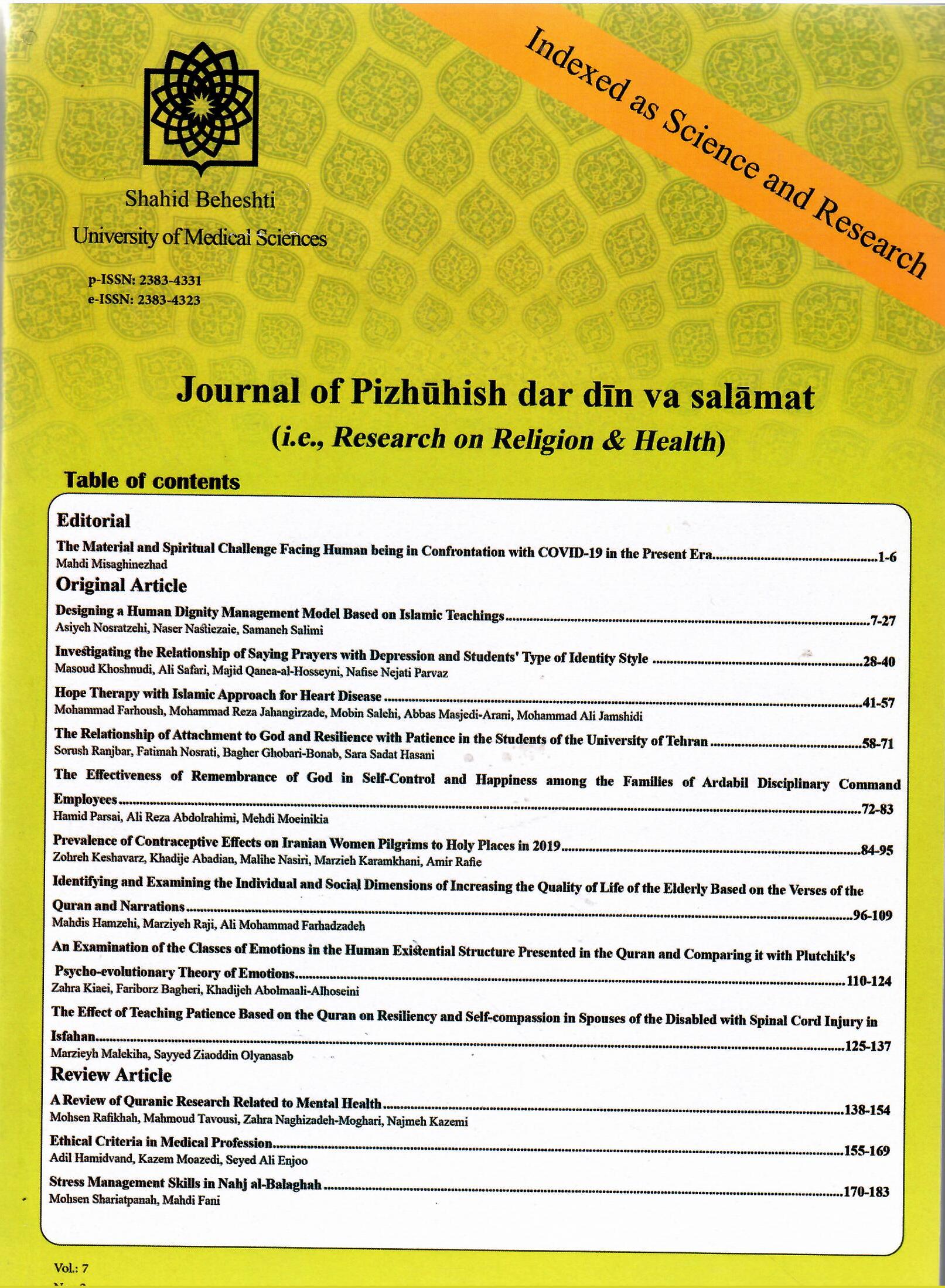
بررسی ارتباط فریضۀ نماز با میزان افسردگی و نوع سبکهای هویتی دانشجویان
پژوهش در دین و سلامت ,
دوره 7 شماره 2 (2021),
21 خرداد 2021
,
صفحه 28-40
https://doi.org/10.22037/jrrh.v7i2.28399
چکیده
سابقه و هدف: با توجه به فراوانی عوامل استرسزا در دانشجویان علوم پزشکی و آثار مخرب افسردگی و تشکیلنشدن هویت بر زندگی شخصی و کاری آنان و با توجه به تأثیرات عمیق و شگرف اعمال مذهبی و در صدر این اعمال نماز در سلامت روان قشر دانشجو و لحاظ موارد ضد و نقیض در این زمینه، پژوهشگران بر آن شدند تا این مطالعه را با هدف تعیین ارتباط فریضۀ نماز با میزان افسردگی و نوع سبکهای هویتی دانشجویان مجتمع آموزش عالی سلامت کاشمر طراحی و اجرا نمایند.
روش کار: در این مطالعۀ توصیفی-همبستگی از نوع مقطعی، تعداد 129 نفر از دانشجویان مجتمع آموزش عالی سلامت کاشمر که معیارهای ورود به مطالعه را داشتند بهصورت آمارگیری تمامشماری در سال 1397 وارد مطالعه شدند. روش جمعآوری دادهها به اینصورت بود که پس از توضیح اهداف پژوهش، شرکتکنندگان پرسشنامههای جمعیتشناختی، افسردگی دانشجویان(USDI) و سبکهای هویتی (ISI-6G) را تکمیل کردند. دادهها پس از جمعآوری با آزمونهای آماری توصیفی و ضریب همبستگی تجزیه و تحلیل شد. در این پژوهش همۀ موارد اخلاقی رعایت شده است و مؤلفان مقاله تضاد منافعی گزارش نکردهاند.
یافتهها: طبق نتایج نمرۀ میانگین افسردگی آزمودنیها 99/26±18/63 و بالاترین نمرۀ سبکهای هویتی مربوط به گویۀ اطلاعاتی و هنجاری بهترتیب با نمرۀ 09/6±55/40 و 24/5±22/33 بود. بین متغیّر اقامۀ نماز، التزام به اقامۀ نماز و شرکت در نماز جماعت با میزان افسردگی و سبک هویت هنجاری دانشجویان ارتباط معنیداری وجود داشت. دانشجویانی که به اقامۀ فریضۀ نماز اهتمام میورزیدند سطح افسردگی کمتر و سطح هویت بالا و همچنین دانشجویانی که در نماز جماعت بهصورت همیشگی شرکت میکردند پایینترین سطح افسردگی و بالاترین سطح گویههای اطلاعاتی، هنجاری، اجتنابی و تعهد را داشتند.
نتیجهگیری: با توجه به یافتههای مطالعۀ حاضر مبنی بر ارتباط فریضۀ نماز با افسردگی و سبکهای هویتی دانشجویان، میتوان با سیاستگذاری مؤثر در فرهنگسازی صحیح اقامۀ نماز در دانشگاهها، موجبات ارتقای سطح هویتی و کاهش سطح افسردگی دانشجویان را مهیا ساخت.
استناد مقاله به این صورت است:
Khoshnudi M, Safari A, Qanea-al-Hosseyni M, Nejati-Parvaz N. Investigating the Relationship of Saying Prayers with Depression and Students' Type of Identity Style. Journal of Pizhūhish dar dīn va salāmat. 2021;7(2):28-40. https://doi.org/10.22037/jrrh.v7i2.28399
- افسردگی، دانشجو، سبکهای هویتی، نماز
ارجاع به مقاله
مراجع
Azad-Marzabadi A. The role of stress in students' mental health. Proceedings of the Second Seminar of Students mental health. Tehran: Tarbiat Modarres Univercity; 2005.
Vahedi S, Eskandari F. The validation and multi-group confirmatory factor analysis of the Satisfaction with Life Scale in nurse and midwife undergraduate students. Iranian Jounal Of Nursing Reserch. 2010;5(17):68-79. (Full Text in Persian)
Fathi M. Incidence rate and sources of stress among nurses working in intensive care unit of Kurdistan university of medical sciences. Sci J Kurdistan Univ Med Sci. 2004;7(4):62-68. (Full Text in Persian)
Vaghei S. Survey on psychological secure status of the students. J Sabzevar Univ Med Sci. 1998;4(3):83-8. (Full Text in Persian)
Noble RE. Depression in women. Metabolism. 2005;54(5):49-52.
Ozdemir H, Rezaki M. General Health Questionnaire-12 for the detection of depression. Turk Psikiyatri Derg. 2007;18(1):13-21.
Aktekin M, Karaman T, Senol YY, Erdem S, Erengin H, Akaydin M. Anxiety, depression and stressful life events among medical students: a prospective study in Antalya, Turkey. Medical education. 2001;35(1):12-7.
Nurmi J, Berzonsky M, Tammi K, Kinney A. Identity processing orientation, cognitive and behavioural strategies and well-being. International Journal of Behavioral Development. 1997;21:555-70.
Erikson E. Identity: Youth and crisis. New York: Norton1968.
Feyzollahi J, Askari S, Khosravipour N, Hasani Z. Prayers And Identity Styles Among Kermanshah Medical Sciences University Students. Culture In THhe Islamic University. 2014;4(1):133-46. (Full Text in Persian)
Berzonsky M, Adams G. Reevaluating the identity status paradigm: Still useful after 35 years. Develop Rev. 1999;9:557-90.
Asna-Asharan S. Investigating the Relationship between Family Patterns and Religious Beliefs with Advanced, Adult, Disturbed and Delayed Identities in Adolescents in Isfahan. Tehran: Azad University, Roodehen Branch;1999. (Full Text in Persian)
Eslamei A, Vakili M, Faraji J. The study of the rate of depression and its relation to kind of free time activity among the medical students. J Gorgan Uni Med Sci. 2002;4(1):52-9. (Full Text in Persian)
Karimi M, Golchin M. An elementary study on prayer and health of youths. J Fundam Ment Health. 2004;5(18):45-56. (Full Text in Persian)
Yamey G, Greenwood R. Religious views of the 'medical' rehabilitation model: a pilot qualitative study. Disabil Rehabil. 2004;26:455-62.
Chavoshi A, Talebian D, Tarkhorani H, SedqiJalal H, Azarmi H, FathiAshtiani A. The relationship between prayers and religious orientation with mental health. Journal of Behavioral Sciences. 2008;2(2):149-56. (Full Text in Persian)
Yamey G, Greenwood R. Religious views of the 'medical' rehabilitation model: a pilot qualitative study. Disabil Rehabil. 2004;26(8):455-62.
McCullough M. Conceptual issues, research review, and research agenda. Journal of Psychology and Theology. 1995;23(1):15-29.
Moatamedi A, Ejei J, Azadfallah P, Kyamanesh A. The relationship between religious tendency and successful aging. Daneshvar Raftar. 2005;1(10):43-56. (Full Text in Persian)
Soleimanizadeh L, Agamolaei T. The relation of depression and individual perception about being religious in Bandar Abbas Nursing, Midwifery and Health Students in 2000. J Arak Univ Med Sci. 2002;5(2):11-5. (Full Text in Persian)
Pargament K. The psychology of religion and coping: Theory, research, practice. New York: Guilford Publications; 1997.
Nasirzadeh R, Rassolzadeh T, Tabatabaie K. Religious beliefs and coping strategies in students. Ofogh-e-Danesh Journal. 2009;15(2):36-45. (Full Text in Persian)
White J, Wampler R, Winn K. The identity style inventory: A revision with a sixth grade reading level. Journal of Adolescent Research. 1998;13(2):223-45.
Khawaja NG, Bryden KJ. The development and psychometric investigation of the university student depression inventory. Journal of affective disorders. 2006;96(1-2):21-9.
Hejazi E, Sharifi A, Shalchi B. Investigation of psychometric properties of university student depression inventory (USDI). Quarterly Journal of Psychological Studies. 2008;4(2):125-49. (Full Text in Persian)
Ranaie F, Ardalan F, Zaheri F. Survey of relationship between attitude and practice toward prayer and depression in students of Kurdistan University of Medical Sciences. Teb Va Tazkiye. 2011;19(4):75-83. (Full Text in Persian)
Hashemi M, Zadehbagheri G, GHafarian S. A Survey on Some Etiologic Factors Related to Depression Among University Students in Yasuj. Journal of Medical Research. 2003;2(1):19-27. (Full Text in Persian)
Ellison C, Boardman J, Williams D, Jackson T. Religious involvement, stress and mental health: findings from the 1995 Detroit area study. Social forces, retrieved June 28, from the istor database. 2006;80:215-94.
Mohtashamipour E, Mohtashamipour M, Shadlomashhadi F, Emadzadeh A, Hasanabadi H. Thesurvey Of Pray And Depression Rate Relationship In Paramedical And Health Students Of Mash Ad University. Ofogh-e-Danesh Journal. 2003;9(1):76-81. (Full Text in Persian)
Rizvi T. Examining the Relationship between Depression, Anxiety and Religious Orientation in Kashmir University Students, India. International Research Journal of Social Sciences. 2015;4(5):1-4.
Lindström E. The Relationship between Identity Development and Religiousness in Swedish Emerging Adults. stockholms universitet psykologiska institutionen. masteruppsatsi psykologi. 2015;30 hp:1-19.
Balbuena L, Bactz M, Bowen R. Religious attendance, spirituality, and major depression in Canada: a 14 year follow-up study. Canadian Journal of psychiatry. 2013;58(4):225-32.
Barton Y, Miller L, Wickramaratne P, Gameroff M, Weissman M. Religious attendance and social adjustment as protective against depression: a 10-years prospective study. Source Columbia University, teachers collage, USA. 2013;146(1):53-70.
Hefti R. Integrating religion and spirituality into mental health care, psychiatry and psychotherapy. Religions. 2011;2(4):611-27.
Desrosiers A, Miller L. Relational spirituality and depression in adolescent girls. Journal of clinical psychology. 2007;63(10):1021-37.
Marzband R, Mollaei M, Nasiri E. Investigating the relation of congregational prayer with Spiritual Health of Medical Sciences Students. Teb Va Tazkieh. 2019;27(1):62-73. (Full Text in Persian)
Dehestani M, ZadeMohammadi A, Mohammadi S. The extent of religiosity and its relationship with university students identity styles. Journal of Behavioral Sciences. 2012;6(2):171-9. (Full Text in Persian)
Duriez B, Soenens B, Beyers W. Personality, identity styles, and religiosity: An integrative study among late adolescents in Flanders (Belgium). Journal of Personality. 2004;72(5):877-910.
Berzonsky MD, Adams GR. Reevaluating the identity status paradigm: Still useful after 35 years. Develop Rev. 1999; 9:557-90.
Mesbah MT. Ethics in Quran. Qum: Imam Khomeini Educational Research Institute; 1999. (Full Text in Persian)
- چکیده مشاهده شده: 679 بار