
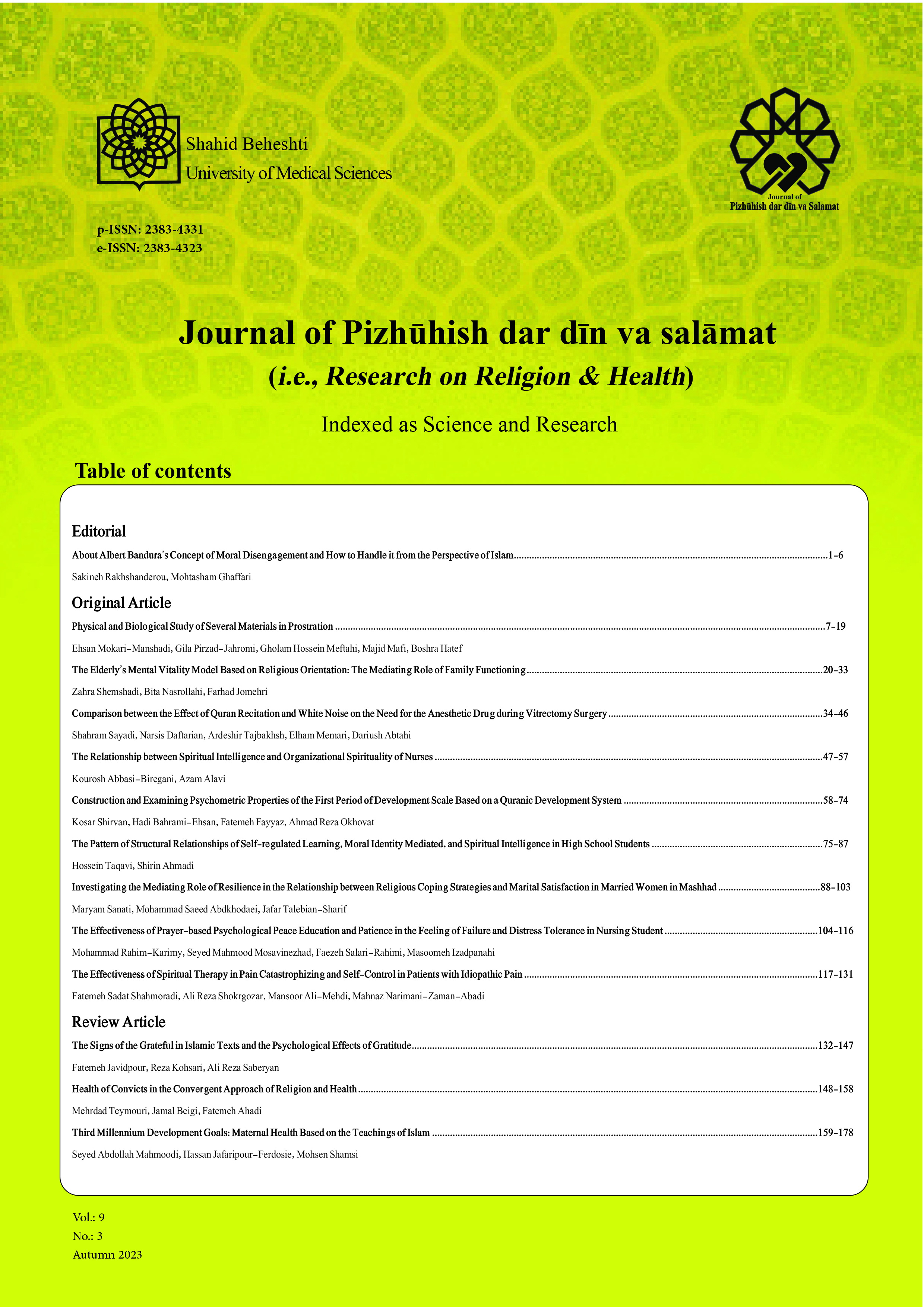
ساخت و بررسی ویژگیهای روانسنجی مقیاس دورۀ اول رشد مبتنی بر منظومۀ رشد قرآنی
پژوهش در دین و سلامت ,
دوره 9 شماره 3 (2023),
11 آبان 2025
,
صفحه 58-74
https://doi.org/10.22037/jrrh.v9i3.37887
چکیده
سابقه و هدف: دورۀ کودکی مهمترین و حساسترین دورۀ رشد انسان و ارزیابی آن از مهمترین وظایف والدین و متخصصان این حیطه است. با وجود مقیاسهای متعدد، تدوین مقیاسهایی با مبنای نظری اسلامی ضرورت دارد. ازاینرو، هدف پژوهش حاضر ساخت مقیاس دورۀ اول رشد مبتنی بر منظومۀ رشد قرآنی اخوت و بررسی روایی و پایایی آن بوده است.
روش کار: روش پژوهش حاضر طرح آمیختۀ اکتشافی است. جامعۀ آماری پژوهش والدین کودکان پنج تا هفت سالۀ شهر تهران بود که در اجرای اصلی 820 نفر بهروش نمونهگیری خوشهای انتخاب شدند. در بخش کیفی، تدوین مقیاس و در بخش کمّی ارزیابی روایی و پایایی انجام شد. در این پژوهش همۀ مسائل اخلاقی رعایت شده است و مؤلفان مقاله تضاد منافعی گزارش نکردهاند.
یافتهها: شاخص روایی 78/0 و ضریب پایایی 94/0 نشاندهندۀ روایی و پایایی مطلوب مقیاس است. تحلیل عاملی اکتشافی نشان داده است که مقیاس دارای دو عامل محوری؛ و بار عاملی گویهها بیشتر از 4/0 بود. در بررسی روایی سازه، مقیاس شامل دو عامل زیربنایی و هشت مؤلفه بود. تمام مسیرها از گویهها به عاملها در سطح 05/0 معنادار بودند و مقیاس روایی سازۀ مناسبی داشت.
نتیجهگیری: یافتهها نشان میدهد که مقیاس محققساخته با عنوان مقیاس تحولی کلام طیّب ابزاری مناسب برای استفاده در جامعۀ ایران است.
- ارزیابی
- روایی و پایایی
- کودک
- منظومۀ رشد قرآنی
ارجاع به مقاله
مراجع
Lerner RM, Agans JP, DeSouza LM, Hershberg RM. Developmental science in 2025: A predictive review. Research in Human Development. 2014; 11(4):255-72.
Overton WF, Molenaar P, Lerner RM. Handbook of child psychology and developmental science: Theory and method, Vol. 1: John Wiley & Sons, Inc. 2015.
Berk LE. The role of make-believe play in development of self-regulation. Encyclopedia on Early Childhood Development[online] https://www childencyclopedia com/play-basedlearning/according-experts/role-makebelieve-play-development-selfregulation. 2018.
.Overton WF, Molenaar PC. Concepts, theory, and method in developmental science: A view of the issues. Handbook of child psychology and developmental science. 2015:1-8.
Ghayemi Moghadam M, Nozari M, Davoodi M, Azerbaijani M. Barresi-e Marahel-e Tahavol bar Asas-e Manabe'-e Islami. Ravanshenasi va Din. 2015; 32(4): 23-42. (Full Text in Persian)
Okhovat A. The methods of lexical expedient. Tehran: Quran and Ahl Al-Bayt Publications, 2013. (Full Text in Persian)
Okhovat A. Development Process Cognition. Tehran: Quran Ahlebayt Publication;2014. (Full Text in Persian)
Okhovat A. Semantics Of Development. Tehran: Quran Ahlebayt Publication; 2017. (Full Text in Persian)
Okhovat A. Development Of Social Thinking Stages: Bologh-e Atefi; Ekram Va Talif Stage. Tehran: Entesharat-e Quran and Ahlul Bayt-e Nabovat 2016. (Full Text in Persian)
Okhovat A. The document on the requirements of raising a tayyeb child. Tehran: Quran Ahlebayt Publication; 2019. (Full Text in Persian)
Fayyaz F, Okhovat AR. Principles and skills of raising children aged 2 to 7 years with a tayyeb selection approach. Tehran: Quran Ahlebayt Publication; 2018. (Full Text in Persian)
Okhovat A. Talk With Children By Tayeb Word:
special for child researchers. Tehran: Quran Ahlebayt Publication; 2019. (Full Text in Persian)
Okhovat A. The Document Of Education and Purification. Tehran: Quran Ahlebayt Publication; 2019. (Full Text in Persian)
Okhovat A. Development Of Social Thinking Stages: Before brith to speech ; Tadib notgh And Talim Kalam Stage. Tehran: Quran Ahlebayt Publication; 2013. (Full Text in Persian)
Farhoush M. Spiritual Growth in Islamic Psychology Research. Journal of Pizhūhish dar dīn va salāmat. 2019;5(2):1-5. (Full Text in Persian)
Mahdavinoor SH, Mahdavinoor SMM. Criteria for spiritual health in five realms of man based on the teachings of the Qur'an. Journal of Pizhūhish dar dīn va Salāmat. 2021;7(4):114-30. (Full Text in Persian)
Mousavi SE, Elahi T, Masjedi-Arani A, Ebrahimi LS, Jalilpour M, Shahsavari Z. A Comparison of Human Development in Psychology and Nahj al-Balaghah. Journal of Pizhūhish dar dīn va salāmat. 2018;4(5):129-40. (Full Text in Persian)
Pérez Escamilla R, Cavallera V, Tomlinson M, Dua T. Scaling up Integrated Early Childhood Development programs: lessons from four countries. Child: care, health and development. 2018;44(1):50-61.
Milner KM, Salazar RB, Bhopal S, Brentani A, Britto PR, Dua T, et al. Contextual design choices and partnerships for scaling early child development programmes. Archives of disease in childhood. 2019; 104(Suppl 1):S3-S12.
Cavallera V, Tomlinson M, Radner J, Coetzee B, Daelmans B, Hughes R, et al. Scaling early child development: what are the barriers and enablers? Archives of Disease in Childhood.2019;104(Suppl 1):S43-S50.
Weitzman C, Wegner L. Section on Developmental and Behavioral Pediatrics, Committee on Psychosocial Aspects of Child and Family Health, Council on Early Childhood, and Society for Developmental and Behavioral Pediatrics, Blum NJ, Macias MM, Bauer NS, Bridgemohan C, Goldson E, McGuinn LJ, Weitzman C, Siegel BS. Promoting optimal development: Screening for behavioral and emotional problems. Pediatrics. 2015;135(2):384-95.
Sun J, Rao N, Engle P. Assessing early child development in the East Asia Pacific region: Cultural appropriateness and item equivalence in measurement. Unpublished manuscript. 2012.
Rao AR, Baskaran V, Sarada R, Ravishankar GA. In vivo bioavailability and antioxidant activity of carotenoids from microalgal biomass-A repeated dose study. Food research international. 2013;54(1):711-7.
Conti- Ramsden G, Durkin K. Language development nd assessment in the preschool period. Neuropsychology
review. 2012;22:384-401.
Soleimani F, Azari N, Kraskian-Mojembari A, Vameghi R, Shahshahani-Pour S, Sajedi F. Developing of the Persian version of Bayley scales of infant and toddlers development screening test and determine its validity and reliability. Archives of Rehabilitation. 2014;14(6):18-29. (Full Text in Persian)
Comrey A, Lee H. A first course in factor analysis: psychology press. Taylor and Francis Group New York, NY; 2013.
Owens R, Farinella K, Metz D, Owens R, Owens R. Introduction to Communication Disorders: A Lifespan Evidence-Based Perspective (In print). 2020.
Guimarães CF, Oda AL. Instrumentos de avaliação de linguagem infantil: aplicabilidade em deficientes. Revista CEFAC. 2013;15:1690-70.2
Monshizadeh L, Vameghi R, Rahimi M, Sajedi F, Hashemi SB, Yadegari F, et al. Is There Any Association Between Language Acquisition and Cognitive Development in Cochlear-Implanted Children? 2021. (Full Text in Persian)
Doove BM, Feron FJ, Van Os J, Drukker M. Preschool communication: Early identification of concerns about preschool language development and social participation. Frontiers in public health. 2021; 8:546536.
Carvalho AD, Lemos SM, Goulart LM. Language development and its relation to social behavior and family and school environments: a systematic review. InCodas. Sociedade Brasileira de Fonoaudiologia. 2016; (28):470-79.
Lindquist KA, MacCormack JK, Shablack H. The role of language in emotion: Predictions from psychological constructionism. Frontiers in psychology. 2015;6:444.
Veldman SL, Santos R, Jones RA, Sousa-Sá E, Okely AD. Associations between gross motor skills and cognitive development in toddlers. Early human development. 2019;132:39-44.
.Rose SA, Feldman JF, Jankowski JJ. Dimensions of cognition in infancy. Intelligence.2004;32(3):245-62.
Snowling MJ, Hulme C. Annual Research Review: Reading disorders revisited–the critical importance of oral language. Journal of Child Psychology and Psychiatry.2021;62(5):635-53.
Iverson JM. Developing language in a developing body: The relationship between motor development and language development. Journal of child language. 2010;37(2):229-61.
Conti-Ramsden G, Durkin K. Language development and assessment in the preschool period. Neuropsychology review. 2012;22(4):384-401.
Jafari Z, Ashayeri H, Malayeri S, Ala aldini F. Translation, reliability and validity of the newsha hearing, language and speech development scale among children in iran. PAYESH.2009;8(3):271-278. (Full Text in Persian)
Faramarzi S, Kiyani M, Lahijian Z. Construction, Validation & Investigating Reliability of the Language Development Scale of Children. Quarterly of Educational Measurement. 2018;8(31):1-31. (Full Text in Persian)
- چکیده مشاهده شده: 260 بار
- pdf دانلود شده: 64 بار