
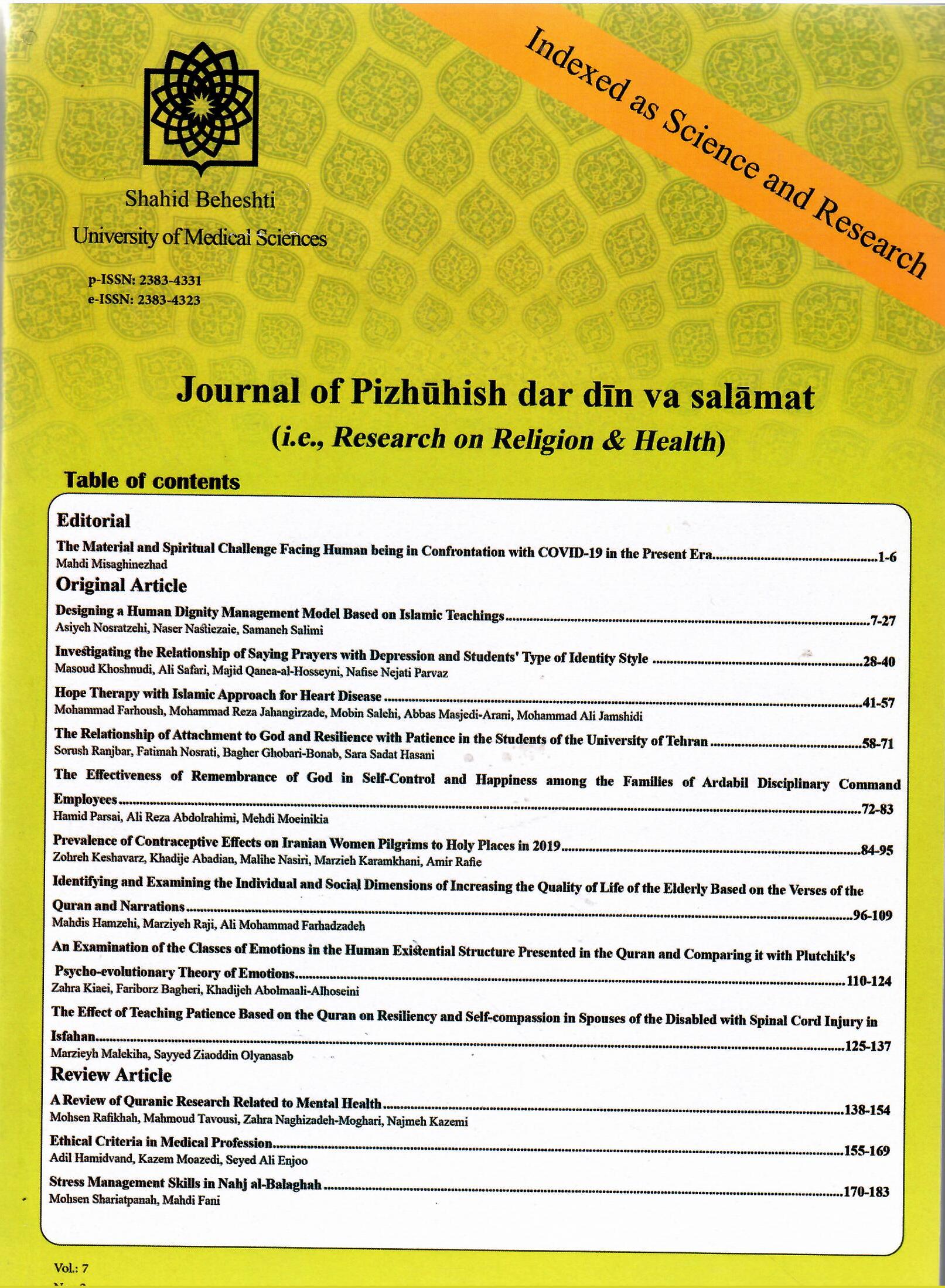
بررسی رابطۀ دلبستگی به خدا و تابآوری با صبر در دانشجویان دانشگاه تهران
پژوهش در دین و سلامت ,
دوره 7 شماره 2 (2021),
21 خرداد 2021
,
صفحه 58-71
https://doi.org/10.22037/jrrh.v7i2.31345
چکیده
سابقه و هدف: صبر یکی از روشهای کنترل و بازداری رفتار در نظر گرفته میشود بهگونهای که به انسان این امکان را میدهد تا خودنظارتی و خودتنظیمی بر رفتار داشته باشد. همچنین صبر همواره یکی از متغیّرهای سلامت روان شناخته شده است و پژوهشگران نیز بر ارتباط بین سبک دلبستگی به خدا و تابآوری با مؤلفههای سلامت روان تأکید کردهاند. ازاینرو، هدف از پژوهش حاضر بررسی رابطۀ دلبستگی به خدا و تابآوری با صبر در دانشجویان دانشگاه تهران بود.
روش کار: این پژوهش توصیفی از نوع همبستگی است. جامعۀ آماری پژوهش تمامی دانشجویان دختر و پسر مشغول به تحصیل دانشگاه تهران در سال تحصیلی 99-1398 بود که تعداد 196 نفر از دانشجویان گروههای علوم انسانی، فنی و مهندسی، علوم پایه و هنرهای زیبا با استفاده از نمونهگیری تصادفی خوشهای انتخاب شدند. برای جمعآوری اطلاعات از پرسشنامههای دلبستگی به خدا، تابآوری و واکنش در رخدادهای زندگی استفاده شد و دادههای بهدستآمده با استفاده از ضریب همبستگی پیرسون و رگرسیون همزمان تحلیل شد. در این پژوهش همۀ موارد اخلاقی رعایت شده است و مؤلفان مقاله تضاد منافعی گزارش نکردهاند.
یافتهها: نتایج نشان داد که بین سبک دلبستگی ایمن به خدا و تابآوری با صبر رابطۀ مثبت و معنادار و بین سبک دلبستگی ناایمن به خدا با صبر رابطۀ منفی و معناداری وجود داشت. همچنین سبک دلبستگی به خدا و تابآوری توانستند صبر را بهطور معناداری پیشبینی کنند.
نتیجهگیری: بر اساس یافتههای بهدستآمده، افرادی که تابآورتر هستند و سبک دلبستگی ایمن به خدا دارند در مقابل مشکلات صبر بیشتری دارند و افرادی که تابآوری کمتر و سبک دلبستگی ناایمن به خدا دارند صبر کمتری نیز دارند.
استناد مقاله به این صورت است:
Ranjbar S, Nosrati F, Ghobari-Bonab B, Hasani SS. The Relationship of Attachment to God and Resilience with Patience in the Students of the University of Tehran. Journal of Pizhūhish dar dīn va salāmat. 2021;7(2):58-71. https://doi.org/10.22037/jrrh.v7i2.31345
- تابآوری، دانشجویان، دلبستگی، سلامت روان، صبر
ارجاع به مقاله
مراجع
Kamari S, Khormaee F. The Mediating Role of Patience in Relationship Between Psychological Hardiness and Hope to Education in High School Students. 2016;2(3):77-60. (Full Text in Persian)
Dai X, Fishbach A. When waiting to choose increases patience. Organizational Behavior and Human Decision Processes. 2013;121(2):256-66.
Rosati AG, Stevens JR, Hare B, Hauser MD. The evolutionary origins of human patience: temporal preferences in chimpanzees, bonobos, and human adults. Current Biology. 2007;17(19):1663-8.
Shamshiri B, Shirvani Shiri A. The Concept of Patience in Quran; Its Philosophical and Educational Implications. Journal of Islamic Education. 2012;6(13):79-98. (Full Text in Persian)
Schnitker SA, Emmons RA. Patience as a virtue: Religious and psychological perspectives. Research in the Social Scientific Study of Religion, Volume 18: Brill; 2007. p. 177-207.
Comer DR, Sekerka LE. Taking time for patience in organizations. Journal of Management Development. 2014.
The holy Qur'an. Al-Bagharah. Verse 153. Translated by: Mohammad Mahdi Fouladvand. Tehran: Justice Message Publications; 2016.
ENJIL.Bob-e 5.
Patten SB. Support, patience, and expectancy: therapeutic options alongside intensified treatments for depression. SAGE Publications Sage CA: Los Angele, CA; 2014.
Noori N. Barresi-ye Paye-haye Ravanshenakhti va Neshanegan-e Sabr dar Qur'an. Ravanshenasi va Din. 2009;1(4):143. (Full Text in Persian)
Herrman H, Stewart DE, Diaz-Granados N, Berger EL, Jackson B, Yuen T. What is resilience? The Canadian Journal of Psychiatry. 2011;56(5):258-65.
Alizadeh H. Psychological toleration, psychological well-being and behavioral disorders. Tehran: Arasbaran; 2013. (Full Text in Persian)
Zolkoski S, Bullock L. Resilience in children and youth: A review. Children and Youth Services. 2012. 34:2295-303
Bonanno GA, Romero SA, Klein SI. The temporal elements of psychological resilience: An integrative framework for the study of individuals, families, and communities. Psychological Inquiry. 2015;26(2):139-69.
Homan KJ, Boyatzis CJ. The protective role of attachment to God against eating disorder risk factors: Concurrent and prospective evidence. Eating Disorders. 2010;18(3):239-58.
Bradshaw M, Ellison CG, Flannelly KJ. Prayer, God imagery, and symptoms of psychopathology. Journal for the Scientific Study of Religion. 2008;47(4):644-59.
Granqvist P, Kirkpatrick LA. Attachment and religious representations and behavior. 2008.
Ghobari Bonab B, Nosrati F, Bozorghi MR. Investigating the relation between attachment to God, patience, and self-esteem in college students of university of Tehran. 2017;1(2):139-65. (Full Text in Persian)
Zahedbabolan A, Rezaie Jamalouie H, Sobhani R. The relationship between devotion to god and tolerance and meaningfulness of students’ lives. Practical psychology. 2012;13(3):75-85. (Full Text in Persian)
Nosrati F, Batavani A, Ghobari-Bonab B, Masjedsaraee MR. The Relationship between Attachment to God, Attachment to Adults, Resilience, Self-compassion and Mindfulness in Undergraduate Students in Tehran University. Journal of Pizhūhish dar dīn va salāmat. 2020;6(1):5-18. (Full Text in Persian)
Farhoush M, Erfani A, Habibollahi H. Relationship between Attachment to God and Happiness and Life Satisfaction: A Comparison between Spiritual Students and Non-Spiritual Students. Cultural Psychology. 2019;3(1):209-23. (Full Text in Persian)
Ghobary Bonab B, Haddadi Kuhsar AA, Rashidi A, Javadi S. Relationship among Image of God and Attachment to God with Mental Health in Parents of Exceptional Children. Journal of Exceptional Children. 2012;12(3):5-14. (Full Text in Persian)
Rowatt W, Kirkpatrick LA. Two dimensions of attachment to God and their relation to affect, religiosity, and personality constructs. Journal for the scientific study of religion. 2002;41(4):637-51.
Connor KM, Davidson JR. Development of a new resilience scale: The Connor‐Davidson resilience scale (CD‐RISC). Depression and anxiety. 2003;18(2):76-82.
Mohammadi M. Factors effective in tolerance of people in danger of misusing drugs. Doctoral dissertation: University of Medical Sciences and Welfare; 2005. (Full Text in Persian)
Mahdiyar M, Taghavi S M, Goodarzi M. Predicting Patience Based on the Worldly and Divine Attachments among the Students. Religion and Health. 2017;4(2):29-38. (Full Text in Persian)
Gomez R, McLaren S. The inter‐relations of mother and father attachment, self‐esteem and aggression during late adolescence. Aggressive Behavior: Official Journal of the International Society for Research on Aggression. 2007;33(2):160-9.
Ghobaribonab B, Lavasani M, Salem S, Nosrati F. The relationship between devotion to god, trust in god and mental health among students of Tehran university. Cultural Psychology 2017. (Full Text in Persian)
August H, Esperandio MRG. Attachment to God: integrative review of empirical literature.
Cassidy J, Shaver PR. Handbook of attachment: Theory, research, and clinical applications: Rough Guides; 2002.
Beck R. God as a secure base: Attachment to God and theological exploration. Journal of Psychology and Theology. 2006;34(2):125-32.
Aghababaie N, Tabik MT, Hatami J. The relationship between patience and life satisfaction, mental health and personality. Psychology periodical. 2014; 5(2): 17-25. (Full Text in Persian)
Jalali J, Taherejabari F, Shafiabadi A. The effect of teaching patience and modesty from viewpoint ofislamic teaching on improvement of communication skill among highschool students of gorgan city. International Congress on Culture and Religious Thought; Qom. 2014. (Full Text in Persian)
Zarandi M, Mahdipoor E. The relationship between self-actualization, patience and life satisfaction among students of Azad Islamic university. Second National Conference on Sustainable Development in Psychology and Educational Sciences, Social and Cultural Studies; Tehran. 2015. (Full Text in Persian)
Ghadampour E, Rahimipour T, Khalili Goshnigani Z. The Effectiveness of Patience Education Based on the Religious Doctrines on Resilience. Ravanshenasi Va Din. 2018;11(1):31. (Full Text in Persian)
- چکیده مشاهده شده: 657 بار