
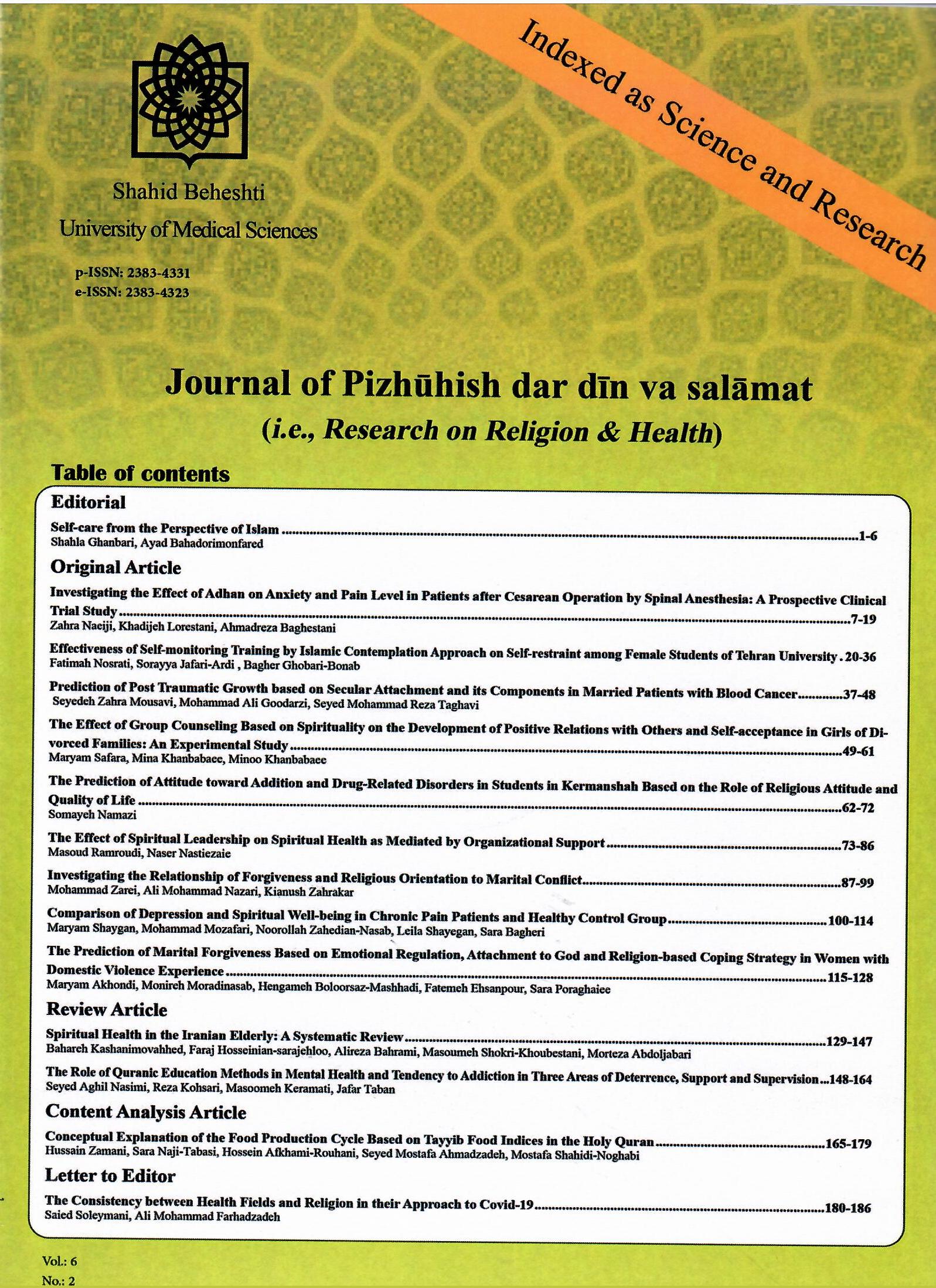
مقایسۀ سلامت معنوی و نشانههای افسردگی در بیماران مبتلا به درد مزمن در مقایسه با افراد سالم
پژوهش در دین و سلامت ,
دوره 6 شماره 2 (2020),
13 ژوئن 2020
,
صفحه 100-114
https://doi.org/10.22037/jrrh.v6i2.23258
چکیده
سابقه و هدف: نتایج برخی مطالعات اخیر حاکی از این است که سلامت معنوی با سلامت جسمی افراد در ارتباط است. بااینحال، نتایج موجود دربارۀ این ارتباط ضد و نقیض میباشد. هدف از مطالعۀ حاضر، مقایسۀ سلامت معنوی و نشانههای افسردگی در افراد مبتلا به درد مزمن در مقایسه با افراد سالم بود.
روش کار: این پژوهش مطالعهای مقطعی از نوع توصیفی-تحلیلی است. جامعۀ هدف بیماران مبتلا به درد مزمن و افراد سالم شهر شیراز در سال 96 و ۹۷ بودند. تعداد کل نمونه ۶۰۰ نفر بود که ۳۰۰ نفر از آنان افراد دارای درد مزمن مراجعهکننده به درمانگاههای درد و ۳۰۰ نفر افراد سالم بودند که بهترتیب بهروش نمونهگیری دردسترس و خوشهای انتخاب شدند و به پرسشنامههای سلامت معنوی پالوتزین و الیسون؛ و سلامت بیمار پاسخ دادند. برای توصیف متغیّرهای جمعیتشناختی از آمار توصیفی، برای مقایسۀ ویژگیهای جمعیتشناختی از آزمون t و کای اسکوئر؛ و برای مقایسۀ نشانههای افسردگی و سلامت معنوی در دو گروه از آزمون t استفاده شد. در این پژوهش همۀ موارد اخلاقی رعایت شده است و مؤلفان مقاله هیچگونه تضاد منافعی گزارش نکردهاند.
یافتهها: نتایج نشان داد تفاوت معنیداری بین گروه افراد سالم و گروه مبتلا به درد مزمن در زمینۀ متغیّرهای جمعیتشناختی وجود نداشت. همچنین، میزان نشانههای افسردگی در افراد دارای درد مزمن (۳۰/۶±۹۷/۹) بهطور معناداری بیشتر از افراد ساالم (09/5±67/8) بود (006/0>P) و سلامت معنوی در افراد دارای درد مزمن (10/12±78/73) در مقایسه با افراد سالم (03/15±14/87) بهطور معنیداری پایینتر بود (00/0>P).
نتیجهگیری: به نظر میرسد انجام مداخلات روانی-معنوی در جهت کاهش نشانههای افسردگی و ارتقای سطح سلامت معنوی افراد جامعه گامی مهم در جهت پیشگیری یا کاهش شدت درد در بیماران مبتلا به درد مزمن باشد.
استناد مقاله به این صورت است:
Shaygan M, Mozafari M, Zahedian-Nasab N, Shayegan L, Bagheri S. Comparison of Depression and Spiritual Well-being in Chronic Pain Patients and Healthy Control Group. Journal of Pizhūhish dar dīn va salāmat. 2020;6(2):100-114. https://doi.org/10.22037/jrrh.v6i2.23258
- درد مزمن؛ معنویت؛ نشانههای افسردگی
ارجاع به مقاله
مراجع
Pagé I, Marchand A-A, Nougarou F, O'shaughnessy J, Descarreaux M. Neuromechanical responses after biofeedback training in participants with chronic low back pain: An experimental cohort study. Journal of manipulative and physiological therapeutics. 2015;38(7):449-57.
Chou R, Gordon DB, De Leon-Casasola OA, Rosenberg JM, Bickler S, Brennan T, et al. Management of Postoperative Pain: a clinical practice guideline from the American pain society, the American Society of Regional Anesthesia and Pain Medicine, and the American Society of Anesthesiologists' committee on regional anesthesia, executive committee, and administrative council. The Journal of Pain. 2016;17(2):131-57.
Merskey HE. Classification of chronic pain: Descriptions of chronic pain syndromés and definitions of pain terms. Pain. 1986.
Breivik H, Collett B, Ventafridda V, Cohen R, Gallacher D. Survey of chronic pain in Europe: prevalence, impact on daily life, and treatment. European journal of pain. 2006;10(4):287-333.
Merskey HE. Classification of chronic pain: Descriptions of chronic pain syndromés and definitions of pain terms. Pain. 1986.
Simon LS. Relieving pain in America: A blueprint for transforming prevention, care, education, and research. Journal of pain & palliative care pharmacotherapy. 2012;26(2):197-8.
Jackson T, Thomas S, Stabile V, Han X, Shotwell M, McQueen K. Prevalence of chronic pain in low-income and middle-income countries: a systematic review and meta-analysis. The Lancet. 2015;385:S10.
Vos T, Flaxman AD, Naghavi M, Lozano R, Michaud C, Ezzati M, et al. Years lived with disability (YLDs) for 1160 sequelae of 289 diseases and injuries 1990-2010: a systematic analysis for the Global Burden of Disease Study 2010. The lancet. 2012;380(9859):2163-96.
Elliott AM, Smith BH, Penny KI, Smith WC, Chambers WA. The epidemiology of chronic pain in the community. The lancet. 1999;354(9186):1248-52.
Surah A, Baranidharan G, Morley S. Chronic pain and depression. Continuing Education in Anaesthesia Critical Care & Pain. 2014;14(2):85-9.
Fayaz A, Croft P, Langford R, Donaldson L, Jones G. Prevalence of chronic pain in the UK: a systematic review and meta-analysis of population studies. BMJ open. 2016;6(6):e010364.
Heidari GA, Tavafian SS. Prevalence of chronic pain and its association with depression in adult patients to health centers in Yazd. Health Education and Health Promotion. 2018;6(2):65-9.
Post RM. Kindling and sensitization as models for affective episode recurrence, cyclicity, and tolerance phenomena. Neuroscience & Biobehavioral Reviews. 2007;31(6):858-73.
Hughes RE, Holland LR, Zanino D, Link E, Michael N, Thompson KE. Prevalence and intensity of pain and other physical and psychological symptoms in adolescents and young adults diagnosed with cancer on referral to a palliative care service. Journal of adolescent and young adult oncology. 2015;4(2):70-5.
Xu H, Qing H, Lu W, Keegan D, Richardson JS, Chlan-Fourney J, et al. Quetiapine attenuates the immobilization stress-induced decrease of brain-derived neurotrophic factor expression in rat hippocampus. Neuroscience Letters. 2002;321(1-2):65-8.
Sadock BJ, Sadock VA. Kaplan and Sadock's synopsis of psychiatry: Behavioral sciences/clinical psychiatry: Lippincott Williams & Wilkins; 2011.
Mathers CD, Loncar D. Projections of global mortality and burden of disease from 2002 to 2030. PLoS medicine. 2006;3(11):e442.
Bravo L, Mico JA, Rey-Brea R, Pérez-Nievas B, Leza JC, Berrocoso E. Depressive-like states heighten the aversion to painful stimuli in a rat model of comorbid chronic pain and depression. Anesthesiology: The Journal of the American Society of Anesthesiologists. 2012;117(3):613-25.
Currie SR, Wang J. Chronic back pain and major depression in the general Canadian population. Pain. 2004;107(1-2):54-60.
Thompson MP, Kaslow NJ, Short LM, Wyckoff S. The mediating roles of perceived social support and resources in the self-efficacy-suicide attempts relation among African American abused women. Journal of Consulting and clinical Psychology. 2002;70(4):942.
Taylor LEV, Stotts NA, Humphreys J, Treadwell MJ, Miaskowski C. A Biopsychosocial-Spiritual Model of Chronic Pain in Adults with Sickle Cell Disease. Pain Management Nursing. 2013;14(4):287-301.
Paloutzian RF, Ellison CW. Loneliness, spiritual well-being and the quality of life. Loneliness: A sourcebook of current theory, research and therapy. 1982:224-37.
Mesbah M, Mahkam R, Moslehi J, Jahangirzadeh Qomi M, Marandi S. Islamic approach to spiritual health. Tehran: Hoghooghi Publication. 2013. (Full Text in Persian)
Abedi Jafari H, Rastgar AA. The emergence of spirituality in organizations: concepts, definitions, presumptions and conceptual model. 2007;2(5):99-121. (Full Text in Persian)
Craven RF, Hirnle CJ, Henshaw C. Fundamentals of nursing: human health and function: Lippincott; 1992.
Nsamenang SA, Hirsch JK, Topciu R, Goodman AD, Duberstein PR. The interrelations between spiritual well-being, pain interference and depressive symptoms in patients with multiple sclerosis. Journal of behavioral medicine. 2016;39(2):355-63.
Abu HO, Ulbricht C, Ding E, Allison JJ, Salmoirago-Blotcher E, Goldberg RJ, et al. Association of religiosity and spirituality with quality of life in patients with cardiovascular disease: a systematic review. Quality of Life Research. 2018:1-21.
Mystakidou K, Tsilika E, Parpa E, Pathiaki M, Patiraki E, Galanos A, et al. Exploring the relationships between depression, hopelessness, cognitive status, pain, and spirituality in patients with advanced cancer. Archives of Psychiatric Nursing. 2007;21(3):150-61.
Johnson KS, Tulsky JA, Hays JC, Arnold RM, Olsen MK, Lindquist JH, et al. Which domains of spirituality are associated with anxiety and depression in patients with advanced illness? Journal of general internal medicine. 2011;26(7):751-8.
Büssing A, Ostermann T, Koenig HG. Relevance of religion and spirituality in German patients with chronic diseases. The International Journal of Psychiatry in Medicine. 2007;37(1):39-57.
Baetz M, Bowen R. Chronic pain and fatigue: Associations with religion and spirituality. Pain Research and Management. 2008;13(5):383-8.
Büssing A, Michalsen A, Balzat H-J, Grünther R-A, Ostermann T, Neugebauer EA, et al. Are spirituality and religiosity resources for patients with chronic pain conditions? Pain medicine. 2009;10(2):327-39.
Mattis JS, Ahluwalia MK, Cowie S, Kirkland-Harris AM. Ethnicity, culture, and spiritual development. The handbook of spiritual development in childhood and adolescence. 2006:283-96.
Treede R-D, Rief W, Barke A, Aziz Q, Bennett MI, Benoliel R, et al. A classification of chronic pain for ICD-11. Pain. 2015;156(6):1003.
Beitel M, Stults‐Kolehmainen M, Cutter CJ, Schottenfeld RS, Eggert K, Madden LM, et al. Physical activity, psychiatric distress, and interest in exercise group participation among individuals seeking methadone maintenance treatment with and without chronic pain. The American journal on addictions. 2016;25(2):125-31.
Hairi NN, Cumming RG, Blyth FM, Naganathan V. Chronic pain, impact of pain and pain severity with physical disability in older people-Is there a gender difference? Maturitas. 2013;74(1):68-73.
Rutherford C, Nixon J, Brown J, Briggs M, Horton M. The Leeds Assessment of Neuropathic Symptoms and Signs Scale (LANSS) is not an adequate outcome measure of pressure ulcer‐related neuropathic pain. European Journal of Pain. 2016;20(10):1710-20.
VanDenKerkhof EG, Mann EG, Torrance N, Smith BH, Johnson A, Gilron I. An epidemiological study of neuropathic pain symptoms in Canadian adults. Pain Research and Management. 2016;2016.
Shaygan M, Shaygan L. Understanding the Relationship Between Spiritual Well-Being and Depression in Chronic Pain Patients: The Mediating Role of Pain Catastrophizing. Pain Management Nursing. 2019;20(4):358-64.
Seyed Fatemi N, Rezaei M, Givari A, Hosseini F. Prayer and spiritual well-being in cancer patients. PAYESH .2006;5(4):295-303. (Full Text in Persian)
Khamseh ME, Baradaran HR, Javanbakht A, Mirghorbani M, Yadollahi Z, Malek M. Comparison of the CES-D and PHQ-9 depression scales in people with type 2 diabetes in Tehran, Iran. BMC psychiatry. 2011;11(1):61.
Kroenke K, Wu J, Bair MJ, Krebs EE, Damush TM, Tu W. Reciprocal relationship between pain and depression: a 12-month longitudinal analysis in primary care. The Journal of Pain. 2011;12(9):964-73.
Boroumand A. Chronic pain, pain self-efficacy and suicidal ideation: The moderating role of pain self-efficacy on relation between depression and suicidal ideation in chronic pain patients. Journal of Fundamentals of Mental Health. 2012;14(54):63-152. (Full Text in Persian)
Dersh J, Polatin PB, Gatchel RJ. Chronic pain and psychopathology: research findings and theoretical considerations. Psychosomatic medicine. 2002;64(5): 773-86.
Bair MJ, Robinson RL, Katon W, Kroenke K. Depression and pain comorbidity: a literature review. Archives of internal medicine. 2003;163(20):2433-45.
Williams LJ, Jacka FN, Pasco JA, Dodd S, Berk M. Depression and pain: an overview. Acta Neuropsychiatrica. 2014;18(2):79-87.
Elfering A, Käser A, Melloh M. Relationship between depressive symptoms and acute low back pain at first medical consultation, three and six weeks of primary care. Psychology, health & medicine. 2014;19(2):235-46.
Kroenke K, Wu J, Bair MJ, Krebs EE, Damush TM, Tu WJTJoP. Reciprocal relationship between pain and depression: a 12-month longitudinal analysis in primary care. 2011;12(9):964-73.
Turk DC, Okifuji A. Psychological factors in chronic pain: Evolution and revolution. Journal of consulting and clinical psychology. 2002;70(3):678.
Kandasamy A, Chaturvedi SK, Desai G. "Spirituality, distress, depression, anxiety, and quality of life in patients with advanced cancer". Indian journal of cancer. 2011; 48(1): 55.
Ebrahimipour H, Vejdani M, Taghipour A, Heidarabadi AB, Molavi Y. Spiritual health in cancer patients at OMID hospital affiliated with Mashhad University of Medical Sciences-2012. Journal of Reaserch on Religion & Health. 2015;1(2):3-9. (Full Text in Persian)
Moradi-Joo M, Babazadeh T, Honarvar Z, Mohabat-Bahar S, Rahmati-Najarkolaei F, Haghighi M. The relationship between spiritual health and public health aspects among patients with breast cancer. Journal of Research on Religion & Health. 2017;3(3):80-91. (Full Text in Persian)
Bekelman DB, Dy SM, Becker DM, Wittstein IS, Hendricks DE, Yamashita TE, et al. Spiritual well-being and depression in patients with heart failure. Journal of general internal medicine. 2007;22(4):470-7.
Nsamenang SA, Hirsch JK, Topciu R, Goodman AD, Duberstein PR. The interrelations between spiritual well-being, pain interference and depressive symptoms in patients with multiple sclerosis. Journal of behavioral medicine. 2016 ;39(2):355-63.
Asgari E, Norouzi M, Radmehr H, Mohammadi H. Examining the Effect of Spiritual Health on Hope and Coping Strategies among Patients with Multiple Sclerosis (Ms). J Res Relig Health. 2017;3(3):5-17. (Full Text in Persian)
Elizabeth Rippentrop A, Altmaier EM, Chen JJ, Found EM, Keffala VJ. The relationship between religion/spirituality and physical health, mental health, and pain in a chronic pain population. Pain. 2005;116(3):311-21.
Huguelet P, Koenig HG. Religion and spirituality in psychiatry: Cambridge University Press; 2009.
Askari MA, Mohammadi H, Radmehr H, Jahangir AH. The effect of spiritual-religious psychotherapy on enhancing quality of life and reducing symptoms of anxiety and depression among the elderly. Journal of Research on Religion and Health. 2018;4(2):29-41. (Full Text in Persian)
Kim C. A correlation study on spiritual wellbeing, hope and perceived health status of the rural elderly. Journal of Korean Public Health Nursing. 2004;18(2):342-57.
Lysne CJ, Wachholtz AB. Pain, spirituality, and meaning making: What can we learn from the literature? Religions. 2011;2(1):1-16.
Arzouman J, Dudas S, Ferrans C, Holm K, editors. Quality of life of patients with sarcoma postchemotherapy. Oncology Nursing Forum; 1991.
West W. Psychotherapy & spirituality: Crossing the line between therapy and religion: Sage; 2000.
Dastgheib Z, Gharlipour Z, Dashdebi KG, Hoseini F, Vafaee R. Association of between mental health and spiritual health among students in Shiraz University. Advances in Nursing & Midwifery. 2014;24(84):53-9. (Full Text in Persian)
Chirico F. Spiritual well-being in the 21st century: It’s time to review the current WHO’s health definition. Journal of Health and Social Sciences. 2016;1(1):11-6.
Reiner SR, Anderson TL, Hall MEL, Hall TW. Adult Attachment, God Attachment and Gender in Relation to Perceived Stress. Journal of Psychology and Theology. 2010;38(3):175-85.
Wachholtz AB, Pearce MJ, Koenig H. Exploring the Relationship between Spirituality, Coping, and Pain. Journal of Behavioral Medicine. 2007;30(4):311-8.
- چکیده مشاهده شده: 683 بار
- PDF دانلود شده: 363 بار