
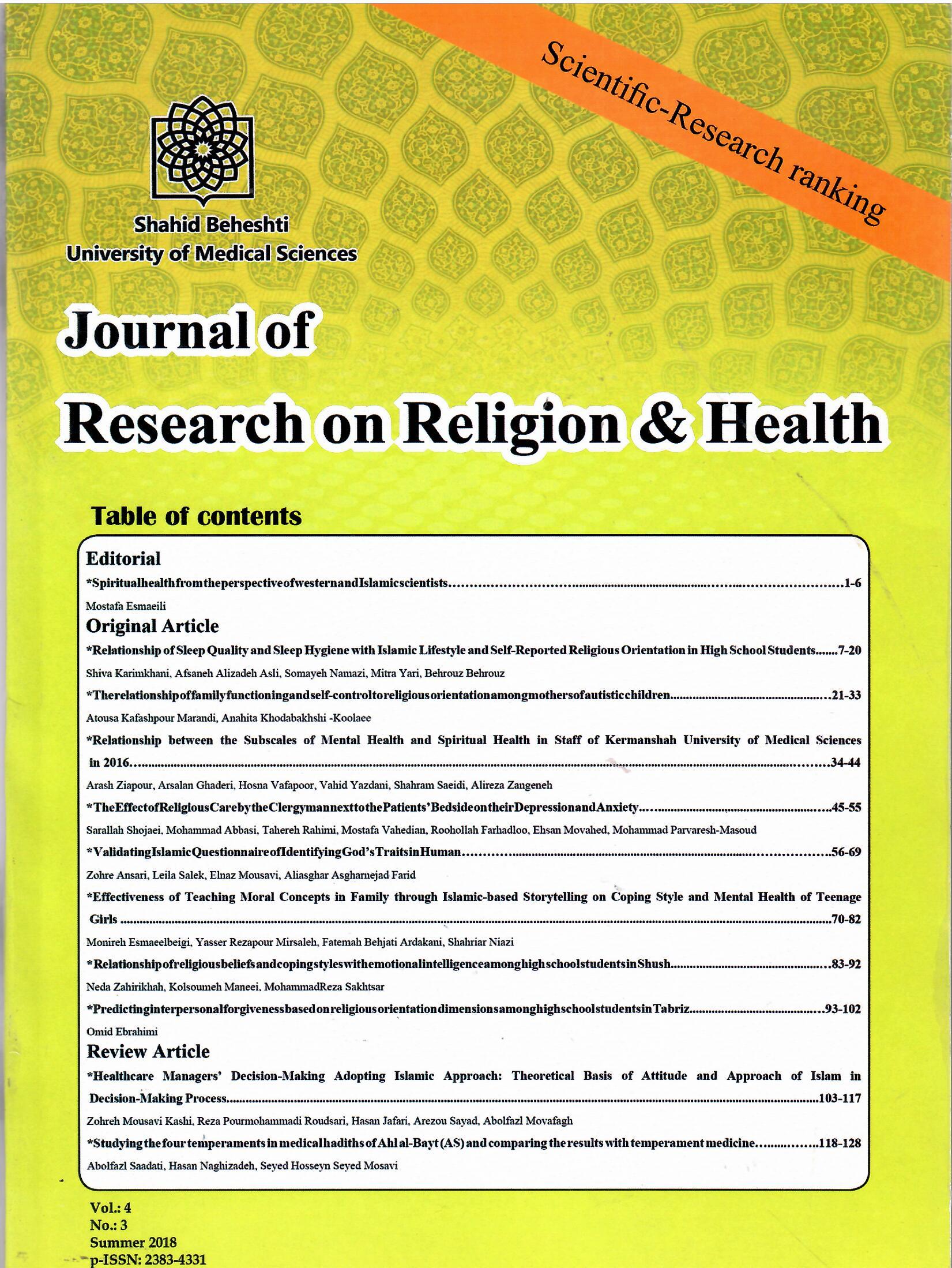
اثربخشی آموزش مفاهیم اخلاق در خانواده به شیوهی قصّهگویی مبتنی بر مفاهیم اسلامی بر سبکهای مقابلهیی و سلامت روانی نوجوانان دختر
پژوهش در دین و سلامت ,
دوره 4 شماره 3 (2018),
9 ژوئن 2018
,
صفحه 70-82
https://doi.org/10.22037/jrrh.v4i3.16829
چکیده
سابقه و هدف: خانواده اصلیترین کانون شکلگیری آموزههای اخلاقی است و ریشهی آموزش مفاهیم اخلاقی در فرد از اخلاق در خانواده شروع میشود. پژوهش حاضر با هدف تعیین اثربخشی آموزش مفاهیم اخلاق در خانواده به شیوهی قصّهگویی مبتنی بر مفاهیم اسلامی بر سبکهای مقابلهیی و سلامت روانی نوجوانان دختر صورت گرفته است.
روش کار: این پژوهش مطالعهیی نیمهآزمایشی ازنوع پیشآزمون - پسآزمون با گروه گواه بود. جامعهی آماری شامل کلیهی دانشآموزان دختر دورهی متوسطهی دوم استان کرمان در سال تحصیلی 94-95 بود که 42 نفر از آنان با روش نمونهگیری در دسترس انتخاب و به صورت تصادفی در دو گروه آزمایش و گواه (هر گروه 21 نفر) جایگزین شدند. ابزار گردآوری دادهها شامل پرسشنامههای سبک مقابلهیی فولکمن و لازاروس؛ و سلامت روان بود. برنامهی مداخلهیی شامل 9 جلسه آموزش مفاهیم اخلاق در خانواده به شیوهی قصّهگویی بود که برای شرکتکنندگان گروه آزمایش اجرا شد و شرکتکنندگان گروه گواه هیچ مداخلهیی دریافت نکردند. در نهایت، دادههای جمعآوری شده با استفاده از تحلیل کواریانس تک متغیّری تجزیه و تحلیل شد. در این پژوهش همهی موارد اخلاقی رعایت شده است. علاوهبراین، نویسندگان مقاله هیچگونه تضاد منافعی گزارش نکردهاند.
یافتهها: یافتهها نشان داد که بین میانگین نمرههای پسآزمون گروه آزمایش نسبت به گروه گواه در سبک مقابلهیی مسئلهمدار و سلامت روان تفاوت مثبت و معنیداری وجود داشت (001/0>P). همچنین سبک مقابلهیی هیجانمدار نیز در گروه آزمایش بهطور معنیداری کمتر از گروه گواه بود (001/0>P). به عبارت دیگر، آموزش مفاهیم اخلاق در خانواده به شیوهی مذکور در گروه آزمایش به کاهش سبک مقابلهیی هیجانمدار، افزایش سبک مقابلهیی مسئلهمدار و سلامت روان نوجوانان دختر منجر شده بود.
نتیجهگیری: با توجه به اهمیت کنترل هیجان و سلامت روان در نوجوانان، میتوان از آموزش مفاهیم اخلاق در خانواده، بهویژه به شیوهی قصّهگویی مبتنی بر مفاهیم اسلامی، برای تقویت سبک مقابلهیی مسئلهمدار و سلامت روانی نوجوانان دختر استفاده کرد.
استناد مقاله به این صورت است:
Esmaeelbeigi M, Rezapour MirsalehY, Behjati Ardakani F, NiaziSH. Effectiveness of Teaching Moral Concepts in Family through Islamic-based Storytelling on Coping Style and Mental Health of Teenage Girls. J Res Relig Health. 2018; 4(3): 70- 82.DOI: https://doi.org/10.22037/jrrh.v4i3.16829
- اخلاق؛ سبک مقابلهیی؛ سلامت روان؛ قصّهگویی؛ نوجوان
ارجاع به مقاله
مراجع
Durkheim E. Professional ethics and civic morals. Routledge. London and New York; 2013. p. 100- 250.
Qanbarpooralam Z. Farahbakhsh K. esmaili M. Reviews and comparisons of family relationships successful and unsuccessful students in school. Journal of Family Research. 2012;8:337-53. (Full Text in Persian)
Goudarzi M, Moenirudbali Z. Evaluation of coping styles and mental health among high school students. Journal of Shahed University. 2006;1:23-32. (Full Text in Persian)
Folkman S, Lazarus RS. The relationship between coping and emotion: Implications for theory and research. Social science & medicine. 1988;26(3):309-17.
Endler NS, Parker JD. Multidimensional assessment of coping: a critical evaluation. Journal of personality and social psychology. 1990;58(5):844.
Ireland JL, Boustead R, Ireland CA. Coping style and psychological health among adolescent prisoners: a study of young and juvenile offenders. Journal of Adolescence. 2005;28(3):411-23.
Scarpa A, Haden SC. Community violence victimization and aggressive behavior: The moderating effects of coping and social support. Aggressive Behavior. 2006;32(5):502-15.
Goggin K, Malcarne VL, Murray TS, Metcalf KA, Wallston KA. Do religious and control cognitions predict risky behavior? II. Development and validation of the Sexual Risk Behavior-related God Locus of Control Scale for adolescents (SexGLOC-A). Cognitive Therapy and Research. 2007;31(1):123-39.
Keyes CL. The mental health continuum: From languishing to flourishing in life. Journal of health and social behavior. 2002:207-22.
Bergmann JR. Making Mental Disorders Visible: Proto-Morality as Diagnostic Resource in Psychiatric Exploration. The Palgrave Handbook of Adult Mental Health: Springer; 2016. p. 247-68.
Borba M. Building moral intelligence: The seven essential virtues that teach kids to do the right thing. San Francisco. 2001;192.
Habibi A, Behrouzi M, Khalifeh A. analysis Narrative components of stories of the Holy Quran. Interdisciplinary researches of the Holy Quran. 2011;2(5):37-49.(Full Text in Persian)
Driscoll C, McKee M. Restorying a culture of ethical and spiritual values: A role for leader storytelling. Journal of Business Ethics. 2007;73(2):205-17.
Dush L. The ethical complexities of sponsored digital storytelling. International Journal of Cultural Studies. 2013;16(6):627-40.
Safooraiiparizi M. The effectiveness of the observance of Islamic moral teachings of Family Efficiency. Journal moral knowledge. 2009;1:91-118.(Full Text in Persian)
Hassanzadeh S. Factors strengthening the family in
Islamic culture. Journal of Islamic education. 2013;4:91-118.(Full Text in Persian)
Aliakbari M, Alipoor A, Dornajafi Shirazi M. the effect of storytelling on pre-school female students in Isfahan city. Journal of Social Cognition. 2014;3:33-43.(Full Text in Persian)
Afshari A. The Educational effects, storytelling. payvand Journal. 2007;4:44-53.(Full Text in Persian)
Noori M. Mustadrak Alvasayel va Mstnbt Almasayel. Qom: Alulbayt Publications; 1990.(Full Text in Persian)
Majlesi M. Bharalanvar. Tehran: Islamia Publications; 2007. p. 428.(Full Text in Persian)
Delavar A. Theoretical Principles and practical research in the humanities and social sciences. Tehran: Roshd Publications; 2011.(Full Text in Persian)
Folkman S, Lazarus RS. Coping as a mediator of
emotion. Journal of personality and social psychology. 1988;54(3):466.
Folkman S, Lazarus RS. Manual for the ways of coping questionnaire: Consulting Psychologists Press; 1988.
Mousavinasab M, Taghavi M. Optimism-pessimism and coping strategies: Prediction of Adolescent Psychological Adaptation. Iranian Journal of Psychiatry and Clinical Psychology. 2006;4(47):380- 89.(Full Text in Persian)
Aghayousefi A, Dadsetan P, Azhee J, Mansour M. The Role of Personality Factors on Coping and the impact of coping therapy On personality factors and depression. Journal of Psychology. 2000;4(4):347-70.(Full Text in Persian)
Lovibond PF, Lovibond SH. The structure of negative emotional states: Comparison of the Depression Anxiety Stress Scales (DASS) with the Beck Depression and Anxiety Inventories. Behaviour research and therapy. 1995;33(3):335-43.
Sahebi A, Asghari M, Salari R. Validation of depression anxiety and stress scale (DASS-21) for an Iranian population. Iranian Psychologists. 2005;4(1):299-313.(Full Text in Persian)
Borba M. Building moral intelligence. San Fransisco: Josey-Bass Coles. 2001.
Schlaefli A, Rest JR, Thoma SJ. Does moral education improve moral judgment? A meta-analysis of intervention studies using the Defining Issues Test. Review of Educational Research. 1985;55(3):319-52.
Mousavi Garmaroudi A. Stories of the Prophets. Tehran: Ghadiani Publicatio; 1995.p26-82.(Full Text in Persian)
Raines ML. Ethical decision making in nurses: relationships among moral reasoning, coping style, and ethics stress. JONA'S healthcare law, ethics and regulation. 2000;2(1):29&hyhen.
Bryant-Davis T, Wong EC. Faith to move mountains: religious coping, spirituality, and interpersonal trauma recovery. American Psychologist. 2013;68(8):675.
Phillips III RE, Ano GG. A re-examination of religious fundamentalism: positive implications for coping. Mental Health, Religion & Culture. 2015;18(4):299-311.
Beheshtifar M, Esmaeli Z, Moghadam MN. Effect of moral intelligence on leadership. European Journal of Economics, Finance and Administrative Sciences. 2011;43(1):6-11.
Malinovic A, Fink A, Lewis A, Unterrainer H-F. Dimensions of Religious/Spiritual Well-Being in relation to personality and stress coping: Initial results from Bosnian young adults. Journal of Spirituality in Mental Health. 2016;18(1):43-54.
Rahmadoost M. Storytelling the importance and the way it. Tehran: Roshd Publications; 2002.(Full Text in Persian)
Nonnemaker JM, McNeely CA, Blum RW. Public and private domains of religiosity and adolescent health risk behaviors: Evidence from the National Longitudinal Study of Adolescent Health. Social science & medicine. 2003;57(11):2049-54.
Kézdy A, Martos T, Boland V, Horváth-Szabó K. Religious doubts and mental health in adolescence and young adulthood: The association with religious attitudes. Journal of Adolescence. 2011;34(1):39-47.
Huang Y-T, Chen Y-W. Risk Factors for Depressed Mood in a Taiwanese School-Based Sample of Adolescents: Does Spirituality Have Protective Effects? The British Journal of Social Work. 2014;45(7):2020-37.
Weber SR, Pargament KI. The role of religion and spirituality in mental health. Current opinion in psychiatry. 2014;27(5):358-63.
Malti T, Noam GG, Beelmann A, Sommer S. Toward dynamic adaptation of psychological interventions for child and adolescent development and mental health. Journal of Clinical Child & Adolescent Psychology. 2016;45(6):827-36.
- چکیده مشاهده شده: 650 بار
- PDF دانلود شده: 420 بار