
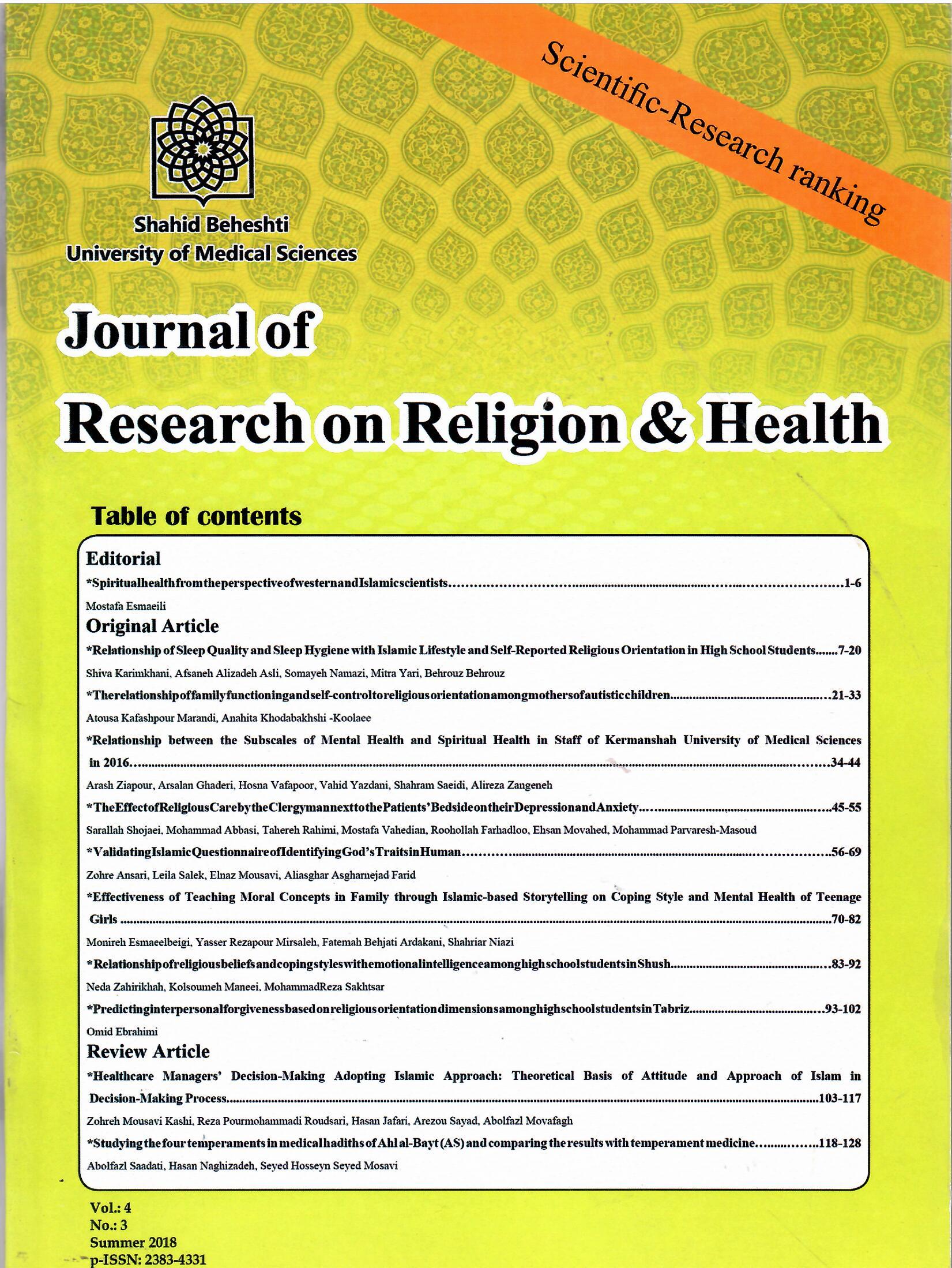
رابطهی بین کارایی خانواده و خودکنترلی با جهتگیری مذهبی در مادران دارای کودک مبتلا به اوتیسم شهر تهران
پژوهش در دین و سلامت ,
دوره 4 شماره 3 (2018),
9 خرداد 2018
,
صفحه 21-33
https://doi.org/10.22037/jrrh.v4i3.16460
چکیده
سابقه و هدف: در ﻣﻨﺎﺑﻊ دینی خودکنترلی ﻧﻈﺎمی ﺟﺎﻣﻊ و ﻣﻨﺤﺼﺮ ﺑﻪ ﻓﺮد؛ و ﺑﺮﮔﺮﻓﺘﻪ از ﻧﻈﺎرت ﺧﺪاوﻧﺪ ﻣﺘﻌﺎل و همچنین نظارت ﻓﺮد ﺑﺮ اﻋﻤﺎل ﺧﻮد اﺳﺖ. از آﻧﺠﺎ ﻛﻪ در آﻣﻮزهﻫﺎی اﺳﻼمی، ﺧﻮدکنترلی ﺟﺎﻳﮕﺎه ویژهیی در زندگی بشر دارد، اﻳﻦ پژوهش با هدف تبیین رابطهی بین کارایی خانواده و خودکنترلی با جهتگیری مذهبی در مادران دارای کودک مبتلا به اوتیسم شهر تهران در سال ۹4-۹5 صورت گرفته است.
روش کار: این پژوهش توصیفی ازنوع همبستگی است. نمونهی مورد پژوهش شامل ١٠٠ ﻣﺎدر دارای ﮐﻮدک مبتلا به اوﺗﯿﺴﻢ شهر تهران در سال ۹4-۹5 است که به روش نمونهگیری در دسترس انتخاب شدند و به ﭘﺮﺳشنامههای ﺟﻬﺖﮔﯿﺮی ﻣﺬهبی آلپورت، ﮐﺎراﯾﯽ ﺧﺎﻧﻮادﻩی ﻣﮏ ﻣﺴﺘﺮ و ﺧﻮدﮐﻨﺘﺮﻟﯽ ﺗﺎﻧﺠﯽ پاسخ دادند. دادههای جمعآوری شده با استفاده از روش آماری تحلیل رگرسیون چندگانه و ضریب همبستگی پیرسون تحلیل شد. در این پژوهش همهی موارد اخلاقی رعایت شده است. علاوهبراین، نویسندگان مقاله هیچگونه تضاد منافعی گزارش نکردهاند.
یافتهها: بر اساس یافتههای بهدستآمده بین خودکنترلی و جهتگیری مذهبی و نیز بین کارایی خانواده و خودکنترلی رابطهی معناداری وجود داشت (05/0p<)؛ یعنی هر چقدر خودکنترلی بیشتر بود جهتگیری مذهبی افزایش مییافت و برعکس. همچنین با افزایش کارایی خانواده، خودکنترلی نیز بیشتر میشد و برعکس (05/0p<). بین کارایی خانواده و جهتگیری مذهبی درونی و بیرونی رابطهی معناداری یافت نشد.
نتیجهگیری: نتایج پژوهش حاضر بر رابطهی بین جهتگیری مذهبی و خودکنترلی تأکید دارد. ازاینرو، پیشنهاد میشود که برنامههای پیشگیرانه، آموزش و مداخلات مذهبی و همچنین خودکنترلی بیشتر مد نظر قرار بگیرد.
استناد مقاله به این صورت است:
Kafashpour Marandi A, Khodabakhshi –Koolaee A. The relationship of family functioning and self-control to religious orientation among mothers of autistic children. J Res Relig Health. 2018; 4(3): 21-33. DOI: https://doi.org/10.22037/jrrh.v4i3.16460
- اوتیسم؛ جهتگیری مذهبی؛ خودکنترلی، کارایی خانواده
ارجاع به مقاله
مراجع
Taulbee J. Understanding children of special needs: the guide for parents, teachers and care-givers. 2nd ed. Tehran: Jungle; 2009. (Full text in Persian)
Khodabakhshi Koolaee A. Patterns of family therapy and parent education. 2nd ed. Tehran: Jungle; 2011. (Full in text Persian)
Adler K, Salantera S, Leino-Kilpi H, Gradel B. An Integrated Literature Review of the Knowledge Needs of Parents With Children With Special Health Care Needs and of Instruments to Assess These Needs. Infants & Young Children.2015;28(1):46-71.
Miller JE, Nugent CN, Russell LB. Which components of medical homes reduce the time burden on families of children with special health care needs. Health services research.2015;50(2):440-61.
Zarei S, Sharif F, Alavi Shooshtari A, Vossoughi M. The effect of stress management program on mental health of the mothers of children with attention deficit hyperactivity disorder. Journal of Nursing Education. 2015;3(4):58-67. (Full text in Persian)
Navabi nejhad Sh. Marriage Counseling & Family Therapy. Tehran: Parents & Educatores;2009. (Full text in Persian)
Weitlauf AS, Vehorn AC, Taylor JL, Warren ZE. Relationship satisfaction, parenting stress, and depression in mothers of children with autism. Autism. 2014;18(2):194-8.
leman D, Boyatzis RE, Rhee KS. Clustering
competence in emotional intelligence: Insights from the emotional competence inventory. In R. Bar-On and J.D.A. Parker (Eds.), Handbook of emotional intelligence (pp. 343-362). San Francisco: Jossey-Bass;2000.
Developmental Disabilities Monitoring Network Surveillance Year, Principal Investigators. Prevalence of autism spectrum disorder among children aged 8 years-autism and developmental disabilities monitoring network, 11 sites, United States, 2010. Morb Mort Wkly Rep Surveil Summ. 2014;63(2):1.
Khodabakhshi Koolaee A, Arab Varamin A, Rooshan Cheseli R. Effectiveness of “Kozloff Parental Training Program” on Expressed Emotion and Burden Among Mothers With Autistic Child. Iranian Journal Rehabilitation Research in Nursing (IJRN. 2015; 3(1): 28-34. (Full text in Persian)
Khodabakhshi Koolaee A, Rajaee Asl N. Efficacy of Hope-Oriented Group Therapy on Quality of Life and Parent-Child Relationship in Mothers with Autistic Children. Journal of Prevention and Health. 2016; 2(2):32-43. (Full text in Persian)
Hoffman CD, Sweeney DP, Hodge D, Lopez-Wagner MC, Looney L. Parenting stress and closeness mothers of typically developing children and mothers of children with autism. Focus on Autism and Other Developmental Disabilities. 2009;24(3):178-87.
Kaushal RT, Kwantes C. The role of culture and personality in choice of conflict management strategy. Interational Journal Relations. 2006; 3(30): 579- 603.
Azarbayjani M. Testing religious orientation by relying on Islam.Tehran: publication institute of University and Islamic Seminary; 2014. (Full text in Persian)
Ralph W, Hood Jr, Peter C. Hill, Spilka B. The Psychology of Religion: An Empirical Approach .4nd
ed. Tehran:Roshd;2011.
McCullough, Michael E, Willoughby, Brian LB. Religion, Self-Regulation, and Self-Control: Associations Explanations,and Implications. Psychological Bulletin. 2009; 135(1):71-88.
Desmond, Scott A. & Ulmer, Jeffery T. & Bader, Christopher D. "Religion, Self Control, and Substance Use", Deviant Behavior.2013; 3(34): 384- 604.
French, Doran C, Eisenberg N, Vaughan J, Purwono U, Suryanti & et al. Religious involvement and the social competence and adjustment of Indonesian Muslim adolescents. Dev Psychol. 2011; 44 (2): 597-611.
Ahmadi A. Role of Islamic values in controlling and monitoring organization. Tehran: Tolid-e Danesh Press; 2003. (Full text in Persian)
Alavi-naien AM, Keyghobadi K, Djazayery A, Djazayery M. The survey of the nutritional status of 25-36 month old rural children and some factors affecting it in the rural areas of Kerman. Journal of Kerman University of Medical Sciences. 2003; 10(2): 1128. (Full text in Persian)
Abtahi H, Kheirandish M. Providing a self- careling model in the organization with the Islamic attitude. Tehran: Tadbir; 2009. (Full text in Persian)
Robbins SP. Management. New Jersey: Prentice Hall Englewood Cliffs; 1999.
Javadi Amoli A. Thematic interpretation of Quran: the morality steps of Quran. Qom: Asra Press; 2009. (Full text in Persian)
Holy Quran, Trans: Makarem Shirazi N. Qom: Sarmayeh Press; 2011. Baghareh: 284. (Full text in Persian)
Holy Quran, Trans: Makarem Shirazi N. Qom: Sarmayeh Press; 2011. Baghareh: 235. (Full text in Persian)
Majlesi MB. Bahar al-anvar. Beirut: Moassese Al-Vafa; 1984.
Rounding K , Lee A , Jacobson J."Religion Replenishes Self-Control", Psychological Science. 2012; 23(6): 635-42.
Carter, Evan C, McCullough, Michael E, Carver, Charles S, "The Mediating Role of Monitoring in the Association of Religion with SelfControl".Socia Psychologicaland Personality Science.2012;3(6):61-7.
Reisig, Michael D, Wolfe, Scott E, Pratt, Travis C."Low Self-control and the Religiosity-Crime Relationship", Criminal Justice and Behavior. 2012; 39(9): 1172-91.
Azarbayjani M, Mousavi M. Introduction to the religion psychology.Tehran:Samt Publication; 2015. (Full text in Persian)
Turiano NA, Shawn D, Whiteman SE, Hampson BW, Roberts & Daniel K. Personality and substance use in midlife: Conscientiousness as amoderator and the effects of trait change. Journal of Research in Personality. 2012;46(3):296-305.
Janbozorgi M. Religious Orientation and Mental Health .Tehran: Research Shaheed Beheshti University of Medical Sciences and Health Services. 1999; 10(4): 345-60. (Full text in Persian)
Saatchi M, Kamkari K, Askarian M. Psychological tests. Tehran:Virayesh Publications; 2010. (Full text in Persian)
Arian-Pour M, Shahabi-Zadeh F, Bahreynian A. The predictive model of spiritual quotient according to attributional styles and self-control. Psychology and Religion. 2015; 8(1): 5-24. (Full text in Persian)
Najafi M, Ahadi H, Delavar A. Examine the relationship between family function and religiosity with identity crisis. Behavior Scholar. 2014;13(16):17-
(Full text in Persian)
Sharifi f. study the relationship between parenting styles with self-control & religious-orientation (MSc Thesis).Mashhad, Iran:Ferdosi University;2012. (Full text in Persian)
Asghari F, Kordmirza E, Ahmadi A. Relation between religious attitude, source of control & Tendency to Substance Abuse. Quarterly Journal Of Research On Addiction. 2013;7(25):103-12. (Full text in Persian)
Welch, Michael R, Tittle, Charles R, Grasmick, Harold G. Christian Religiosity, Self-Control and Social Conformity. Social Forces. 2006;84(3):1605-23.
Carter, Evan C, McCullough, Michael E, Carver, Charles S. The mediating role of monitoring in the association of religion with self-control. social psychological and personality science. 2012;3(6):1-7.
Desmond, Scott A, Ulmer, Jeffery T, Bader, Christopher D. Religion prosocial learning, self-control, and delinquency. manuscript submitted for publication. 2008; 34(5):107-19.
Delisi M. Low Self-Control is a Brain-Based Disorder. Sage Publications Ltd; 2014.
Geyer AL, Baumeister RF. Religion, Morality, and Self-Control: Values,Virtues, and Vices. In R. F. Paolourzian & C. L. Park (Eds.), Handbook of the Psychology of Religion and Spirituality.2005; 412-32.
Rounding K, Lee A, Jacobson, Jill A, Li-Jun Ji. "Religion Replenishes Self-Control".Psychological Science.2012;23(1): 635-42.
Holy Quran, Sura of Al-Hajarat. (The Heights), Verse 13.
Darisavi S, Faghihi A. Factors of Self Control,s Lack from Holy Quran,s View. Marifat-I Akhlaqi. 2013; 4(1):75-92. (Full text in Persian)
Holy Qoran, Sura of Al-Kahf. Verse 28.
Tabatabaee, M. Tafsir Almizan.ghom: Jamee Modaresin; 1996. (Full text in Persian)
Holy Quran,Sura of Al-Maede. Verse 105.
Ebne Ajibe A. Al-bahr Al-madid Fi Tafsir Al-Quran Al-Majid: Cairo; 1998.
Aliverdinia A, Memar R, Nasr S. Experimental Study of the relationship between Religiosity,self-control & Deviant behavior. Journal of the socio-cultural strategy. 2014;4(16):7-43. (Full text in Persian)
Klanjšek R, Vazsonyi AT, Trejos-Castillo E. Religious orientation, low self-control, and deviance: Muslims, Catholics, Eastern Orthodox-, and “Bible Belt” Christians. Journal of Adolescence. 2012: 35(3):671-82.
Gupta G. "Spiritual Intelligence and Emotional Intelligence in Relation to Self-Efficacy and Self-Regulation Among College Students", International Journal of Social Sciences & Interdisciplinary Research.2012; 1 (2): 60-9.
Safoorai M. Indicators of Efficient Family. Islamic Studies of women and family Bulletin. 2013;1(1):29-58. (Full text in Persian)
Ghadiri M. Children self-control, Source of moral restraint upbringing way. 2010;2(10):78-116. (Full text in Persian)
- چکیده مشاهده شده: 619 بار
- PDF دانلود شده: 403 بار