
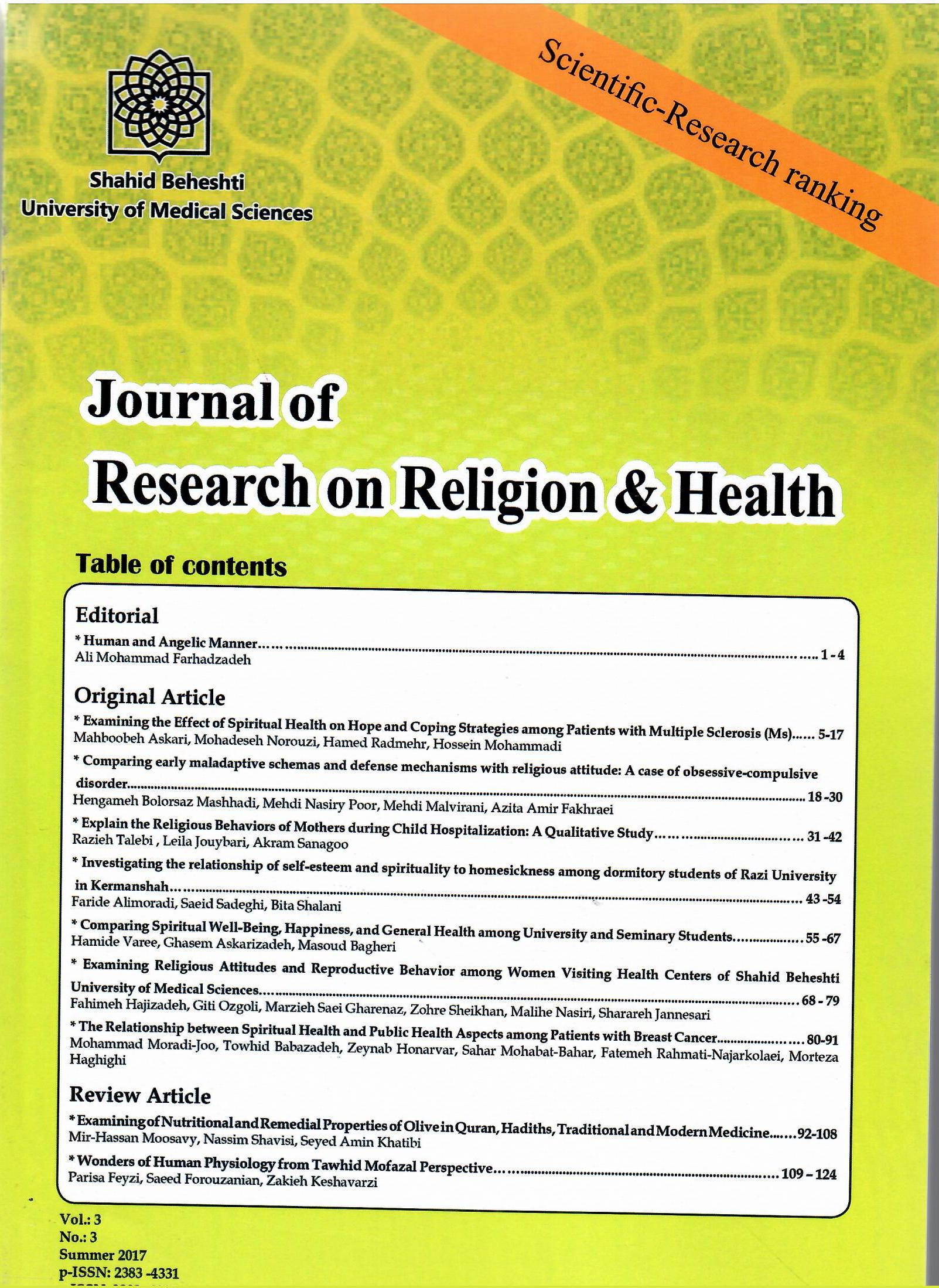
مقايسهی مؤلفههای بهزيستي معنوي با شادکامي و سلامت عمومي در دانشجويان دانشگاه شهید باهنر و حوزههای علمیهی شهر کرمان
پژوهش در دین و سلامت ,
دوره 3 شماره 3 (2017),
14 خرداد 2017
,
صفحه 55-67
https://doi.org/10.22037/jrrh.v3i3.14758
چکیده
سابقه و هدف: معنویت یکی از مهمترین عاملهای افزایش شادکامی و سلامت عمومی گزارش شده است. با توجه به اینکه محیط، یکی از عاملهای ایجاد بهزیستی معنوی است؛ این پژوهش با هدف بررسي مقايسهیي رابطهی بهزيستي معنوي با شادکامي و سلامت عمومي در دانشجويان دانشگاه شهيد باهنر و حوزههای علمیهی شهر کرمان انجام شده است.
روش کار: این پژوهش از نوع علّی - مقایسهیی و جامعهی آماری آن شامل همهی دانشجویان دانشگاه شهید باهنر و حوزههای علمیهی شهر کرمان است. بدین صورت که 376 نفر از دانشجویان دانشگاه شهيد باهنر بهروش نمونهگيري تصادفي خوشهیي چندمرحلهیي و 274 نفر از دانشجویان حوزههاي علميه، بهروش نمونهگیری در دسترس انتخاب شدند. ابزارهای اندازهگیری شامل پرسشنامههای بهزيستي معنوي (SWB)، شادکامي آکسفورد (AHQ) و سلامت عمومي (GHQ-28) است. دادهها با استفاده از روشهای رگرسیون چندگانه، آزمونهای تی مستقل و یومن ویتنی تجزیه و تحلیل شد. در این پژوهش همهی موارد اخلاقی رعایت شده است. علاوهبراین، نویسندگان مقاله هیچگونه تضاد منافعی گزارش نکردهاند.
یافتهها: نتايج پژوهش نشان داده که بین بهزيستي معنوي، بهزیستی وجودی و بهزیستی مذهبی با شادکامي، رابطهی مثبت وجود دارد (001/0>P)، درحالیکه هر سه با سلامت عمومی رابطهی منفی دارند (001/0>P)؛ همچنین بهزيستي معنوي و شادکامي تفاوت معناداري در دانشجویان دانشگاه شهید باهنر و حوزه دارند (01/0>P)، اما تفاوت دو گروه در سلامت عمومی معنادار نیست (05/0<P).
نتیجهگیری: بر اساس نتایج پژوهش، سطح بالاتر بهزیستی معنوی و شادکامی در حوزههای علمیه، نشاندهندهی اثر معنويت موجود در این مدارس، در متغیّرهای مورد بررسی است و لزوم توجه به جنبههاي معنوي و تلاش برای رشد و توسعهی آن را گوشزد ميسازد.
- بهزيستي معنوي، حوزهی علمیه، دانشجویان، سلامت عمومي، شادکامي
ارجاع به مقاله
مراجع
Bonet M. The impact of spiritual well-being and stressful life experiences on traumatic stress. 2009.
Tiew LH, Creedy DK, Chan MF. Student nurses' perspectives of spirituality and spiritual care. Nurse education today. 2013;33(6):574-9.
Jafari E, Najafi M, Sohrabi F, Dehshiri GR, Soleymani E, Heshmati R. Life satisfaction, spirituality well-being and hope in cancer patients. Procedia-Social and Behavioral Sciences. 2010;5:1362-6.
Moodley T. The relationship between coping and spiritual well-being during adolescence: University of the Free State; 2008.
Jackson BR. Daily spiritual experiences: A buffer against the effect of daily perceived stress on daily mood: University of Notre Dame; 2010.
Lewis CA, Maltby J, Day L. Religious orientation, religious coping and happiness among UK adults. Personality and Individual differences. 2005;38(5):1193-202.
Stewart ME, Watson R, Clark A, Ebmeier KP, Deary IJ. A hierarchy of happiness? Mokken scaling analysis of the Oxford Happiness Inventory. Personality and Individual Differences. 2010;48(7):845-8.
Veenhoven R. How do we assess how happy we are? Tenets, implications and tenability of three theories. Happiness, economics and politics. 2009:45-69.
Green M, Elliott M. Religion, health, and psychological well-being. Journal of religion and health. 2010;49(2):149-63.
Ellison CG, Fan D. Daily spiritual experiences and psychological well-being among US adults. Social Indicators Research. 2008;88(2):247-71.
Aghili M, Venkatesh Kumar G. Relationship between religious attitude and happiness among professional employees. Journal of the indian academy of applied psychology. 2008;34:66-9.
Fisher J. Relating with God Contributes to Variance in Happiness, over that from Personality and
Age. Religions. 2013;4(3):313-24.
Stavrova O, Fetchenhauer D, Schlösser T. Why are religious people happy? The effect of the social norm of religiosity across countries. Social science research. 2013;42(1):90-105.
You KS, Lee H-O, Fitzpatrick JJ, Kim S, Marui E, Lee JS, et al. Spirituality, depression, living alone, and perceived health among Korean older adults in the community. Archives of Psychiatric Nursing. 2009;23(4):309-22.
Ghobaribonab B, Hakimirad E, Motavallipour A. The relationship between spirituality and mental health in college students: the case of university of Tehran. The sixth international conference on new directions in the humanities faith university; Istanbul, Turkey2008. p. 15-8.
Krause N. God-mediated control and change in self-rated health. The International journal for the psychology of religion. 2010;20(4):267-87.
Ellison CG, Burdette AM, Hill TD. Blessed assurance: Religion, anxiety, and tranquility among US adults. Social Science Research. 2009;38(3):656-67.
Koenig HG, Al Zaben F, Khalifa DA. Religion, spirituality and mental health in the West and the Middle East. Asian journal of psychiatry. 2012;5(2):180-2.
Mohammadi H, Mortazavi MA, Mousavi MR, JAVANMARD GH, Monfaredi A. Determination of the relationship between Religious commitment and mental health among engineering students of Bonab University. Journal of Reaserch on Religion & Health. 2016;2(2):44-53.(Full Text in Persian)
Rezaei-Adryani M, Azadi A, Ahmadi F, Azimi A. Comparison level of stress, Anxiety, Depression and quality of life in dormitory resident students. Iranian Journal of Nursing Research. 2007;4(2):31-8.(Full Text in Persian)
Sajjadi MS, Askarizade G. Role of Mindfulness and Cognitive Emotion Regulation Strategies on Predicting the Psychological Symptoms of Medical Students. Bimonthly of Education Strategies in Medical Sciences 2015;8(5):301-8.(Full Text in Persian)
Krejcie RV, Morgan DW. Determining sample size for research activities. Educational and psychological measurement. 1970;30(3):607-10.
Safai-Rad E, Karimi L, Shumusi N, Ahmadi M. The relationship between spiritual well-being and mental health. Journal of Sabzevar University of Medical Sciences and Health Services. 2010;17(4):270-6.(Full Text in Persian)
Paloutzian R, Ellison C. Loneliness, spiritual well-being and the quality of life In Peplau LA & Perlman D.(Eds.), Loneliness: A sourcebook of current theory, research and therapy (pp. 224–237). New York, NY: Wiley; 1982.
Dehshiri G, Sohrabi F, Jafari E, Najafi M. Students assess the psychometric properties of the scale of spiritual well-being. Psychological writings. 2008;4(3):129-44.
Hills P, Argyle M. Musical and religious experiences and their relationship to happiness. Personality and Individual Differences. 1998;25(1):91-102.
Alipour A, Noorbala A. Preliminary study of the reliability and validity of the Oxford Happiness Inventory in Students of Tehran University. Journal of Psychiatry and Clinical Psychology. 2007;4:71-81.(Full Text in Persian)
Hadi Nejad H, Zare F. Reliability, validity and Oxford Happiness Questionnaire survey. Psychological research. 2009;12(1):262-77.(Full Text in Persian)
Nemat-pour S, Shahbazian H. The relation stress factors due to diabetes among parents with insulin dependent diabetes mellitus children and their mental health. Ahwaz University of Medical Sciences Journal. 2006;5:534-39.(Full Text in Persian)
Fathi-Ashtiani A. Psychological tests, personality and mental health evaluation. 6 ed: Publishing Mission; 2010.(Full Text in Persian)
Taghavi MR. Evaluate the validity and reliability of public health. Journal of Psychology and Education. 2000;20:381-98.
A review of the life of Seyyed Razi (RA [Internet]. Available from: Available from: http://iec-md.org/maaref/nahjolbalagha/nahjolbalagha_seyed_razi_salavaati.html.
Rey Shahri M. Model joy of the Holy Quran and Hadith: Dar al-Hadith publishing; 2012.(Full Text in Persian)
The holy Quran.Al-fajr.verse 27-30. Translated by: Ayatollah Al-ozma Naser Makarem Shirazi. Qom: Imam Ali Ebne Abi Taleb (Ýa); 2010.(Full Text in Arabic)
Bakhshayesh AR, Mortazavi M, Haeri M. A comparative study of happiness in Islam and psychology. Journal of Sociology and Social Sciences. 2011;1:84-101.(Full Text in Persian)
- چکیده مشاهده شده: 797 بار
- PDF دانلود شده: 759 بار