
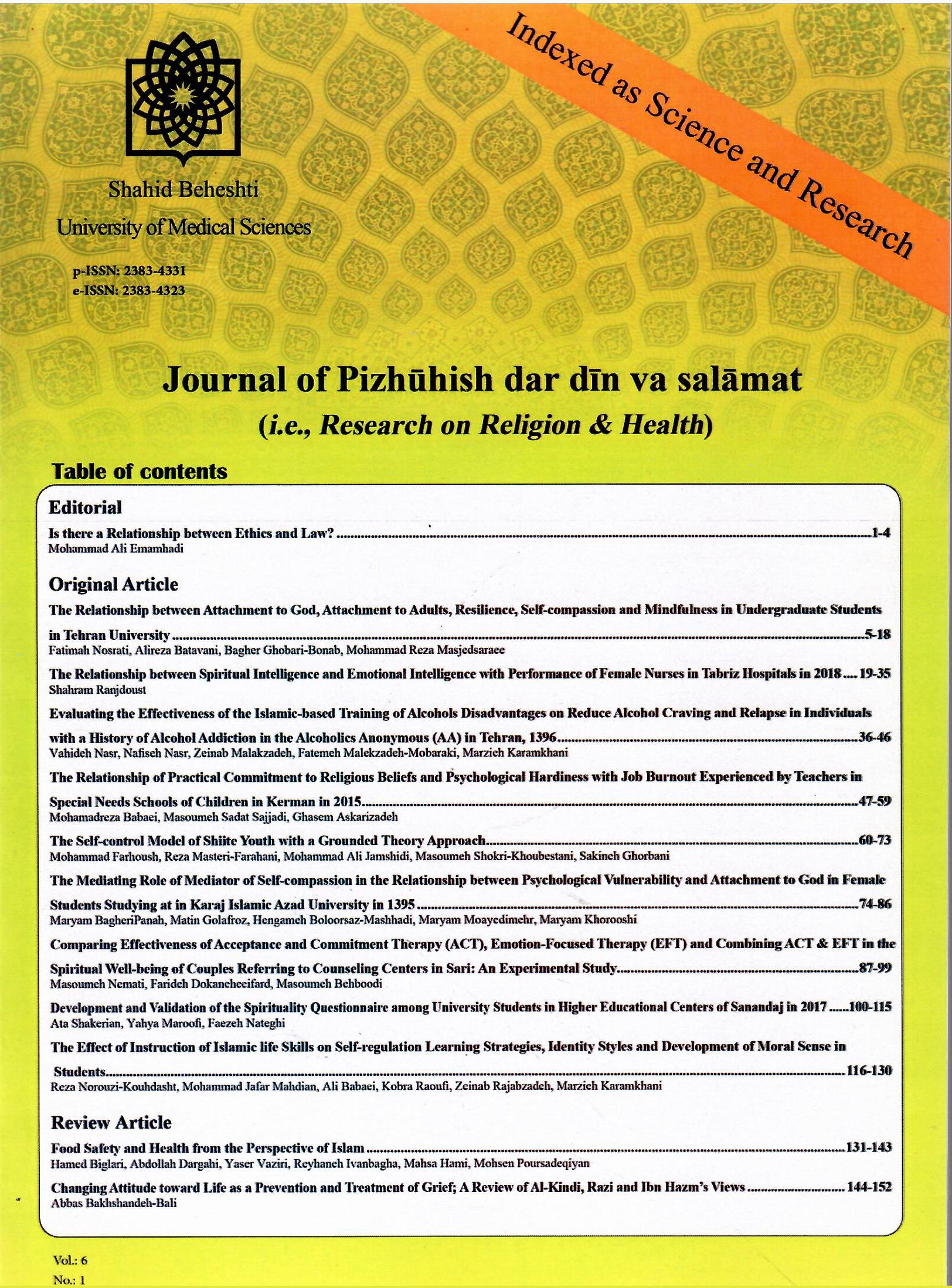
بررسی نقش میانجیگر شفقت به خود در رابطۀ بین آسیبپذیری روانشناختی و دلبستگی به خدا در دانشجویان دختر دانشگاه آزاد اسلامی واحد کرج در سال 1395
پژوهش در دین و سلامت ,
دوره 6 شماره 1 (2020),
22 مارس 2020
,
صفحه 74-86
https://doi.org/10.22037/jrrh.v6i1.22202
چکیده
سابقه و هدف: ناراحتیهای روانشناختی ازجمله مشکلات شایعی هستند که اغلب دانشجویان آن را تجربه میکنند. هدف این پژوهش بررسی نقش میانجیگر شفقت به خود در رابطۀ بین آسیبپذیری روانی و دلبستگی به خدا در دانشجویان بود.
روش کار: پژوهش حاضر توصیفی و از نوع همبستگی است. جامعۀ آماری پژوهش شامل کلیۀ دانشجویان دختر مشغول به تحصیل در دانشگاه آزاد اسلامی واحد کرج در سال 1395 بود که با روش نمونهگیری تصادفی ساده 280 نفر برای مطالعه انتخاب شدند. دادههای پژوهش با استفاده از مقیاسهای شفقت به خود؛ فرم كوتاه مقیاس افسردگي، اضطراب و استرس؛ و دلبستگی به خدا جمعآوری شد. بهمنظور تجزیه و تحلیل دادهها از روشهای آمار توصیفی، ضریب همبستگی پیرسون و رگرسیون؛ و برای آزمودن اثرهای واسطهای از روش بارون و کِنی استفاده شد. در این پژوهش همۀ موارد اخلاقی رعایت شده است و مؤلفان مقاله تضاد منافعی گزارش نکردهاند.
یافتهها: نتایج نشان داد که بین دلبستگی به خدا با شفقت به خود (61/0=r و 05/0>P) و آسیبپذیری روانی (60/0-=r و 05/0>P) رابطۀ معناداری وجود داشت. همچنین، دلبستگی به خدا بهتنهایی توان تبیین 52 درصد از تغییرات آسیبپذیری روانی را داشت؛ اما شفقت به خود و دلبستگی به خدا با هم توان تبیین 61 درصد از تغییرات آسیبپذیری روانی را داشتند.
نتیجهگیری: نتایج این پژوهش ضرورت بازشناسی نقش شفقت به خود و دلبستگی به خدا را در آسیبپذیری روانی دانشجویان تأکید میکند.
استناد مقاله به این صورت است:
BagheriPanah M, Golafroz M, Boloorsaz-Mashhadi H, Moayedimehr M, Khorooshi M. The Mediating Role of Mediator of Self-compassion in the Relationship between Psychological Vulnerability and Attachment to God in Female Students Studying at in Karaj Islamic Azad University in 2016. Journal of Pizhūhish dar dīn va salāmat. 2020;6(1):74-86. https://doi.org/10.22037/jrrh.v6i1.22202
- آسیبپذیری روانشناختی؛ دانشجو؛ دختر؛ دلبستگی به خدا؛ شفقت به خود
ارجاع به مقاله
مراجع
McLennan JD. Video-conferencing Telehealth Linkage attempts to Schools to Facilitate Mental Health Consultation. Journal of the Canadian Academy of Child and Adolescent Psychiatry. 2018;27(2):137.
Voth Schrag RJ, Edmond TE. Intimate partner violence, trauma, and mental health need among female community college students. Journal of American college health. 2018;66(7):702-11.
HatamKhani S. The Relationship between Mindfulness Skills, Psychological Flexibility and Psychopathology Symptoms. Tehran, Iran: Tarbiat Modares University; 2010. (Full Text in Persian)
Neff KD. The development and validation of a scale to measure self-compassion. Self and identity. 2003;2(3):223-50.
Neff KD, Kirkpatrick KL, Rude SS. Self-compassion and adaptive psychological functioning. Journal of research in personality. 2007;41(1):139-54.
Neff KD. The role of self-compassion in development: A healthier way to relate to oneself. Human development. 2009;52(4):211.
Peivastegar M, Besharat M, Pajouhinia S, Seifi M. Explanation of psychological vulnerability based on the attachment styles in students of mixed-state universities of Tehran. Knowl Res Appl Psychol. 2012;13(1):29-31. (Full Text in Persian)
Bitarafan L, Kazemi M, Yousefi Afrashte M. Relationship between styles of attachment to god and death anxiety resilience in the elderly. Iranian Journal of Ageing. 2018;12(4):446-57. (Full Text in Persian)
Desai S, Arias I, Thompson MP, Basile KC. Childhood victimization and subsequent adult revictimization assessed in a nationally representative sample of women and men. Violence and victims. 2002;17(6):639.
Salehi S. The Relation between Self-compassion with Intensity, Catastrophizig, and Self-efficacy of Pain and affect in Women with Musculoskeletal Pain. Anesthesiology and Pain. 2018;8(2):72-83. (Full Text in Persian)
Homan KJ. A mediation model linking attachment to God, self-compassion, and mental health. Mental Health, Religion & Culture. 2014;17(10):977-89.
Garmezy N. Stressors of childhood. In N. Garmezy & M. Rutter (Eds.), Stress, coping, and development in children (pp. 43-84). New York: McGraw-Hill. 1983.
Eskandari H, Pajouhinia S, Abavisani Y. Explanation of Psychological Problems Based on Cognitive Flexibility and Self Differentiation. The Neuroscience Journal of Shefaye Khatam. 2016;4(3):18-27. (Full Text in Persian)
Joeng JR, Turner SL, Kim EY, Choi SA, Lee YJ, Kim JK. Insecure attachment and emotional distress: Fear of self-compassion and self-compassion as mediators. Personality and Individual Differences. 2017;112:6-11.
Zessin U, Dickhäuser O, Garbade S. The relationship between self‐compassion and well‐being: A meta‐analysis. Applied Psychology: Health and Well‐Being. 2015;7(3):340-64.
Kemper KJ, Mo X, Khayat R. Are mindfulness and self-compassion associated with sleep and resilience in health professionals? The Journal of Alternative and Complementary Medicine. 2015;21(8):496-503.
Ganji H. Mental Health. Tehran: Arashbaran publishing house; 2015. (Full Text in Persian)
Rostami M, Abdi M, Heidari H. Correlation of Childhood Maltreatment, Self-Compassion and Mental Health in Married People. Journal of Fundamentals of Mental Health. 2014;16(61):73-61. (Full Text in Persian)
Muris P. A protective factor against mental health problems in youths? A critical note on the assessment of self-compassion. Journal of child and family studies. 2016;25(5):1461-5.
Farnsworth JK, Mannon KA, Sewell KW, Connally ML, Murrell AR. Exploration of caregiver behavior on fear of emotion, spirituality, and self-compassion. Journal of Contextual Behavioral Science. 2016;5(3):160-8.
Granqvist P, Kirkpatrick LA. Attachment and religious representations and behavior. In J. Cassidy & P. R. 2010.
Ainsworth MDS, Blehar MC, Waters E, Wall SN. Patterns of attachment: A psychological study of the strange situation: Psychology Press; 1978.
Refahi Z, Bahmani B, Nayeri A, Nayeri R. The relationship between attachment to God and identity styles with Psychological well-being in married
teachers. Procedia-Social and Behavioral Sciences. 2015;174:1922-7.
Nayeri A, Refahi Z, Bahmani B. Comparing attachment to god and identity styles and psychological well-being in married teachers: With regard to demographic factors. Procedia-Social and Behavioral Sciences. 2014;152:58-64. (Full Text in Persian)
Salazar LR. Exploring the relationship between compassion, closeness, trust, and social support in same-sex friendships. The Journal of Happiness & Well-Being. 2015;3(1):15-29.
Zahed-Babelan A, Rezaei Jamaloei H, Sobhani-Herfati R. An investigation of the relationship between attachment to God and resilience with meaningful life among students. Knowledge and Research in Applied Psychology. 2012;13(49):75-85.
Knofczynski GT, Mundfrom D. Sample sizes when using multiple linear regression for prediction. Educational and psychological measurement. 2008;68(3):431-42.
Sahebi A, Asghari MJ, Salari R. Validation of depression anxiety and stress scale (DASS-21) for an Iranian population. 2005. (Full Text in Persian)
Oliaei Z, Samani S, Fani H. Investigating the Validity and Reliability of Attachment Scale to God. Journal Management System. 2012;2(1):65-81. (Full Text in Persian)
Cheraghian H, Faskhodi BZ, Heidari N, Sharifi PY. Self-compassion as a relationship moderator between academic burnout and mental health in students. International Journal Academic Research in Progressive Education and Development. 2016;5(2):128-38. (Full Text in Persian)
Saeedi Z, Ghorbani N, Sarafraz MR, Sharifian MH. The Relationship between Self-Compassion, Self-esteem and regulation of self-conscious emotions. Research on Psychological Health, 6(3). 2012;6:1-9. (Full Text in Persian)
Rajabi G, Maghami E. Self-compassion as mediator between attachment dimensions with mental well-being: a path analysis model. Health Psychol. 2015;4(4):83-100. (Full Text in Persian)
Shabani R, Mahmodi G, Ghobari-Banab B, EmamiPour S, Sepahmansor M. Pishbini-ye Behzisti-ye Ravanshenakhti bar Asas-e Sabkhaye Delbastegi va Shafeghat be Khod dar Madaran-e DaneshAmoozan-e Dowre-ye Ebtedaei-ye Shahr-e Urmia. Zan va Motaleat Khanevadeh. 2015;8(27):73-94. (Full Text in Persian)
Raque-Bogdan TL, Ericson SK, Jackson J, Martin HM, Bryan NA. Attachment and mental and physical health: Self-compassion and mattering as mediators. Journal of Counseling Psychology. 2011;58(2):272.
Beck R. God as a secure base: Attachment to God and theological exploration. Journal of Psychology and
Theology. 2006;34(2):125-32.
Bradshaw M, Ellison CG, Marcum JP. Attachment to God, images of God, and psychological distress in a nationwide sample of Presbyterians. The International Journal for the Psychology of Religion. 2010;20(2):130-47.
- چکیده مشاهده شده: 805 بار
- PDF دانلود شده: 504 بار