
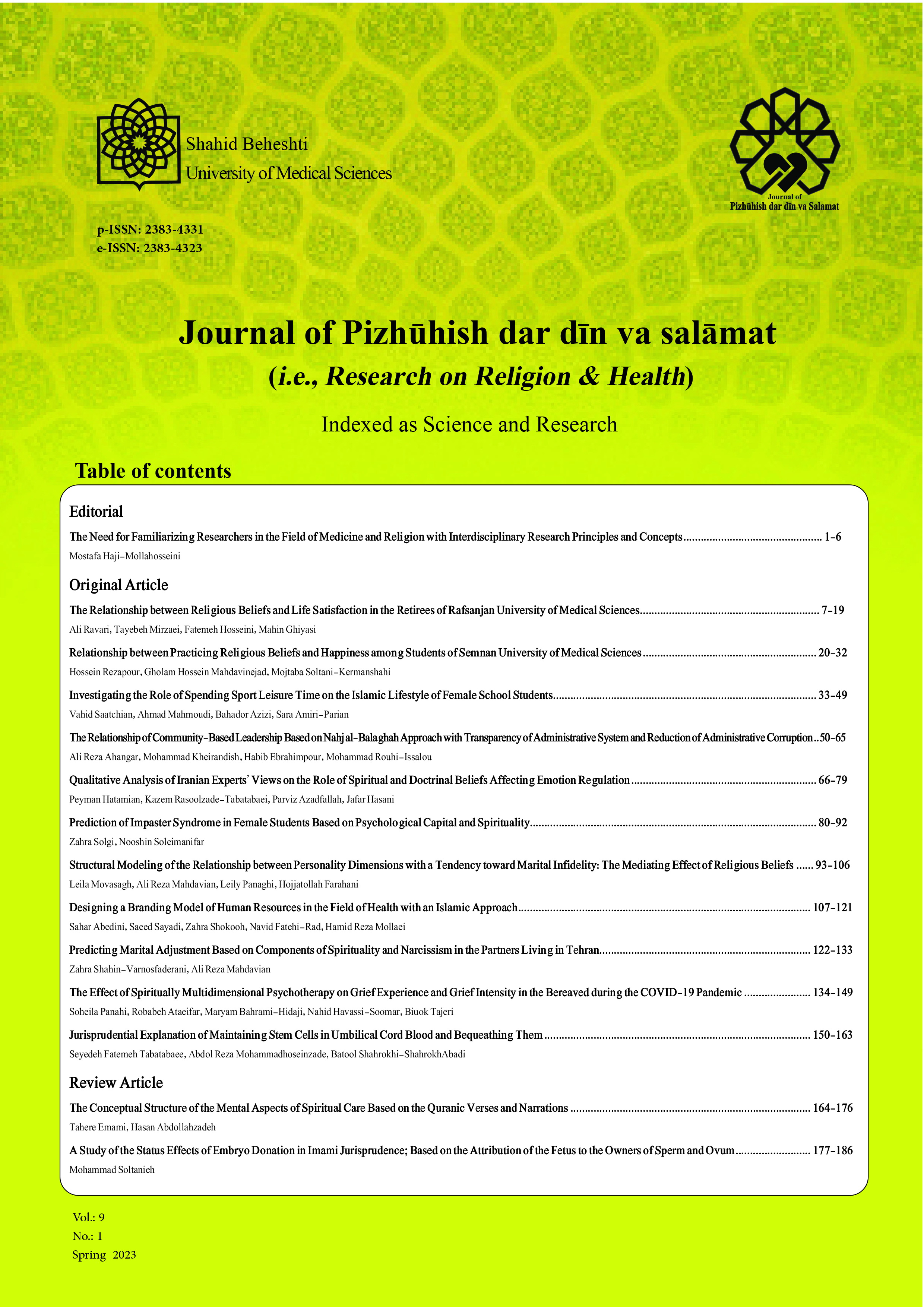
The Need for Familiarizing Researchers in the Field of Medicine and Religion with Interdisciplinary Research Principles and Concepts
Journal of Pizhūhish dar dīn va Salāmat (i.e., Research on Religion & Health),
Vol. 9 No. 1 (2023),
27 May 2025
,
Page 1-6
https://doi.org/10.22037/jrrh.v9i1.40652
Abstract
Today, scholars are accumulating knowledge behind the fence or in the enclosure of specialization while the abundant knowledge in one single discipline does not necessarily lead to increased wisdom and a fruitful life. Knowledge can be abused and its improper distribution may even prove harmful. The solution to complicated social, political, economic, and religious issues today are neither based on accumulation of knowledge not dependent on dependent on the religious teachings irrespective of the scientific developments (1, 2). What we need is an understanding of the relationship between different fields of knowledge, which is referred to as interdisciplinary knowledge. A correct understanding of the relationship between the medical sciences (medicine) and religious sciences (Islamic teachings) necessitates interdisciplinary research.
- Experimental sciences; Islamic teachings; Interdisciplinary research
How to Cite
References
Frodeman R, Klein JT, Pacheco RCDS. The Oxford handbook of interdisciplinarity: Oxford University Press; 2017.
Javadi Amoli A. The Role of the Intellect in the Geometry of Religious Knowledge. 3 ed: Esra Press. Iran; 2017. (Full Text in Persian)
Mahallati MS. Islam and Secularism. 1 ed. Tehran: Mirase Ahle Ghalam Publications; 2019. (Full Text in Persian)
Mesko B. The Guide to the Future of Medicine:Technology and the Human Touch. 1 ed. Budapest: Webicina Kft; 2014.
Tavallaie A. Philosophization of Body and Soul. 1 ed. Tehran: Dehkadeh Salamat Publications; 2020. (Full Text in Persian)
Darzi G. Ravesh-Shensi-e Motaleat-e Mian-Reshtehi-e Qura'ni. 1 ed. Tehran: Imam Sadigh University Publications; 2020. (Full Text in Persian)
- Abstract Viewed: 333 times
- pdf (فارسی) Downloaded: 31 times