
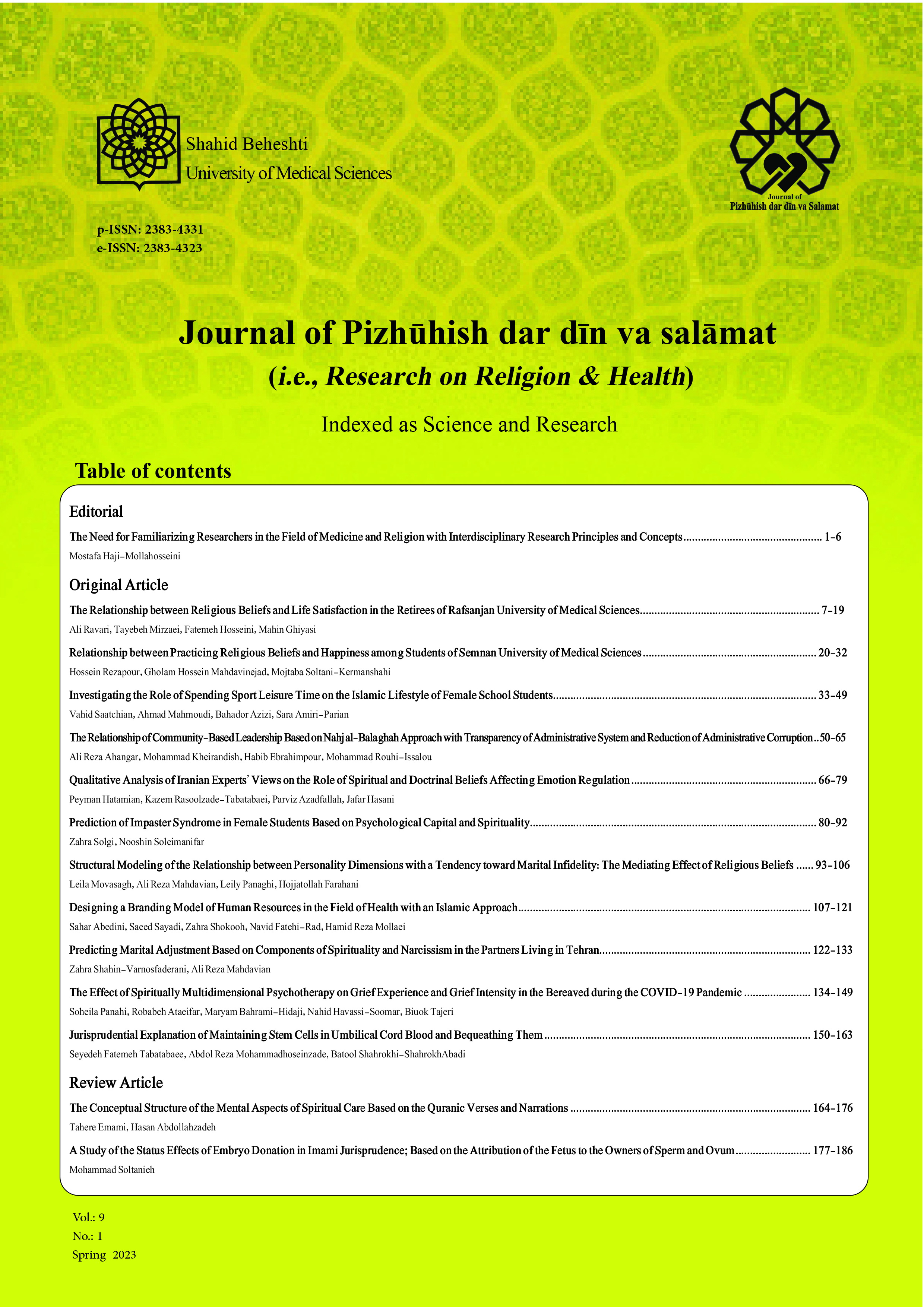
Prediction of Impaster Syndrome in Female Students Based on Psychological Capital and Spirituality
Journal of Pizhūhish dar dīn va Salāmat (i.e., Research on Religion & Health),
Vol. 9 No. 1 (2023),
27 Khordad 2025
,
Page 80-92
https://doi.org/10.22037/jrrh.v9i1.36359
Abstract
Background and Objective: Impaster syndrome, which has a relatively high prevalence in students, is associated with numerous social, psychological and economic consequences. Therefore, this study was conducted with the aim of prediction of Impaster Syndrome in female students based on psychological capital and spirituality.
Methods: The research design was correlational. All female students of Payame Noor University in the center of Islamabad-e-Gharb made up the population of this study, out of whom 202 were selected by available sampling method, They answered Imposter, spiritualism, and psychological capital questionnaires. Data analysis was performed using descriptive statistics, correlation coefficient and multiple regression. In this study, all ethical considerations were taken into account and the authors reported no conflict of interests.
Results: The results showed a significant negative correlation between the total score of psychological capital (r=-0.60, P=0.014) and also each of its dimensions including self-efficacy (r=-0.21, P=0.002), optimism (r=-0.17, P=0.004), resilience (r=-0.10, P=0.004) and hope (r=-0.11, P=0.005) with Impaster syndrome in female students. There was also an inverse and significant relationship between the total score related to spiritualism (r=-0.49, P=0.008) and the dimensions of self-awareness (r=0-.10, P=0.014), spiritual beliefs (r=-0.07, P=0.016), spiritual activity (r=-0.05, P=0.022) and spiritual need (r=-0.05, P=0.013). Regression coefficients also showed that the predictor variables together explained 39% of the variance in Impaster syndrome.
Conclusion: According to the results, it is suggested that more attention be paid to the role of spirituality and Islamic structures to improve the educational and psychological quality of members in educational and professional centers, besides improving psychological capital.
- Impaster syndrome; Psychological capital; Spirituality; University Student
How to Cite
References
Bravata DM, Watts SA, Keefer AL, Madhusudhan DK, Taylor KT, Clark DM, et al. Prevalence, predictors, and treatment of impostor syndrome: a systematic review. Journal of General Internal Medicine. 2020;35(4):1252-75.
Schmulian D, Redgen W, Fleming J. Impostor syndrome and compassion fatigue among graduate allied health students: A pilot study. Focus on Health Professional Education: A Multi-disciplinary Journal. 2020;21(3):1-14.
Canning EA, LaCosse J, Kroeper KM, Murphy MC. Feeling like an imposter: The effect of perceived classroom competition on the daily psychological experiences of first-generation college students. Social Psychological and Personality Science. 2020; 11(5): 647-57.
Edwards MS, Martin AJ, Ashkanasy NM. Mental health and psychological well-being among management students and educators. Sage Publications Sage CA: Los Angeles, CA; 2021. p. 3-18.
Lee E, Morfitt P. Imposter syndrome, women in technical services, and minority librarians: The shared experience of two librarians of color. Technical Services Quarterly. 2020;37(2):136-47.
Alsaleem L, Alyousef N, Alkaff Z, Alzaid L, Alotaibi R, Shaik SA. Prevalence of self-esteem and imposter syndrome and their associated factors among king saud university medical students. Journal of Nature and Science of Medicine. 2021;4(3):226-31.
Bravata DM, Madhusudhan DK, Boroff M, Cokley KO. Commentary: Prevalence, predictors, and treatment of imposter syndrome: A systematic review. Journal of Mental Health & Clinical Psychology. 2020; 4(3):12-16.
Terry D, Peck B, Smith A, Nguyen H. Occupational self-efficacy and psychological capital amongst nursing students: a cross sectional study understanding the malleable attributes for success. European Journal of Investigation in Health, Psychology and Education. 2019;10(1):159-72.
Davari R, Ahmadi H. Structural model of personality traits with mediating role of spirituality in suicidal tendency and drug abuse. 2019. (Full Text in Persian)
Bagheri Sheykhangafshe F, Shabahang R. Prediction of psychological wellbeing of elderly people based on spirituality, social support, and optimism. Journal of Religion and Health. 2020;7(2):22-32. (Full Text in Persian)
Khosravi Z, Farokhzad P. The role of spirituality and self-efficacy in predicting happiness and mental health: A cross-sectional study. Islam And Health Journal. 2020;5(2):42-9. (Full Text in Persian)
Faghernejad F, Hassani M. The Effect of Spirituality on the Quality of Work Life and Entrepreneurship as Mediated by Professional Ethics in the Staff of Lorestan University. Journal of Pizhūhish dar dīn va salāmat. 2021;6(4):101-16. (Full Text in Persian)
Bahamin Gh, DavariFard F, SadeghiFard YZ. Mediatory role of spirituality in mental health and tendency toward drug use. Journal of Pizhūhish dar dīn va salāmat. 2018;4(4):69-79. (Full Text in Persian)
Safara M, Khanbabaee M, Khanbabaee M. The Effect of group counseling based on spirituality on the development of positive relations with others and self-acceptance in girls of divorced families: An experimental study. Journal of Pizhūhish dar dīn va salāmat. 2020;6(2):49-61. (Full Text in Persian)
Hidemi S, Yumi M. Relationship Between the Factors of Spirituality and Self-Esteem in Nurses Working in Palliative Care Wards: A Cross-Sectional Study in the Chugoku Region. Journal of Religion and Health 2020;18(1):239-48.
Terpstra J, Lehto R, Wyatt G. Spirituality, quality of life, and end of life among Indigenous peoples: scoping review. Journal of Transcultural Nursing.
;32(2):161-72.
Rosenstein A, Raghu A, Porter L, editors. Identifying the prevalence of the impostor phenomenon among computer science students. Proceedings of the 51st ACM Technical Symposium on Computer Science Education; 2020. 30-36.
Kalayi Rad M, Madani Pour N, Salehi M. The Relationship between Perfectionism and Early Maladaptive Fantasies with Imposter Syndrome in Female Students. Journal of Excellence in counseling and psychotherapy. 2021;9(36):24-33. (Full Text in Persian)
Erbasi A, Ozbek MC. The effect of psychological capital on work engagement. Australian Academy of Business and Economics Review. 2017;2(4):276-84.
Jafari A. Comparing Cognitive Flexibility, Psychological Capital and Coping Strategies with Pain between Individuals with COVID-19 Responding and Non-Responding to Home Treatment. Journal of Counseling Research. 2020;19(74):4-35. (Full Text in Persian)
Ramsey JL, Spencer AL. Interns and imposter syndrome: proactively addressing resilience. Medical education. 2019;53(5):504-5.
Fox C, Webster BD, Casper WC. Spirituality, psychological capital and employee performance: An empirical examination. Journal of Managerial Issues. 2018:194-213.
Mirzaie H, Mirzaee M, Fathi L. Investigating the relationship between dimensions of religiosity and psychological capital (Case Study: Students of Tabriz University). Two Quarterly Journal of Contemporary Sociological Research. 2018;7(12):1-21. (Full Text in Persian)
Wu W-L, Lee Y-C. How spiritual leadership boosts nurses’ work engagement: The mediating roles of calling and psychological capital. International journal of environmental research and public health. 2020;17(17):6364.
Shakernejad A. Analysis of Discourse Signs of New Spirituality (and Examining Its Possible Effects on Religious Lifestyle). Qabasat. 2020;25(95):61-86. (Full Text in Persian)
- Abstract Viewed: 529 times
- pdf (فارسی) Downloaded: 129 times