
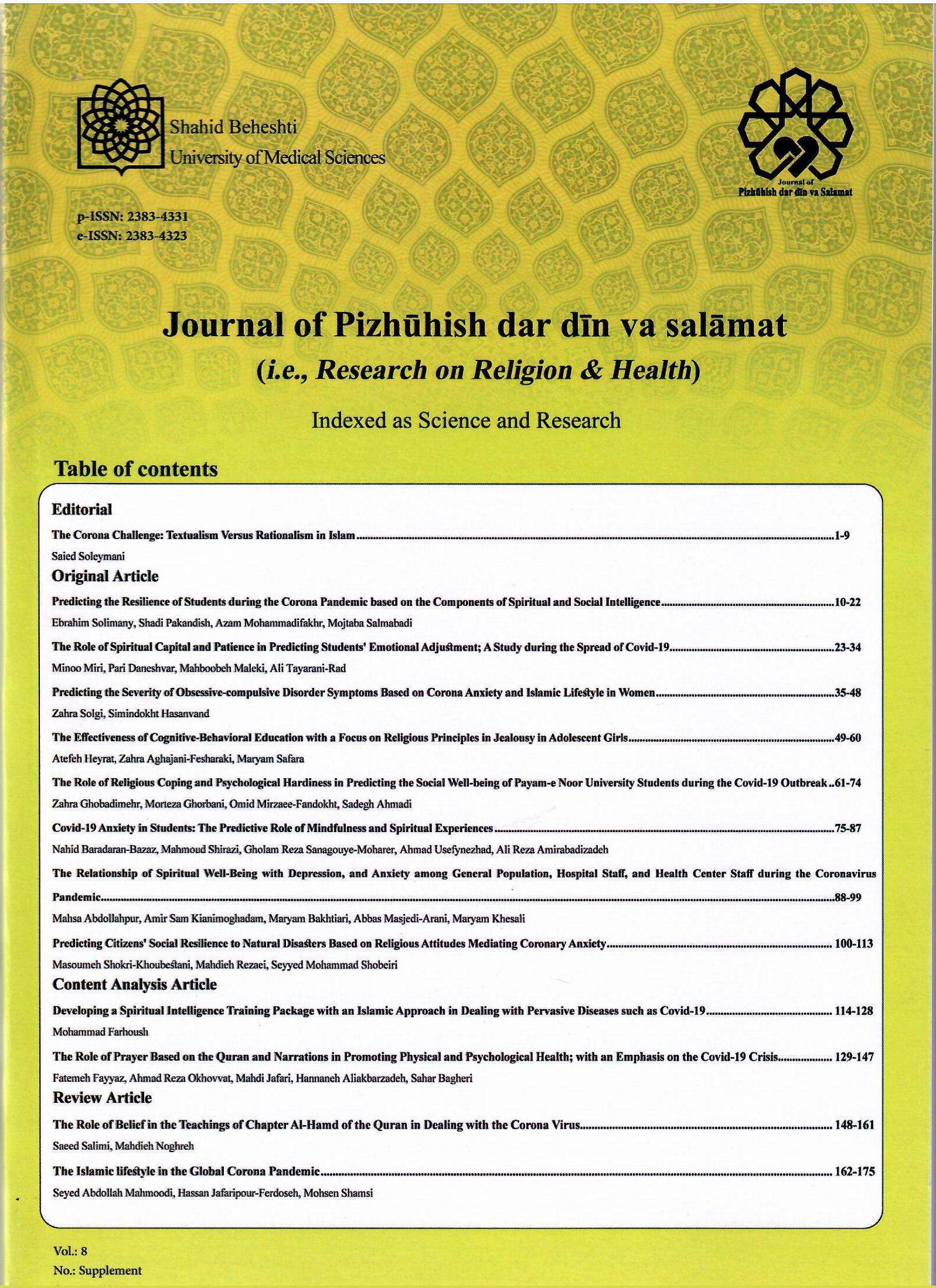
پیشبینی تابآوری دانشجویان در ایام کرونا بر اساس مؤلفههای هوش معنوی و اجتماعی پیشبینی تابآوری دانشجویان در ایام کرونا بر اساس مؤلفههای هوش معنوی و اجتماعی
پژوهش در دین و سلامت ,
دوره 8 شماره SI (2022),
23 سپتامبر 2022
,
صفحه 10-22
https://doi.org/10.22037/jrrh.v8iSI.34794
چکیده
سابقه و هدف: یکی از راههای مواجهه با بلایای مختلف مانند ویروس کرونا افزایش تابآوری است؛ ازاینرو هدف پژوهش حاضر پیشبینی تابآوری دانشجویان در ایام کرونا بر اساس مؤلفههای هوش معنوی و اجتماعی بود.
روش کار: پژوهش حاضر از نوع مطالعات همبستگی است. جامعۀ آماری پژوهش شامل تمامی دانشجویان پسر دانشگاه فرهنگیان پردیس شهید باهنر بیرجند در سال تحصیلی 1399-۱400 بود که از میان آنان 260 نفر بهروش نمونهگیری دردسترس انتخاب شدند و بهصورت اینترنتی در پژوهش شرکت کردند و به پرسشنامههای هوش معنوی کینگ، هوش اجتماعی سیلورا و همکاران و تابآوری کونور و دیویدسون پاسخ دادند. برای تحلیل دادهها از آزمون همبستگی پیرسون و رگرسیون چندگانه استفاده شد. در این پژوهش همۀ موارد اخلاقی رعایت شده است و مؤلفان مقاله تضاد منافعی گزارش نکردهاند.
یافتهها: نتایج نشان داد که رابطۀ مستقیم و معنیداری بین هوش معنوی (572/0=r) و هوش اجتماعی (633/0=r) با تابآوری وجود داشت (01/0>P). علاوهبراین، مؤلفههای هوش معنوی شامل تفکر وجودی-انتقادی (01/0P< و 209/0=β)، ارائۀ معنای شخصی (01/0P< و 260/0=β)، آگاهی متعالی (01/0P< و 319/0=β) و توسعۀ حالت هوشیاری (01/0P< و 108/0=β) و مؤلفههای هوش اجتماعی شامل پردازش اطلاعات اجتماعی (01/0P< و 353/0=β)، آگاهی اجتماعی (01/0P< و 259/0=β) و مهارتهای اجتماعی (01/0P< و 205/0=β) بهصورت مثبت تابآوری را پیشبینی کردند.
نتیجهگیری: با توجه به یافتههای پژوهش، ایجاد و گسترش برنامههایی در جهت تقویت هوش معنوی و اجتماعی بهمنظور افزایش سطح تابآوری دانشجویان توصیه میشود.
- تابآوری؛ دانشجویان؛ هوش اجتماعی؛ هوش معنوی
ارجاع به مقاله
مراجع
Zhou P, Yang X-L, Wang X-G, Hu B, Zhang L, Zhang W, et al. A pneumonia outbreak associated with a new coronavirus of probable bat origin. nature. 2020;579(7798):270-3.
Mohammadi M, Rajabnia M, Abdehagh M. Gastrointestinal manifestations of COVID-19: a review article in adults. Scientific Journal of Kurdistan University of Medical Sciences. 2020;25(4):42-55. (Full Text in Persian)
Paul A, Sikdar D, Hossain MM, Amin MR, Deeba F, Mahanta J, et al. Knowledge, attitudes, and practices toward the novel coronavirus among Bangladeshis: Implications for mitigation measures. PloS one. 2020;15(9):e0238492.
Terrizzi Jr JA, Shook NJ, McDaniel MA. The behavioral immune system and social conservatism: A meta-analysis. Evolution and Human Behavior. 2013; 34(2):99-108.
Gritsenko V, Skugarevsky O, Konstantinov V, Khamenka N, Marinova T, Reznik A, et al. COVID 19 fear, stress, anxiety, and substance use among Russian and Belarusian university students. International Journal of Mental Health and Addiction. 2021; 19(6):2362-8.
Polizzi C, Lynn SJ, Perry A. Stress and coping in the time of COVID-19: Pathways to resilience and recovery. Clinical Neuropsychiatry. 2020;17(2):59-62.
Lupe SE, Keefer L, Szigethy E. Gaining resilience and reducing stress in the age of COVID-19. Current opinion in gastroenterology. 2020;36(4):295-303.
Masten AS, Barnes AJ. Resilience in Children: Developmental Perspectives. Children. 2018;5(7):98.
Karami N, Nazari S, Karami AA. Improving Community Resilience using Bamboo Emergency Sheltering in the Face of Disasters. International Journal of Scientific Engineering and Technology. 2020;4(10):494-7. (Full Text in Persian)
Rajabiyan dehzireh M, Heydari S. The relationship between spiritual intelligence and emotional intelligence and resilience, life satisfaction and mental health of the spouses. Rooyesh. 2020; 9 (5) :105-16. (Full Text in Persian)
Ramachandaran SD, Krauss SE, Hamzah A, Idris
K. Effectiveness of the use of spiritual intelligence in women academic leadership practice. International Journal of Educational Management.2017;3(2):160-78.
Molaei B, Nadrmohammadi M, Molavi P, Azarkolah A, Sharei AS, Alizadehgoradel J. The role of spiritual intelligence and life satisfaction in the mental health. Iranian Journal of Nursing Research. 2021;15(6):47-55. (Full Text in Persian)
King D. Personal meaning production as a component of spiritual intelligence. International Journal of Existential Psychology and Psychotherapy. 2010;3(1):1-5.
Sim TN, Loh BS. Attachment to God: Measurement and dynamics. Journal of Social and Personal relationships. 2003;20(3):373-89.
Marashi SA, Mirzaei F, Mehrabian T. The Relationship of Spiritual Intelligence and Problem-solving Styles with Resiliency among University Students. Ravanshenasi Va Din. 2017;10(3):137-46. (Full Text in Persian)
Hamid N, Keikhosravani M, Babamiri M, Dehghani M. The relationship between mental health, spiritual intelligence with resiliency in student of Kermanshah University of Medical Sciences. Jentashapir Journal of Cellular and Molecular Biology. 2012;3(12):331-8. (Full Text in Persian)
Seddighi Arfaei F, Yazdkhasty A, Nadi Ravandi M. Resiliency Rate Predictability Based on Spiritual Intelligence among Students and Religion Researchers. Irainian Journal of Culture in the Islamic University. 2014;4(12):353-72. (Full Text in Persian)
Riggio R. What is social intelligence? Why does it matter. Psychology Today June. 2014;3:2014.
Buzan T. The power of spiritual intelligence: 10 ways to tap into your spiritual genius: HarperCollins UK; 2012.
Rahimi H, Eftekhar HS. A study of social intelligence in students at Kashan University of Medical Sciences during year 2015. Journal of Nursing Education. 2016;5(3):41-6. (Full Text in Persian)
Silvera D, Martinussen M, Dahl TI. The Tromsø Social Intelligence Scale, a self‐report measure of social intelligence. Scandinavian journal of psychology. 2001;42(4):313-9.
Rajabi S, Valadbeigi P. Predicting psychological well-being on the basis of spiritual, emotional and social intelligences in iranian's college students. Frooyesh. 2016;5(1):199-216. (Full Text in Persian)
Narimani M, Ghaffari M. The role of moral and social intelligence in predicting resiliency and quality of life in parents of children with learning disabilities. Journal of Learning Disabilities. 2016;5(2):106-28. (Full Text in Persian)
Ajourlou M, Aghabakhshi Ha. The relationship
between social intelligence and social health among women working in Karaj Welfare Organization in 2014. Social Research. 2017;9(35):124-46. (Full Text in Persian)
Krejcie RV, Morgan DW. Determining sample size for research activities. Educational and psychological measurement. 1970;30(3):607-10.
Rezaie A. The Tromsø Social Intelligence Scale: Factorial Structure and Reliability of the Persian Version of Scale in the Students Population. Journal of Modern Psychological Researches. 2011;5(20):65-82. (Full Text in Persian)
Raghib M, Ahmadi S, Siyadat A. An Analysis of the Level of Spiritual Intelligence of Isfahan University Students and Its Relationship with Demographic Characteristics. Journal of Educational Psychology Studies. 2009; 5(8):39-56. (Full Text in Persian)
Connor KM, Davidson JR. Development of a new resilience scale: The Connor‐Davidson resilience scale (CD‐RISC). Depression and anxiety. 2003;18(2):76-82.
Keyhani M, Taghvaei D, Rajabi A, Amirpour B. Internal consistency and confirmatory factor analysis of the Connor-Davidson Resilience Scale (CD-RISC) among nursing female. Iranian journal of medical education. 2015;14(10):857-65. (Full Text in Persian)
Carr A. Positive Psychology, The science of Happiness and human Strengths. Brunner–routledge. Tailor &francis group. Hove and New York; 2004.
Zohar D, Marshall I, Marshall I. SQ: Connecting with our spiritual intelligence: Bloomsbury Publishing USA; 2000.
Harriott SA. The Relationship Between Emotional & Social Intelligence and Conflict Management Behavior in Leadership. 2014
- چکیده مشاهده شده: 424 بار
- pdf دانلود شده: 250 بار