
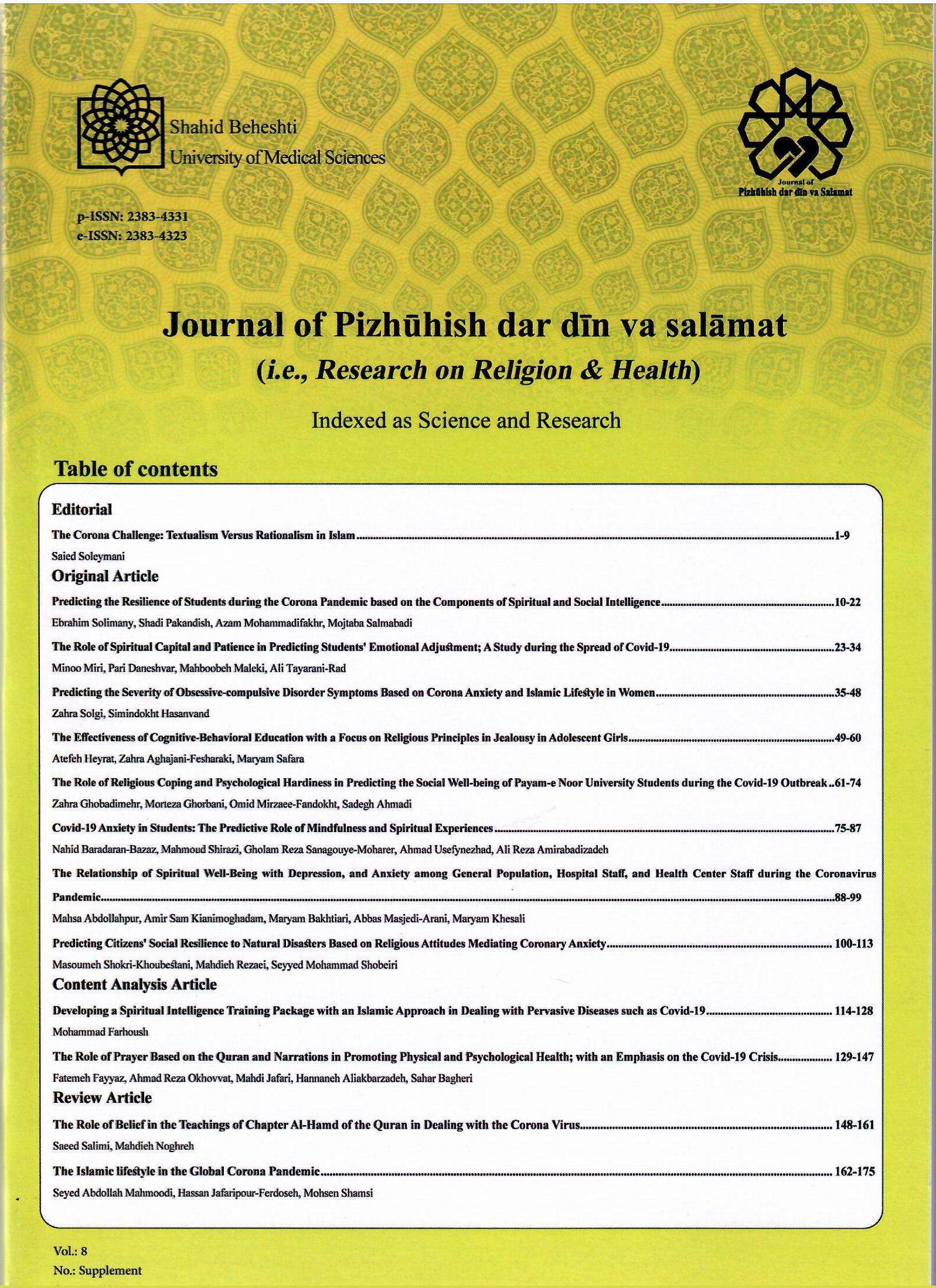
Predicting the Severity of Obsessive-compulsive Disorder Symptoms Based on Corona Anxiety and Islamic Lifestyle in Women
Journal of Pizhūhish dar dīn va Salāmat (i.e., Research on Religion & Health),
Vol. 8 No. SI (2022),
23 Mehr 2022
,
Page 35-48
https://doi.org/10.22037/jrrh.v8iSI.34372
Abstract
Background and Objective: Obsessive-compulsive disorder and its socio-health consequences are one of the most costly issues in today's society. Therefore, the present study was conducted to predict the symptoms of obsessive-compulsive disorder based on corona anxiety and Islamic lifestyle in women.
Methods: The method used in this study was descriptive correlational. Out of the women with obsessive-compulsive disorder referring to the psychiatric ward of Farabi Educational and Medical Center in Kermanshah in 2020, 200 couples were selected by available sampling method and completed Alipour et al.’s Corona Anxiety Scale, Hudgson and Rachman’s Obsessive-Compulsive Scale, and Kaviani’s Islamic Lifestyle Scale. Data analysis was performed using descriptive statistics, correlation matrix and hierarchical regression. In this study, all ethical considerations were observed and the authors reported no conflict of interests.
Results: The results showed that the severity of obsessive-compulsive disorder symptoms was inversely related to Islamic lifestyle (r=-0.61, P=0.004) and its dimensions (P<0.05). The psychological factor of corona anxiety (r=0.42, P=0.001) and the physical factor of corona anxiety (r=0.27, P=0.015) showed a positive and significant relationship with the severity of obsessive-compulsive symptoms at the level of 0.05. Regression analysis showed that corona anxiety predicts 20% of the variance in obsessive severity. The Islamic lifestyle, independent of the corona anxiety, was able to predict 6% of the variance in the severity of the obsession.
Conclusion: In general, the results showed that the Islamic lifestyle and control of coronary anxiety can be used to reduce severity of the symptoms in obsessive patients.
- Corona anxiety; Islamic; Lifestyle; Obsessive; Women
How to Cite
References
Fineberg NA, Hollander E, Pallanti S, Walitza S, Grünblatt E, Dell’Osso BM, et al. Clinical advances in obsessive-compulsive disorder: a position statement by the International College of Obsessive-Compulsive Spectrum Disorders. International clinical psychopharmacology. 2020;35(4):173-93.
First MB, Gaebel W, Maj M, Stein DJ, Kogan CS, Saunders JB, et al. An organization‐and category‐level comparison of diagnostic requirements for mental disorders in ICD‐11 and DSM‐5. World Psychiatry. 2021;20(1):34-51.
Amani M, Abolghasemi A, Ahadi B, Narimani M. The prevalence of obsessive-compulsive disorder among the women 20 to 40 years old of Ardabil city, Western part of Iran. Journal of Fundamentals of Mental Health. 2013;15(59):233-42. (Full Text in Persian)
Safaralizadeh F, Bagheriyeh F. The prevalence obsessive-compulsive disorder in students in Khoy University in 2013. IJPN. 2014;2(2):13-21. (Full Text in Persian)
Goodman WK, Storch EA, Sheth SA. Harmonizing the neurobiology and treatment of obsessive-compulsive disorder. American Journal of Psychiatry. 2021;178(1):17-29.
Kong X-Z, Boedhoe PS, Abe Y, Alonso P, Ameis SH, Arnold PD, et al. Mapping cortical and subcortical asymmetry in obsessive-compulsive disorder: findings from the ENIGMA Consortium. Biological psychiatry. 2020;87(12):1022-34.
Del Casale A, Sorice S, Padovano A, Simmaco M, Ferracuti S, Lamis DA, et al. Psychopharmacological treatment of obsessive-compulsive disorder (OCD). Current neuropharmacology. 2019;17(8):710-36.
Damirchi ES, Mojarrad A, Pireinaladin S, Grjibovski AM. The role of self-talk in predicting death anxiety, obsessive-compulsive disorder, and coping strategies in the face of coronavirus disease (COVID-19). Iranian journal of psychiatry. 2020;15(3):182-8. (Full Text in Persian)
Labrague LJ, De los Santos JAA. COVID‐19 anxiety among front‐line nurses: Predictive role of organisational support, personal resilience and social support. Journal of nursing management. 2020; 28(7): 1653-61.
Reddy YJ, Sudhir PM, Manjula M, Arumugham SS, Narayanaswamy JC. Clinical Practice Guidelines for Cognitive-Behavioral Therapies in Anxiety Disorders and Obsessive-Compulsive and Related Disorders. Indian journal of psychiatry. 2020;62 (Suppl 2):S230.
Waqas M, Hania A, Hongbo L. Psychological predictors of anxious responses to the COVID-19 pandemic: Evidence from Pakistan. Psychiatry Investigation. 2020;17(11):1096-104.
Dubey S, Biswas P, Ghosh R, Chatterjee S, Dubey M, Chatterjee S. Psychosocial impact of COVID-19. Diabetes MetabSyndr. 2020; 14 (5): 779-788.
Sotoudeh HG, Alavi SS, Akbari Z, Jannatifard F, Artounian V. The effect of brief crisis intervention package on improving quality of life and mental health in patients with COVID-19. Iranian journal of psychiatry. 2020;15(3):194-205. (Full Text in Persian)
Firth J, Solmi M, Wootton RE, Vancampfort D, Schuch FB, Hoare E, et al. A meta‐review of “lifestyle psychiatry”: the role of exercise, smoking, diet and sleep in the prevention and treatment of mental disorders. World Psychiatry. 2020;19(3):360-80.
Wang S, Li B, Wu Y, Ungvari GS, Ng CH, Fu Y, et al. Relationship of sleep duration with sociodemographic characteristics, lifestyle, mental health, and chronic diseases in a large Chinese adult population. Journal of Clinical Sleep Medicine. 2017;13(3):377-84.
Besharat MA, Hosseini SA, Jahed HA, Bahrami Ehsan H, Dortaj F. Introduce a new intervention model based on Islamic lifestyle for decreasing the risk of cardiovascular disease in people at risk: A comparative study. Journal of religion and health. 2021;60(2):736-51. (Full Text in Persian)
Asadzandi M. An Islamic religious spiritual health training model for patients. Journal of religion and health. 2020;59(1):173-87. (Full Text in Persian)
Pakzad M, Dolatian M, Jahangiri Y, Nasiri M, Dargah FA. The correlation between Islamic lifestyle and pregnancy-specific stress: a cross-sectional, correlational study. Open access Macedonian journal of medical sciences. 2018;6(6):1163-7. (Full Text in Persian)
Karimkhani S, Alizadeh Asli A, Namazi S, Yari M, Behrouz B. Relationship of sleep quality and sleep hygiene with islamic lifestyle and self-reported religious orientation in high school students. J Res Relig Health 2018;4(3):7-20. (Full Text in Persian)
RostamiNasab-DolatAbad Z, Ehsanpour F, Mohammadkhani M, Shariatmadar-Tehrani A, Bagheri-Mahyari N. The Moderating Role of Islamic Lifestyle in the Relationship between Cognitive Emotion Regulation and Mobile Dependency in Kermanshah’s Adolescent Girls in. Journal of Pizhūhish dar dīn va salāmat. 2019;5(3):84-95. (Full Text in Persian)
The Holy Quran. Translated by: Hossein Ansarian. Tehran: International Publishing Company.
Tabachnick BG, Fidell LS. Using multivariate statistics Boston. MA: Allyn and Bacon. 2007;5:2007.
Hodgson RJ, Rachman S. Obsessional-compulsive complaints. Behaviour research and therapy. 1977;15(5):389-95.
Basharpoor S, Herangza M. The Effect of Childhood Psychological Maltreatment on Obsessive-compulsive Symptoms in Nonclinical Population: the mediating roles of the responsibility and cognitive fusion. Journal of Clinical Psychology. 2020;12(1):77-88. (Full Text in Persian)
Kaviani M. Quantification and measurement of Islamic life style. Ravanshenasi va Din. 2011;4(2):27-44. (Full Text in Persian)
Alipour A, Ghadami A, Alipour Z, Abdollahzadeh H. Preliminary validation of the Corona Disease Anxiety Scale (CDAS) in the Iranian sample. Quarterly Journal of Health Psychology. 2020;8(4):163-7. (Full Text in Persian)
Sadeqi S, Sharifirahnmo S, Fathi A, Mohamadi S. Predicting Covid-19 anxiety and its social stigma experience based on the dimensions of internet addiction after the first age of epidemic in students. Health Research Journal. 2020;5(4):268-78. (Full Text in Persian)
Li K, Zhang H, Wang B, Yang Y, Zhang M, Li W, et al. Hippocampal functional network: The mediating role between obsession and anxiety in adult patients with obsessive-compulsive disorder. The World Journal of Biological Psychiatry. 2020;21(9):685-95.
Coban DA. Investigation of impulsivity, anxiety and depressive symptoms as predictors of suicide in obsessive-compulsive disorder/Obsesif kompulsif bozuklukta ozkiyim ongordurucusu olarak durtusellik, anksiyete ve depresif belirtilerin incelenmesi. Anadolu Psikiyatri Dergisi. 2020:180-7.
Zoghi l, Ajilchi B, Yosefirad E, Dehghan monazam Aa. The Relationship between Illness Perception, Obsessive Beliefs and General Health in patients referring to Corona virus (COVID-19) Diagnosis. Educational Psychology. 2020;16(55):215-28. (Full Text in Persian)
Ranjbari T, Hafezi E, Mohamadi A, Ranjbar Shirazi F, Ghafari F. Comparison of the anxiety, worry and intolerance of uncertainty among individuals with obsessive-compulsive and substance use disorders. Journal of Research in Psychological Health. 2018;12(1):75-88. (Full Text in Persian)
Akouchekian S, Salehi F, Najafi M, Almasi A. Prevalence of Urinary Complaints in Patients with Obsessive-Compulsive Disorder and its Relationship with Obsession, Anxiety, and Depression. Journal of Research in Behavioural Sciences. 2016;14(1):7-13. (Full Text in Persian)
Mohammadpour S, Jooshanlou M. The Relationship between Generalized Anxiety Disorder and Obsessive-Compulsive Personality Disorder with Psychological Well-Being in Students of Lorestan University of Medical Sciences in 2014: The Mediating Role of Passionate Obsessive Love. Journal of Rafsanjan University of Medical Sciences. 2015;14(5):353-66. (Full Text in Persian)
Marcks BA, Weisberg RB, Edelen MO, Keller MB. The relationship between sleep disturbance and the course of anxiety disorders in primary care patients. Psychiatry research. 2010;178(3):487-92.
Nasrollahi Z, Biderafsh A. Relationship of Islamic Lifestyle with Depression and Anxiety among the Students of Qom University of Medical Sciences in 2018. Health, Spirituality and Medical Ethics. 2020; 7(3):51-5. (Full Text in Persian)
Pakzad M, Dolatian M, Jahangiri Y, Nasiri M, Zeydi AE. Relationship between islamic lifestyle and mental health in pregnant women: A cross-sectional study. Bangladesh Journal of Medical Science. 2020;19(3):394-400. (Full Text in Persian)
Gordon EW, Song LD. Variations in the experience of resilience. Educational resilience in inner-city America: Challenges and prospects. 1994:27-43.
Haddadi Kuhsar AA, Ghobari Bonab B. Predicting Obsessive-compulsive behavior and Phobic Anxiety among Students of Medical Sciences: The role of the Concept of God. J Res Relig Health. 2018;4(4):59-68. (Full Text in Persian)
Ekhtiary Sadegh M, Imani Naeini M, MirzaMohammadi MH. The Prediction of Loneliness among the Kermanshahi Elderly Based on Self-Compassion, Spirituality, and Islamic Lifestyle. J Res Relig Health. 2018;4(2):69-80. (Full Text in Persian)
Ahmadi MR, Hossayni Motlagh M, Haratian A. Abiding by the Islamic Style of Life Depression and Anxiety. Journal of Lifestyle. 2015;1(1):31-45. (Full Text in Persian)
- Abstract Viewed: 463 times
- pdf (فارسی) Downloaded: 250 times