
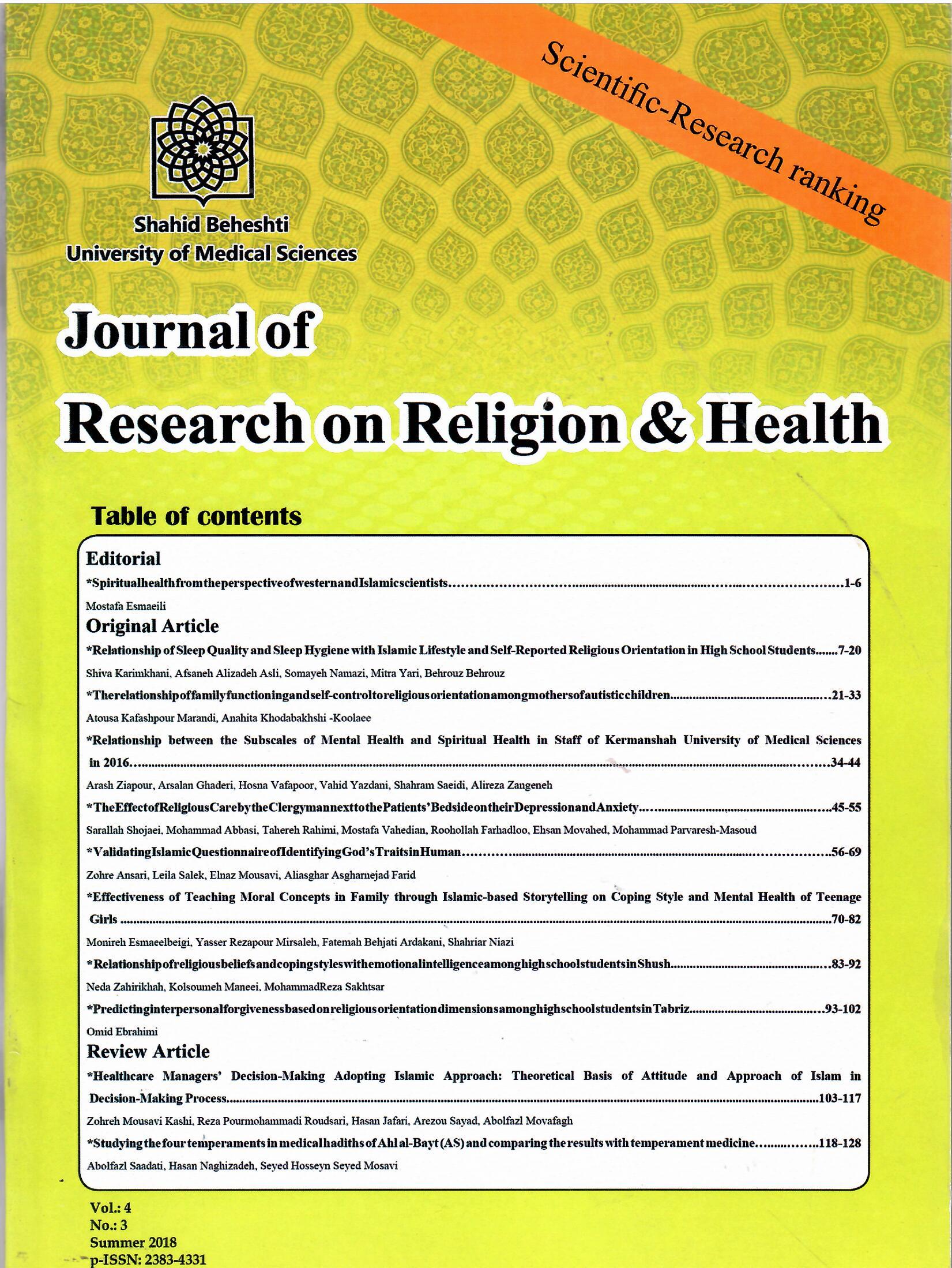
Relationship of religious beliefs and coping styles with emotional intelligence among high school students in Shush
Journal of Pizhūhish dar dīn va Salāmat (i.e., Research on Religion & Health),
Vol. 4 No. 3 (2018),
9 June 2018
,
Page 83-92
https://doi.org/10.22037/jrrh.v4i3.16105
Abstract
Background and Objective: Excitement forms a great part of life and religious beliefs are regarded as psychological motivation rooted in human nature, and coping styles as a series of cognitive and behavioral processes to prevent, manage or reduce stress. Hence, the aim of this study was to examine the relationship of religious beliefs and coping styles with emotional intelligence among high school students in the city of Shush.
Method: The research method in this study was descriptive and correlational. The population of the study included all high school students, both male and female (2012 in total, 1254 girls and 758 boys). 200 students were selected and required to complete three questionnaires, namely Emotional Intelligence by Bar-On, Religious Attitude by Golriz and Baraheni (1975) and Strategies developed by Lazarus. To analyze the data, descriptive statistical methods and Pearson correlation coefficient were used. It should be noted that all ethical issues were observed in this research and the researchers declared no conflict of interests.
Results: Based on the results of the present study, there is a significant relationship (p>0/05; r=0/389) between religious beliefs and emotional intelligence of high school students in the city of Shush and also between coping style and emotional intelligence (p>0/05; r=0/821).
Conclusion: Given the results of this study, teachers are recommended to hold workshops for students at school in order to familiarize them with the religion and Islam so that students become more familiar with religion.
Please cite this article as: Zahirikhah N, Maneei K, Sakhtsar MR. Relationship of religious beliefs and coping styles with emotional intelligence among high school students in Shush. J Res Relig Health. 2018; 4(3): 83- 92.DOI: https://doi.org/10.22037/jrrh.v4i3.16105
- Coping styles; Emotional intelligence; Religious beliefs; Shush; Students
How to Cite
References
Zahirikhah N. Assessing the relationship between the Quality of attachment, Religious beliefs, coping styles with Emotional intelligence in high school students' Susa. The thesis of Educational Psychology Master's Azad University of Ahvaz. 2016;5. (Full Text in Persian)
Hein S. Emotional intelligence for all. Tehran: Creative visualization; 2004.
Fatemi M. Emotional intelligence. Tehran: Sargl; 2006. (Full Text in Persian)
Ciarrochi J. Emotional intelligence in everyday life. second ed. Isfahan2005.
Sobhaninejad M, Usebashi AR. Emotional Intelligence and Management Organization (theoretical foundations, teaching methods and assessment tools). Tehran: Yasteroun; 2009. (Full Text in Persian)
Allport GW. The Religious Context of Prejudice.
Journal for the Scientific Study of Religion. 1966; 5: 447-57.
Durkheim E. Elementary Forms of Religious Life. Tehran: Tehran center; 2003.
Kleene. Usul al-Kafi. Tehran: Islamia School; 2009. (Full Text in Persian)
Folkman S. Folkman, S. (2013). Stress: appraisal and coping. New York: Springer; 2013. p. 1913-5.
Penley JA, Tomaka J. Associations among the Big Five, emotional responses, and coping with acute stress. Personality and individual differences. 2002;32:1215-28.
Dafeeei M. The Relationship between coping behaviors and personal characteristics and psychological health of infertile couples Yazd [Faculty of Medicine]: Tarbiat Modarres University; 1994. (Full Text in Persian)
Spangler G, Grossmann KE. Biobehavioral organization in securely and insecurely attached infants. Child development. 1993;64:1439-50.
Karimi M. The relationship between religious beliefs and emotional intelligence and academic performance of students in Eghlid: Marvdasht Islamic Azad University; 2015. (Full Text in Persian)
Abbasi RA, Roshan R. Examine the relationship between religious beliefs and emotional intelligence among high school students. Bimonthly Journal of the conduct scientific research / clinical psychology and personality. 2011(43):31-8. (Full Text in Persian)
Mohammadi D, Torabi S, Gharaei B. The relationship between coping styles and emotional intelligence among secondary school students in Tehran. Iranian Journal of Psychiatry and Clinical Psychology. 2009(2). (Full Text in Persian)
Bastian VA, Burns NR, Nettelbeck T. Emotional intelligence predicts life skills, but not as well as personality and cognitive abilities. Personality and individual differences. 2005; 39:1135-45.
Mayer JD, Perkins DM, Caruso DR, Salovey P. Emotional intelligence and giftedness. Roeper review. 2001;23:131-7.
Bar-on R. The Bar- on model of emotional- social intelligence (ESI). 1997(18):13-25.
Samoueei R. Over time seriously. Tehran: culture, science researchers; 2005. (Full Text in Persian)
Golriz G, Baraheni M. Research for preparation of religious attitude and the relationship between religious attitudes and personality characteristics with other feedback [psychology]: Tehran University Press; 1975. (Full Text in Persian)
Grancher D. The impact of religion on mans blood pressure. Journal of Religion & Health. 2000;28:285-78.
Salovey P, Bedell BT, Detweiler JB, Mayer JD. The psychology of what works. Coping intelligently. New York: Oxford University press; 1999 p. 141-164.
- Abstract Viewed: 541 times
- PDF (فارسی) Downloaded: 420 times