
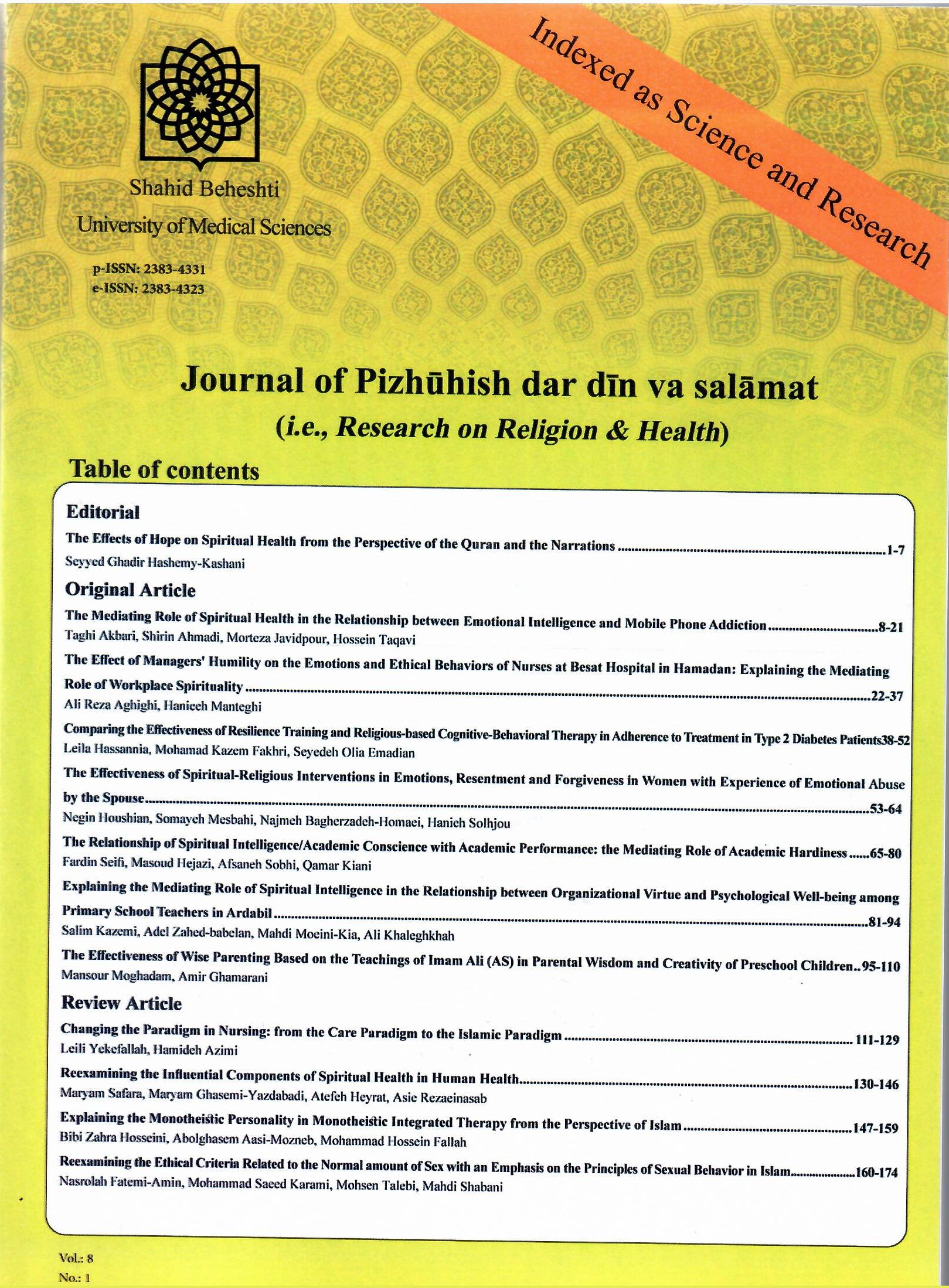
علاقة الذکاء الروحي و الرغبة الدراسیة بالتقدم الدراسي بالمثابرة و الإجتهاد الدراسي لدی التلمیذ
مجلة البحث في الدين و الصحّة,
مجلد 8 عدد 1 (2022),
19 آذار 2022
,
الصفحة 65-80
https://doi.org/10.22037/jrrh.v8i1.33341
الملخص
خلفية البحث وأهدافه: التفوّق الدراسي عبارة عن نتائج ومآلات سلوکیة تحظی باهتمام کبیر لدی التلمیذ ویعتبر مؤشراً مهماً في تقییم المنظومات والمناهج الدراسیة. وانطلاقا من هذه القناعة تصبح معرفة العوامل والأسباب المؤثرة في التفوق الدراسي مهمة ولا مناص من الإلمام بمختلف جوانبها. وبناء علی هذه الرؤیة والقناعة یسعی هذا البحث لإلقاء الضوء علی معرفة علاقة الذکاء الروحي بالمجهود الفردي ومعرفة همزة الوصل بینهما ومعرفة دور المثابرة في الدراسة لتلامیذ الصف التاسع لمدینة زنجان وتأثیر مجهود الطالب في التفوق الدراسي.
منهجية البحث: هذه الدراسة الوصفیة هي نوع من التضامن بین الطلاب. وقد أجریت هذه الدراسة علی مدارس البنین في مدینة زنجان في العام الدراسي 1398-1397 الشمسیة. وقد تم تقسیم النماذج علی أساس جدول مورغان إلی 317 تلمیذاً وأجریت الدراسة علی المشارکین بشکل مراحل مختلفة. أما جمع المعطیات فکان بواسطة منهجیة استبیان مک ایلوری و بانتیك. أما معیار المثابرة الدراسیة فقد کانت حسب منهجیة بنیشك للذکاء الروحي. ولدراسة أداء التلامیذ فقد اعتمدت الدراسة علی معدل درجات التلامیذ وتطبیق منهجیة بیرسون للتضامن و رکرسیون. أما دراسة دور الوسیط فقد اعتمدت علی منهجیة بارون و کُني.
المعطیات: أثبتت النتائج أنّ هناك صلة وثیقة بین المثابرة الدراسیة والتفوق الدراسي (05/0P<). کما أنّ هناك علاقة إیجابیة بین التفوق الدراسي لدی التلامیذ و المثابرة الدراسیة (05/0P<) أما العلاقة بین الذکاء الروحي والتفوق الدراسي فقد کانت بارزة جداً (05/0P<). إضافة إلی ذلك وبالنظر إلی مراحل تعیین دور الوسیط عند بارون و کني کانت المثابرة الدراسیة وسیطاً بین المثابرة والتفوق الدراسي. لکن لم تثبت النتائج أنّ هذا الأمر له تاثیر علی الذکاء الروحي. بشکل عام أثبتت النتائج حسب منهجیة رکرسیون أنّ الضمیر الدراسي والذکاء الروحي استطاعا أن یحققا 15 بالمئة من مجموع التفوق الدراسي.
الاستنتاج: الذکاء الروحي أحد أهم الأسباب المؤثرة في التفوق الدراسي. وبتأثیرها علی المثابرة الدراسیة یمکن أن تحقق نتائج مبهرة في التفوق الدراسي.
- التفوق الدراسيغ الذکاء الروحي؛ الضمیر الدراسي؛ المثابرة الدراسیة
كيفية الاقتباس
المراجع
American Psychiatric Association A. Diagnostic and statistical manual of mental disorders: American Psychiatric Association Washington, DC; 1980.
Yang H-J. Factors affecting student burnout and academic achievement in multiple enrollment programs in Taiwan’s technical–vocational colleges. International journal of educational development. 2004;24(3):283-301.
Duckworth AL, Taxer JL, Eskreis-Winkler L, Galla BM, Gross JJ. Self-control and academic achievement. Annual review of psychology. 2019;70:373-99.
Seif A. Modern parenting Psychology, learning and teaching psychology. 7 ed2018. (Full Text in Persian)
Yarahmadi1 Y, Ebrahimibakht H, Asadzadeh H, Ahmadian H. The Effectiveness of Academic Buoyancy Training Program on Students’ Academic Performance, Academic Engagement, and Academic Buoyancy. Research in Teaching. 2018;6(2):163-82.
Sabori Khosro shahi H. Education In Globalization Period:Challenges And Needed Strategies To Face on. Strategic Studies of public policy. 2010;1(1):153-96.
Rostami B, Moein Z, Fakour E, Amini K, Rostami H. Academic Motivation and Relevant Predictive Factors in Pharmaceutical Students of Zanjan University of Medical Sciences, Zanjan, Iran in 2016. Journal of Medical Education Development. 2018; 10(28):27-38.
Noroozi S, Hakimzadeh R, Davarniya R, Mahmudi MJ, Baratian A. Effect of Cognitive Behavioral Group Intervention in Enhancing Academic Conscience of Students. Journal of Prevention and Health. 2016;2(4):10-9. (Full Text in Persian)
Salehi R, Abedi M-R, Baghban I, Nilforoshan P, Abedi A. Developing a Theoretical Model of
Academic Counseling Based on the Effective Factors on Academic Success. Biannual Journal of Applied Counseling. 2014;4(1):18-48.
Karimkhani A, Neshat N. The relationship between the big five personality information-seeking behavior of graduate students. 2016.
Haren EG, Mitchell CW. Relationships between the Five-Factor Personality Model and coping styles. Psychology and Education: An Interdisciplinary Journal. 2003;40:38-49.
Costa P, McCrae R. Revised NEO Personality (NEOPI-R) and NEO Five Factor Inventory (NEO-FFI) Professional Manual Odessa, fll: Psychological Assessment Resources. Hoboken. NJ: John Wiley & Sons; 1992.
Kabini Moghadam S, Entesar Foumani G, Hejazi M, Asadzadeh H. Comparison of the Effectiveness of Instruction of Self-Regulated Learning and Help-Seeking Strategies Training on Increasing Educational Buoyancy and Conscience of Procrastinating Students. Research in School and Virtual Learning. 2020; 7(3): 77-88.
Fazli A, Fouladchang M. The relation of academic conscience to academic burnout: The mediating role of aca-demic goal orientation. 2018.
Farahanghpour F, Khadivi A, Adib Y. Relationship of Spiritual Intelligence and Self- esteem with Students’ Educational Improvement. Women and Family Studies. 2010;3(9):99-122.
Rahmani Daryasary M, Yavarinia S, Sepehrianazar F. The Relationship between spiritual intelligence, hope and responsibility with academic achievement of high school female students. Educational Psychology. 2020;16(56):181-96.
Emmons RA. Is spirituality an intelligence? Motivation, cognition, and the psychology of ultimate concern. The International Journal for the psychology of Religion. 2000;10(1):3-26.
Zohar D, Marshall I, Marshall I. SQ: Connecting with our spiritual intelligence: Bloomsbury Publishing USA; 2000.
Maseleno A, Hardaker G, Sabani N, Suhaili N. Data on multicultural education and diagnostic information profiling: Culture, learning styles and creativity. Data in brief. 2016;9:1048.
Lyashenko MS, Frolova NH. LMS projects: A platform for intergenerational e-learning collaboration. Education and information technologies. 2014;19(3): 495-513.
King DB. Rethinking claims of spiritual intelligence: A definition, model, and measure: ProQuest; 2008.
Khadivi A, Adib Y, Farhanghpour F. Relationship between spiritual intelligence and self-esteem with studentseducational improvement. European Journal of Experimental Biology. 2012;2(6):2408-14.
Moradi K, Asadzadeh H, Karami A, Najafi M. Modeling the academic achievements based on academic emotions and academic engagement with the mediating role of positive development youth. Educational Psychology. 2019;15(51):147-73.
Jafari S, Mollaei Z. Mediating role of self-regulated learning strategies for spiritual intelligence and academic achievement. 2019.
Ahmadi A, Zainalipour H, Rahmani M. Studying the role of academic hardiness in academic achievement of students of Islamic Azad University, Bandar Abbas Branch. Journal of Life Science and Biomedicine. 2013;3(6):418-23.
Wardani R. Academic Hardiness, Skills, and Psychological Well-being On New Student. Journal Psikologi. 2020;19(2):13.
Kobasa SC, Maddi SR, Zola MA. Type A and hardiness. Journal of behavioral medicine. 1983;6(1): 41-51.
Bean J, Eaton SB. The psychology underlying successful retention practices. Journal of College Student Retention: Research, Theory & Practice. 2001; 3(1):73-89.
Elhampour F, Ganji H, Abolmaali Alhosani K. Comparing academic achievement, academic engagement, hardiness and perceived classroom environment among female and male students. Journal of School Psychology. 2019;8(3):7-25.
Gogheri T, Samavi SA, Najarpourian S. Structural relationship model of type D personality and depression with the mediating role of cognitive distortions and family functioning in irritable bowel syndrome patients and healthy people: A multi-group analysis. Current Psychology. 2021:1-10. (Full Text in Persian)
Subramanian S, Vinothkumar M. Hardiness personality, self-esteem and occupational stress among IT professionals. Journal of the Indian Academy of Applied Psychology. 2009;35:48-56.
Darvishzadeh K, Bozorgi ZD. The relationship between resilience, psychological hardiness, spiritual intelligence, and development of the moral judgement of the female students. Asian Social Science. 2016;12(3):170-6.
Abdollahi A, Noltemeyer A. Academic hardiness: Mediator between sense of belonging to school and academic achievement? The journal of educational research. 2018;111(3):345-51.
McIlroy D, Bunting B. Personality, behavior, and academic achievement: Principles for educators to inculcate and students to model. Contemporary Educational Psychology. 2002;27(2):326-37.
Benishek LA, Feldman JM, Shipon RW, Mecham SD, Lopez FG. Development and evaluation of the revised academic hardiness scale. Journal of Career Assessment. 2005;13(1):59-76.
Vianello M, Robusto E, Anselmi P. Implicit conscientiousness predicts academic performance. Personality and Individual Differences. 2010;48(4): 452-7.
Komar S, Brown DJ, Komar JA, Robie C. Faking and the validity of conscientiousness: A Monte Carlo investigation. Journal of Applied Psychology. 2008; 93(1):140.
Shiner RL, Masten AS. Transitional links between personality and adaptation from childhood though adulthood. Journal of Research in Personality. 2002; 36:580-8.
Wolfe RN, Johnson SD. Personality as a predictor of college performance. Educational and psychological measurement. 1995;55(2):177-85.
Eilam B, Zeidner M, Aharon I. Student conscientiousness, self‐regulated learning, and science achievement: an explorative field study. Psychology in the Schools. 2009;46(5):420-32.
Peng C. Self-regulated learning behavior of college students of science and their academic achievement. Physics procedia. 2012;33:1446-50.
Poropat AE. A meta-analysis of the five-factor model of personality and academic performance. Psychological bulletin. 2009;135(2):322.
Safarkhanlou J, Nezhad Ismail Azizi MB. Reviewing the connection between personality feature with the career and satisfaction of the staff of security organizations. Police Protectoral and Security Studies quarterly. 2019;14(52):29-58.
Narimani M, Amini ZM, Barahmand U, Abolghasemi A. A Study of the Relationship Between Psychological Hardiness, Thinking Styles, Social Skills and Academic Achievement in School Children. Modern psychological research. 2007;2(5):93-107.
Abdolmaleki J, Afrashte MU, Mohammadi ZRN, Abdolmaleki S, Siyami L. Designing and Evaluating the Casual Model of Academic Achievement: The Analysis of the Relationship Between the Parent's Perception and Achievement Motivation with Academic Achievement. Journal of Family and Research. 2008;2(4):47-72. (Full Text in Persian)
Mirzakhni P, Delavar A, Makvandi B. The Relationship between Personality and Spiritual Intelligence among Members of Young Researchers and Elite Club, Islamic Azad University. Journal of Innovation and Creativity in Human Science; 2014; 4(1):129-58. (Full Text in Persian)
- الملخص المشاهدات: 686 الأوقات
- PDF (فارسی) التنزيلات: 527 الأوقات