
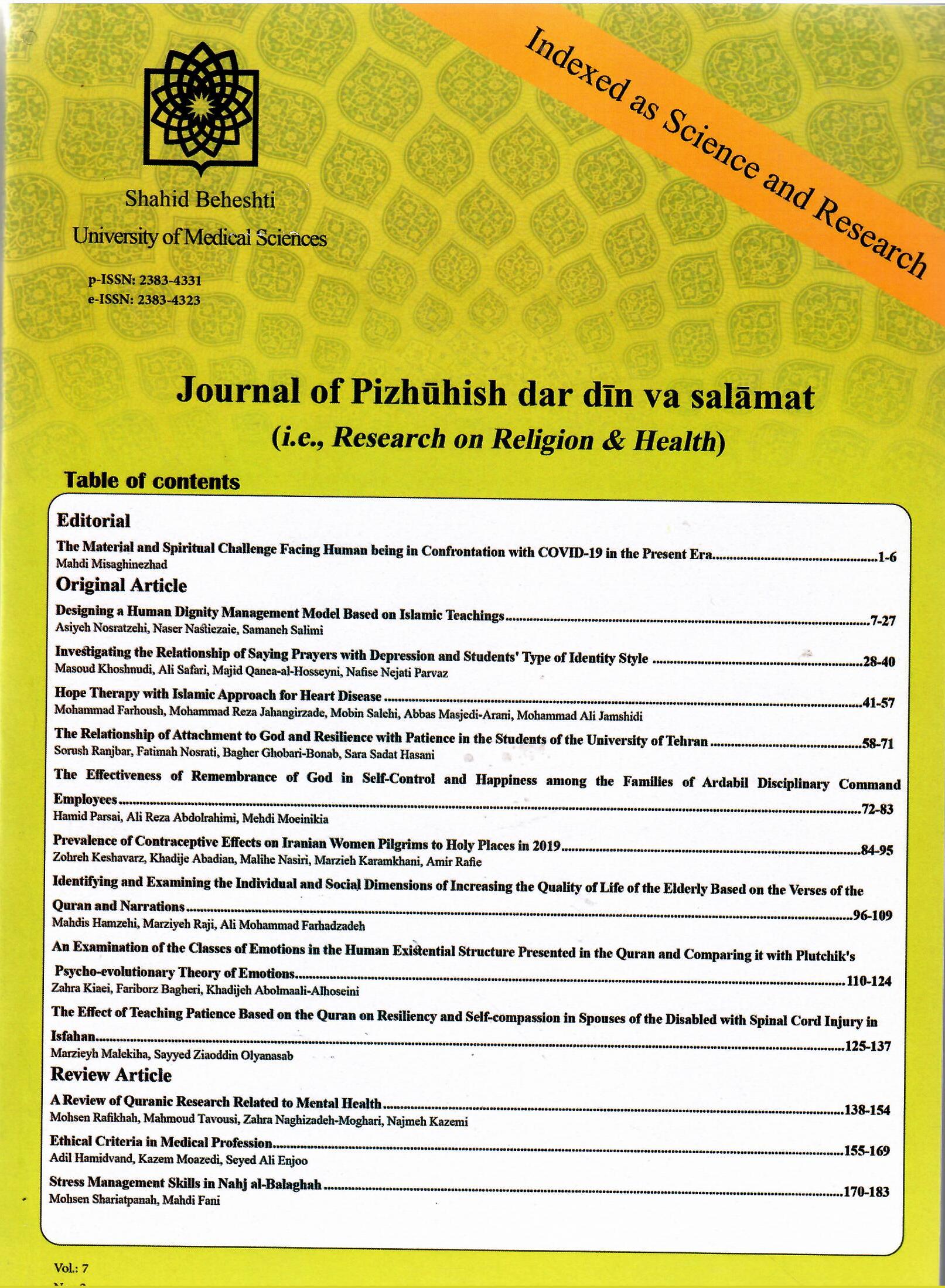
The Effectiveness of Remembrance of God in Self-Control and Happiness among the Families of Ardabil Disciplinary Command Employees یاد خدا
Journal of Pizhūhish dar dīn va Salāmat (i.e., Research on Religion & Health),
Vol. 7 No. 2 (2021),
21 June 2021
,
Page 72-83
https://doi.org/10.22037/jrrh.v7i2.31896
Abstract
Background and Objective: Spirituality is one of the dimensions of human that shows his connection and integration with the universe. Due to the importance of spirituality and its effect on self-regulatory and self-controlling behaviors, the aim of this study was to investigate the effect of remembrance of God on self-control and happiness among the families of Ardabil Disciplinary Command employees.
Methods: This research is a quasi-experimental research with pre-test and post-test control group design. The statistical population of this study consisted of all families of Ardabil police personnel who participated in the ideological courses of this organization in 2019. Thirty people were selected by available sampling method out of the sample population and randomly assigned to the experimental and control groups (N=15). The process of spiritual therapy lasted for 12 sessions, each session lasting 45 minutes, and the control group did not receive any intervention. Data collection tools included self-control and happiness questionnaires. In this study, all ethical considerations were observed and no conflict of interest was reported by the authors.
Results: The results of analysis of covariance showed that spirituality therapy was effective in improving the overall scores related to self-control and happiness in police officers' families.
Conclusion: Based on the obtained findings, spirituality therapy can be used as an effective method in improving self-control and happiness of officers' families in Ardabil.
Please cite this article as: Parsayi H, Abdolrahimi AR, Moeinikia M. The Effectiveness of Remembrance of God in Self-Control and Happiness among the Families of Ardabil Disciplinary Command Employees. Journal of Pizhūhish dar dīn va salāmat. 2021;7(2):72-83. https://doi.org/10.22037/jrrh.v7i2.31896
- Ardabil, Happiness, Police officers, Remembering God, Self-control
How to Cite
References
Diamond A. Executive functions. Annual review of psychology. 2013;64:135-168.
Timpano KR, Schmidt NB. The relationship between self-control deficits and hoarding: A multimethod investigation across three samples. Journal of abnormal psychology. 2013;122(1):13.
Becker A, Mandell AR, Tangney JP, Chrosniak LD, Shaw TH. The effects of self-control on cognitive resource allocation during sustained attention: a transcranial Doppler investigation. Experimental brain research. 2015;233(7):2215-23.
Tangney JP, Baumeister RF, Boone AL. High self‐control predicts good adjustment, less pathology, better grades, and interpersonal success. Self-regulation and self-control. Journal of personality. 2004;72(2):271-324.
Wikström P-OH, Treiber K. The role of self-control in crime causation: Beyond Gottfredson and Hirschi's general theory of crime. European Journal of criminology. 2007;4(2):237-64.
Schmeichel BJ, Baumeister RF. Self-regulatory strength. Handbook of self-regulation: Research, theory, and applications. 2004:84-98.
Rafiei Honar H, Jan Bozorgi M, Pasandideh A, Rasoulzadeh Tabatabai SK. Explaining the structure of self-control based on Islamic thought. Ravanshenasi va Din. 2014;7(3):5-26. http://ravanshenasi.nashriyat.ir/ node/84. (Full Text in Persian)
McCullough ME, Willoughby BL. Religion, self-regulation, and self-control: Associations, explanations, and implications. Psychological bulletin. 2009;135(1):69.
BaBamiri M, Vatankhah M, Masumi Jahandizi H, Nemati M, Darvishi M. The Relationship between Coping Styles, Negative Automatic Thoughts, and Hope with Happiness in Addicts of Ahvaz Drug Abuse Rehabilitation Clinics in 2011. J Adv Med Biomed Res. 2013;21(84):82-91. URL: http://zums.ac.ir/journal/article-1-2075-fa.html
Choi J, Choi I. Happiness is medal-color blind: Happy people value silver and bronze medals more than unhappy people. Journal of Experimental Social Psychology. 2017;68:78-82.
Argyle M, Hills P. The Oxford Happiness Questionnaire: a compact scale for the measurement of psychological well-being. Personality and individual differences. 2002;33(7):1073-82.
Connors S, Khamitov M, Moroz S, Campbell L, Henderson C. Time, money, and happiness: Does putting a price on time affect our ability to smell the roses? Journal of Experimental Social Psychology. 2016;67:60-4.
Das S, Punnoose VP, Doval N, Nair VY. Spirituality, religiousness and coping in patients with schizophrenia: A cross sectional study in a tertiary care hospital. Psychiatry research. 2018;265:238-43.
Mohr S. Integration of spirituality and religion in the care of patients with severe mental disorders. Religions. 2011;2(4):549-65.
Boalhari J, Naziri Q, Zamanian S. Effectiveness of spiritual group therapy in reducing depression, Anxiety, and stress of women with breast cancer. Sociology of Women. (Journal of Women and Society) 2011;3(1):85-116. (Full Text in Persian)
Rickhi B, Moritz S, Reesal R, Xu TJ, Paccagnan P, Urbanska B, et al. A spirituality teaching program for depression: a randomized controlled trial. The International Journal of Psychiatry in Medicine. 2011;42(3):315-29.
Etemadi O. Faith and spirituality in counseling and psychotherapy. Psychotherapy News. 2007;35(1):131-46.https://www.noormags.ir/view/en/articlepage/6878/135/image. (Full Text in Persian)
Koenig HG. Research on religion, spirituality, and mental health: A review. The Canadian Journal of Psychiatry. 2009;54(5):283-91.
Hodge AS, Alderson CJ, Mosher DK, Davis CW, Hook JN, Van Tongeren DR, et al. Religion and spirituality, free will, and effective self-regulation. The Science of Religion, Spirituality, and Existentialism: Elsevier; 2020; 103-317.
McCullough EM, Carter EC. Religion, self-control, and self-regulation: How and why are they related? 2013.
Amirarjmandi SZS, Hashemiyan K, Niknam M. Effect of Spiritual Group Training on Decreasing Depression and Increasing Marital Satisfaction among Married Women in Tehran, Region 5. Educational Psychology. 2015;11(35):137-48. (Full Text in Persian)
Kamri S, Foladcheng M. The effectiveness of spirituality therapy based on positivity on life expectancy and life satisfaction of adolescents. Clinical Psychology Research and Counseling. 2016;6(1):5-26. (Full Text in Persian)
Khaleghipuor S, Masjidi M, Ahmadi Z. Effectiveness of Islamic spiritual therapy on the lifestyle and the percentages of the white blood cells in the aged depressed subjects. Journal of Research in Psychological Health. 2016;10(3):16-32. (Full Text in Persian)
Galanter M, Siegel C. Training manual for spirituality discussion groups for mental health with focus on cultural competency center. New York: Mc Graw-Hill. 2009.
Rafieehonar H, Janbozorgi M. The relationship between religious orientation and self control. Ravanshenasi va Din. 2010;3(1):31-42. (Full Text in Persian)
Furnham A, Ve Berwin C. Personality and happiness. Personality and Individual Differences. 1990;11:1093-6.
Alipoor A, Noorbala AA. A Preliminary Evaluation of the Validity and Reliability of the Oxford Happiness Questionnaire in Students in the Universities of Tehran. IJPCP. 1999; 5 (1 and 2):55-66
- Abstract Viewed: 447 times