
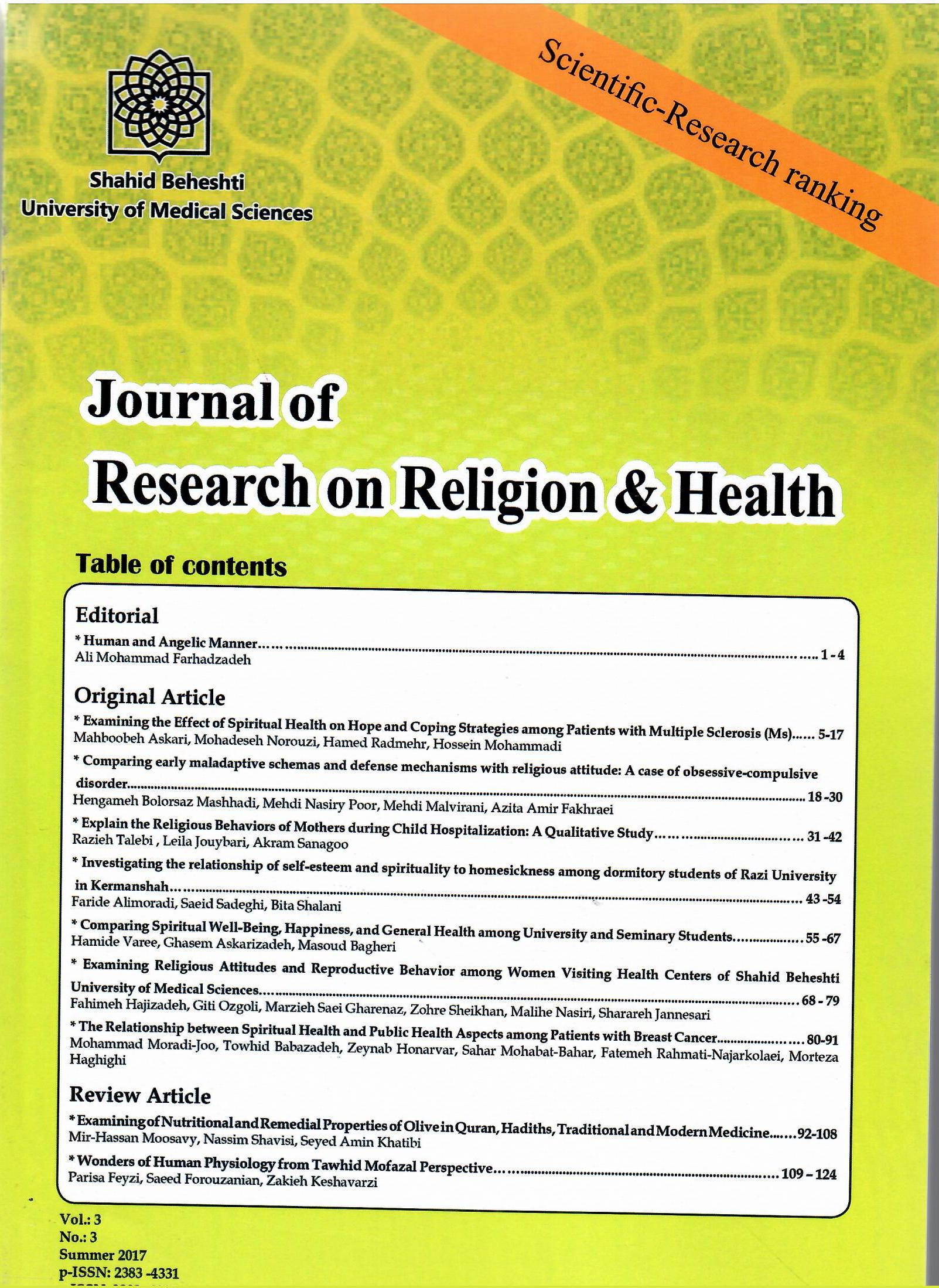
مقایسهی طرحوارههای ناسازگار اولیه و سازوکارهای دفاعی با نگرشهای مذهبی، در زنان مبتلا به اختلال وسواسی - اجباری و زنان سالم شهر همدان
مجلة البحث في الدين و الصحّة,
مجلد 3 عدد 3 (2017),
14 حزيران 2017
,
الصفحة 18-30
https://doi.org/10.22037/jrrh.v3i3.14749
الملخص
چکیده
سابقه و هدف: درمان اختلال وسواسی - اجباری از بحثبرانگیزترین موضوعهای بالینی است. با توجه به هزینههای متعدد ناشی از آن، بازبینی پیشینهی تحقیقی برای دستیابی به سودمندترین گزینههای درمانی ضروری به نظر میرسد. پژوهش حاضر با هدف مقایسهی طرحوارههای ناسازگار اولیه و سازوکارهای دفاعی با نگرشهای مذهبی در زنان مبتلا به اختلال وسواسی - اجباری (OCD)و زنان سالم شهر همدان صورت گرفته است.
روش کار: این پژوهش از نوع علّی - مقایسهیی و جامعهی آماری آن شامل همهی زنان مبتلا به OCD شهر همدان است. با استفاده از روش نمونهگیری تصادفی ساده، 100 زن مبتلا به OCD و 100 زن سالم (از بین همراهان بیماران و کارمندان دانشگاه)، بر اساس مصاحبهی بالینی، ملاکهای تشخیصی DSM-V و تکمیل پرسشنامه انتخاب شدند. ابزارهای گردآوری اطلاعات شامل پرسشنامههای طرحوارههای ناسازگارانه (YSQ-SF)، سازوکارهای دفاعی (DSQ-40) و نگرشهای مذهبی (RAQ) بود. دادههای پژوهش نیز با استفاده از شاخصهای آمار توصیفی و تحلیل واریانس چند متغیّره (MANOVA) تجزیه و تحلیل شد. در این پژوهش همهی موارد اخلاقی رعایت شده است. علاوهبراین، نویسندگان مقاله هیچگونه تضاد منافعی گزارش نکردهاند.
یافتهها: یافتهها نشان داده که تفاوت معناداری بین گروههای بالینی و بهنجار در پنج حوزهی طرحوارههای ناسازگار اولیه (بریدگی و طرد، عملکرد مختل، محدودیتهای مختل، دیگر جهتمندی و گوشبهزنگی بیشازحد و بازداری) وجود دارد (05/0>P). علاوهبراین، در نمرههای سبکهای دفاعی (رشدیافته، رشدنایافته و روانآزرده) و نگرشهای مذهبی نیز این تفاوت معنادار بوده است (05/0>P).
نتیجهگیری: نتایج پژوهش بر اهمیت تأثیر مداخلههای پیشگیرانه در علائم روانشناختی بیماران نوروتیک و ترسیم افقهای، جدید در مداخلههای بالینی، با توجه به بُعد دین، تأکید دارد.
- اختلال وسواسی – اجباری، زنان، سازوکارهای دفاعی، طرحواره های ناسازگار نگرش مذهبی
كيفية الاقتباس
المراجع
Edition F, Association AP. Diagnostic and statistical manual of mental disorders: Washington, American Psychological Association; 2014.
Veal D, Willson R. Overcoming obsessive compulsive disorder (a self- help guide: using cognitive behavioral techniques). Translated by: Jamalfer S. Tehran: Publication Arasbaran; 2012. (Full Text in Persian)
Belloch A, Morillo C, Luciano JV, García-Soriano G, Cabedo E, Carrió C. Dysfunctional belief domains related to obsessive-compulsive disorder: A further examination of their dimensionality and specificity. The Spanish Journal of Psychology. 2010;13(1):376-88.
HamidiBagejan S, Poursharifi H, MahmoodAlilou M, Shirvani A-. Thought-action fusion andthought Suppression in People with Obsessive-Compulsive Symptoms, High SchizotypyandOverlapping Symptoms. Research inPsychological Health. 2011; 5(1): 12-22.(Full Text in Persian)
Salehi I, Mosalman M. Evaluation of the relationship between religious attitude and depression, anxiety and stress in students of guilan university. Religion & Health. 2015;3(1):57-64. (Full Text in Persian)
Kim CY. Carl Gustav Jung and Granville Stanley Hall on Religious Experience. Journal of religion and health. 2016;55(4):1246-60.
Tsai T-J, Chung U-L, Chang C-J, Wang H-H. Influence of Religious Beliefs on the Health of Cancer Patients. Asian Pacific Journal of Cancer Prevention. 2016; 17(4):2315-20.
Deb S, McGirr K, Sun J. Spirituality in Indian University Students and its Associations with Socioeconomic Status, Religious Background, Social Support, and Mental Health. Journal of religion and health. 2016;55(5):1623-41.
Arrey AE, Bilsen J, Lacor P, Deschepper R. Spirituality/religiosity: a cultural and psychological resource among sub-Saharan African migrant women with HIV/AIDS in Belgium. PLoS One. 2016; 11(7): e0159488.
Harvey IS, Story CR, Knutson D, Whitt-Glover MC. Exploring the relationship of religiosity, religious support, and social support among African American women in a physical activity intervention program. Journal of religion and health. 2016;55(2):495-509.
Holbrook C, Izuma K, Deblieck C, Fessler DM, Iacoboni M. Neuromodulation of group prejudice and religious belief. Social cognitive and affective neuroscience. 2016;11(3):387-94.
Young JE, Klosko JS, Weishaar ME. Schema therapy (apractitioner,sguide). Translated by:Hamidpour ,H .Andoz, Z. Tehran: Publication Arjmand; 2015. (Full Text in Persian)
Lee NK, Cameron J, Jenner L. A systematic review of interventions for co‐occurring substance use and borderline personality disorders. Drug and alcohol review. 2015;34(6):663-72.
Hoffart Lunding S, Hoffart A. Perceived parental bonding, early maladaptive schemas and outcome in schema therapy of cluster c personality problems. Clinical psychology & psychotherapy. 2016;23(2):107-17.
Reeve JM. Understanding motivation and emotion. Translated by: SayedMohammadi, Y. Tehran: Publication Virayesh; 2016.(Full Text in Persian)
Blackman JS. 101 Defenses: How the mind shields itself. Translated by: JavadZadeh GH. Tehran: Publication Arjmand; 2016.(Full Text in Persian)
Corey G. Theory and Practice of Counseling and Psychotherapy. Translated by: SayedMohammadi ,Y. Tehran: Publication Arasbaran; 2016.(Full Text in Persian)
Besharet MA. Alexithymia and defensive style. Journal of Mental Health. 2016;10(3):181-90. (Full Text in Persian)
Inozu M, Ulukut FO, Ergun G, Alcolado GM. The mediating role of disgust sensitivity and thought‐action fusion between religiosity and obsessive compulsive symptoms. International Journal of Psychology. 2014; 49(5): 334-41.
Albucher RC, Abelson JL, Nesse RM. Defense mechanism changes in successfully treated patients with obsessive-compulsive disorder. American Journal of Psychiatry. 1998;155(4):558-9.
Hamidi F, Motlagh SS. Comparison of irrational beliefs and defence mechanisms in patients with obsessive compulsive disorder and normal individuals. Procedia-Social and Behavioral Sciences. 2010;5:1620-4.
Lawrence PJ, Williams TI. Pathways to inflated responsibility beliefs in adolescent obsessive-compulsive disorder: a preliminary investigation. Behavioural and cognitive psychotherapy. 2011; 39(02): 229-34.
Deiani N, Noori A, Golparvar M. Students metacognitive beliefs associated with component storage behavior/speculation. AdvCogn Sci. 2014; 15(3): 40-50.(Full Text in Persian)
Yoosofnejad Shirvani M, Peyvastegar M. The relationship between life satisfaction and early maladaptive schemas in university students. Knowledge & Research in Applied Psychology. 2011; 12(44): 55-65.(Full Text in Persian)
Farjad M, Mohammadi N, Rahimi CH, Hadianfard H. The relationship between personality organization and defense mechanisms. Journal of Psychology. 2013; 17(2):18-32.(Full Text in Persian)
Ebrahimi A, Neshatdoost H, Kalantari M, Molavi H, Asadollahi G. Factor structure, reliability and validity of Religious Attitude Scale. J Fundam Ment Health. 2008;10(38):107-16.
Atalay H, Atalay F, Karahan D, Caliskan M. Early maladaptive schemas activated in patients with obsessive compulsive disorder: A cross-sectional study. International journal of psychiatry in clinical practice. 2008;12(4):268-79.
Haaland AT, Vogel PA, Launes G, Haaland VØ, Hansen B, Solem S, et al. The role of early maladaptive schemas in predicting exposure and response prevention outcome for obsessive-compulsive disorder. Behaviour research and therapy. 2011;49(11):781-8.
Thiel N, Tuschen-Caffier B, Herbst N, Külz AK, Nissen C, Hertenstein E, et al. The prediction of treatment outcomes by early maladaptive schemas and schema modes in obsessive-compulsive disorder. BMC psychiatry. 2014;14(1):362.
Damiano SR, Reece J, Reid S, Atkins L, Patton G. Maladaptive schemas in adolescent females with anorexia nervosa and implications for treatment. Eating behaviors. 2015;16:64-71.
Dimatteo MR. The Psychology of Health.Translated by; MusaviAsl SM, et al. Tehran: SAMT; 2016. (Full Text in Persian)
Jun JY, Lee Y-JG, Lee S-H, Yoo SY, Song J, Kim SJ. Association between defense mechanisms and psychiatric symptoms in North Korean Refugees. Comprehensive psychiatry. 2015;56:179-87.
- الملخص المشاهدات: 997 الأوقات
- PDF (فارسی) التنزيلات: 657 الأوقات