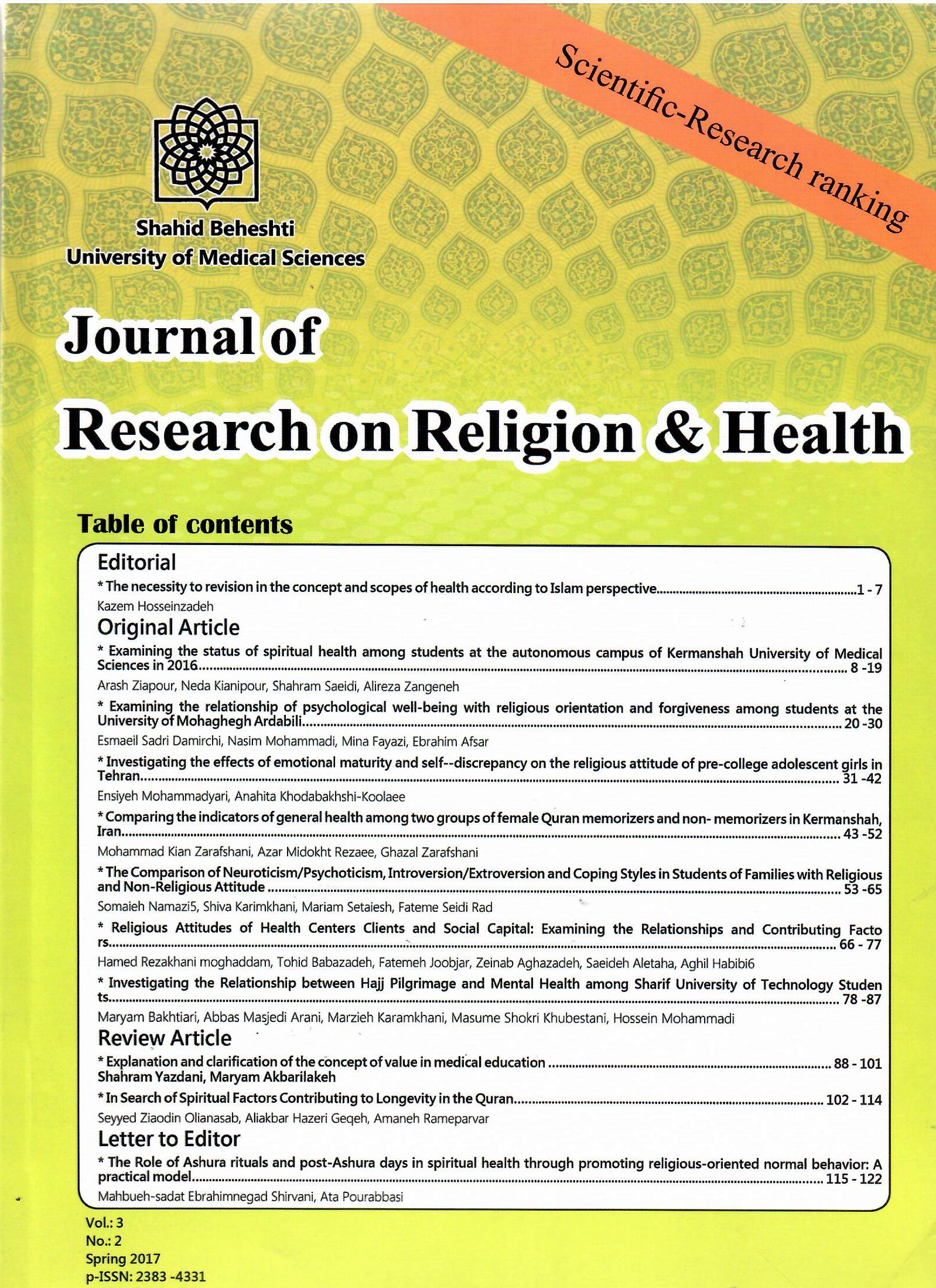
Editorial


The necessity to revision in the concept and scopes of health according to Islam perspective

Kazem Hosseinzadeh

Journal of Pizhūhish dar dīn va Salāmat (i.e., Research on Religion & Health), Vol. 3 No. 2 (2017), 26 February 2017, Page 1-7
https://doi.org/10.22037/jrrh.v3i2.14969

Health is a vital concept in human life and always the achievement, maintain, and promotion of health is emphasized thoroughly. Definition of health is not exclusive; individuals define it according to their own perspectives, nevertheless the World Health Organization (WHO) define it comprehensively as; a state of complete physical, mental and social well-being and not merely the absence of disease or infirmity. However, WHO declares some defects in the definition including: 1) has not described the complete well-being thoroughly, 2) has not introduced the favorite instruments measuring health.


Please cite this article as: Hosseinzadeh K. The necessity to revision in the concept and scopes of health according to Islam perspective. J Res Relig Health. 2017;3(2): 1- 7.

Original Article


Examining the status of spiritual health among students at the autonomous campus of Kermanshah University of Medical Sciences in 2016

Arash Ziapour , Neda Kianipour , Shahram Saeidi , Alireza Zangeneh

Journal of Pizhūhish dar dīn va Salāmat (i.e., Research on Religion & Health), Vol. 3 No. 2 (2017), 26 February 2017, Page 8-19
https://doi.org/10.22037/jrrh.v3i2.12507

Background and Objective: Spiritual well-being is regarded both as one of the major dimensions of health among human beings and a prominent approach to improving public health. So, given the significance of this aspect of health, the present study aimed to Examining the status of spiritual health among students at the autonomous campus of Kermanshah University of Medical Sciences in 2016.

Method: In this descriptive and analytical study, the statistical population comprised 346 students at the autonomous campus, Dentistry and Pharmaceuticals, Kermanshah University of Medical Sciences in 2016, and all of them were selected by census method in the study. For data collection, the 20-item spiritual well-being scale by Paloutzian & Ellison (1982) was utilized. To analyze data, the t-test and ANOVA were employed. All ethical issues were observed. Moreover, the authors did not report conflict of interest.

Results: The results of the present study revealed that the spiritual well-being of students was average (71.86±4.84), and of all demographic variables under study, only the variable of gender was correlated with the mean score of spiritual well-being. Furthermore, the students’ scores of religious well-being measured higher than that of their existential well-being.

Conclusion: According to the dominant religious culture in Iranian society, expected influences of religious as a compatibility source is normal. Therefore, it is necessary for the protection of young people pay attention to their spiritual dimension, to witness the impact of such care and create a sense of peace and healing in patients.


Please cite this article as: Ziapour A, Kianipour N, Saeidi Sh, Zangeneh A. Examining the status of spiritual health among students at the autonomous campus of Kermanshah University of Medical Sciences in 2016. J Res Relig Health. 2017; 3(2): 8- 19.

Examining the relationship of psychological well-being with religious orientation and forgiveness among students at the University of Mohaghegh Ardabili

Esmaeil Sadri Damirchi , Nasim Mohammadi , Mina Fayazi , Ebrahim Afsar

Journal of Pizhūhish dar dīn va Salāmat (i.e., Research on Religion & Health), Vol. 3 No. 2 (2017), 26 February 2017, Page 20-30
https://doi.org/10.22037/jrrh.v3i2.13551

Background and Objective: Given the rise of positive-thinking approach to mental health in recent years, Psychological well-being, which is a measure for the growth of the real talents of each individual, has attracted scientific attention. This study aimed to investigate the relationship of psychological well-being to religious orientation and forgiveness among students at the University of Mohaghegh Ardabili.

Methods: The descriptive and correlational method was used in this study and the statistical population consisted of students of mohaghegh Ardabili University in 2015. 150 students were selected using available sampling method. The subjects were inquired to answer the Ryff's Psychological Well-being questionnaire, Alport religious orientation questionnaire and Walker and Garsokh Forgiveness Scale. Multiple regression analysis was used to analyze the data. All ethical issues were observed. Moreover, the authors did not report conflict of interest.

Results: The findings proved that there is a positive significant relationship between psychological well-being with intrinsic religious orientation and Forgiveness as well as negative significant between psychological well-being and external religious orientation among students (p<0/01).

Conclusion: Therefore, It can be concluded that attention to religious orientation and efforts to promote forgiveness in students can improve their psychological well-being.


Please cite this article as: Sadri Damirchi E, Mohammadi N, Fayazi M, Afsar E. The relationship between Religious orientation and Forgiveness with psychological well-being among students. J Res Relig Health.2017;3(2): 20- 30.

Investigating the effects of emotional maturity and self--discrepancy on the religious attitude of pre-college adolescent girls in Tehran

Ensiyeh Mohammadyari , Anahita Khodabakhshi-Koolaee

Journal of Pizhūhish dar dīn va Salāmat (i.e., Research on Religion & Health), Vol. 3 No. 2 (2017), 26 February 2017, Page 31-42
https://doi.org/10.22037/jrrh.v3i2.14248

Background and Objective: Achieve to emotional maturity and lack of self-discrepancy is important factors in people’s religious attitudes. So the aim this study is Investigating the effects of emotional maturity and self-­discrepancy on the religious attitude of pre-college adolescent girls in Tehran

Methods: The research method is descriptive and correctional. statistical population consists of all pre-college student girls in Tehran. 405 students were selected using Morgan table and multi-stage cluster sampling method. Data collection tools were emotional maturity questionnaire, self-discrepancy questionnaire and religious attitude questionnaire. Collected data has been analyzed using correlation and regression analysis. All ethical issues were observed. Moreover, the authors did not report conflict of interest.

Results: This study Investigated that emotional maturity and self-discrepancy variables determined religious attitudes with a factor of 0.10. The emotional maturity factor (beta-0.31) has the greatest impact on religious attitudes (p<0.01), and real-ideal self-­discrepancy with beta 0.11 is the second factor influencing religious attitude in adolescent girls (p<0.05). In this explanation, real-­ought self discrepancy had no significant effect on the religious attitude (p>0.05).

Conclusion: The results showed that emotional maturity and self-discrepancy variables play important role in the religious attitude of adolescent girls. Therefore these variables must be considered to promote their religion, and field of necessary education to students such as life skills training should be provided to improve emotional maturity and self-discrepancy.


Please cite this article as: Mohammadyari E, Khodabakhshi-Koolaee A. Investigating the effects of emotional maturity and self-discrepancy on the religious attitude of pre-college adolescent girls in Tehran. J Res Relig Health. 2017; 3(2): 31- 42.

Comparing the indicators of general health among two groups of female Quran memorizers and non- memorizers in Kermanshah, Iran

Mohammad Kian Zarafshani , Azar Midokht Rezaee , Ghazal Zarafshani

Journal of Pizhūhish dar dīn va Salāmat (i.e., Research on Religion & Health), Vol. 3 No. 2 (2017), 26 February 2017, Page 43-52
https://doi.org/10.22037/jrrh.v3i2.12546

Background and Objective: General health has always been a critical issue in human’s life. Religion and religious education is influential in individuals’ general health. Thus, the purpose of this descriptive study was to determine the effect of Quran memorization on general health.

Method: This study used a simple random sampling procedure to select 106 female Quran memorizers and 91 non-memorizers. With respect to the collected data, the demographic information, such as age, marital status, education, and occupation, was elicited; in addition, general health was measured using the General Health Questionnaire (GHQ-28). The data were analyzed through comparison of means to spot the group differences. In this study, all the ethical issues were considered; moreover, the authors declare no conflict of interest.

Results: The results of the study revealed that Quran memorizers were in a better status in terms of general health when compared with the non-memorizers. Accordingly, there were significant differences between the two groups in terms of stress, sleep disorders, depression, and physical signs. Furthermore, a significant difference was detected in terms of social functioning.

Conclusion: Since Quran memorizers enjoyed better general health, it could be concluded that extending Quran principles and realizing their effects on individuals’ general health could provide greater understanding of Quran and its potential for treating psychological disorders, hence promoting psychological and mental health.

Please cite this article as: Zarafshani M, Rezaee A, Zarafshani Gh. Comparing the indicators of general health among two groups of female Quran memorizers and non- memorizers in Kermanshah, Iran. J Res Relig Health. 2017; 3(2): 43- 52.

The Comparison of Neuroticism/Psychoticism, Introversion/Extroversion and Coping Styles in Students of Families with Religious and Non-Religious Attitude

Somaieh Namazi , Shiva Karimkhani , Mariam Setaiesh , Fateme Seidi Rad

Journal of Pizhūhish dar dīn va Salāmat (i.e., Research on Religion & Health), Vol. 3 No. 2 (2017), 26 February 2017, Page 53-65
https://doi.org/10.22037/jrrh.v3i2.14729

Background and Objective: The family as a social institution has an important role in children’s psychological development. This study was examined the neuroticism-psychoticism, introversion-extroversion and coping styles in Students whose families believe in religion in comparison with secular families.

Method: The present study was a causal-comparative study. The statistical population was all the middle school students in Kermanshah City, in 2016. 380 people were selected using Krejcie and Morgan table and multi-stage cluster sampling. They completed ROQ (by their parents), EPQ-AF and CISS questionnaires. Data were analyzed using descriptive statistics, ANOVA and Tukey tests. All ethical issues were observed. Moreover, the authors did not report conflict of interest.

Results: Correlation and analysis of variance showed that personality dimensions of neuroticism and psychoticism have negative correlation with problem-oriented coping style and avoidance coping style, positive relation  (P<0.001). Extraversion- showed positive relationship with problem oriented coping style and negative relationship with the emotion and avoidance, (P<0.001). Also, results showed that neuroticism, psychosis and extroversion were higher in non-religious people and religious people more than other people used Problem-focused coping style (P<0.001).

Conclusion: According to this study, religious belief has inhibitory role in the occurrence of mental disorders. Thus strengthening the foundations of religious beliefs in society, especially in students is an effective step in prevention.


Please cite this article as: Namazi S, Karimkhani Sh, Setaiesh M, Seidi Rad F. The Comparison of Neuroticism/Psychoticism, Introversion/Extroversion and Coping Styles in Students of Families with Religious and Non-Religious Attitude. J Res Relig Health. 2017; 3(2): 53- 65.

Religious Attitudes of Health Centers Clients and Social Capital: Examining the Relationships and Contributing Factors

Hamed Rezakhani moghaddam, Tohid Babazadeh , Fatemeh Joobjar , Zeinab Aghazadeh, Saeideh Aletaha , Aghil Habibi

Journal of Pizhūhish dar dīn va Salāmat (i.e., Research on Religion & Health), Vol. 3 No. 2 (2017), 26 February 2017, Page 66-77
https://doi.org/10.22037/jrrh.v3i2.13399

Background and Objective: The related literature shows that religious attitude has noticeable effects on all aspects of human life. This study was designed to examine the status of religious attitudes of clients attending health centers and its relationship with social capital.

Method: This descriptive-analytical study was conducted on 160 clients of health centers in Kouchesfahan in 2014. To collect the required data, a standard 40-item questionnaire of religious attitudes and the 36-item Bullen’s questionnaire concerning social capital were used. Then, correlation test, chi- square, t- test and ANOVA were employed to analyze the data. In this study, All the ethical issues were observed. Moreover, the authors did not report conflict of interest.

Results: The results demonstrated that total means score for religious attitudes was calculated 125.9 ± 28.7. Minimum and maximum means were measured for “religious belief” and “religious behavior” dimension; they were 45.3 ± 11 and 37.6 ± 11.3, respectively. Furthermore, no significant relationship between social capital and dimensions of religious attitudes was found.

Conclusion: According to the findings, it is safe to conclude that the more the religious behavior, the more favorable the social capital will be. Thus, promoting religious rites and practices in society can help to improve social capital.


Please cite this article as: Rezakhani moghaddam H, Babazadeh T, Joobjar F, Aghazadeh Z, Aletaha S, Habibi A. Religious Attitudes of Health Centers Clients and Social Capital: Examining the Relationships and Contributing Factors. J Res Relig Health. 2017; 3(2): 66- 77.


Investigating the Relationship between Hajj Pilgrimage and Mental Health among Sharif University of Technology Students

Maryam Bakhtiari, Abbas Masjedi Arani , Marzieh Karamkhani , Masume Shokri Khubestani , Hossein Mohammadi

Journal of Pizhūhish dar dīn va Salāmat (i.e., Research on Religion & Health), Vol. 3 No. 2 (2017), 26 February 2017, Page 78-87
https://doi.org/10.22037/jrrh.v3i2.15083

Background and Objective: The significance of research into psychological aspects of Hajj pilgrimage and its rituals is rooted in the psychological importance of religion as a complete set of programs for human’s life. Given that, this study has set out to examine the relationship between Hajj pilgrimage and mental health among the students of Sharif University of Technology.

Method: This applied research adopted a descriptive – correlational design. 350 students (male = 84, female = 266) were randomly selected to participate in this study. After selecting the representative population, the related questionnaires were completed by the participants before and after Hajj pilgrimage to gather the required data. In doing so, the General Health Questionnaire (GHQ) and Meaning in Life Questionnaire were administered. Finally, the data using SPSS statistical software and descriptive statistical techniques (the mean and standard deviation) and inferential statistical method (t-test) were analyzed. In this study, all the ethical issues were considered; besides, the authors declared no conflict of interest.

Results: The results indicated that there was a significant increase in the participants’ mean score of mental health and meaning in life. Moreover, Hajj pilgrimage increased the mental health and meaning in life.

Conclusion: Findings of this study revealed that pilgrimage to Mecca lowers anxiety, depression, and stress. Furthermore, it raises social functioning and meaning in life. In fact, pilgrimage is one of the most important religious practices to improve mental health, which needs to be taken into account when interventions toward mental health are intended.


Please cite this article as: Bakhtiari M,Masjedi Arani A, Karamkhani M, Shokri Khubestani M, Mohammadi H. Investigating the Relationship between Hajj Pilgrimage and Mental Health among Sharif University of Technology Students. J Res Relig Health. 2017; 3(2): 78- 87.

Review Article


Explanation and clarification of the concept of value in medical education

Shahram Yazdani , Maryam Akbarilakeh

Journal of Pizhūhish dar dīn va Salāmat (i.e., Research on Religion & Health), Vol. 3 No. 2 (2017), 26 February 2017, Page 88-101
https://doi.org/10.22037/jrrh.v3i2.13790

Background and Objective: Developing the education of medical sciences is one of the main objectives of the Ministry of Health and Medical Education. The first step toward creating value-based educational programs in the country is to clarify the concept of value in medical education, which is addressed in this study.

Method: Through critical interpretive synthesis, document analysis was performed to clarify the concept of value in medical education; then, the related literature on ‘value’ was investigated. From among 800 articles, 70 articles were selected by purposive sampling. A well-reasoned synthesis of the contradictory findings in different studies was conducted. As the next step, critical analysis on the documents was carried out so that the concept of value along with new concepts and their relationships, the philosophy, and the place of values in medical education of Iran were recreated. All the ethical issues were observed. Moreover, the authors did not report conflict of interest.

Results: Values are created as a system within each individual, forming the basis of judgment and decision making. Values shape attitudes and guide our behavior. Furthermore, beliefs affect our scientific approaches. Scientific evidence that has been provided is not devoid of the scholars and researchers’ values. In our Islamic society, the basic assumptions shape our beliefs and values; then, these values determine our direction and behavioral patterns so that we do not get out of the circle of morality.  

Conclusion: In our country, in many areas including medical education, those programs that guarantee the achievement of values are needed. To foster the values in this field, the first step is paving the way for understanding and internalization of values along with the development of teaching procedures to gain value-based experiences.


Please cite this article as: Yazdani Sh,  Akbarilakeh M. Explanation and clarification of the concept of value in medical education. J Res Relig Health. 2017; 3(2): 78- 91.  

In Search of Spiritual Factors Contributing to Longevity in the Quran

Sayyed Ziaodin Olyanasab , Aliakbar Hazeri Geqeh , Amaneh Rameparvar

Journal of Pizhūhish dar dīn va Salāmat (i.e., Research on Religion & Health), Vol. 3 No. 2 (2017), 26 February 2017, Page 102-114
https://doi.org/10.22037/jrrh.v3i2.13648

Background and Objective: Despite considerable advancements in science and technology, problems like anxiety, depression, and insecurity have increasingly overwhelmed societies, jeopardizing human’s spiritual health and, consequently, physical health. Given that, the importance of addressing different aspects of physical and spiritual health is grasped more than before. Increase in life expectancy or longevity is one of the manifestations of spiritual health. The purpose of this study is to investigate the spiritual causes of longevity pointed out in the Quran.

Method: In this study, the analytical library method was used. Materials included books related to Islamic sciences and religion, existing commentaries, and also articles on psychology with an emphasis on spiritual health and longevity. All the ethical issues were observed. Moreover, the authors did not report conflict of interest.

Results: Findings of this study showed that according to the Quran, five spiritual factors contribute to longevity. Furthermore, the Quran has paid more attention to spiritual factors leading to longevity than the physical and worldly ones.  

Conclusion: To prolong longevity in the era of technology, practising spiritual matters underscored in the Quran will be effective and fruitful.


Please cite this article as: Olyanasab S.Z, Hazeri Geqeh A, Rameparvar A. In Search of Spiritual Factors Contributing to Longevity in the Quran. J Res Relig Health. 2017; 3(2):102- 114.  


Letter to Editor


The Role of Ashura rituals and post-Ashura days in spiritual health through promoting religious-oriented normal behavior: A practical model

Mahbubeh-sadat Ebrahimnegad Shirvani , Ata Pourabbasi

Journal of Pizhūhish dar dīn va Salāmat (i.e., Research on Religion & Health), Vol. 3 No. 2 (2017), 26 February 2017, Page 115-122
https://doi.org/10.22037/jrrh.v3i2.14330

Background and Objective: Islamic world especially Shia experience some different atmosphere in Muharram because of Ashura. This atmosphere can provide a proper field for reducing some maladaptive behaviors and stabilizing religious-based behaviors in society by setting up Ashura rituals in all cities. Surely cultural policy makers wish to remain this spiritual atmosphere for other times in order to improve spiritual health in people.

Methods: In this regard, Authors try to provide some practical solutions through Ashura rituals and their analysis according to some behavioral models such as transtheoretical model of behavioral change. All ethical issues were observed. Moreover, the authors did not report conflict of interest.

Results: several behavioral strategies may be offered according to time of interventions lasts from Ashura rituals. These solutions can lead to institutionalization of favorable and adaptive behaviors both in individual and social level.

Conclusion: In this paper, it istried to introduce the practical solutions by reviewing the dimensions of behavior changes and matching them with the circumstances of society in Muharram.


Please cite this article as: Ebrahimnegad Shirvani M, Pourabbasi A. Ashura rituals, post-Ashura days and their role in spiritual health by promoting religious-based behaviors, a practical model. J Res Relig Health. 2017; 3(2): 115- 122.