
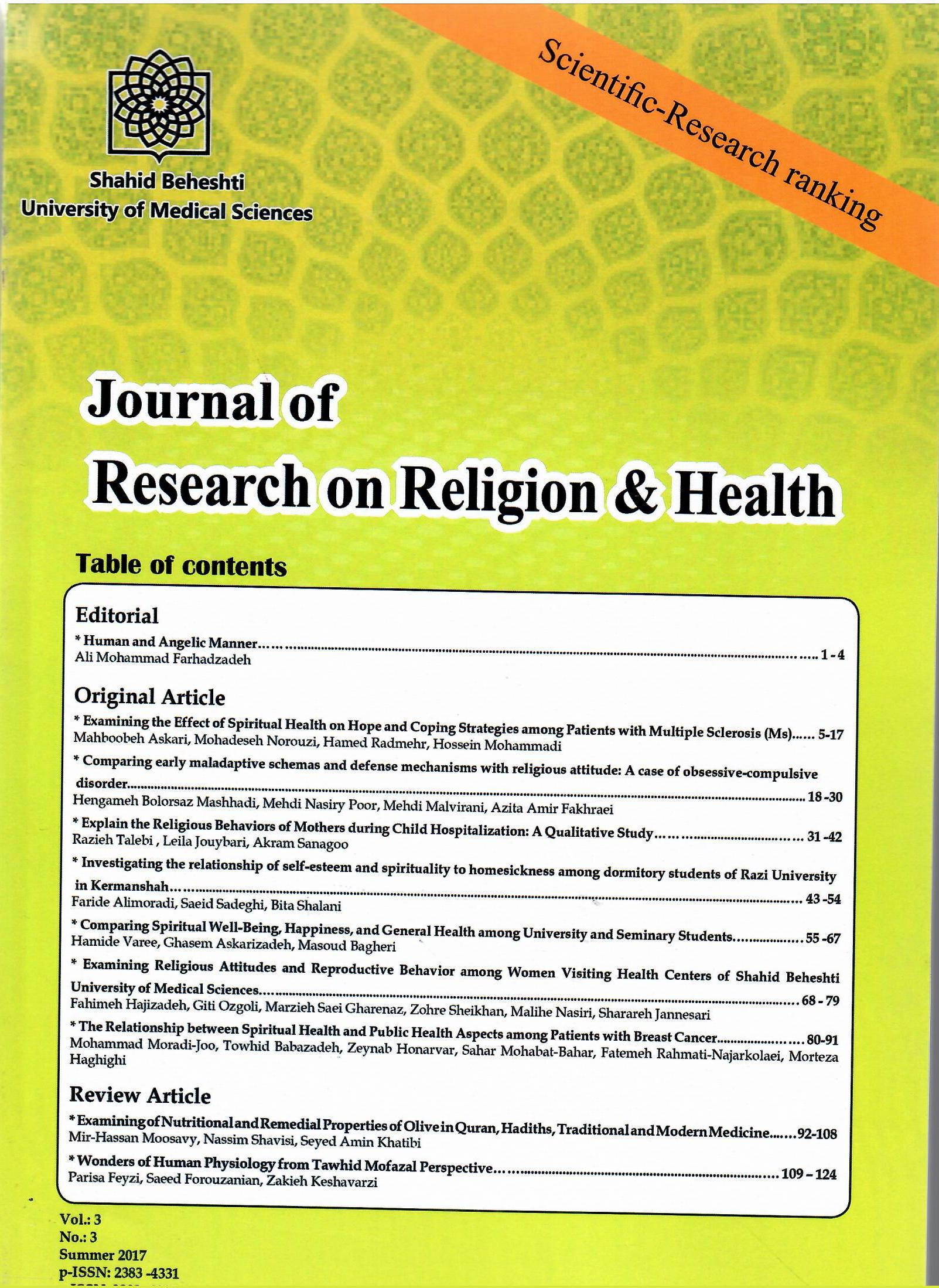
بررسی اثربخشی آموزش سلامت معنوی بر امیدواری و راهبردهای مقابلهیی در بیماران مبتلا به مولتیپل اسکلروزیس (ام.اس.)
پژوهش در دین و سلامت ,
دوره 3 شماره 3 (2017),
14 ژوئن 2017
,
صفحه 5-17
https://doi.org/10.22037/jrrh.v3i3.15403
چکیده
سابقه و هدف: شناخت ابعاد معنوی، جزء حیاتی سلامت انسان است که به افزایش علاقه به آموزش معنویت منجر میشود. سلامت معنوی تأثیر مثبتی روی سلامتی، طول عمر و بهبودی از بیماری جسمانی دارد. ازاینرو، هدف این پژوهش بررسي اثربخشي آموزش سلامت معنوی گروهي بر امیدواری و راهبردهای مقابلهیی بیماران مبتلا به مالتيپل اسكلروزیس (ام.اس.) است.
روش کار: این پژوهش از نوع کارآزمایی بالینی است که جامعهی آماری آن را اعضای «جامعهی حمایت از بیماران ام.اس.» شهر تهران تشکیل میدهند. پس از محاسبهی حجم نمونه، نمونهگیری در دو مرحله انجام شد؛ ابتدا 100 نفر از اعضای جامعهی حمایت از بیماران ام.اس. و سپس 30 نفر، بهصورت تصادفی انتخاب شدند و در دو گروه آزمایش (15 نفر) و کنترل (15 نفر) قرار گرفتند. یک روانشناس بالینی آموزش دیده، آموزش سلامت معنوی را بهصورت گروهی، در هشت جلسهی 90 دقیقهیی برگزار کرد. ابزار گردآوری اطلاعات شامل پرسشنامهی امیدواری میلر (MHS) و پرسشنامهی راهبردهای مقابلهیی لازاروس و فولکمن (CSQ) بود. نمرههای پیشآزمون و پسآزمون نیز با استفاده از تجزیه و تحلیل کوواریانس، تحلیل شد. در این پژوهش همهی موارد اخلاقی رعایت شده است. علاوهبراین، نویسندگان مقاله هیچگونه تضاد منافعی گزارش نکردهاند.
یافتهها: یافتهها نشان میدهد که آموزش هشت جلسه مداخلهی سلامت معنوی در گروه آزمایش، نسبت به گروه کنترل، موجب تغییر در نمرههای حاصل از متغیّرهای امیدواری (35/0)، راهبردهای مقابلهیی مسئلهمدار (40/0) و هیجانمدار (25/0) شده است.
نتیجهگیری: نتایج پژوهش گویای این است که آموزش سلامت معنوی میتواند در افزایش امیدواری و تقویت راهبردهای مقابلهیی کارآمد (مسئلهمدار) افراد مبتلا به ام.اس. مؤثر باشد.
- امیدواری، راهبردهای مقابلهیی، سلامت معنوی
ارجاع به مقاله
مراجع
Goldenberg MM. Multiple sclerosis review. Pharmacy and Therapeutics. 2012;37(3):175-84.
Renoux C, Vukusic S, Mikaeloff Y, Edan G, Clanet M, Dubois B, et al. Natural history of multiple sclerosis with childhood onset. New England Journal of Medicine. 2013;356(25):2603-13.
Kern S, Schrempf W, Schneider H, Schultheiss T, Reichmann H, Ziemssen T. Neurological disability, psychological distress, and health-related quality of life in MS patients within the first three years after diagnosis. Multiple sclerosis.2009;15(6):752-8.
Ghafari S, Ahmadi F, Nabavi M, Memarian R. Effects of applying progressive muscle relaxation technique on depression, anxiety and stress of multiple sclerosis patients in Iran National MS Society; 2008. 32(1): 45-53.(Full Text in Persian)
Gum A, Snyder CR. Coping with terminal illness: The role of hopeful thinking. Journal of palliative medicine. 2002;5(6):883-94.
Morgante L. Hope in multiple sclerosis: a nursing perspective. International Journal of MS Care. 2000; 2(2): 9-15.
Madan S, Pakenham KI. The stress-buffering effects of hope on adjustment to multiple sclerosis. International journal of behavioral medicine. 2014; 21(6): 877-90.
De Ridder DTD, Van Heck GL, Endler NS, Parker JDA. Coping Inventory for stressful situations; Dutch manual. Lisse: Swets test publishers; 2004.
McCabe MP, McKern S, McDonald E. Coping and psychological adjustment among people with multiple sclerosis. Journal of psychosomatic research. 2004; 56(3): 355-61.
van der Hiele K, van Gorp DAM, Benedict RHB, Jongen PJ, Arnoldus EPJ, Beenakker EAC, et al. Coping strategies in relation to negative work events and accommodations in employed multiple sclerosis patients. Multiple Sclerosis Journal–Experimental, Translational and Clinical. 2016;2:2055217316680638.
Pakenham KI, Stewart CA, Rogers A. The role of coping in adjustment to multiple sclerosis-related adaptive demands. Psychology, Health & Medicine. 1997;2(3):197-211.
Hart S, Fonareva I, Merluzzi N, Mohr DC. Treatment for depression and its relationship to improvement in quality of life and psychological well-being in multiple sclerosis patients. Quality of Life Research. 2005;14(3):695-703.
Elkins DN, Hedstrom LJ, Hughes LL, Leaf JA, Saunders C. Toward a humanistic-phenomenological spirituality definition, description, and measurement. Journal of humanistic Psychology. 1988;28(4):5-18.
Thomas LE, Eisenhandler SA. Aging and the religious dimension: ABC-CLIO; 1994.
Smith TB, McCullough ME, Poll J. Religiousness and depression: evidence for a main effect and the moderating influence of stressful life events. Psychological bulletin. 2003;129(4):614.
Tuck I, McCain NL, Elswick Jr RK. Spirituality and psychosocial factors in persons living with HIV. Journal of advanced nursing. 2001;33(6):776-83.
Fernsler JI, Klemm P, Miller MA. Spiritual well-being and demands of illness in people with colorectal cancer. Cancer Nursing. 1999;22(2):134-40.
Kamian S, Taghdisi MH, Azam K, Estebsari F. Evaluating Effectiveness of Spiritual Health Education on Increasing Hope among Breast Cancer Patients. Iranian Journal of Health Education and Health Promotion. 2014;2(3):208-14.
Huguelet P, Koenig HG. Religion and spirituality in psychiatry: Cambridge University Press; 2009.
Zinnbauer BJ, Pargament KI, Cole B, Rye MS,
Butter EM, Belavich TG, et al. Religion and spirituality: Unfuzzying the fuzzy. Journal for the scientific study of religion. 1997:549-64.
Bahrainian SA, Mohammadi H, Mortazavi MA. The relationship between trusting God and mental health in medical students of Shahid Beheshti University of Tehran. Journal of Reaserch on Religion & Health. 2015;1(4):12-20.(Full Text in Persian)
Ellison CG, Taylor RJ. Turning to prayer: Social and situational antecedents of religious coping among African Americans. Review of Religious Research. 1996:111-31.
Abdi N, Lari MA. Standardization of Three Hope Scales, as Possible Measures at the End of Life, in Iranian Population. Iranian Journal of Cancer Prevention. 2011;4(2):71-7.(Full Text in Persian)
Bierman A. Does religion buffer the effects of discrimination on mental health? Differing effects by race. Journal for the Scientific Study of Religion. 2006;45(4):551-65.
Dezutter J, Soenens B, Hutsebaut D. Religiosity and mental health: A further exploration of the relative importance of religious behaviors vs. religious attitudes. Personality and individual differences. 2006;40(4):807-18.
Vaillant G, Templeton J, Ardelt M, Meyer SE. The natural history of male mental health: Health and religious involvement. Social Science & Medicine. 2008;22(6):221-31.
Agha-yousefi A, Choubsaz F, Shaghaghi F, Motiei G. The effect of coping techniques training on coping strategies of infertile women in Kermanshah. Journal of Kermanshah University of Medical Sciences (J Kermanshah Univ Med Sci). 2012;16(2):155-64.(Full Text in Persian)
Baldacchino D, Draper P. Spiritual coping strategies: a review of the nursing research literature. Journal of advanced nursing. 2001;34(6):833-41.
Siegel K, Schrimshaw EW. The perceived benefits of religious and spiritual coping among older adults living with HIV/AIDS. Journal for the scientific study of religion. 2002;41(1):91-102.
Piazza D, Holcombe J, Foote A, Paul P, Love S, Daffin P. Hope, social support and self-esteem of patients with spinal cord injuries. Journal of Neuroscience Nursing. 1991;23(4):224-30.
Marcotte J. Spirituality and life satisfaction of people with multiple sclerosis [M.S.]. Ann Arbor: California State University, Long Beach; 2011.
Sung MS, Kim CN. A correlation study on spiritual wellbeing, hope and perceived health status of the elderly. Journal of Korean Community Nursing.
;10(1):53-69.
Kim Y, Seidlitz L. Spirituality moderates the effect of stress on emotional and physical adjustment. Personality and Individual differences. 2002; 32(8): 1377- 90.
Knox D, Langehough SO, Walters C, Rowley M. Religiosity and spirituality among college students. College Student Journal. 1998.
Maltby J, Lewis CA, Day L. Religious orientation and psychological well‐being: The role of the frequency of personal prayer. British Journal of Health Psychology. 1999;4(4):363-78.
Maton KI. The stress-buffering role of spiritual support: Cross-sectional and prospective investigations. Journal for the scientific study of religion. 1989:310-23.
Camic P, Knight S. Clinical handbook of health psychology: A practical guide to effective interventions: Hogrefe Publishing; 2004.
Arzouman JM, Dudas S, Ferrans CE, Holm K, editors. Quality of life of patients with sarcoma postchemotherapy;1991.
Levin JS, Taylor RJ. Panel analyses of religious involvement and well-being in African Americans: Contemporaneous vs. longitudinal effects. Journal for the Scientific Study of Religion. 1998:695-709.
Poloma MM, Pendleton BF. Religious domains and general well-being. Social Indicators Research. 1990;22(3):255-76.
Hall BA. Patterns of spirituality in persons with advanced HIV disease. Research in Nursing & Health. 1998;21(2):143-53.
- چکیده مشاهده شده: 1402 بار
- PDF دانلود شده: 1251 بار