
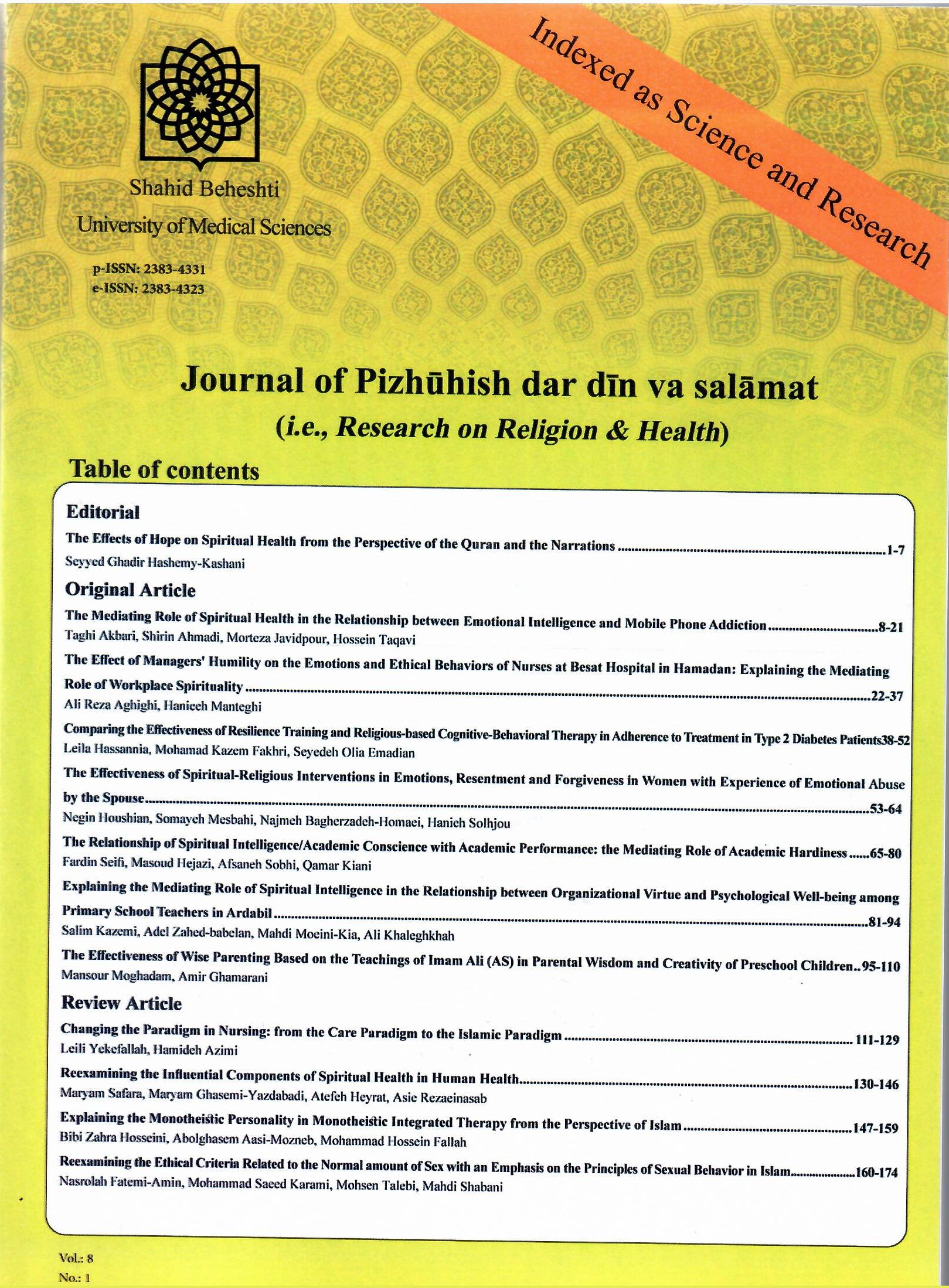
Explaining the Mediating Role of Spiritual Intelligence in the Relationship between Organizational Virtue and Psychological Well-being among Primary School Teachers in Ardabil
Journal of Pizhūhish dar dīn va Salāmat (i.e., Research on Religion & Health),
Vol. 8 No. 1 (2022),
19 March 2022
,
Page 81-94
https://doi.org/10.22037/jrrh.v8i1.33130
Abstract
Background and Objective: In the 21st century, new perspectives emerged on the moral aspects of teachers in schools, and the role that virtue plays in fostering constructive emotions and interactions has highlighted the growing importance of virtue in improving psychological well-being. The aim of this study was to explain the mediating role of spiritual intelligence in the relationship between organizational virtue (as an Islamic religious variable) and psychological well-being among primary school teachers in Ardabil.
Methods: The research method is descriptive correlational based on structural equation modeling. The statistical population of this study included all primary school teachers in Ardabil (no=3850), out of whom 350 were selected as the statistical sample of the research based on Cochran's formula and using multi-stage random cluster sampling method to collect data. Standard questionnaires of psychological well-being, organizational virtue, and spiritual intelligence were used to collect data. Also, structural equation modeling was used to analyze the data. In this study, all the ethical considerations were observed and the authors reported no conflict of interest.
Results: The results of the correlation coefficient showed a significant correlation between the variables of organizational virtue, spiritual intelligence and psychological well-being in a positive direction. The results also showed that organizational virtue has a positive and significant direct effect on psychological well-being (0.27). Organizational virtue has a positive and significant direct effect on spiritual intelligence (0.84). Spiritual intelligence has a positive and significant effect on psychological well-being (0.68). In addition, organizational virtue has a positive and significant indirect effect on psychological well-being (9.74) through spiritual intelligence.
Conclusion: The higher the teachers 'spiritual intelligence and vigilance in the organization, the higher the psychological well-being and job satisfaction. Therefore, virtue as an Islamic moral variable in the organization can affect the teachers' spiritual intelligence and psychological well-being.
- Psychological well-being; Organizational virtue; Spiritual intelligence; Teachers
How to Cite
References
Cameron K, Bright D, Caza A. Exploring the Relationships between Organizational Virtuousness and Performance. American Behavior Scientist. 2004;47(6):766-90.
Manz CC. The virtuous organization: Insights from some of the world's leading management thinkers: World Scientific; 2008.
Rego A, Ribeiro N, Cunha MP. Perceptions of organizational virtuousness and happiness as predictors of organizational citizenship behaviors. Journal of Business Ethics. 2010;93(2):215-35.
Narimani M, Yosefi F, Kazemi R. The role of attachment styles and quality of life in predicting psychological well-being in adolescents with learning disabilities. Journal of learning disabilities. 2014;3(4):124-42. (Full Text in Persian)
Michael Manie F. Structural relationship between psychological wellbeing and perceived emotional intelligence, the ability to control negative thinking and depression in mothers of children with mental retardation compared with normal children. Exceptional children research ninth. 2008(2):103-20.
Cho J, Martin P, Margrett J, MacDonald M, Poon LW. The relationship between physical health and
psychological well-being among oldest-old adults. Journal of aging research;2011.
Pailler S, Tsaneva M. The effects of climate variability on psychological well-being in India. World Development. 2018;106:15-26.
Cloninger CR. On well-being: Current research trends and future directions. Mens Sana Monographs. 2008;6(1):3.
Shahbazi A, Rahgozar H. The Relationship Between the Relationship between Moral Intelligence with Organizational Commitment and Organizational Trust Among Employees of Islamic Azad University Marvdasht Branch. Journal of New Approaches in Educational Administration. 2017;8(30):209-34. (Full Text in Persian)
Mahmoodi F, Sadeghi F, Jamal Omidi M. The role of spiritual attitude in predicting cognitive emotion regulation strategies in students. Journal of Religion and Health. 2017;5(1):51-60. (Full Text in Persian)
Shabani J. Spiritual intelligence (concepts, theories and applications). edition 1. Tehran:Savalan; 2015. (Full Text in Persian)
Ghadampoor E, Mirdrikvand F, Moradizadeh S. Comparing spiritual intelligence, spiritual well-being and social support in delinquent and normal teenagers. Islam And Health Journal. 2019;4(2):14-24. (Full Text in Persian)
Smith S. Explaining the Interaction of Emotional Intelligence and SpiritualityTraumatology. Journal of Social Science. 2004;10(4):231-43.
King U. The search for spirituality: Our global quest for a spiritual life: BlueBridge; 2008.
Ryff CD. Happiness is everything, or is it? Explorations on the meaning of psychological well-being. Journal of personality and social psychology. 1989;57(6):1069.
Celik A, Esen E. The moderating role ofpsychological wellbeing organizationalvirtuousness and work engagement. Journal of International Social Research. 2017;10(50):668-74.
Chun R. Ethical character and virtue of organizations: An empirical assessment and strategic implications. Journal of Business Ethics. 2005;57(3):269-84.
Burke R, Koyuncu M, Fiksenbaum L. Flow, work satisfactions and psychological well-being among nurses in Turkish hospitals. Arch Nurs Pract Care 2(1): 010-017 DOI: http://dx doi org/1017352/anpc. 2016;7(010):13-9.
Turkian B, Karimi F. Model of the relationship between virtue and organizational loyalty with psychological well being and job engagement (case Model of the relationship between virtue and organizational loyalty with psychological well-being and job engagement (case study: isfahan highschool teachers). Knowledge & Research in Applied Psychology. 2019;20(3):55-64.
Tabli H, Moradi MR, Irannejad J. Analysis of the Relationship between Organizational Virtue as a Moral Component with Spiritual Intelligence, Emotional Intelligence and Organizational Commitment. Quarterly Journal of Ethics in Science and Technology. 2017;1(21):1-11. (Full Text in Persian)
Bohrani A, Foroutani Z. Prediction of organizational virtue based on moral leadership and spiritual intelligence. Islam & Management. 2020;9(3):1-10. (Full Text in Persian)
Hassanzadeh Samarin T, Sefidkar S. Investigation the relationship between organizational virtuousness and organizational citizenship behavior. Management Studies in Development & Evolution. 2015; 23(76): 141-55. (Full Text in Persian)
Shojaei A, Soleymani E. The effectiveness of spiritual intelligence training on psychological well-being of students covered by the imam khomeini relief committee. Journal of School Psychology. 2015;4(1):104-21. (Full Text in Persian)
Rahimi Pour M, Karami E. The mediating role of spiritual intelligence with psychological well-being and life satisfaction in Mehriz Elderly people. The Scientific Journal of Rehabilitation Medicine. 2014;3(3):72-81. (Full Text in Persian)
Ziapour A, Molavi S, Afsari D. A study of the relationship between organizational virtuousness and employee engagement. International Research Journal of Applied and Basic Sciences. 2015;9:1442-7. (Full Text in Persian)
Sotoodeh H, Shakerinia I, Kheyrati M, Dargahi S, Ghasemi Jobaneh R. Surveying the relationship between spiritual and moral intelligence and the psychological well-being of nurses. Iranian Journal of Medical Ethics and History of Medicine. 2016;9(1):63-73. (Full Text in Persian)
Parvaneh E, Momeni K, Parvaneh A, Karimi P. Predicted psychological well-being according to spiritual intelligence and hardiness of students female. IHJ. 2015; 1 (4) :14-20. (Full Text in Persian)
Heidari A, Kouroshnia M, Hosseini M. The mediating role of psychological well-being in the relationship between Spiritual intelligence and happiness. Psychological Methods and Models. 2015;6(21):73-86. (Full Text in Persian)
- Abstract Viewed: 600 times
- PDF (فارسی) Downloaded: 398 times