
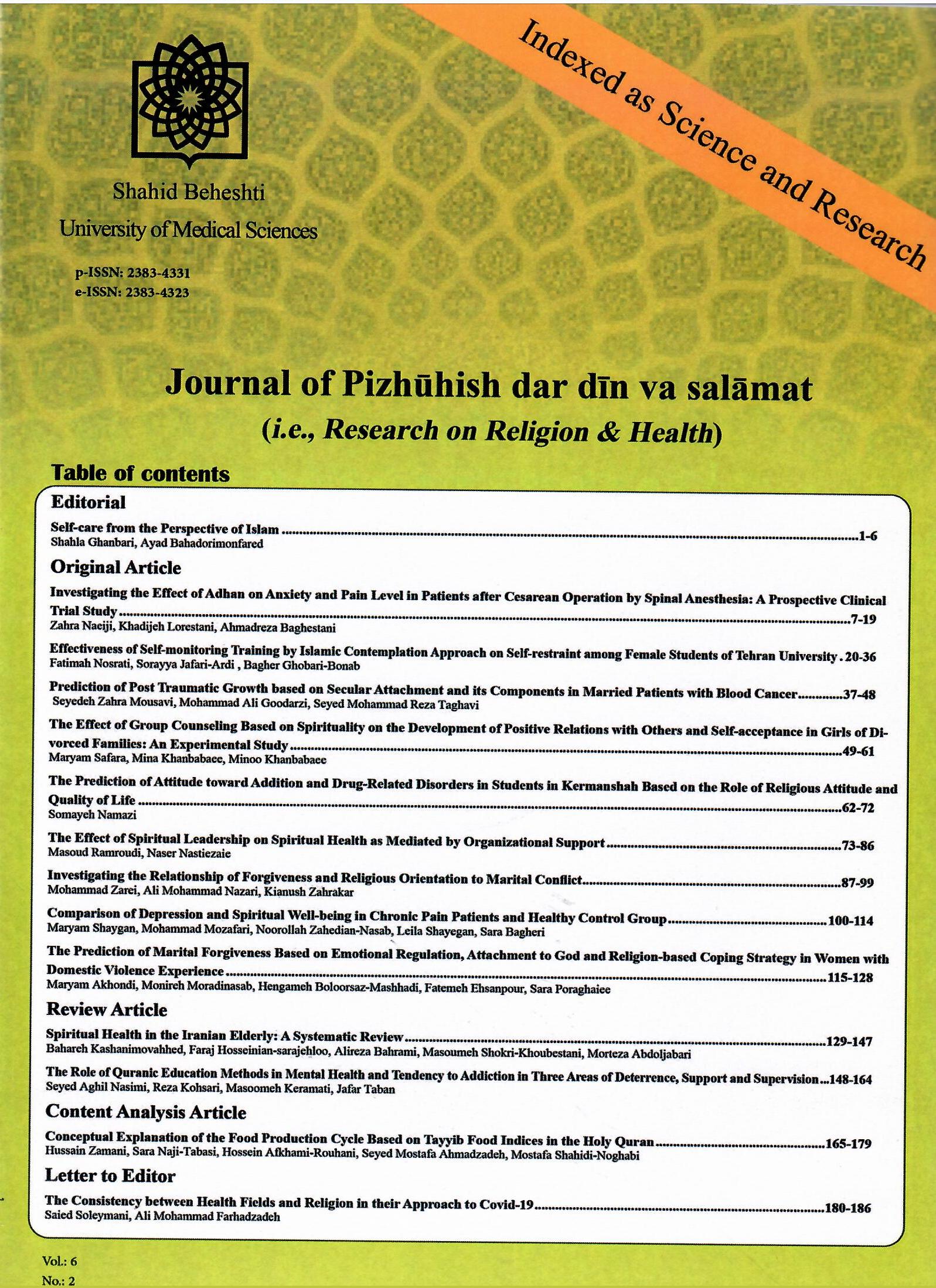
التنبؤ بالنمو مابعد الصدمة بناءً على التعلق المادي وأبعاده لدى المرضى المتزوجين المصابين بسرطان الدم
مجلة البحث في الدين و الصحّة,
مجلد 6 عدد 2 (2020),
13 حزيران 2020
,
الصفحة 37-48
https://doi.org/10.22037/jrrh.v6i2.22556
الملخص
خلفية البحث وأهدافه: ركزت العديد من الدراسات المختلفة في السنوات الاخيرة على قضية النمو ما بعد الصدمة فيما يتعلق بمختلف الضغوطات، بما في ذلك الأمراض الجسدية. الغرض من الدراسة، التنبؤ بالنمو مابعد الصدمة وفقا للتعلق المادي وابعاده في المتزوجين المصابين بسرطان الدم في مدينة شيراز.
منهجية البحث: تم اجراء هذه الدراسة بطريقة وصفيةـ مستعرضة ومن نوع البحث الارتباطي. اشتمل المجتمع الاحصائي جميع المرضى المصابين بسرطان الدم الذين راجعوا مستشفى "نمازي" أو مستوصف "مطهري" في شيراز لغرض العلاج خلال فترة 18-2017. ومن بين هؤلاء المرضى، تم اختيار 124 مريضاً باستخدام طريقة أخذ العينات المتاحة. اشتملت أدوات التقييم، استبيانات النمو ما بعد الصدمة والتعلق المادي. ومن اجل تحليل المعطيات، تم استخدام اختبار ارتباط بيرسون والانحدار البسيط والمتعدد. تمت مراعاة جميع الموارد الأخلاقية في هذا البحث واضافة الى هذا فإن مؤلفي البحث لم يشيروا الى اي تضارب في المصالح.
الكشوفات: اظهرت النتائج ان التعلق المادي يستطيع ان يتنبأ بالنمو مابعد الصدمة بشكل سلبي (05/0>P). واضافة الى هذا، فمن بين مكونات استبيان التعلق، قدم مكون "التعلق الى الوضع الراهن" تنبأ اقوى بمستوى النمو بعد الصدمة مقارنة للمكونات الأخرى.
الاستنتاج: وفقًا لنتائج البحث، فإن التعالیم والمداخلات التي تستطيع ان تبعد المرضى المصابين بسرطان الدم عن "التعلقات المادية"، خاصة "التعلق إلى الوضع الراهن"، فمن شأنها أن تسهل النمو ما بعد الإصابة.
يتم استناد المقالة على الترتيب التالي:
Mousavi SZ, Goodarzi MA, Taghavi SMR. Prediction of Post Traumatic Growth based on Secular Attachment and its Components in Married Patients with Blood Cancer. Journal of Pizhūhish dar dīn va salāmat. 2020;6(2):37-48. https://doi.org/10.22037/jrrh.v6i2.22556
- التعلق المادي؛ سرطان الدم؛ المتزوج؛ النمو مابعد الإصابة
كيفية الاقتباس
المراجع
Baillie SE, Sellwood W, Wisely JA. Post-traumatic growth in adults following a burn. Burns. 2014;40(6):1089-96.
Tedeschi RG, Calhoun LG. The Posttraumatic Growth Inventory: Measuring the positive legacy of trauma. Journal of traumatic stress. 1996;9(3):455-71.
Tedeschi RG. Posttraumatic growth in combat veterans. Journal of Clinical Psychology in Medical Settings. 2011;18(2):137.
Linley PA, Joseph S. Positive change followingtrauma and adversity: A review. Journal of traumatic stress: official publication of the international society for traumatic stress studies. 2004;17(1):11-21.
Corey G. Theory and practice of group counseling: Nelson Education; 2011.
Nikmanesh Z. Prediction of posttraumatic growth base on of spirituality and social support in patients with breast cancer. Iranian Quarterly Journal of Breast Disease. 2013;6(2):35-42. (Full Text in Persian)
Fazel M, Salimi BH, Farahbakhsh K, Esmaeili M. Post traumatic growth Model in cancer patients: A grounded theory study. 2017. (Full Text in Persian)
Sawyer A, Ayers S, Field AP. Posttraumatic growth and adjustment among individuals with cancer or HIV/AIDS: A meta-analysis. Clinical Psychology Review. 2010;30(4):436-47.
Heidarzadeh M, Rassouli M, Mohammadi SHahbolaghi F, Alavi MH, Karam AM, Mirzaee H, et al. Posttraumatic growth and its dimensions in patients with cancer. Middle East Journal of Cancer. 2014;5(1):23-49. (Full Text in Persian)
Mehrabi E, Hajian S, Simbar M, Houshyari M, Zayeri F. Post-traumatic growth: a qualitative analysis of experiences regarding positive psychological changes among Iranian women with breast cancer. Electronic physician. 2015;7(5):1239.
Zand A, Imani S, Saadati M, Borna H, Ziaei R, Honari H. Effect of age, gender and blood group on blood cancer types. Kowsar Medical journal. 2010;15(2):111-4. (Full Text in Persian)
Bakhshi Biniaz R, Mortazavi Y, Taherkhani R, Dehghan N, Mostafaei L, Sefidi F, et al. The Experts' Views on Challenges and Needs for Diagnosis and Treatment Process of Blood Cancer in Iran. Journal of Zanjan University of Medical Sciences & Health Services. 2014;22(91): 61-72. (Full Text in Persian)
Elahi Qomshei M. Quran Karim. Qom: Publication Aeyne Danesh; 2005p;74. (Full Text in Persian)
Ebrahimipour H, Vejdani M, Taghipour A, Heidarabadi AB, Molavi Y. Spiritual health in cancer patients at OMID hospital affiliated with Mashhad University of Medical Sciences-2012. Journal of Reaserch on Religion & Health. 2015;1(2):3-9. (Full Text in Persian)
Bahrainian SA, Mohammadi H, Mortazavi MA. The relationship between trusting God and mental health in medical students of Shahid Beheshti University of Tehran. Journal of Reaserch on Religion & Health. 2015;1(4):12-20. (Full Text in Persian)
Karimifar M, Rouholamini MS, Dinparvar E, Sohrabi Esmroud F. Asarbakhshi-ye Amoozesh-e Moalefehay-e Ma'navi bar Moalefehay-e Ravanshenasi-ye Mosbat dar Novjavanan. Pazuheshname Eslami Zanan va Khanevadeh. 2016; 4(2):113-36. (Full Text in Persian)
Askari MA, Mohammadi H, Radmehr H, Jahangir AH. The effect of spiritual–religious psychotherapy on enhancing quality of life and reducing symptoms of anxiety and depression among the elderly. J Res Relig Health. 2018;4(2):29-41. (Full Text in Persian)
James AG, Fine MA. Relations between youths' conceptions of spirituality and their developmental outcomes. Journal of Adolescence. 2015;43:171-80.
Hurlbut J, Ditmyer M. Defining the meaning of spirituality through a qualitative case study of sheltered homeless women. Nursing for women's health. 2016;20(1):52-62.
Rosmarin D, Alper D, Pargament K. Religion, spirituality, and mental health. 2016.
Sharma V, Marin DB, Koenig HK, Feder A, Iacoviello BM, Southwick SM, et al. Religion, spirituality, and mental health of US military veterans: Results from the National Health and Resilience in Veterans Study. Journal of affective disorders. 2017;217:197-204.
Ghahremani Z, Heidari N, Shabani M, Agvami M, Hariri M. Religious beliefs and mental health among handicapped community member. J Adv Med Biomed Res. 2014;22(90):53-61. (Full Text in Persian)
Olson MM, Trevino DB, Geske JA, Vanderpool H. Religious coping and mental health outcomes: An exploratory study of socioeconomically disadvantaged patients. Explore. 2012;8(3):172-6.
Lucette A, Ironson G, Pargament KI, Krause N. Spirituality and religiousness are associated with fewer depressive symptoms in individuals with medical conditions. Psychosomatics. 2016;57(5):505-13.
Mihaljevic S, Aukst-Margetic B, Karnicnik S, Vuksan-Cusa B, Milosevic M. Do spirituality and religiousness differ with regard to personality and recovery from depression? A follow-up study. Comprehensive psychiatry. 2016;70:17-24.
Mahdiyar M, Taghavi M, Goodarzi M. Construction and validation of secular attachment scale. Culture in the Islamic University. 2018;7(4):467-84. (Full Text in Persian)
Elliott JE. Compensatory buffers, depression, and irrational beliefs. Journal of Cognitive Psychotherapy. 1992;6(3):175-84.
Cassibba R, Papagna S, Calabrese MT, Costantino E, Paterno A, Granqvist P. The role of attachment to God in secular and religious/spiritual ways of coping with a serious disease. Mental Health, Religion & Culture. 2014;17(3):252-61.
Valikhani A, Sarafraz MR. Research Methodology in Psychology. Tehran: Publication Binesh; 2015.p;99. (Full Text in Persian)
Nikmanesh Z, Emamhadi M, Mirabdollahi N. Predictions of post-traumatic growth according to spirituality, social support and positive affection in deferent age groups with breast cancer. Journal of Research and Health. 2013;3(2):355-62.
Fattahi R, Neshat Doost HT, Rabiee M, Sharifi E. Barresi-ye Rabeteh-ye bein Moghabeleh-ye Mazhabi va Khoshbakhti-ye Ma'navi ba Salamat-e Ravan-e Zanan. Pazuheshname Eslami Zanan va Khanevadeh. 2015;5(8):85-98. (Full Text in Persian)
Moallemi S, Bakhshani NM, Raghibi M. On the relationship between mental health, spiritual intelligence and dysfunctional attitudes in students of Systan and Baluchestan University, Southeast of Iran. Quart J Fundamental Mental Health. 2011;3(48):702-9. (Full Text in Persian)
Frankl VE, Man S. Search for Meaning: An Introduction to logotherapy.Translator: Nehzat Salehian & et al. 48 ed. Tehran: Publication Dorsa; 2018.
- الملخص المشاهدات: 520 الأوقات
- PDF (فارسی) التنزيلات: 255 الأوقات