
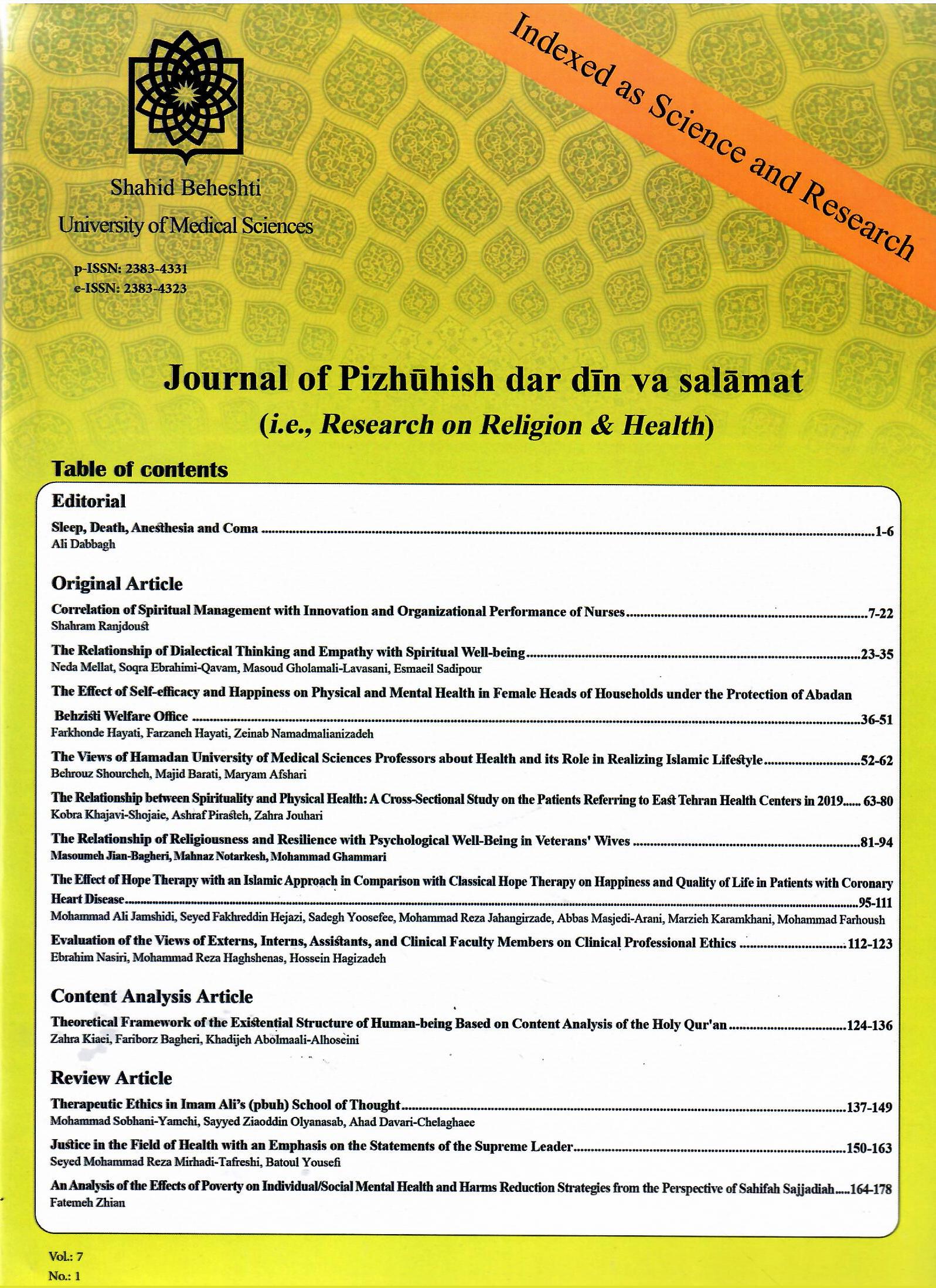
Evaluation of the Views of Externs, Interns, Assistants, and Clinical Faculty Members on Clinical Professional Ethics
Journal of Pizhūhish dar dīn va Salāmat (i.e., Research on Religion & Health),
Vol. 7 No. 1 (2021),
14 Esfand 2021
,
Page 112-123
https://doi.org/10.22037/jrrh.v7i1.25575
Abstract
Background and Objective: Education and observance of the principles of professional ethics in the clinical fields of medicine are always considered as important. The purpose of this study was to determine the views of trainees, interns and clinical assistants on the importance of observing clinical professional ethics.
Methods: This is a descriptive cross-sectional study. The statistical population of the study included all trainees, interns, clinical assistants and clinical faculty members of Mazandaran University of Medical Sciences in 2017-18, out of whom (380 people) 320 were selected by available sampling method. The questions were identified in five areas: conscientiousness, respect for others, career excellence, honor and honesty, and altruism. T-test and ANOVA were used to analyze the quantitative data and chi-square test was used for analyzing the qualitative variables. In this study, all ethical considerations have been observed and no conflict of interest was reported by the authors.
Results: 320 participants took part in the present study (84%), out of whom 163 (50.9%) were female. Their mean age was 26.8±6.4. With regard to their frequency distribution, 128 (40%) were externs, 127 (39.7%) were interns, 51 (17.5%) were assistants and 9 (2.8%) were professors. 84.1% of the participants considered avoiding the use of derogatory sentences towards patients as an important option in clinical professional ethics. Men and women did not differ in their views on the importance of moral statements (P<0.844). The views of externs, interns, residents and professors on the importance of ethical codes were significantly different (P<0.035).
Conclusion: From the perspective of clinical participants, some items such as respect for patients were more important but were less important in the field of job excellence. Therefore, there is a need to strengthen internal motivation and emphasize the position of clinical professional ethics indicators in medical training programs for some insignificant reported items.
Please cite this article as: Nasiri E, Haghshenas MR, Hagizadeh H. Evaluation of Trainees, Interns and Assistants, and Clinical Faculty Members about Clinical Professional Ethics. Journal of Pizhūhish dar dīn va salāmat. 2021;7(1):112-123. https://doi.org/10.22037/jrrh.v7i1.25575
- Ethics education; Medical Professionalism; Medical ethics
How to Cite
References
Shojaei AA. The virtues of Muslim physicians. Medical Ethics and History of Medicine. 2017;10(1):302-18. (Full Text in Persian)
Ghafari F. Dornamei az Akhlaghe Pezeshki va Reayete Hoghoghe Bimar dar barkhi Motone Tebe Sonati Iran va Eslam. Medical History Quartery. 2010;2(4):11-45. (Full Text in Persian)
Mohamadi N, Gholami N, Rezaei S, Zangeneh M, Shahnavazi M, Roshanaei G, et al. Evaluating staff and students’ knowledge about professional ethics in the Field of Communication, Law and Ethics Research Medical Education (RME). GUMS. 2018;9(4):1-9
Shojaei A, Faramarz-Gharamaleki A. Students' rights in teaching system. Iranian Journal of Medical Ethics and History of Medicine. 2010;4(1):71-7. (Full Text in Persian)
Pourleyli A, Oveisi S, Sabzmakan L, Fereidoun A. Mutual Viewpoints of Faculty Members and Residents Regarding Clinical and Educational Performance Compliance with Professional Ethics in Qazvin University of Medical Sciences. Iranian Journal of Medical Education. 2015;14(11):1007-19.
Amni H. Taahode herfeie,yek entekhab ya yek zarorat dar amozesh va arzyabihe dorehe dastyari. Iranian Journal of Psychiatry and Clinical Psychology (IJPCP). 2015;21(2):85-7. (Full Text in Persian)
Tabei S, Afshar L. Patint's Rights in University Teaching Hospitala and Ethical Chaldenges. Medical eEthics Quartery. 2010;4(13):89-105. (Full Text in Persian)
Allami A, Mohammadi N, Shirazi M. Faculty Members Experience About Teaching of Medical Professionalism in Qazvin University of Medical Sciences. Research in Medical Education. 2015;7(2):1-11. (Full Text in Persian)
Fazeli Z, Fazeli-Bavandpour FS, Rezaei-Tavirani M, Mozafar M, Haidari-Moghadam R. Professional ethic and its role in the medicine. Scientific journal of ilam univercity of medical sciences. 2012;20(4):13-8. (Full Text in Persian)
Mobashery M, Khosravi SH, Deris F, Taji F, Taheri -Mardanpour E. Characteristics of a Good Teacher in Terms of Students of Health School in Shahrekord University of Medical Sciences. Research in Medical Education. 2011;3(2):1-8.
Mohamadizadeh M, Rahimi H, Sabri M, Yamani N. Tadvin va Piyadesazi "Majmoehe Dastoroamal va Abzarhaye Arzeshyabi Payebandi Dastyaran be Osole Herfeaei" dar Grohaye Amozeshi Balini Tarbiyat Konandeh Dastyare Takhasosi. Iranian Journal of Medical Education (IJME). 2017;17:137-42 .(Full Text in Persian)
Padash P, Sanagoo A, Jouybari L, Mobasher E. The Perspectives of the Faculty Members, Medical Interns and Residents of Obstetrics and Gynecology Ward about Influencing Factors of Professional Ethics Development in Practice. The Iranian Journal of Obstetrics, Gynecology and Infertility. 2017;20(5):39-47. (Full Text in Persian)
Akbari M, Moeintaghavi A, Ghanbari H, Bagheri M, OtoufiA. A comparison of the students and teachers viewpionts about the characteristics of a good teacher in dentistry. Journal of Mashhad Dental School. 2015;38(4):281-90.
Darabi MR, Derakhshan A, Ali-Kiani M, Hosein-Maleki G, Saeidi M. Evaluating and Comparing the Views of Teachers and Students about the Criteria of a Good Professor at Mashhad University of Medical Sciences, Iran. Dev Med Educ. 2014;10(4):473-84.
Ghorbani R, Haji-Aghajani S, Heidarifar M, Andade FM, Shams-Abadi. Viewpoints of nursing and para-medical students about the features of a good university lecturer. Koomesh. 2009;10(2):77-84. (Full Text in Persian)
Dibaii A, Saadati N, Qadakzadeh S. Attitude of medical students and graduates of medical ethics at the University of Jondi Shapour, 2006-2007. Medical Ethics Journal. 2009;3(7):111-39 .(Full Text in Persian)
Johnston C, Haughton P. Medical students’ perceptions of their ethics teaching. Journal of Medical Ethics. 2007;33(7):418-22.
Purama A, Azizzadeh M, Asadabadi A. Professional values of nursing students in Kerman: A descriptive study. Journal of Medical Ethics and History of Medicine (IJME). 2015;7(6):79-88. (Full Text in Persian)
Martin P, Yarbrough S, Alfred D. Professional values held by baccalaureate and associate degree nursing students. Journal of Nursing Scholarship. 2003;35(3):291-6.
Mueller P. Incorporating professionalism into medical education: the Mayo Clinic experience. Keio J Med. 2009;58(3):133-43.
Mohammad Davoudi A, Milad M, Shayan S. The Relationship between Professional Ethics and Organizational Commitment Mediated by Organizational Justice in Ministry of Health and Medical Education, Deputy of Education. Iranian Journal of Medical Education (IJME). 2018;18:541-50. (Full Text in Persian)
Chestnut D. On the road to professionalism. Anesthesiology 2017;126(5):780-6.
Vasheghani-Farahani A, Maleki M, Golpira R, Bakhshandeh H, Parsa M, Mayel-Afshar M, et al. Perspectives of doctors, nurses and patients on physicians’ observance of professional ethics. Iran J Med Ethics Hist Med. 2015;8(1):59-66.
Seyedjavadi M, Mohammadi R, Mirzayee A, Mirzayee M. Surveying the Level of Ethical Development of Nurses Working in Educational Hospitals of Ardabil University of Medical Sciences in 2017. International Journal of Medical Education. 2019;12(1):183-95. (Full Text in Persian)
- Abstract Viewed: 468 times