
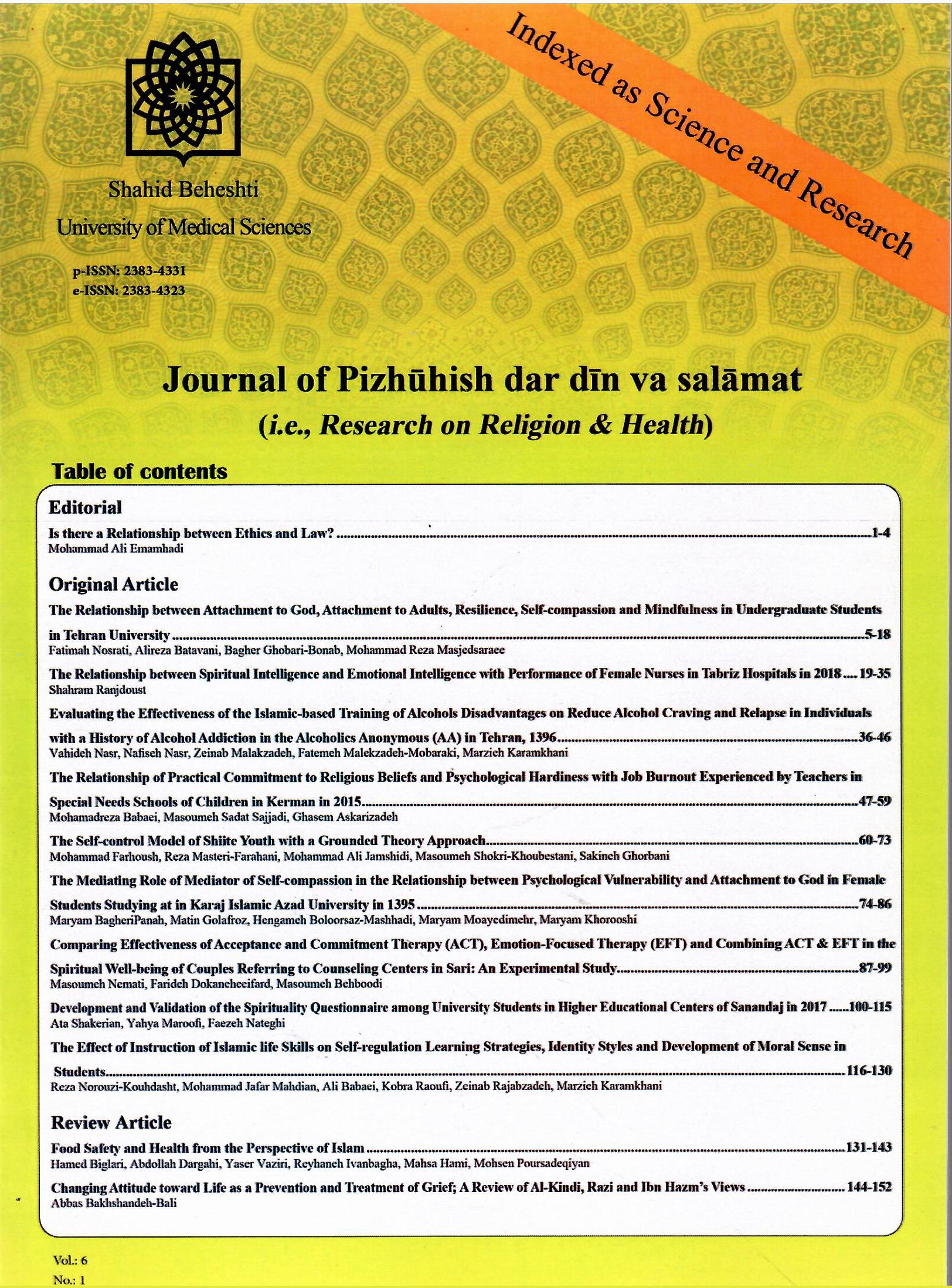
Changing Attitude toward Life as a Prevention and Treatment of Grief; a Review of Al-Kindi, Razi and Ibn Hazm’s Views
Journal of Pizhūhish dar dīn va Salāmat (i.e., Research on Religion & Health),
Vol. 6 No. 1 (2020),
22 March 2020
,
Page 144-152
https://doi.org/10.22037/jrrh.v6i1.21831
Abstract
Background and Objective: Some Muslim philosophers tried to present solutions for basic prevention and treatment of worldly grief with a focus on rational principles. This can be observed in al-Kindi’s thoughts as a first Muslim philosopher. Other important philosophers like Razi and Ibn Hazm also tried to more deeply pay attention to the issue. Therefore, the purpose of the present study is to check out the solutions presented by al-Kindi, Razi and Ibn Hazm for controlling worldly grief.
Methods: This is a library-based study organized as a descriptive-analytic method and tries to investigate al-Kindi, Razi and Ibn Hazm’s works on basic prevention and treatment of worldly grief. The author declared no conflict of interest.
Results: The findings of this study point to the existence of a rational solution, which is matched with religious texts in al-Kindi, Razi and Ibn Hazm’s works. Accordingly, al-Kindi, Razi and Ibn Hazm consider human mistake in attitude to the world as the main cause of worldly grief. In other words, getting engaged in the material issues directs the spirit toward grief. At the time of grief, the attitude toward life needs be reconsidered.
Conclusion: Based on the findings if a person can adopt a logical view of life in the world and act in the right way, he/she can control the worldly grief and replace it with happiness.
Please cite this article as: Bakhshandeh-Bali A. Changing Attitude toward Life as a Prevention and Treatment of Grief; a Review of Al-Kindi, Razi and Ibn Hazm’s Views. Journal of Pizhūhish dar dīn va salāmat. 2020;6(1):144-152. https://doi.org/10.22037/jrrh.v6i1.21831
- Grief; Happiness; Islam; Philosophy; Spirit
How to Cite
References
Azarnoosh A. Modern Arabic-Persion Dictionary. Tehran: Ney; 2002. p. 120. (Full Text in Arabic)
Ragheb E. Al-Mofradat fi Gharib Al-Quran. Vol.1. Dameshgh: Dar Al-Ghalam; 1991. p. 231. (Full Text in Arabic)
Fayyomi A. Al-Mesbah Al-Monir. Vol.2. Qom: Dar Al-Fekr; 1405. p. 641. (Full Text in Arabic)
Ibn Manzore MI. lesan Al-Arab. Vol.13. Beirute: Dar-o Alsader; 1993. p. 111. (Full Text in Arabic)
Kashani A. Tozih Manazel Al-Saelin. Qom: Bidar Publication; 2006.p. 234. (Full Text in Arabic)
The Holy Quran. Qom: Imam Ali Ebne Abi Taleb (Ýa); 2010. Mojadalah. verse 10. (Full Text in Arabic)
Majlesi M. Bihar-Al-Anwar. Tehran: Eslamiah Publication; 1985.p. 240. (Full Text in Arabic)
Gilani A. Explanation of the Mesbah Al-Shariah. Qom: Payame Hagh Publication; 1998.p. 187. (Full
Text in Persian)
Balkhi JM. Masnavi-ye-Ma'navi. Tehran: Ministry
of Culture and Islamic Guidance; 1994. p.323. (Full Text in Persian)
Badvi A. Philosophy. Vol.2. Qom: Zavi Al-Ghorba Publication; 2006. p.145. (Full Text in Arabic)
Badvi A. Philosophy. Vol.2. Qom: Zavi Al-Ghorba Publication; 2006. p.309. (Full Text in Arabic)
Pourafkari N. Dictionary of Psychology and Psychiatry. Tehran: Culture of Contemporary;1997. p.635. (Full Text in Persian)
Nejati MO. Ravanshenasi az Didgah-e Daneshmandan-e Mosalman.Translator: Beheshti S. Tehran: Roshd; 2009.p.47. (Full Text in Persian)
Nejati MO. Ravanshenasi az Didgah-e Daneshmandan-e Mosalman.Translator: Beheshti S. Tehran: Roshd; 2009.p.46. (Full Text in Persian)
Nejati MO. Ravanshenasi az Didgah-e Daneshmandan-e Mosalman.Translator: Beheshti S. Tehran: Roshd; 2009.p.310. (Full Text in Persian)
Ainevand S. Din va Ravanshenasi az Didgah-e Ebn Roshd. Tehran: Ney; 2006 .p. 19. (Full Text in Persian)
Badvi A. Philosophy. Vol.2. Qom: Zavi Al-Ghorba Publication; 2006.p.310. (Full Text in Arabic)
Safa Z. Tarikh-e Oloom-e Aghli dar Tamadon-e Eslami ta Avaset-e Qharn-e Panjom. Tehran: Majid Publication; 2005.p.199. (Full Text in Persian)
Razi M. Al-Teb Al-Rohani. Tehran: Islamic Studies Institute of the University of Tehran and McGill; 2007.p. 46. (Full Text in Arabic)
Razi M. Al-Teb Al-Rohani. Tehran: Islamic Studies Institute of the University of Tehran and McGill; 2007.p.75. (Full Text in Arabic)
Ibn Hazm A. Al-Akhlagh va Al-Seyr fi Modavamah Al-Nofos. Beyrot: Dar Al-Afagh Al- Jadidah; 1978.p.14. (Full Text in Arabic)
Ravanshenasi az Didgah-e Daneshmandan-e Mosalman.Translator: Beheshti S. Tehran: Roshd; 2009.p.160. (Full Text in Persian)
Ibn Hazm A. Al-Fasl fi Al-Ahva va Al-nehal. Vol.5. Beyrut: Dar Al-Fekr; 1980.p.72. (Full Text in Arabic)
Ibn Hazm A. Al-Akhlagh va Al-Seyr fi Modavamah Al-Nofos. Beyrut: Dar Al-Afagh Al-Jadidah; 1978.p. 13-4. (Full Text in Arabic)
Balkhi JM. Masnavi-ye-Ma'navi. Vol.5. Tehran: Ministry of Culture and Islamic Guidance; 1994.p. 673. (Full Text in Persian)
Bakhshandehbali A. Barresi-ye Marahel-e Sheklgiri-ye Hoviat-e Dini-ye Koodakan va Nojavanan. Qom: Center for Radio and TV Islamic Studies; 2006. p. 29-61. (Full Text in Persian)
Ibn Hazm A. Al-Taghrib lehadd Al-Mantegh.
Beyrut: Al-Moassasah Al-Arabiyyah; 1983.p.287-8. (Full Text in Arabic)
Bakhshandehbali A. Avaz-e Aghle Sorkh: Morori bar Andishehay-e Sheikh Eshragh. Tehran: Centre of Young Thougth; 2010. p.42-69. (Full Text in Persian)
Bakhshandehbali A. Roots of lights Order Sohravardi. Qom: Maarefah; 2010.p.54-5. (Full Text in Persian)
Suhrawardi S. Collection Works of Sheykh Eshraq Vol.2. Tehran: Institution of liberal Arts and Researches Cultural; 2001.p.244. (Full Text in Persian)
Suhrawardi S. Collection Works of Sheykh Eshraq. V.3. Tehran: Institution of liberal Arts and Researches Cultural; 2001. 393-5. (Full Text in Persian)
- Abstract Viewed: 710 times
- PDF (فارسی) Downloaded: 349 times