
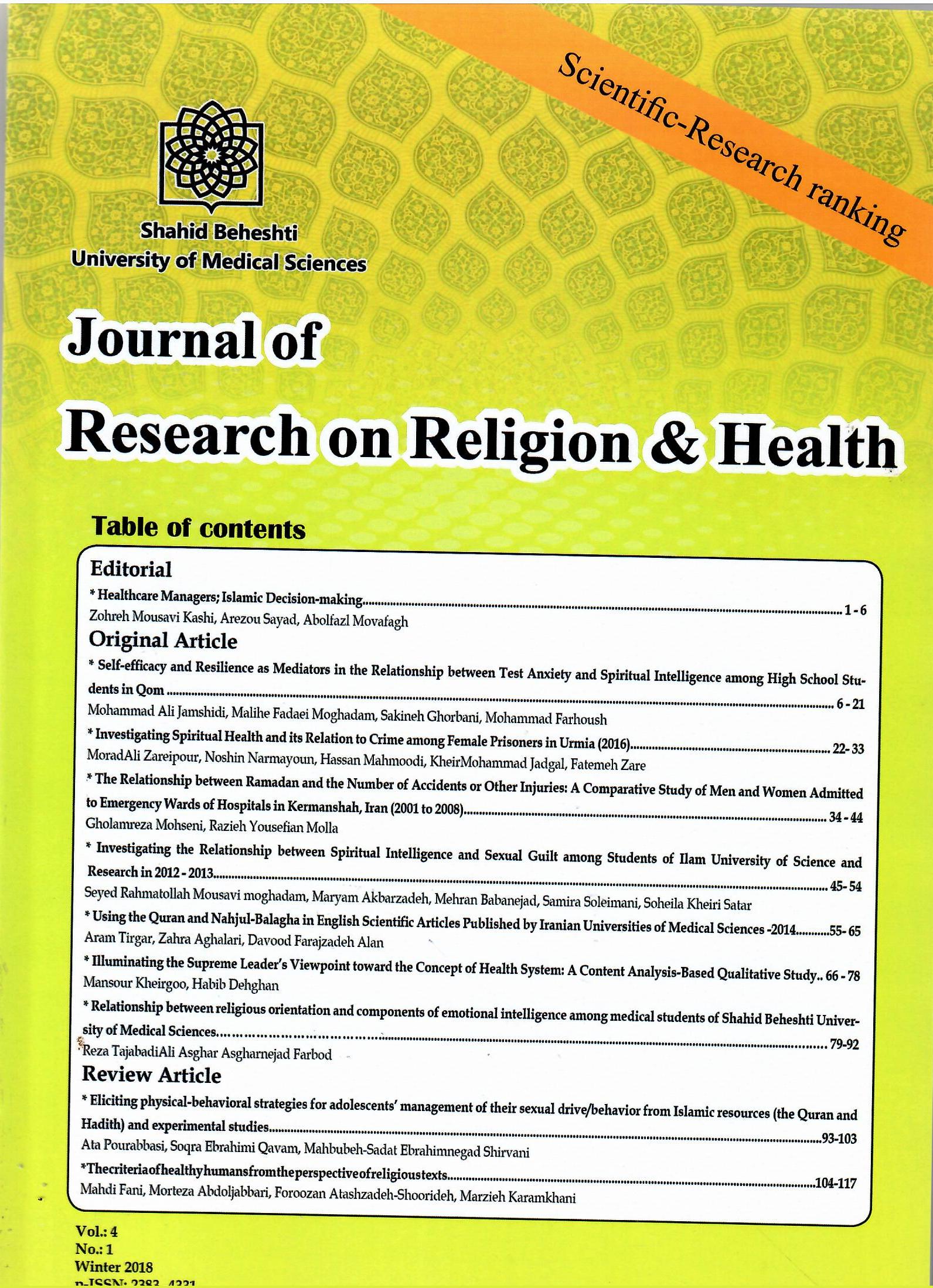
نقش میانجی خودکارآمدی و تابآوری در رابطهی هوش معنوی و اضطراب امتحان دانشآموزان دبیرستانی شهر قم
پژوهش در دین و سلامت ,
دوره 4 شماره 1 (2018),
30 دسامبر 2017
,
صفحه 7-21
https://doi.org/10.22037/jrrh.v4i1.15402
چکیده
سابقه و هدف: هوش معنوی در کاهش اضطراب امتحان که موجب کاهش عملکرد تحصیلی میشود، مؤثر است. کشف متغیّرهای واسطه در رابطهی هوش معنوی و اضطراب امتحان، زمینهی تدوین بستههای آموزشی مناسبتر هوش معنوی را برای کاهش این اضطراب فراهم میکند. هدف این پژوهش، بررسی نقش میانجی خودکارآمدی و تابآوری در رابطهی هوش معنوی و اضطراب امتحان است.
روش کار: این پژوهش توصیفی ازنوع همبستگی است و جامعهی آماری آن را تمامی دانشآموزان دبیرستانی شهر قم در سال تحصیلی 95 - 96 تشکیل میدهند. نمونهگیری پژوهش بهروش خوشهیی تصادفی انجام شده است. بدینمنظور سه مدرسهی دخترانه و سه مدرسهی پسرانه بهطور تصادفی انتخاب؛ و 380 پرسشنامه در برخی کلاسها توزیع شد که پس از جمعآوری آنها، 269 پرسشنامه (127 پسر و 142 دختر) پذیرفتنی بود. شرکتکنندگان پرسشنامههای اضطراب امتحان ساراسون، هوش معنوی عبداللهزاده، خودکارآمدی شرر و همچنین پرسشنامهی تابآوری کونور و دیویدسون را تکمیل کردند. برای تحلیل دادهها از روشهای همبستگی پیرسون و تحلیل مسیر بر اساس مدل بارون و کنی استفاده شده است. در این پژوهش همهی موارد اخلاقی رعایت شده است. علاوهبراین، نویسندگان مقاله هیچگونه تضاد منافعی گزارش نکردهاند.
یافتهها: نتایج تحلیل همبستگی پیرسون نشان داده که رابطهی اضطراب امتحان با هوش معنوی (267/0)، خودکارآمدی (475/0-) و تابآوری (330/0-) معنادار (01/0< P) است. علاوهبراین، نتایج تحلیل مسیر بر اساس مدل بارون و کنی نشان داده که خودکارآمدی (17/0) و تابآوری (09/0) رابطهی اضطراب امتحان و هوش معنوی را بهطور کامل میانجیگری میکند.
نتیجهگیری: بر اساس نتایج بهدست آمده، هوش معنوی از راه خودکارآمدی و تابآوری موجب کاهش اضطراب امتحان میشود. ازاینرو، پیشنهاد میشود برای کاهش اضطراب امتحان دانشآموزان، بستههای آموزشی هوش معنوی با تأکید بر افزایش خودکارآمدی و تابآوری آنان تدوین شود.
استناد مقاله به این صورت است:
JamshidiMA, Fadaei MoghadamM, GhorbaniS, FarhoushM. Self-efficacy and Resilience as Mediators in the Relationship between Test Anxiety and Spiritual Intelligence among High School Students in Qom. J Res Relig Health. 2018; 4(1): 7- 21.DOI: https://doi.org/10.22037/jrrh.v4i1.15402
- اضطراب امتحان؛ تابآوری؛ خودکارآمدی؛ میانجیگری؛ هوش معنوی
ارجاع به مقاله
مراجع
Zou Y, Leon W, Yao M, Hu X, Lu S, Zhu X, et al. Test anxiety and telomere length: Academic stress in adolescents may not cause rapid telomere erosion.: Oncotarget; 2017.
Trifoni A, Shahini M. How Does Exam Anxiety Affect the Performance of University Students?. Mediterranean Journal of Social Sciences. 2011; 2(2): 93-101.
Ghaffari A, Arfa Bellucci F. The relationship between achievement motivation and academic self-concept and test anxiety in graduate students of Ferdowsi University of Mashhad. Journal of Consulting and Clinical Psychology preceding studies (Studies in Education and Psychology). 2011; 1(2): 34-67. (Full Text in Persian)
Sabze Araye Langrudy M, Mohammadi M, Mehry Y, Taleei A. Mental health component and test anxiety in students at ordinary and talent schools. Applied psychological research of Psychology and Educational Sciences. 2014; 5(3): 1_17. (Full Text in Persian)
Rajabi C, Abolghasemi A, Abbasi M. The role of self-esteem and test anxiety in predicting life satisfaction in students with dyscalculia. Learning disabilities. 2012; 1(3): 46_62. (Full Text in Persian).
Jenaabadi H, Nastiezaie N, Jalalzaei S. The Effect of Time Management Training on Student’s Test Anxiety. 2 Journal of Nursing Education. 2016; 5(1): 12-22. (Full Text in Persian)
Yaghubi A, Mohagheghi H, Erfani N, Olfati N. The effect of time management training on reducing tese anxiety in the Junior High School female students in Hamedan. Journal of Ilam University of Medical Sciences. 2013; 21(1): 70_7. (Full Text in Persian)
Arizi samany Q, Abedi i, Ahmdyfrushany c. Meta-analysis of the effectiveness of psychological interventions on test anxiety level in Iran by Rosenthal and Robin methods. School psychologist. 2013; 2(5): 99_118. (Full Text in Persian)
Qhahvechi Alhoseini F, Fathy ashtiany A, Saketkin M. Compare the effectiveness of Meta-cognitive therapy with cognitive therapy in reducing test anxiety. developmental psychology of Iranian psychologists. 2015; 11(14): 357_66. (Full Text in Persian)
Kuhestani H, Baghchani N, Hekmatpu D. Exploring the experiences of nursing students of Holy Quran in test anxiety control: A Qualitative Study. Qualitative Research in Health Sciences. 2013; 2(4): 379_92. (Full Text in Persian)
Ghorbani F, Ghorbani Z, Avazeh A. The Effect of Listening to the Holy Quran on the Level of Pre-Exam Anxiety of Secondary School Students in Zanjan City, in 2011. Journal of Zanjan University of Medical Sciences. 2014; 22(90): 89-96. (Full Text in Persian)
Heidari M, Shahbazi c. An Assessment of the Effect of Recitation of the Quran on Exam Anxiety in Nursing and Emergency Medicine Students. Steps in Development of Medical Education. 2015; 12(1): 56-69. (Full Text in Persian)
Khoramirad A, Arsangjang S, Ahmaritehran H, Dehghani H. The Relation between Spiritual Intelligence and Test Anxiety Among Nursing and Midwifery Students: Application of Path Analysis. Iranian Journal of Medical Education. 2017; 13(4): 319-30. (Full Text in Persian)
Hosseini Z, Amiri H. The Relationship between Spiritual Intelligence and Anxiety Level in girl Second High School Students of West Islamabad. First International Congress of Comprehensive Psychology of Iran. Tehran Center for Development of Iran 2015. (Full Text in Persian)
Amram J. Intelligence Beyond IQ: The contribution of emotional and spiritual intelligences to effective business leadership. Institute of transpersonal psychology. 2005:35-9.
Ghobari Bonab B, Salimi M, Sliany L, Nurimoghaddam C. Spiritual Intelligence. Journal of modern religious thought. 2007; 3(10): 125_47. (Full Text in Persian)
Samadi p. Spiritual Intelligence. NEW THOUGHTS ON EDUCATION. 2006; 2(3-4): 99-114. (Full Text in Persian)
Ahmed A, Arshad M, Mahmood A, Akhtar S. Spiritual Intelligence (SQ): A Holistic Framework for Human Resource Development. Revista» Administratie si Management Public «(RAMP). 2016(26):60-77.
Zohar D, Marshal I. Spiritual intelligence: The ultimate intelligence. New York: USA: Blooms Bury; 2000.
Emmons R. Are spirituality intelligence Motivation, cognition and the psychology of ultimate concern? The international Journal for Psychology of Religion. 2000; 10(1): 3-26.
Amram J. The seven Dimension of spiritual intelligence: An ecumenical, grounded theory. . San Francisco: Institute of transpersonal psychology, American Psychological Association; 2007.
Sohrabi F, Naseri A. Spiritual Intelligence and its measurement scales. Edition S, editor. Tehran: The Sound of Light; 2013. (Full Text in Persian)
Mahin Rasuli A, M. M, Badri R. Study of relationship between religious and nonreligious causal attributions with test anxiety of third year high school girls in Tabriz. Behavioral Sciences. 2012; 4(11): 61_79. (Full Text in Persian)
Barzegarbafruiee M, Janbozorgi M, Neyusha B. The role of "religious commitment" and "gender" in the "test anxiety. Islamic studies and psychology. 2016; 2012(6): 43_61. (Full Text in Persian)
Torres K, Turner J. Students’ foreign language anxiety and self-efficacy beliefs across different levels of university foreign language coursework. J Span Lang Teach. 2016 Jan 2; 3(1): 57-73.
Erzen E, Odacı H. The effect of the attachment styles and self-efficacy of adolescents preparing for university entrance tests in Turkey on predicting test anxiety. Learn Individ Differ. 2016 Nov 25; 36(10): 1728-41.
Putwain D, Nicholson L, Connors L, Woods K. Resilient children are less test anxious and perform better in tests at the end of primary schooling. Learn Individ Differ. 2013; 28: 41-6.
Fuente JdAdl, López-García MdA, Mariano-Vera MdG, Martínez-Vicente JdA, Zapata L. Personal Self-Regulation, Learning Approaches, Resilience and Test Anxiety in Psychology Students. . Estud Sobre Educ. 2017 Mar 23; 32(0):9-26.
Partovi A, Boland H. Relationship between Spiritual Intelligence and Resilience to the Mothers’ Stress and Neonatal Anthropometric Indices. Int J Humanit Cult Stud IJHCS ISSN 2356-5926. 2016 May 29; 1(1): 732-41
Tasharrofi Z, Hatami H, Asgharnejad A. The study of relationship between spiritual intelligence, resilience and spiritual well-being with occupational burnout in nurses. Eur J Exp Biol. 2013; 3(6): 410_4.
Abdel-Khalek A, Lester D. The association between religiosity, generalized self-efficacy, mental health, and happiness in Arab college students. Personal Individ Differ. 2017 Apr 15; 109: 12-6
Bandura A. Self-efficacy: The exercise of control. USA: W. H. Freeman; 1997.
Leone E, Dorstyn D, Ward L. Defining Resilience in Families Living with Neurodevelopmental Disorder: A Preliminary Examination of Walsh’s Framework. J Dev Phys Disabil. 2016 Aug 1; 28(4): 595-608.
The holy Quran.Sura Al-talagh.verse 3. Qom: darolghoran karim 1994.
The holy Quran.Sura Al-fosselat.verse 30. Qom: darolghoran karim 1994.
The holy Quran.Sura Al-ghafer.verse 60. Qom: darolghoran karim 1994.
The holy Quran.Sura Al-ahghaf.verse 13. Qom: darolghoran karim; 1994.
Ibn shoebe h. Tuhaf al-uqul. Qom: Teachers Societi publication 1984. (Full Text in Arabic).
Hooman H. structural equation modeling using LISREL software. Tehran the publication of samt 2014. (Full Text in Persian)
Sarason I. The Test Anxiety Scale: Concept and Research: Defense Technical Information Center; 1977.
Byabangard I. Test anxiety, nature, causes, treatments, along with relevant tests. edition. s, editor. Tehran: Islamic Culture Publications Office 2007. (Full Text in Persian)
Sherer M, Maddux JE, Mercadante B, Prentice-Dunn S, Jacobs B, Rogers RW. The self-efficacy scale: construction and validiation. Psychological Reports. 1982; 51(2): 663-71.
Gholamali lavasani M, Rastgu L, Azarnyyad A, Ahmadi T. The effect of Happiness training by cognitive-behavioral method on self efficacy and academic stress. Cognitive strategies in learning. 2014; 0(2): 1-18. (Full Text in Persian)
Abdollahzadeh H. Construction & st&ardization of spiritual intelligence questionnaire. Tehran: Publication of psychometric; 2009.(Full Text in Persian)
Connor KM, Davidson JRT. Development of a new resilience scale: The Connor-Davidson Resilience Scale (CD-RISC). Depression And Anxiety. 2003; 18(2): 76-82.
Mohammady M. Factors affecting the resilience of people at risk of substance abuse, PhD: University of Welfare and Rehabilitation Sciences; 2005. (Full Text in Persian)
Azizi S. The Mediator variables, mediating and intervening in marketing research: concept, differences, statistical tests and procedures. New market research [Internet]. 2013 Apr 1; 2(3): 155-74. (Full Text in Persian)
Sisk DA, Torrance EP. spiritual intelligence: Developing higher consciousness. Buffalo, New York: Creative Educatin Foundation Press; 2001.
Noori samarin S. The relationship between spiritual intelligence and emotional intelligence and self-efficacy in students of Islamic Azad University of Dezful. Psychology and religion. 2016; 9(1): 107-22. (Full Text in Persian)
mombeyni s, maktabi g, behrozi n. The Effect of Academic Self-Efficacy and Metacognition on Test Anxiety and Academic Help-Seeking Behavior in 3rd Grade High School Boys. Knowledge & Research in Applied Psychology. 2015; 16(3): 42-8. (Full Text in Persian)
Askarizade Mahani M, Soleimani L, Zafarnia N, Miri C. The relationship between Self-efficacy with mental health and academic achievement Bam, Faculty of Nursing. Development of Research in Nursing & Midwifery 2015; 2(12): 29_37. (Full Text in Persian)
Akbari burang M, Aminyazdi A. The Self-efficacy believes and test anxiety in students of Islamic Azad University of southern Khorasan. Knowledge Horizon. 2009; 45(15): 70_7. (Full Text in Persian)
Bakhtiyarpour c, Hafezi F, Behzadi shini F. The relationship between locus of control, perfectionism and self-efficacy and academic performance with test anxiety in students. New findings in psychology, social psychology 2009; 13(5): 35_52. (Full Text in Persian)
Mirsamiee M, Ebrahimi ghavamabadi s. The relationship between self-efficacy, social support and test anxiety and mental health of male and female students of Allameh Tabatabai University. Psychology, Educational Psychology and Educational Sciences. 2007; 7(2): 73_92. (Full Text in Persian)
Khosravi M, Nikmanesh Z. Relationship of Spiritual Intelligence With Resilience and Perceived Stress. Iran J Psychiatry Behav Sci. 2014; 8(4): 52-6. (Full Text in Persian)
Nykamal M, Shadmanfar N. The relationship of spiritual intelligence and psychological resiliency in students. Psychological research. 2014; 6(22): 111_26. (Full Text in Persian)
Sedyqy arfaee F, Yazdkhasti A, Nady Ravandi M. Resiliency predictability based on spiritual intelligence in students and scholars of religion. Culture in the Islamic University. 2014; 4(12): 353-72. (Full Text in Persian)
Khodabakhshykulayee A, Heidari s, Khoshkonesh A, Heidari M. The relationship of spiritual intelligence and resilience to stress and preferred mode of delivery among pregnant women. Journal of Obstetrics Gynecology and Infertility. 2013; 16(58): 8_15. (Full Text in Persian)
Aerabian A, Khodapanahi M, Heidari M, Saleh Sedghpour B. The relationship between self-efficacy beliefs on mental health and educational success. Journal of Psychology. 2004; 32(8): 360_71. (Full Text in Persian)
Behdani S, Dastjerdi R, Sharifzadeh GR. Relationship between trust in God and self–efficacy With mental health in type II diabetics. Journal of Birjand University of Medical Sciences. 2012; 19(3): 302-11 (Full Text in Persian)
- چکیده مشاهده شده: 1357 بار
- PDF دانلود شده: 849 بار