
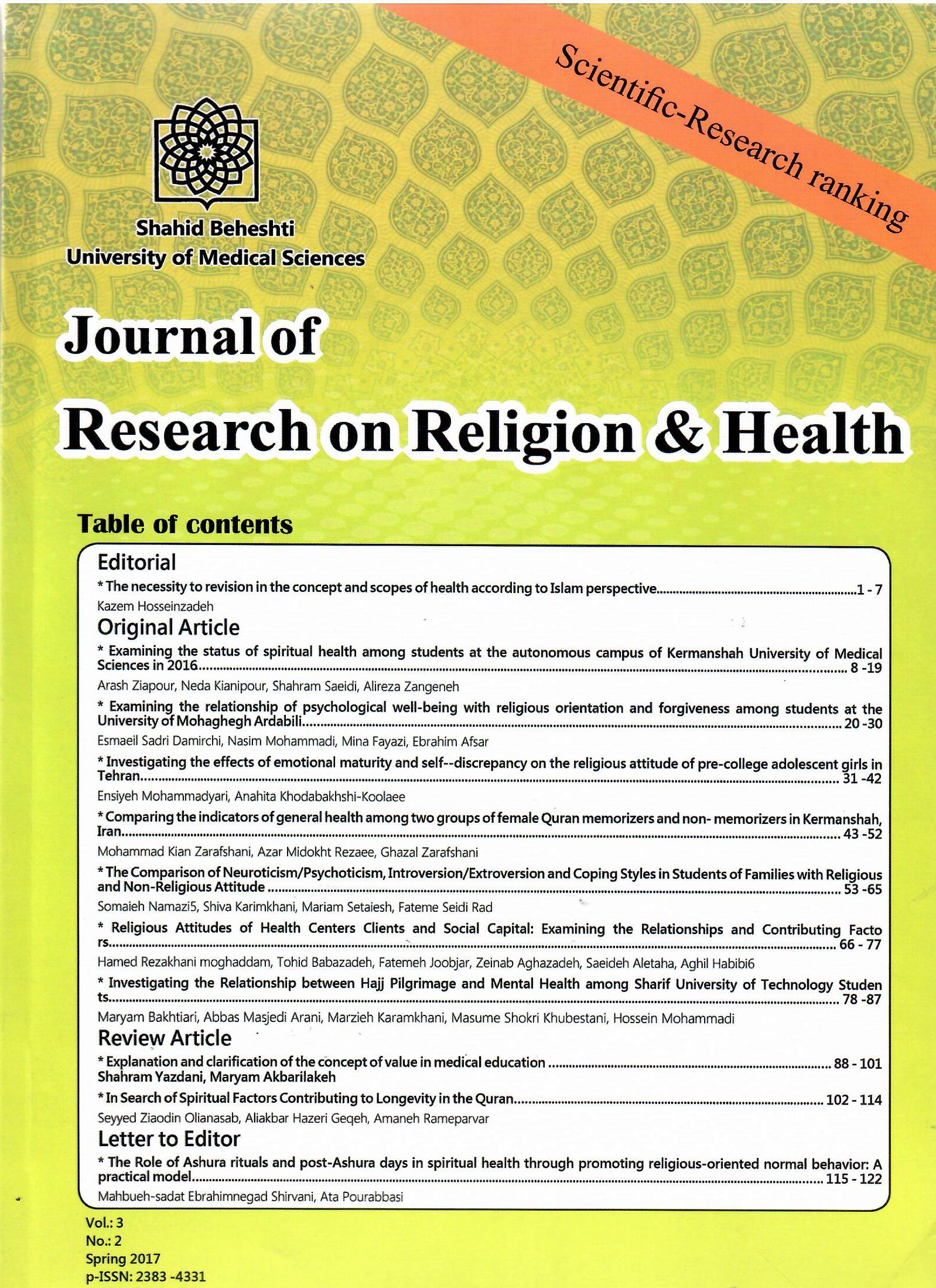
بررسی اثر بلوغ عاطفی و خودگسستگی در نگرش دینی دختران مقطع پیش دانشگاهی دبیرستان های شهر تهران
پژوهش در دین و سلامت ,
دوره 3 شماره 2 (2017),
26 فوریهٔ 2017
,
صفحه 31-42
https://doi.org/10.22037/jrrh.v3i2.14248
چکیده
سابقه و هدف: رسیدن به بلوغ عاطفی و نداشتن خودگسستگی از عامل های مهم داشتن نگرش دینی در افراد محسوب می شود. ازاین رو، در این پژوهش به بررسی اثر بلوغ عاطفی و خودگسستگی در نگرش دینی دختران نوجوان پیش دانشگاهی شهر تهران پرداخته شده است.
روش کار: این پژوهش از نوع توصیفی- همبستگی؛ و جامعه ی آماری شامل همه ی دانش آموزان دختر مقطع پیش دانشگاهی سال تحصیلی 94 - 95 شهر تهران است. برای انجام پژوهش، تعداد 405 نفر با استفاده از جدول کرجسی مورگان و روش نمونه گیری خوشه یی چند مرحله یی انتخاب شدند. ابزار جمع آوری داده ها، شامل پرسشنامه های بلوغ عاطفی (EM)، خودگسستگی و نگرش دینی بود و داده ها با استفاده از آزمون آماری تحلیل رگرسیون هم زمان، تجزیه و تحلیل شد. در این پژوهش همهی موارد اخلاقی رعایت شده است. علاوهبراین، نویسندگان مقاله هیچگونه تضاد منافعی گزارش نکردهاند.
یافتهها: یافته های پژوهش نشان میدهد که متغیّرهای بلوغ عاطفی و خودگسستگی با ضریب تعیین10/0، نگرش دینی را تبیین می کنند. بنابراین، بلوغ عاطفی با بتای31/0- ، مهمترین عامل اثرگذار (01/0p<) و خودگسستگی واقعی- آرمانی با بتای 11/0، دومین عامل اثرگذار (05/0p<) در تبیین نگرش دینی دختران نوجوان است. در این تبیین، خودگسستگی واقعی - بایسته، تأثیر معناداری نداشت (05/0p>).
نتیجهگیری: نتایج پژوهش نشان میدهد که متغیّرهای بلوغ عاطفی و خودگسستگی نقش مهمی در نگرش دینی دختران نوجوان دارند. ازاینرو، برای تقویت دینداری نوجوانان باید به این متغیّرها توجه؛ و زمینه ی آموزش های لازم به دانش آموزان (مانند آموزش مهارت های زندگی)، برای بهبود این متغیّرها فراهم شود.
استناد مقاله به این صورت است:
Mohammadyari E, Khodabakhshi-Koolaee A. Investigating the effects of emotional maturity and self-discrepancy on the religious attitude of pre-college adolescent girls in Tehran. J Res Relig Health. 2017; 3(2): 31- 42.
- بلوغ عاطفی
- خودگسستگی
- دانش آموزان
- دختران
- نگرش دینی
ارجاع به مقاله
مراجع
Behzadi BA. study of relationship between compatibility and emotional maturity of the student Islamic Azad University of Shiraz. Shiraz: Shiraz Azad University; 2000. (Full Text in Persian)
Lipschitz-Elhawi R, Itzhaky H. The contribution of
internal and external resources to emotional adjustment: A comparison of at-risk and normative adolescents. Child and Adolescent Social Work Journal. 2008; 25(5): 385- 96.
Homan H, AdhamiJamali M, Ghasemi L. Survey the Credit validity and viability Norm finding Social maturity and its relationship with Emotional Maturity in High school students in the city of Babel. Journal of Psychological research. 2011; 2(8): 13- 27. (Full Text in Persian)
Moradi A. A study of relationship emotional maturity and self- Knowledge on public school students and government examples. Tehran: Institue for human Sciences and Cultural Studies; 2013. (Full Text in Persian)
Kalaiselvan S, Maheswari K. A Study on Emotional Maturity amang the Post Granduate Students. Humanities and Social Science. 2016; 21(2): 32-4.
Berk LE. Exploring of lifespan Development. 3 ed. USA: Prentice Hall PTR; 2007.
Poorshariar H, Rasiilzadeh K, Khodapanahi M, Khazemnezhad A, Gafari S. A Study of Compatibility levels and Personality Traits in adolescents. Journal of Behavioral Sciences. 2008; 2(2): 75-85. (Full Text in Persian)
Nematollahi KN, T. A study of relationship emotional maturity and general health among single and married studend Arsangan’s Islamic Azad University. National conference on sustainable development in education sciences and psychology, Social and cultural studies; Tehran, Iran. 2014. (Full Text in Persian)
Pastey GS, Aminbhavi VA. Impact of Emotional Maturity on Stress and Self Cofidence of Adolescents. Journal of the Indian Academy of Applied Psychology. 2006; 32(1): 66- 70.
Ghafari T. A study of relationship emotional maturity and feeling lonely with Tendency to addiction on adolescents. Tabriz: Tabriz University; 2012. (Full Text in Persian)
Gravand H, Ghanbari Hashem Abadi B, Kamkar Zahrvand P, Jafari S. A comparative study of religious orientation (indoor- outdoor) with mental health and irrational beliefs. 2012; 5(1): 79- 103. (Full Text in Persian)
Ghodratimirkohi M, Khormaei E. The Relationship between religiosity and mental health in adolescents. Journal of Behavioral sciences. 2010; 2(5): 12- 21. (Full Text in Persian)
Kajbaf M, Reeicypoor H. A study of relationship Religious Attitude and Mental health on high school female students in Isfahan,Islamic Studies and. Psychology Journal. 2008; 1(2): 31- 44. (Full Text in Persian)
Samani S, Sadegh zadeh M. Survey
self_discrepancy based on process model and content family in adolescents. Education studies in psychology. 2005; 6(30): 111- 24. (Full Text in Persian)
Harter S, Marold D, .R. WN, Cobbs G. A Model of the effects of perceived parent and peer support on Adolescent false selt Behavior. Child development. 1996; 62(2): 360- 74.
Hashemi S. A study of self-conceptIntermediation role for parenting styles and aslf-discrepancy. Marvdashet: Islamic Azad University, Marvdashet unit; 2011. (Full Text in Persian)
Phillips AG, Silvia P. Evaluating self-reflection and insight as self-conscious traits. Personality and Individual Differences. 2011; 50(2): 234-7.
Samani S. Predict famel students religious self-discrepancy based Dimensional prospective tissue on the process and content family. Psychological Methods and Models. 2011; 2(8): 101- 13. (Full Text in Persian)
Marsiglia FF, Kulis S, Nieri T, Parsai M. God forbid! Substance use among religious and nonreligious youth. American Journal of Orthopsychiatry. 2005; 75(4): 585.
Nonnemaker JM, McNeely CA, Blum RW. Public and private domains of religiosity and adolescent health risk behaviors: Evidence from the National Longitudinal Study of Adolescent Health. Social science & medicine. 2003; 57(11): 2049- 54.
Higgins ET. Self- discrepancy: A theory relation self and affect. Psychological Review. 1987; 94(3): 319- 40.
Sadeghzadeh M. A study of self-discrepancy according to process model and family content. Shiraz: Shiraz University; 2006. (Full Text in Persian)
Akbari Nezhad S. Relationship between self-discrepancy and gratitude with feeling of shame and guilt on adolescent girls high schools in central province. Tehran: Al-zahra university; 2015. (Full Text in Persian)
Khodayarifard M, Shokoohi Yekta M, Ghobari Bonab B. Prepare Religious Attitude questionnaire students. Journal of Psychology & Theology. 2000; 4(15): 268- 85. (Full Text in Persian)
Sharifi F. Survey the relationship between religious attitude and autonomous self-regulation of male and female students. The first national conference on the findings of cognitive science in education; Mashhad: Mashhad Ferdowsi University; 2011. (Full Text in Persian)
Jamshidisolko B, Arabmoghaddam N, Darkhah F. Survey the relationship between religiosity and resilience in middle and high school students in shiraz. Journal of New Thoughts on Education. 2014; 10(1): 141- 61. (Full Text in Persian)
Motahhari M. Introduction to Islamic worldview:
Man and faith. 13 ed. Tehran: Sadra Publication; 2006. (Full Text in Persian)
Salimi M. Comparison of the effect of educational patterns and degree of religiousity from the perspective of parents of female high school students on emotional maturity. Tehranh: AL-Zahra University; 2010. (Full Text in Persian)
Mehrani B. A study of effectivity level multi-faceted approach Lazarus to emotional maturity of third grade girl in the district 2 Education Mallard, Shahriar. Tehran: Allameh Tabatabaei University; 2007. (Full Text in Persian)
Yeganeh T. The relationship religious orientation with emotional maturity and self–regulation in adolescents. Tabriz: Tabriz University; 2013. (Full Text in Persian)
Higgins ET, Klein R, Strauman T. Self-concept discrepancy theory: A psychological model for distinguishing among different aspects of depression and anxiety. Social cognition. 1985; 3(1): 51.
Higgins ET, Bond RN, Klein R, Strauman T. Self-discrepancies and emotional vulnerability: how magnitude, accessibility, and type of discrepancy influence affect. Journal of personality and social psychology. 1986; 51(1): 5.
Seyed Jafari H. Survey the relationship between religious attitudes, self-efficacy and general health of students. Shahrood: Islamic Azad University of Shahrood; 2015. (Full Text in Persian)
Lashni E. Survey of religion and its role in public health and self-nactualization Sistan and balochestan University students. Sistan and Balochestan: University of Sistan and Balochestan; 2011. (Full Text in Persian)
Higgins ET. Self-discrepancy theory: What patterns of self-beliefs cause people to suffer? Advances in experimental social psychology. 1989; 22: 93- 136.
- چکیده مشاهده شده: 976 بار
- PDF دانلود شده: 580 بار