
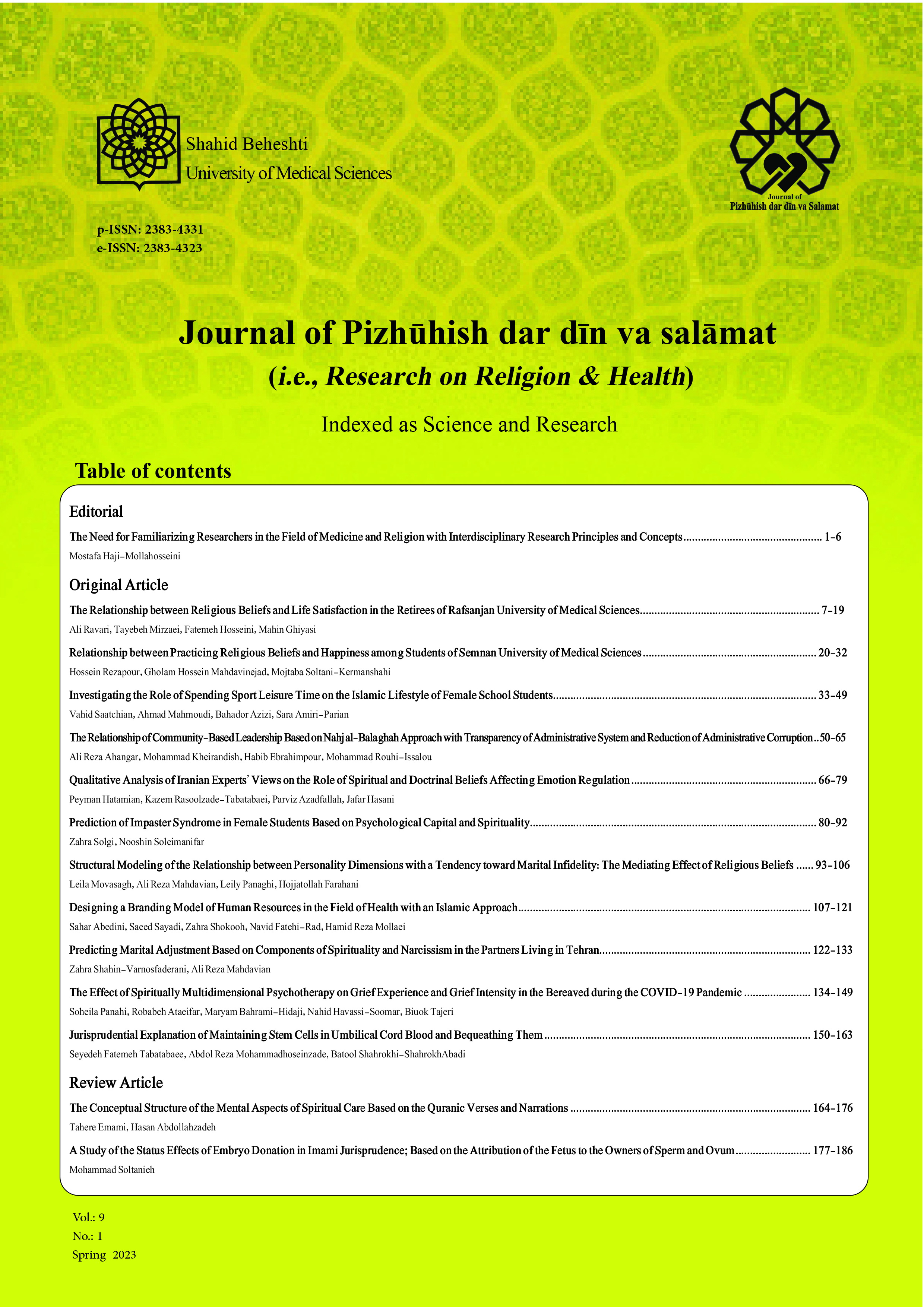
Qualitative Analysis of Iranian Experts’ Views on the Role of Spiritual and Doctrinal Beliefs Affecting Emotion Regulation
Journal of Pizhūhish dar dīn va Salāmat (i.e., Research on Religion & Health),
Vol. 9 No. 1 (2023),
27 May 2025
,
Page 66-79
https://doi.org/10.22037/jrrh.v9i1.36139
Abstract
Background and Objective: Religion and religious beliefs play an important role in human life in many societies, Therefore, the present study aimed to qualitatively analyze the opinion of Iranian experts about the role of spiritual and doctrinal beliefs affecting emotion regulation.
Methods: The present study had a qualitative design and was conducted by content analysis. The participants were specialists and experts working in the field of emotion regulation in Iran and were selected through purposeful sampling method. Semi-structured interviews were conducted with 11 experts until the saturation point was reached. In this study, all ethical considerations were observed and the authors reported no conflict of interests.
Results: After conducting the interviews, similar and duplicate codes were removed and matched. The results of data analysis yielded three main categories with six sub-themes. The main categories included religious and spiritual attitudes, taught spiritual/religious emotion regulation, and differentiating beliefs from superstitions.
Conclusion: The results showed that spiritual and doctrinal beliefs played a significant role in the way individuals regulated their emotions. Therefore, counselors and mental health therapists are recommended to pay attention to this important issue while interacting with the clients during treatment sessions.
- Emotion regulation; Health promotion; Iranian society; Spiritual beliefs
How to Cite
References
Coppin G, Sander D. Theoretical approaches to emotion and its measurement. Emotion measurement: Elsevier; 2021. p. 3-37.
Brockman R, Ciarrochi J, Parker P, Kashdan T. Emotion regulation strategies in daily life: Mindfulness, cognitive reappraisal and emotion suppression. Cognitive behaviour therapy. 2017; 46(2): 91-113.
Shackman AJ, Wager TD. The emotional brain: Fundamental questions and strategies for future research. Elsevier; 2019. p. 68-74.
Lewis M, Haviland-Jones JM, Barrett LF. Handbook of emotions: Guilford Press; 2010.
Poursamar SL, Azadfallah P, Farahani H. Conceptualizing emotion regulation in Iranian women: qualitative research based on grounded theory approche. Journal of psychological achievements. 2019;26(1):59-78. (Full Text in Persian)
Kneeland ET, Goodman FR, Dovidio JF. Emotion beliefs, emotion regulation, and emotional experiences in daily life. Behavior therapy. 2020;51(5):728-38.
Hatamian P, Hatamian P, Nouri M. The efficacy emotion regulation training sequel of gross on safety behavior nurses. 2020. (Full Text in Persian)
Gross JJ, Thompson RA. Emotion Regulation: Conceptual Foundations. InJ. J. Gross (Ed.), Handbook of Emotion Regulation. New York: The Guillford Press. 2007;3:25.
Naragon-Gainey K, McMahon TP, Chacko TP. The structure of common emotion regulation strategies: A meta-analytic examination. Psychological bulletin. 2017; 143(4):384.
Koschmieder C, Neubauer AC. Measuring emotion regulation for preservice teacher selection: A theory-driven development of a situational judgment test. Personality and Individual Differences. 2021;168: 110363.
Kring AM, Sloan DM. Emotion regulation and psychopathology: A transdiagnostic approach to etiology and treatment: Guilford Press; 2009.
Aldao A, Nolen-Hoeksema S, Schweizer S. Emotion-regulation strategies across psychopathology: A meta-analytic review. Clinical psychology review. 2010;30(2):217-37.
Thielsch C, Ehring T, Nestler S, Wolters J, Kopei I, Rist F, et al. Metacognitions, worry and sleep in everyday life: Studying bidirectional pathways using Ecological Momentary Assessment in GAD patients. Journal of Anxiety Disorders. 2015;33:53-61.
Kenny TE, Singleton C, Carter JC. Testing predictions of the emotion regulation model of binge eating disorder. International Journal of Eating Disorders. 2017;50(11):1297-305.
Bruggink A, Huisman S, Vuijk R, Kraaij V, Garnefski N. Cognitive emotion regulation, anxiety and depression in adults with autism spectrum disorder. Research in Autism Spectrum Disorders. 2016;22:34-44.
Hatamian P, Babaei A, Rasoolzadeh Tabatabaei S. Effectiveness of meta-cognitive based-training on emotion regulation and anxiety sensitivity in elderly with history of cardiovascular disease living in elderly care homes in Tehran city. Journal of Health and Care. 2019;21(4):319-29. (Full Text in Persian)
Karami J, Momeni KM, Hatamian P. The relationship between emotion dysregulation with psychoactive substance abuse in nurses working at hospitals of Kermanshah Iran 2016. Bali Medical Journal. 2017;6(3):495-9. (Full Text in Persian)
Kocsis RN. Book review: diagnostic and statistical manual of mental disorders: (DSM-5). Sage Publications Sage CA: Los Angeles, CA; 2013.
Noorbala AA, Damari B, Riazi IS. Evaluation of mental disorders incidence trend in Iran. 2014. (Full Text in Persian)
Lim N. Cultural differences in emotion: differences in emotional arousal level between the East and the West. Integrative medicine research. 2016;5(2):105-9.
Barrett LF, Mesquita B, Ochsner KN, Gross JJ. The experience of emotion. Annual review of psychology. 2007;58:373.
Trommsdorff G, Cole PM. Emotion, self-regulation, and social behavior in cultural contexts: The Guilford Press; 2011.
Kwon H, Yoon KL, Joormann J, Kwon J-H. Cultural and gender differences in emotion regulation: Relation to depression. Cognition & Emotion. 2013; 27(5):769-82.
Ford BQ, Mauss IB. Culture and emotion regulation. Current opinion in psychology. 2015;3:1-5.
Miyamoto Y, Ma X, Petermann AG. Cultural differences in hedonic emotion regulation after a negative event. Emotion. 2014;14(4):804.
Mirjalili RS, Janbozorgi M, Batoulzadeh Tabatabaei SK, Pasandideh A. An Investigation into the Effectiveness of Transdiagnostic Treatment Based on the Emotional Adjustment by a Religious-Spiritual Design on Reducing the Symptoms and Improving the General Function of the Women with Anxiety Disorders. The Islamic Journal Of Women and The Family. 2018;6(3):9-37. (Full Text in Persian)
Mahmoodi F, Sadeghi F, Jamalomidi M. Canonical analysis of the association between spiritual attitude and cognitive emotion regulation strategies among the students of Tabriz University of Medical Sciences. 2017. 15(3):280-90. (Full Text in Persian)
Paloutzian RF, Park CL. Handbook of the psychology of religion and spirituality: Guilford Publications; 2014.
Mohammadi H, Mazidi M. The Role of Faithfulness in Predicting the Strategies of Student Excitement Cognition Order. Irainian Journal of Culture in The Islamic University. 2015;4(4):605-20. (Full Text in Persian)
Jan-Bozorgi M. Spiritually Multidimensional Psychotherapy (SMP): Activation of spiritual action and its effectiveness on psychological problems of anxious clients. Journal of Islamic Psychology. 2016; 2(3):8-39. (Full Text in Persian)
Krippendorff K. Content analysis: An introduction to its methodology: Sage publications; 2018.
Khorramdel K, Rashid S, Barahmand U, Abolghasemi A. Evaluation of the psychometric properties of a Semi-structured Hoarding Rating Scale-Interview (HRS-I) in a Clinical Sample. The Medical Journal of Military Medicine. 2017;19(2):28-35.
Lincoln YS, Guba EG. Naturalistic inquiry. Thousands Oaks. Calif: Sage. 1985.
Schnitker SA, Houltberg B, Dyrness W, Redmond N. The virtue of patience, spirituality, and suffering: Integrating lessons from positive psychology, psychology of religion, and Christian theology. Psychology of Religion and Spirituality. 2017;9(3): 264.
Hojatkhah SM, Taroghtayeb M, Rahmani-Nik S, Karimi-Taleghani M, Sattari H, Ehsanpour F. The Role of Forgiveness and Spiritualism in Predicting Couples' Happiness. Journal of Pizhūhish dar dīn va salāmat. 2021;7(3):111-23. (Full Text in Persian)
Vaezi R, Alvani SM, Daneshjafari D, Motamedi M. Multi-Sectoral Partnership Approach; a Faith-Based Model for the Development of Health Infrastructures in Islamic Societies. Journal of Pizhūhish dar dīn va salāmat. 2021;7(3):124-39. (Full Text in Persian)
Khakkar S, Jahangiri M, Esmaeil Zadeh SM. A survey of health status and its dimensions in the Islamic teachings. Journal of Religion and Health. 2020;7(2):68-74. (Full Text in Persian)
Nosratzehi A, Nastiezaie N, Salimi S. Designing a Human Dignity Management Model Based on Islamic Teachings. Journal of Pizhūhish dar dīn va salāmat. 2021;7(2):7-27. (Full Text in Persian)
Moshki M, Mousavi SA, Momen Bilandi J. Design and evaluation of the spiritual health locus of control scale (SHLCS) in the Iranian Students. Journal of Religion and Health. 2019;7(1):20-30. (Full Text in Persian)
Sarkhel S. Kaplan and Sadock's Synopsis of Psychiatry: Behavioral Sciences/Clinical Psychiatry.Translated by; Farzin Rezaei. Tehran: Arjmand Publication Company; 2009. (Full Text in Persian)
Hoseynizadeh Arani SS, Kalantari A. Religion, mental health and loneliness: examine the relationship between the level of religiosity and mental health with loneliness (Study Case: Tehran Citizens). Journal of Applied Sociology. 2015;26(4):25-44. (Full Text in Persian)
Dehghani H, Ebrahimi H. Studying the feeling of social and psychological security with a tendency toward superstition (case study: Isfahan University students). Strategic Research on Social Problems in Iran University of Isfahan. 2019;8(4):99-122. (Full Text in Persian)
Abaszadeh M, Ansari Ozaei N, Bodafi A. The study of Superstitionism among students with qualitative approach. Quarterly of Social Studies and Research in Iran. 2019;8(4):847-72. (Full Text in Persian)
Servatyari K, Garousi S, Yousefi F. Frequency of belief in superstitions and its related factors among the students of Kurdistan University of Medical Sciences. Scientific Journal of Kurdistan University of Medical Sciences. 2018;23(6):25-36. (Full Text in Persian)
- Abstract Viewed: 468 times
- pdf (فارسی) Downloaded: 90 times