
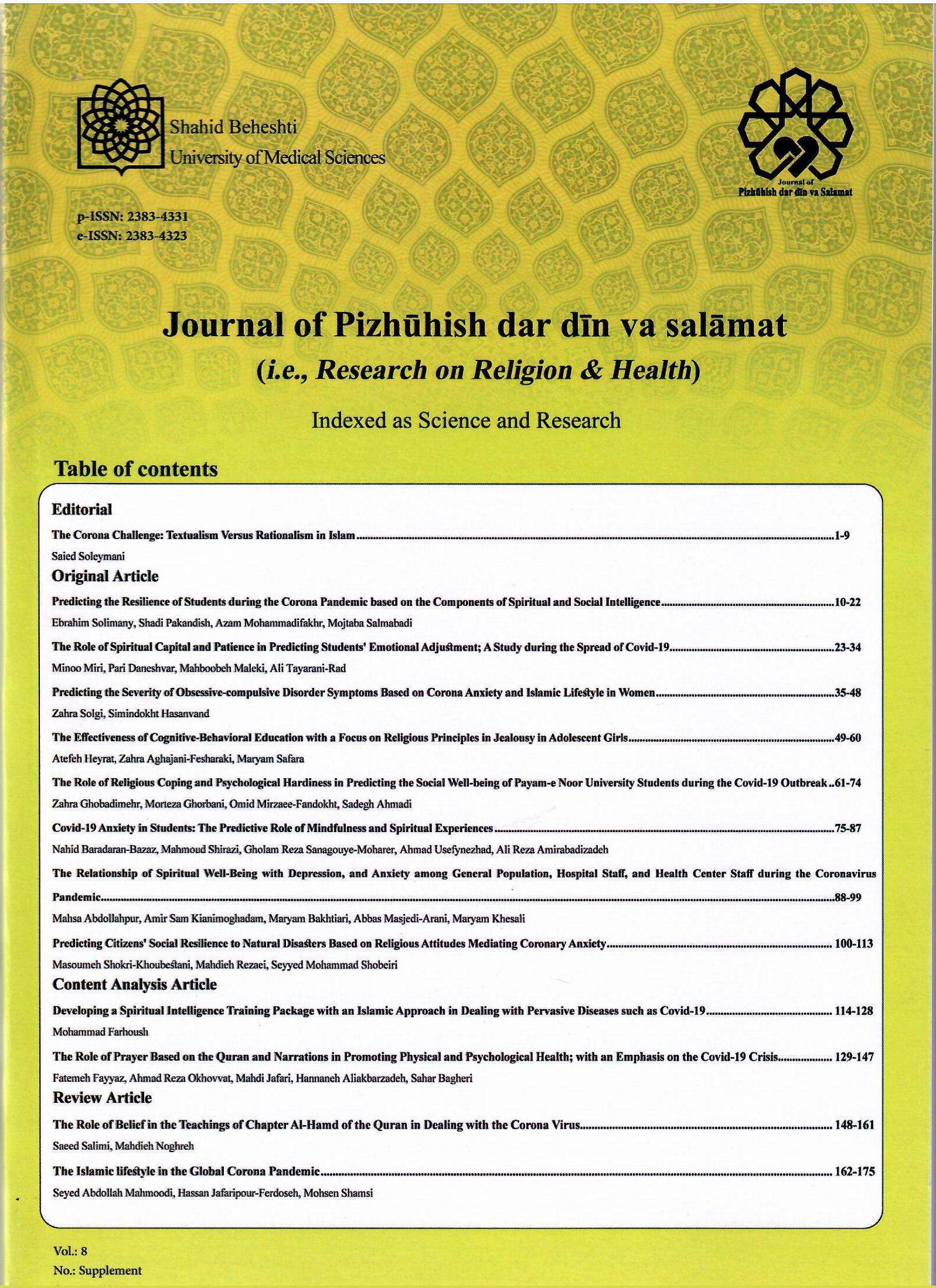
The Effectiveness of Cognitive-Behavioral Education with a Focus on Religious Principles in Jealousy in Adolescent Girls
Journal of Pizhūhish dar dīn va Salāmat (i.e., Research on Religion & Health),
Vol. 8 No. SI (2022),
23 September 2022
,
Page 49-60
https://doi.org/10.22037/jrrh.v8iSI.34249
Abstract
Background and Objective: Although cognitive psychology with more than seven decades of history corrects people's irrational beliefs and negative thoughts, few studies have combined this method with Islamic teachings. Therefore, the purpose of this study was to investigate the effect of cognitive correction training based on Islamic knowledge on jealousy in adolescent girls.
Methods: The present study is quasi-experimental with a pre-test, post-test control group design and the statistical population of the study included all adolescent girls aged 16 to 18 in secondary school in Isfahan in the academic year 2019-2020. The sample size was 30 participants, who were selected using available sampling method. Samples were randomly assigned to experimental (n=15) and control (n=15) groups. The measuring instrument used in the study was Valizadeh and Azerbaijani’s Jealousy Questionnaire. The experimental group underwent eight one-hour sessions of intervention in cognitive-behavioral training with a focus on religious principles. The control group did not receive any intervention. The collected data were analyzed at two levels of descriptive statistics (mean, standard deviation) and inferential statistics (analysis of covariance). In this study, all ethical considerations were observed and the authors reported no conflict of interests.
Results: The results showed that cognitive-behavioral training had an effect on jealousy in adolescent girls and its dimensions on the post-test in the experimental group. The rate of this effect was 24.7% in jealousy and 21.3% in the dimensions of jealousy components, cognitive dimension of jealousy, 18.6% in emotional jealousy and 22.5% in behavioral jealousy. The significance value considered to be lower than 0.01.
Conclusion: Considering that religious beliefs are considered as human values in Iran, cognitive-behavioral training based on religious teachings affects people's behavior and cognition; in this study it changed the level of jealousy in the students. Therefore, they can examine their irrational thoughts and emotions and change the destructive behaviors within themselves.
- Cognitive-Behavioral Therapy; Religious principles; Jealousy
How to Cite
References
Tezvaran Z, Akan H, Zahmacioglu O. Risk of depression and anxiety in high school students and factors affecting it. HealthMED. 2012:3333.
Jelinek JP. The Basic Works of Aristotle. Modern Schoolman. 1941;19(1).
Valizadeh A, Azarbayejani M. Azmoon-e Avaliyeh Sanjesh-e Hesadat ba Tekyeh bar Manabe-e Islami. Ravanshenasi va Din. 2010;3(2):45-60. )Full Text in Persian)
Zolfaghari S, Najarian Z, Najarian B. Study of the jealousy effects on mental health from the perspective of Islam and Psychology. Journal of Reaserch on Religion & Health. 2016;2(3):65-74.) Full Text in Persian)
Golberstein E, Wen H, Miller BF. Coronavirus disease 2019 (COVID-19) and mental health for children and adolescents. JAMA pediatrics. 2020; 174(9):819-20.
Sheikholeslami F. Study of the Effect of Group Therapy on Depression Following Myocardial Infarction. Avicenna Journal of Clinical Medicine. 2004;11(2):48-53. )Full Text in Persian)
Buss DM, Abrams M. Jealousy, infidelity, and the difficulty of diagnosing pathology: A CBT approach to coping with sexual betrayal and the green-eyed monster. Journal of Rational-Emotive & Cognitive-Behavior Therapy. 2017;35(2):150-72.
Leahy RL, Tirch DD. Cognitive behavioral therapy for jealousy. International journal of cognitive therapy. 2008;1(1):18-32.
Dolan M, Bishay N. The effectiveness of cognitive therapy in the treatment of non-psychotic morbid jealousy. The British Journal of Psychiatry. 1996; 168(5):588-93.
Radecki-Bush C, Farrell AD, Bush JP. Predicting jealous responses: The influence of adult attachment and depression on threat appraisal. Journal of Social and Personal Relationships. 1993;10(4):569-88.
Zolfaghari S, Najarian Z, Najarian B. Study of the jealousy effects on mental health from the perspective of Islam and Psychology. Journal of Reaserch on Religion & Health. 2016;2(3):65-74. )Full Text in Persian)
Pedram M, Mohammadi M, Naziri G, Aeinparast N. Effectiveness of Cognitive-behavioral Group Therapy on the Treatment of Anxiety and Depression Disorders and on Raising Hope in Women with Breast Cancer. Quarterly Journal of Women and Society. 2010;1(4):34-61) .Full Text in Persian)
Sohrabi A, Bavandpoor A. Asar-bakhshi-e Darman-e Shenakhti Rafatri Yekparch-e Shodeh ba Zehn-Agahi bar Bi-Etemadi, Hesadat va Rezayat dar Ravabet-e Romantic-e Daneshgah-e Kordestan. The6th Congress of the Iranian Psychological Association;
Tehran; 2017) .Full Text in Persian)
Pearce MJ, Koenig HG, Robins CJ, Nelson B, Shaw SF, Cohen HJ, et al. Religiously integrated cognitive behavioral therapy: a new method of treatment for major depression in patients with chronic medical illness. Psychotherapy. 2015; 52(1):56-66.
Agha-Dadashzadeh R. Shenakht-e Ezterab va Darman-e an az Didgah-e Quran. International Conference on New Research Findings in Psychology and Educational Sciences; Tehran; 2015. (Full Text in Persian)
Valizadeh A, Azarbayjani M. Preliminary test for measuring jealousy based on Islamic sources. Psychology and Religion. 2010;10(2):45-60. (Full Text in Persian)
Dobson D, Dobson K.S .Scientific guide to cognitive-behavioral therapy, Translated by Helmi K, Taghizadeh ME.Tehran: Arjmand; 2016. (Full Text in Persian)
Bavandpour A, Sohrabi A. The effect of cognitive-behavioral therapy integrated with mindfulness on distrust, jealousy and satisfaction in romantic relationships. Sixth Congress of the Iranian Psychological Association; Tehran; 2017. (Full Text in Persian)
Lim C, Sim K, Renjan V, Sam HF, Quah SL. Adapted cognitive-behavioral therapy for religious individuals with mental disorder: a systematic review. Asian journal of psychiatry. 2014;9:3-12.
Paukert AL, Phillips L, Cully JA, Loboprabhu SM, Lomax JW, Stanley MA. Integration of religion into cognitive-behavioral therapy for geriatric anxiety and depression. Journal of Psychiatric Practice.2009; 15(2):103-12.
Eral B. Gender Difference in Jealousy”: Sexual versues Emotional Infidelity: Faculty of California State University; 1998.
Zolfaghari S, Najarian Z, Najarian B. Study of the jealousy effects on mental health from the perspective of Islam and Psychology. Journal of Research on Religion & Health. 2016;2(3):65-74. (Full Text in Persian)
Ghanbarzadeh N, Narimani Z. Tahlil-e Asar-e Madi-e Hesadat dar Kalam-e Amir al-Mu'minin (Pbuh). Marefat-e Akhlaghi. 2014;16(5):27-44. (Full Text in Persian)
Saffarinia M. The prediction of mental health based on the anxiety and the social cohesion that caused by Coronavirus. Quarterly Social Psychology Research. 2020;9(36):129-41. (Full Text in Persian)
Fani M, Karamkhani M. Religion: spiritual health guide. Journal of Reaserch on Religion & Health. 2015;1(3):41-9. (Full Text in Persian)
Ashoori J, Jalilabkenar S, Ashoori M. Investigation of cognitive-behavioral instruction effect on students mental health with learning disorder in Tehran counties in academic year 2012-13. journal of Ilam university of medical sciences. 2015;23(3):73-83.
Mojahed A, Kalantari M, Molavi H, Neshatdust HT. Comparison of Islamic oriented and classicalcognitive behavioral therapy on mental health of martyr's and veteran's wives. Journal of Fundamentals of Mental Health. 2010;11(4):282-300. (Full Text in Persian)
Salimi S, Hajibabaeei HR, Rezazadeh-Asgari Z. The Effect of Faith in Divine Mercy on the Reduction of Cognitive Aspects of Mental Pressures from the Perspective of the Quran. Journal of Pizhūhish dar dīn va salāmat. 2020;6(3):157-69 .(Full Text in Persian)
- Abstract Viewed: 368 times
- pdf (فارسی) Downloaded: 176 times