
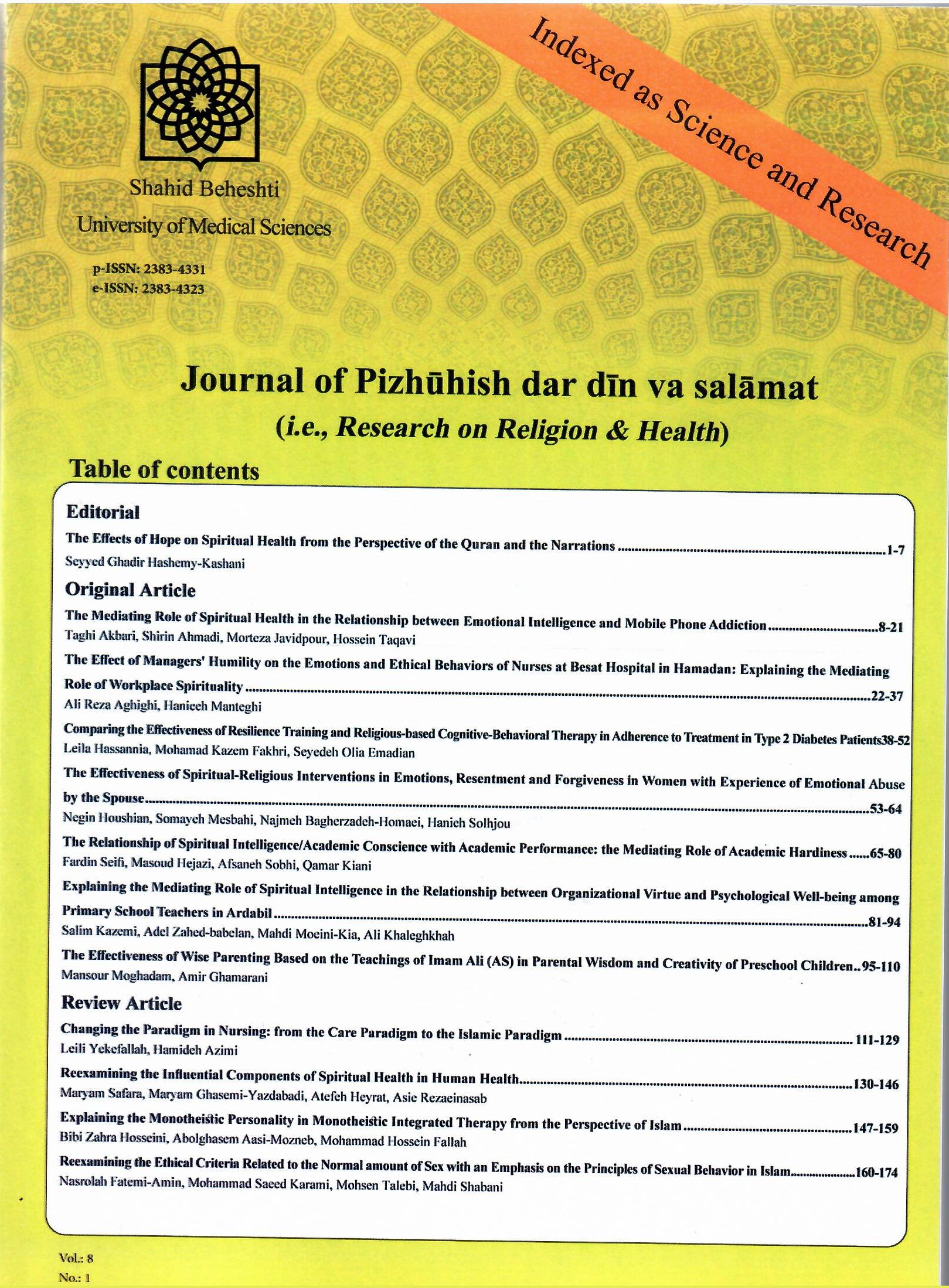
Explaining the Monotheistic Personality in Monotheistic Integrated Therapy from the Perspective of Islam
Journal of Pizhūhish dar dīn va Salāmat (i.e., Research on Religion & Health),
Vol. 8 No. 1 (2022),
19 March 2022
,
Page 147-159
https://doi.org/10.22037/jrrh.v8i1.31287
Abstract
Background and Objective: Due to the existence of psychological and behavioral disorders in societies, psychologists have resorted to various therapies to solve these problems; one of these therapies is monotheistic integrated therapy in which a person achieves a personality that can correct their abnormal behavior and prevent the recurrence of this behavior. In this review article, we examine the characteristics of this God-centered personality that is developed by the therapy in individuals, in psychological and religious texts.
Methods: This research is based on descriptive and qualitative research and is a documentary based on library resources. The information collected was from books on hadith, psychology, and the Qur'an, as well as Qur'anic, hadith, and commentary software, which was analyzed by content analysis of the texts. The authors did not report any conflict of interest.
Results: The findings indicate that this treatment was stated in the Qur'an 1400 years ago and the way to deal with mental problems is to achieve a monotheistic personality, in which the individual obtains complete mental peace by putting God at the center of life and can also solve his/her psychological and behavioral problems.
Conclusion: The results show that people who have a God-centered personality, in addition to being balanced, seek excellence and strive with pure intention for closeness to God and have a correct understanding of various matters and an adaptive behavior in dealing with the environment. In fact, the more prominent the role played by religion in people's lives, the fewer physical and psychological problems and social ills will be.
- Mental health; Narrations; Personality; Qur'an; Spiritual-religious treatment
How to Cite
References
Soleimani M. The role of patterns human education. Mashhad: Zarih-e Aftab; 2011. (Full Text in Persian)
Afrooz GA. An abstract of applied educational psychology Tehran: Parents and Teachers Association 2007. (Full Text in Persian)
Bashiri A. A Prelude to the Theory of PersonalityBased on Religious Thought. Ravanshenasi Va Din. 2012;5(1):5-36. (Full Text in Persian)
The Holy Quran. Translated by Naser Makarem Shirazi. Tehran: Dar Al-Quran Publication; 2017.
Noor-Alizadeh M. Rabeteh Khod-Agahi ba Khod-Agahi va Tasir-e an bar Salamat-e Ravan. 2012. (Full Text in Persian)
Dalia ZPartnoana, translated by Mehdi Shiri, Journal of Criticism and Opinion, 2000. Ravanshenasi va Din; Zaroorat-e Roykardi Jadid.Translated by Mehdi Shiri. Journal of Criticism and Opinion. 2000(35-36):47-66. (Full Text in Persian)
Delkhamoush MT, Ahmadi- Mobarakeh M. Content and structure of values among iranian adolescents. Journal of Development Psychology. 2011;8(29):5-28. (Full Text in Persian)
Tabik MT. The relationship between the five major factors of personality and self-cognitive processes with the classification of temperament capabilities in positive psychology, . Tehran: University of Tehran; 2010. (Full Text in Persian)
Kiomarsi MR. The Relationship between Religious Orientation and Personality Factors, Master Thesis.
Qom: Imam Khomeini Institute of Education and Research; 2003. (Full Text in Persian)
Janbozorgi M. Religious orientation and mental health. Journal of Research In Medical Sciences. 2008;31(4):345-50. (Full Text in Persian)
Gharraee B, Ahmadvand A, Aakbari A, Zenozian S. Relationship Between Mental Health and Intrinsic-Extrinsic Religion in Kashan. Journal of Modern Psychological Researches. 2008;3(10):61-84. (Full Text in Persian)
Jafari AR. Barresi-e Rabeteh Jahatgiri-e Mazhabi( Darooni-Borooni) ba Shivehaye Moghabeleh ba Esteres-e Daneshjooyan. Behavioral Sciences Quarterly. 2005;1(1):91-114. (Full Text in Persian)
Lahsayeezadeh A, Azargoon Z, Moradi G. The relationship between immigrants’ Religious orientation and mental health, The case study of Ghasr Shirin. Journal Of Social Sciences. 2007;1(2):149-69. (Full Text in Persian)
Khatib SM, Janbozorgi M, Tabatabaie R-z. The Role of Personality Factors and Religious Lifestyle in Mental Health. Islam and Psychological Research. 2016;1(3):85-98. (Full Text in Persian)
Kazdin AE. Treatment of antisocial behavior in children: current status and future directions. Psychological bulletin. 1987;102(2):187. (Full Text in Persian)
Sharifinia MH. Comparison of the effectiveness of integrated monotheistic treatment and cognitive therapy in reducing criminal behaviors and substance abuse in addicted prisoners in Qom prison 2008. (Full Text in Persian)
Jalali Tehrani SMM. Tovhid Darmani. Naqd Va Nazar. 2004;9(35-36):17-46. (Full Text in Persian)
Sharifinia MH. Arzyabi-e Tasir-e Ravesh-e Darman-e Yekparch-e Tovhidi dar Kahesh-e Masraf-e Mavad-e Mokhader va Raftarhay-e Por-Khatar-e Zendanian-e Zendan-e Markazi-e Qom. Qom: Organization of prisons and security measures of the country; 2007. (Full Text in Persian)
Cresini R. Rahnemay-e Darman-e Nov-Avarane translated by Goddess Ardakani, ElhamArdakani. Tehran: Giva; 2012. (Full Text in Persian)
Sharifinia MH. Olgoohay-e Ravan-Darmani Yek-Parche ba Moarefi Darman-e Yekparch-e Tovhidi. Tehran: Pazhuheshgah-e Hovzeh va Daneshgah; 2013. (Full Text in Persian)
Hadi M, Jan Bozorgi M. The effectiveness of integrated monotheistic treatment on personality and clinical components. Journal of Psychology and Religion. 2009;2(6):71-104. (Full Text in Persian)
Safara M, Balali-Dehkordi N, Sadidpour SS. A Meta-analysis of the Effect of Religiosity and Spirituality on Treatment of Psychotic-clinical Disorders. Journal of Pizhūhish dar dīn va salāmat. 2019;5(3):124-36. (Full Text in Persian)
Rahimi-Pordanjani T, Mohamadzade-Ebrahimi A, Doostkam Z. Religious attitudes and psychological hardiness as predictors of stress in students’ life. J Res Relig Health. 2018;4(4):21-32. (Full Text in Persian)
Moein M. Moein Dictionary. Tehran: Amir Kabir; 1972. (Full Text in Persian)
Salarifar MR, Mousavi Asl SM, Dolatkhah M, Shojaei MS. Behdasht-e Ravani ba Negaresh be Manabe-e Eslami. 2 ed. Tehran: Samat,Research Center and University; 2011. (Full Text in Persian)
Dehkhoda AA. Dehkhoda Dictionary. 2ed. Tehran: Tehran University Press; 1998. (Full Text in Persian)
Atkinson R, Nolen Hooksma S, Bam D, Smith E, Atkinson R. Hilgard Psychology translatoed by Reza Zamani, Mehrdad Beyk, Behrouz Birshak, Mohammad Naghi Braheni, Mehrnaz Shahrarai Tehran: Roshd; 2019. (Full Text in Persian)
Ross A. Ravanshenasi Shakhsiat (Nazariyeha va Farayandha), translated by Siavash Jamalfar. Tehran: Arasbaran; 2007. (Full Text in Persian)
Karimi Y. Ravanshenasi Shakhsiat (Nazariyeha va Farayandha), translated by Siavash Jamalfar. Tehran: Arasbaran; 2007. Tehran: Payam Noor university; 2007. (Full Text in Persian)
Ahadi H, Jamhari F. Ravanshenasi Roshd. Tehran: Ayandeh Derakhshan; 2019. (Full Text in Persian)
Ahmadi AA. Ravanshenasi Shakhsiat az Didgah-e Eslam. Tehran: Amirkabir; 1989. (Full Text in Persian)
Safara M, Salmabadi M. Examining Normal Personality from the Perspective of Psychology and the Qur'an. Journal of Pizhūhish dar dīn va salāmat. 2019;5(2):115-26. (Full Text in Persian)
Sharif Razi M. Nahj-o-al-Balagheh. Nameh 35.
Fani M, Abdoljabbari M, Atashzadeh-Shoorideh F, Karamkhani M. A study of the criteria for identifying healthy humans and healthy relationships from the perspective of religious texts. J Res Relig Health. 2018;4(1):104-17. (Full Text in Persian)
Khoda-Rahimi S, Jafari SGA. Naghsh-e Mazhab bar Farayandhay-e Behdasht-e Ravani va Ravan-Darmani dar Ravanshenasi-e Balini. Tazehay-e Ravan Darmani. 1998;2(7,8). (Full Text in Persian)
Nejati MO. Quran va Ravanshenasi. Mashhad: Bonyad-e Pazuheshhay-e Eslami Astan-e Ghods-e Razavi; 1988. (Full Text in Persian)
- Abstract Viewed: 517 times
- PDF (فارسی) Downloaded: 254 times