
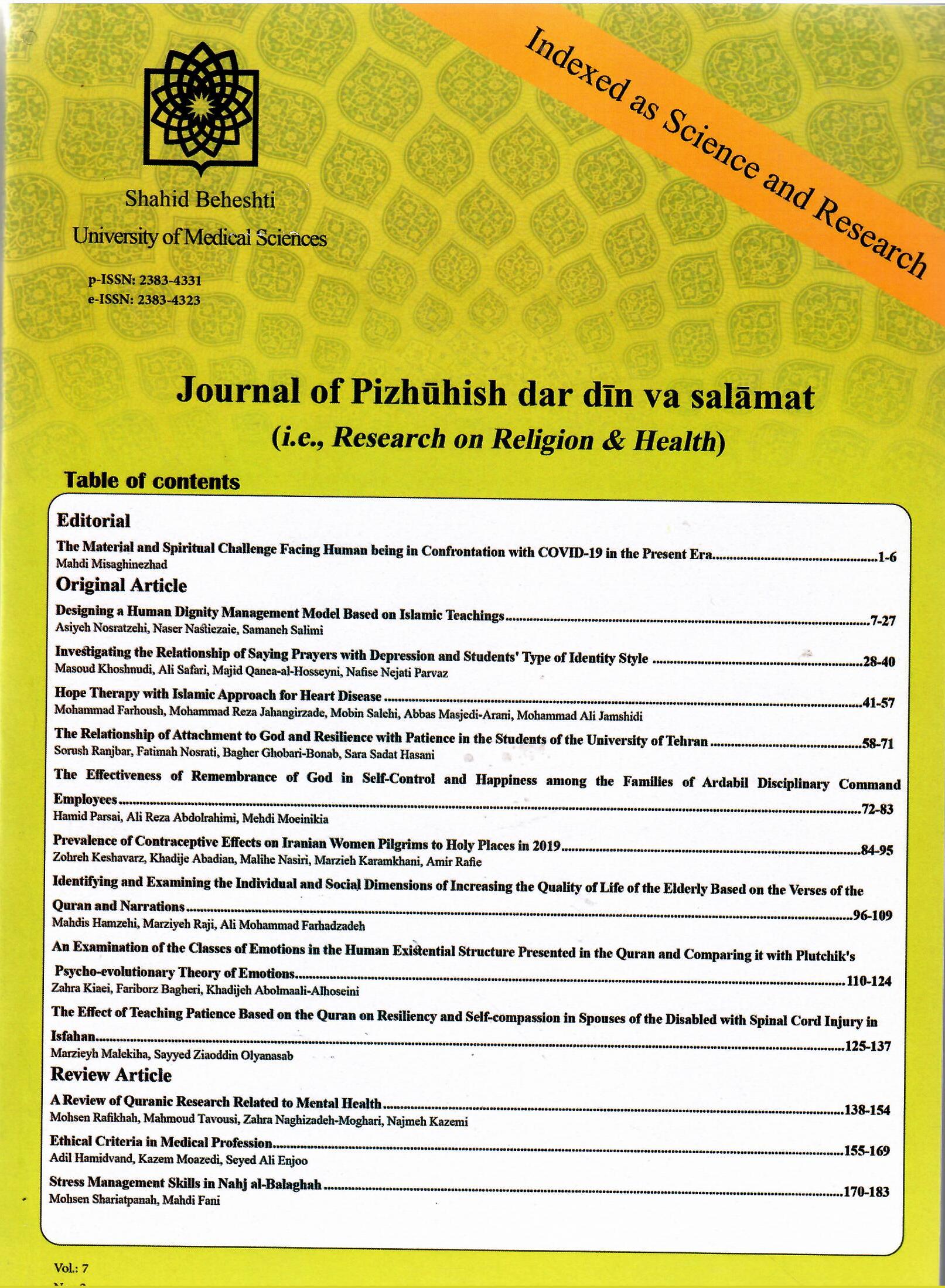
دراسة الفئات العاطفية في البنية الذاتية للإنسان في القرآن وفقاً لنظرية بلوتشيك في علم النفس التطوري
مجلة البحث في الدين و الصحّة,
مجلد 7 عدد 2 (2021),
21 خرداد 2021
,
الصفحة 110-124
https://doi.org/10.22037/jrrh.v7i2.29484
الملخص
خلفية البحث وأهدافه: الانسان المعاصر عاطفي اكثر من اي زمن مضى والعواطف مع انها سبب بقاء النوع البشري فإنها تؤدي الى مجموعة واسعة من الامراض النفسانية في حال خروجها عن الوضع الطبيعي والتي تتزايد وفق الدراسات الحديثة. هناك تعاريف وفئات متعددة ذكرتها النظريات المختلفة حول العواطف والعلاقة فيما بينها والتي قد تم الحصول على كثير منها من خلال دراسة سلوك الحيوانات ومدى انطباقها مع سلوك الانسان. ومن اهم هذه النظريات واكثرها تطبيقا، نظرية بلوتشيك في علم النفس التطوري، لكن ياترى هل كل هذه الفئات العاطفية للبشر مبتنية على التعاليم الاسلامية والقرآنية؟ ان الانسان كائن يفوق الحيوانات وله بعد مايسمى بالبعدالروحي؛ فيمكن تعريف عواطف مختلفة له. ومن اجل هذا، فإن الغرض من هذا البحث، دراسة مدى تطبيق الفئات العاطفية لبلوتشيك مع البنية الذاتية للانسان في القرآن الكريم.
منهجية البحث: في هذه الدراسة التي تمت بطريقة تحليل المضمون، في البداية تم اعداد نموذج استمارة ترميز التقييم من الفئات العاطفية لـ"لبوتشيك" وكذلك صورة الانسان في القرآن الكريم مستخدما الكتب والمصادر المختلفة فيما تتعلق بنظريات "بلوتشيك" و القرآن الكريم والتفسير ومن ثم قدمت الى اثنين من المقيمين المدربين. تمت مراعاة جميع الموارد الاخلاقية في هذا البحث واضافة الى هذا فإن مؤلفي البحث لم يشيروا الى اي تضارب في المصالح.
الكشوفات: اظهرت النتائج ان جميع الفئات العاطفية لـ"بلوتشيك" موجودة في تعريف القرآن الكريم عن الانسان ومعظمه يتصنف ضمن قسمي "الحالة" و"القوة" وعلى اساسه تم اقتراح 26 فئة عاطفية جديدة بما في ذلك الضيق والفرح والرعب والربط والأعمی و20 فئة عاطفية اخرى.
الاستنتاج: ضمن تعريف العواطف الجديدة التي يتم تقديمها مع اخذ الجوانب المادية والغير المادية للبنية الذاتية للانسان بعين الاعتبار، فإنه يقوم بتعريف موضع العواطف على اساس الوجود الانساني في القرآن وهو "القلب" وبالتأكيد ان القلب هو مصدر الاضطرابات العاطفية وسلامته ضمان للعلاج.
يتم استناد المقالة على الترتيب التالي:
Kiaei Z, Bagheri F, Abolmaali-Alhoseini Kh. An Examination of the Classes of Emotions in the Human Existential Structure Presented in the Quran and Comparing it with Plutchik's Psycho-evolutionary Theory of Emotions. Journal of Pizhūhish dar dīn va salāmat. 2021;7(2):110-124. https://doi.org/10.22037/jrrh.v7i2.29484
- الإسلام، الاضطرابات العقلية، أمراض القلب، الأنثروبولوجيا، الصدر، العواطف، القلب
كيفية الاقتباس
المراجع
Plutchik R. A Psychoevolutionary Synthesis. New York: Harper & Row; 1980.p.162.
Reeve J. Motivation and Emotion. Translated by Yahya Seyed Mohammadi 7 ed. Tehran: Virayesh; 2019. (Full Text in Persian)
Plutchik R. Emotion in the practice of psychotherapy. Washington, DC: American Psychological Association;2000.
Kiaei Z, Bagheri F, Abolmaali K. Comparison of human image from platchik and Schwartz with man map in the Quran through content analysis. Tehran: science and research university; 2020. (Full Text in Persian)
Watson D, Naragon-Gainey K. Personality, emotions, and the emotional disorders. Clinical Psychological Science. 2014;2(4):422-42.
Plutchik R, Kellerman H. Emotion (Theory, Research and Experience). New York: Academic press; 1980.
Vandenbos GR. APA Dictionary of psychology. 2 ed. Washington, DC; 2007.
Watson R. Future Files A Brief History of the Next 50 Years. London: Nicholas, Brealey; 2010.
Starks M. Suicidal Utopian Delusions in the 21st Century: Philosophy, Human Nature and the Collapse of Civilization. 4 ed. New York: Independently published; 2018.
Yuta Bann E. Discovering B asic Emotion Sets via Semantic Clustering on a Twitter Corpus: University of Bath BSc (Hons) Computer Science Dissertation; 2012.
Ortony A, Turner TJ. What's basic about basic emotions? Psychological Review;1990.p.315-31.
Plutchik R. The Nature of Emotions: Human emotions have deep evolutionary roots, a fact that may explain their complexity and provide tools for clinical practice Journal American Scientist. 2001;89(4):344-50.
Plutchik RC, Hope R Circumplex models of personality and emotions. Washington DC: American psychological association; 1997.
LeDoux JE. Evolution of human emotion: a view through fear Progress in brain research Elsevier; 2012.
Phelps EA, LeDoux JE. Contributions of the amygdala to emotion processing: from animal models to human behavior. Neuron. 2005;48(2):175-87.
Phelps EA. Human emotion and memory: interactions of the amygdala and hippocampal complex. Current opinion in neurobiology. 2004;14(2):198-202.
Mehrabi Bahar A. National Doctrine of the Health of the Islamic Republic of Iran on Horizon 1414 (Dissertation). Tehran: University of Tehran; 2010. (Full Text in Persian)
Mirzaei R, Khosrowpanah A. The quiddity of anthropology. Religious Anthroplogy. 2011;7(24):35-63. (Full Text in Persian)
Jafari MT. The Quran, the symbol of reasonable life. 1 ed. Tehran: Allameh Jafari Institute for Compilation and Publication; 2002. (Full Text in Persian)
Bahmani F. Relation of the heart in Persian literature with Sadr, Shafaq, Heart and Fadd in the
Holy Quran. 2 ed. Tehran: Thought School; 2012. (Full Text in Persian)
Khanbabaei M, Fayyaz ID, Malaki H. The Explanation of Educational Model of Educated Man based on Human Map in the Quran. Tehran: Allameh Tabataba'i; 2019. (Full Text in Persian)
Tabataba'i F, Bagheri F. Studying Sexual Fantasies in Emotional Relations based on Grounded Theory. Tehran: Science and Research; 2018. (Full Text in Persian)
Ghorashi A. Quran Qamoos. Tehran: Darolketab al-Islami; 2003. (Full Text in Persian)
Bagheri F. Naghsh-e Mafhoom-e Ghayat-Shenakhti dar Taeen-e Nahanjare-haye Marefat-Shenasi ba Roykard-e Materyalism. Zehn. 2012;13(50):50-85. (Full Text in Persian)
The holy Quran. Al-Hojorat. Verse 7. Translated by: Mohammad Mahdi Fouladvand. Tehran: Justice Message Publications; 2016.
The holy Quran. Al-Bagharah. Verse 256. Translated by: Mohammad Mahdi Fouladvand. Tehran: Justice Message Publications; 2016.
Vejdani F, Imani M. Tahlil-e Mafhoom-e Roshd ba Teky-e bar Ayat-e Ghoran-e Karim. Research in Islamic Education Issues. 2013.20(16):11-35. (Full Text in Persian)
The holy Quran. Al-Bagharah. Verse 7. Translated by: Mohammad Mahdi Fouladvand. Tehran: Justice Message Publications; 2016.
The holy Quran. Al- An'am. Verse 125. Translated by: Mohammad Mahdi Fouladvand. Tehran: Justice Message Publications; 2016.
The holy Quran. Al-Yusuf. Verse 30. Translated by: Mohammad Mahdi Fouladvand. Tehran: Justice Message Publications; 2016.
Abolmaali K. Deduction/Induction: Qualitative Text Analysis. Educational Science from Islamic Point of View.2013;1(1):85-102. (Full Text in Persian)
Javadi Amoli A. Tasneem Tafsir. 50 ed. Qom: Esrae; 2016. (Full Text in Persian)
Tabataba'i SMH. Tafsir al-Mizan. Qom: Islamic Publications Office; 1971. (Full Text in Persian)
Bagherian Khuzani M. The nature of heart disease and its treatment in Quran and Narrations. Ma'rifat. 2019;27(4):35-48. (Full Text in Persian)
Kaviani M, Panahi A. Psychology in the Quran: Your Concepts and Teachings. 6 ed. Qom: Research Institute of Hawzah and University; 2016.p.316. (Full Text in Persian)
Qureishi AA. The meaning of the Quran. 9 ed. Qom: Dar al-Ketab al-Islamiyah. 2002. (Full Text in Persian)
Bahrami Ehsan H, Amjadian M, Rostami R, Vahedi S. Designing a Religous-based Intervention Theory Based on Islamic Teachings for Anxiety, Stress, and Depression Reduction in Coronary Artery Bypass Grafting Patients. Journal of Religion and Health. 2019;6(2):40-52. (Full Text in Persian)
Sanatnegar S, Bahrami H, Okhovat A, JanBozorgi M. The Semantics of Generalized Anxiety Disorder from the View of the Holy Quran. Studies in Islam and Psychology. 2017;11(20):89-115. (Full Text in Persian)
Willcox G. The Feeling Wheel A Tool for Expanding Awareness ofEmotions and Increasing Spontaneity and Intimacy. Transactional Analysis Journal. 2001;12(4).
Milani M. Human-animal emotional contagion and client communication. The Canadian Veterinary Journal. 2017;58(12):1329. (Full Text in Persian)
Sotres-Bayon F, Quirk GJ. Prefrontal control of fear: more than just extinction. Current opinion in neurobiology. 2010;20(2):231-5.
Atkinson RL, Atkinson RC, Smith EE, Bem DJ, Nolen-Hoeksema S. Atkinson and Hilgard's Introduction to Psychology (with Lecture Notes and InfoTrac). Tehran: Roshd; 2017. (Full Text in Persian)
Minsky M. The Emotion Machine. New York: Simon & Schuster; 2007.
Glasser W. Choice Theory: A New Psychology of Personal Freedom. New York: HarperCollins Publishers Inc; 2005.
- الملخص المشاهدات: 657 الأوقات