
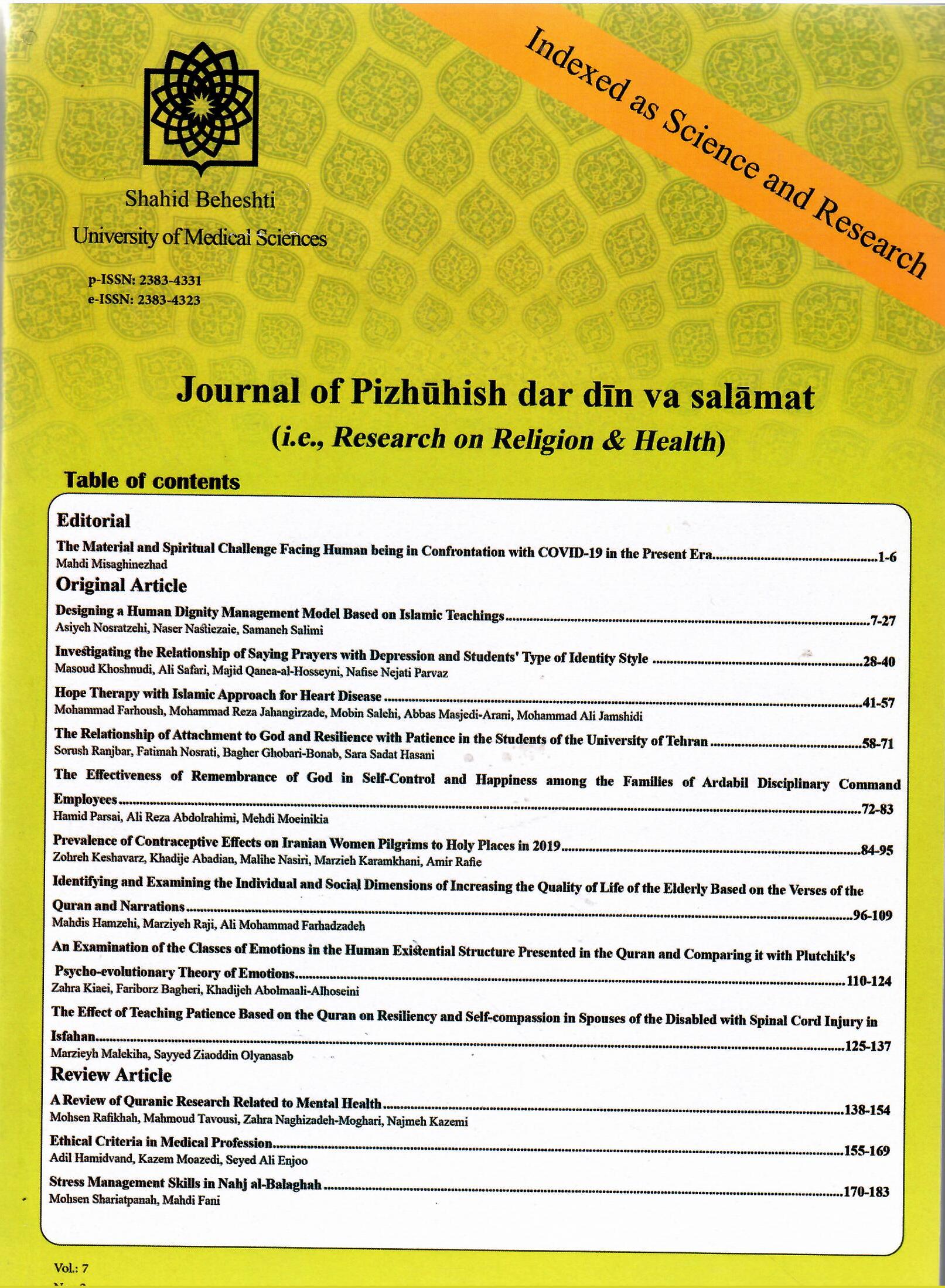
تأثیر آموزش صبر بر مبنای قرآن بر تابآوری و خودشفقتورزی در همسران معلولان ضایعۀ نخاعی شهر اصفهان
پژوهش در دین و سلامت ,
دوره 7 شماره 2 (2021),
21 خرداد 2021
,
صفحه 125-137
https://doi.org/10.22037/jrrh.v7i2.28976
چکیده
سابقه و هدف: مقاومت در برابر مشکلات زندگی و صبر بر پیامدهای ناگوار یکی از مهارتهای ضروری برای زندگی در دنیای امروز است که همواره در اسلام نیز تأکید شده است. هدف پژوهش حاضر بررسی اثربخشی آموزش صبر بر مبنای قرآن بر افزایش تابآوری و خودشفقتورزی همسران معلولان ضایعۀ نخاعی در شهر اصفهان بود.
روش کار: پژوهش حاضر نیمهتجربی از نوع پیشآزمون-پسآزمون با گروه کنترل است. جامعۀ آماری شامل تمامی همسران معلولان ضایعۀ نخاعی شهر اصفهان در سال 1398 بود که تعداد 30 نفر از آنان با توجه به معیارهای شمول بهصورت داوطلبانه انتخاب و بهطور تصادفی در دو گروه آزمایش (15 نفر) و کنترل (15 نفر) قرار داده شدند. دادهها با استفاده از پرسشنامههای ویژگیهای جمعیتشناختی، مقیاس تابآوری (کانر-دیویدسون) و مقیاس خودشفقتورزی (فرم کوتاه- راس و همکاران) جمعآوری و با روش تحلیل کوواریانس تکمتغیّره (آنکوا) تحلیل شد. در این پژوهش همۀ موارد اخلاقی رعایت شده است و مؤلفان مقاله تضاد منافعی گزارش نکردهاند.
یافتهها: بر اساس نتایج بهدستآمده، بین میانگین نمرات پسآزمون گروه آزمایش و گروه کنترل در دو متغیّر تابآوری و خودشفقتورزی تفاوت معناداری وجود داشت (005/0>P).
نتیجهگیری: یافتهها نشان میدهد که آموزش صبر بر مبنای قرآن در افزایش تابآوری و خودشفقتورزی در همسران معلولان ضایعۀ نخاعی مؤثر است.
استناد مقاله به این صورت است:
Malekiha M, Olyanasab SZ. The Effect of Teaching Patience Based on the Quran on Resiliency and Self-compassion in Spouses of the Disabled with Spinal Cord Injury in Isfahan. Journal of Pizhūhish dar dīn va salāmat. 2021;7(2):125-137. https://doi.org/10.22037/jrrh.v7i2.28976
- تابآوری، خودشفقتورزی، صبر، ضایعۀ نخاعی، قرآن، معلولان، همسران
ارجاع به مقاله
مراجع
World Health Organization, International Spinal Cord Society. International perspectives on spinal cord injury: World Health Organization; 2013.
Hosseini H. The survey of quality of life of spinal cord injured people in Yazd in 2014. Military Caring Sciences Journal. 2015;1(2):88-98. (Full Text in Persian)
Mallett R, Runswick-Cole K. Approaching disability: Critical issues and perspectives: Routledge; 2014.
Riggar T, Crimando W, Dunlap PN, Soldner JL. Rehabilitation Administration Literature: 30+ Years of Role and Function. Monograph of the National Clearinghouse of Rehabilitation Training Materials. 2008;1:1-409.
Hawley CE, McMahon BT, Reid C, Shaw LR. Rehabilitation counseling and education: Career counseling suggestions for the profession. Journal of Vocational Rehabilitation. 2000;14(2):95-101.
Tiêt Q, Huizinga D. Dimensions of the construct of resilience and adaptation among inner-city youth. Journal of Adolescent Research. 2002;17(3):260-76.
Friborg O, Hjemdal O, Rosenvinge JH, Martinussen M. A new rating scale for adult resilience: what are the central protective resources behind healthy adjustment? International journal of methods in psychiatric research. 2003;12(2):65-76.
Hamid N, Enayati M. The Effect of Religious–Based Cognitive Behavioral Therapy on Resiliency in Couples. JSR. 2015;15(57):26-35. (Full Text in Persian)
Malekiha M, Moradi B. Effectiveness of Time Perspective Therapy on Increasing Psychological Well-Being and Happiness in Veterans with PTSD. Iranian Journal of War and Public Health. 2019;11(3):153-9. (Full Text in Persian)
Trompetter HR, de Kleine E, Bohlmeijer ET. Why does positive mental health buffer against psychopathology? An exploratory study on self-compassion as a resilience mechanism and adaptive emotion regulation strategy. Cognitive therapy and research. 2017;41(3):459-68.
Dashtbozorgi Z, Homaee R. The relationship between self-copmassion, social support and hope with perscution of Nursing students. Educational Strategie. 2018;11(1):127-32. (Full Text in Persian)
Germer CK, Neff KD. Self‐compassion in clinical practice. Journal of clinical psychology. 2013;69(8):856-67.
Yazdani M, Momeni K. The Role of Life Style and Toleration in Predicting Mental Health and Self-Empathy among the Students of Razi University in Kermanshah, 2014. 2016:55-65. (Full Text in Persian)
Neff KD. Self-compassion: Moving beyond the pitfalls of a separate self-concept. 2008.
Yarnell LM, Neff KD. Self-compassion, interpersonal conflict resolutions, and well-being. Self and Identity. 2013;12(2):146-59.
Mokhberi G. Editorial note: Femail high school students attitude toward physical disability. 2015;15(4):1-10. (Full Text in Persian)
Nuri N. The Study of psychological bases and symptoms of patience in Quran. Psychology and Religion. 2008;1(4):143-68. (Full Text in Persian)
Al-Raghib Al-Isfahani H. Al-Mofradat fi Gharib al-Quran. Beirut: Dar Al-Ma’rifah, tth. 2004. (Full Text in Persian)
Mostafavi H. Al-Karim Al-Quran Research in Literature: Ministry of Culture and Islamic Guidance. Qom: Bayan; 1363.
Ṭabrisī F. Majmaʻ al-Bayān fī Tafsīr al-Quran. Tehran: Naser Khosrow. 1993;1372.(Full Text in Persian)
The holy Quran. Al-Bagharah. Verse 249. Translated by: Hossein Ansarian. Qom: Bayan Roshan; 2018.
The holy Quran. Al-E-Imran. Verse 148. Translated by: Hossein Ansarian. Qom: Bayan Roshan; 2018.
The holy Quran. Al-E-Imran. Verse 146. Translated by: Hossein Ansarian. Qom: Bayan Roshan; 2018.
The holy Quran. Al-Bagharah. Verse 251. Translated by: Hossein Ansarian. Qom: Bayan Roshan; 2018.
The holy Quran. Al-E-Imran. Verse 120. Translated by: Hossein Ansarian. Qom: Bayan Roshan; 2018.
The holy Quran. Al-An'am. Verse 4. Translated by: Hossein Ansarian. Qom: Bayan Roshan; 2018.
The holy Quran. Al-Fussilat. Verse 5. Translated by: Hossein Ansarian. Qom: Bayan Roshan; 2018.
The holy Quran. Al-Bagharah. Verse 7. Translated by: Hossein Ansarian. Qom: Bayan Roshan; 2018.
The holy Quran. Al-Hud. Verse 11. Translated by: Hossein Ansarian. Qom: Bayan Roshan; 2018.
The holy Quran. Al-Ra'd. Verse 4. Translated by: Hossein Ansarian. Qom: Bayan Roshan; 2018.
Askaryan S, Agheri M, Hassan Zadeh M. Investigating the Influence of training religious coping skillson resiliency, adaptability and stress management in veterans' spouses. Iranian Journal of War and Public Health. 2014;6(1):60-7. (Full Text in Persian)
Bakhshizadeh S, Afrooz G, Behpajooh A, Ghobari Bonab B, Shokoohi yekta M. The effectiveness of resiliency based on islamic spirituality training on marital satisfaction and components of resiliency based on islamic spirituality inmothers of slow pace children. Journal of Exceptional Children Empowerment. 2017;7(20):60-75. (Full Text in Persian)
Movahedi L, Zandvanhannaiini A, Zareeimahmoodabadi H. The effect of spiritual intelligence instruction on the increasing spiritual intelligence and two components in Maybod adult physical handicaps. Tolooebehdasht. 2017;15(5):109-21. (Full Text in Persian)
Sharifisaki S, Alipour A, AghaYousefi AR, Mohammadi MR, Ghobari Bonab B, Anbiaei R. Relationship of patience and self-compassion with depression in patients with breast cancer. 2018;11(2):37-45. (Full Text in Persian)
Skoda AM. The relation between self-compassion, depression, and forgiveness of others: University of Dayton; 2011.
Gilbert P, Procter S. Compassionate mind training for people with high shame and self‐criticism: Overview and pilot study of a group therapy approach. Clinical Psychology & Psychotherapy: An International Journal of Theory & Practice. 2006;13(6):353-79.
Keshavarz Mohammadi R. Effectiveness of self-compassion on distress tolerance, emotion regulation and anxiety sensitivity in divorced women. Family Pathology, Counseling and Enrichment Journal. 2018;4(1):17-32. (Full Text in Persian)
Morin C, Collechi C, Stone J, Sood R, Brink D. The effect of self-compassion on the forgiveness, resiliency and marital satisfaction of couples. J mar. 2015;7(1):85-96.
Wijesuriya N, Tran Y, Middleton J, Craig A. Impact of fatigue on the health-related quality of life in persons with spinal cord injury. Archives of physical medicine and rehabilitation. 2012;93(2):319-24.
Olyanasab SZ, Shahandeh A. Investigating the Effect of Reciting the Quran and Listening to it on the Dimensions of Spiritual Well-Being of Payame Noor University Students. J Res Relig Health. 2019;4(5):103-17. (Full Text in Persian)
Conor L, Davidson M. An inventory for resilience construct. Personality and Individual Differences. 2003;35:41-53.
Edward Kl. The phenomenon of resilience in crisis care mental health clinicians. International Journal of Mental Health Nursing. 2005;14(2):142-8.
Momeni K, Akbari M, Atashzadeh-Shorideh F. Relationship between resilience and burnout in nurses Teb va Tazkiye. 2009;17(75-74):29-36. (Full Text in Persian)
Neff LA, Broady EF. Stress resilience in early marriage: Can practice make perfect? Journal of personality and social psychology. 2011;101(5):1050-75.
Raes F, Pommier E, Neff KD, Van Gucht D. Construction and factorial validation of a short form of the self‐compassion scale. Clinical psychology & psychotherapy. 2011;18(3):250-5.
Khanjani S, Foroughi AA, Sadghi K, Bahrainian SA. Psychometric properties of Iranian version of self-compassion scale (short form). Pajoohandeh Journal. 2016;21(5):282-9. (Full Text in Persian)
Leilan MP, Kheiri Y, Babapour J. Relationship between attachment to God and trust with psychological vulnerability of students with mediating on patience. International Research Journal of Applied and Basic Sciences. 2015;9(9):1568-73. (Full Text in Persian)
McConkey R, Truesdale-Kennedy M, Chang M-Y, Jarrah S, Shukri R. The impact on mothers of bringing up a child with intellectual disabilities: A cross-cultural study. International journal of nursing studies. 2008;45(1):65-74
- چکیده مشاهده شده: 527 بار