
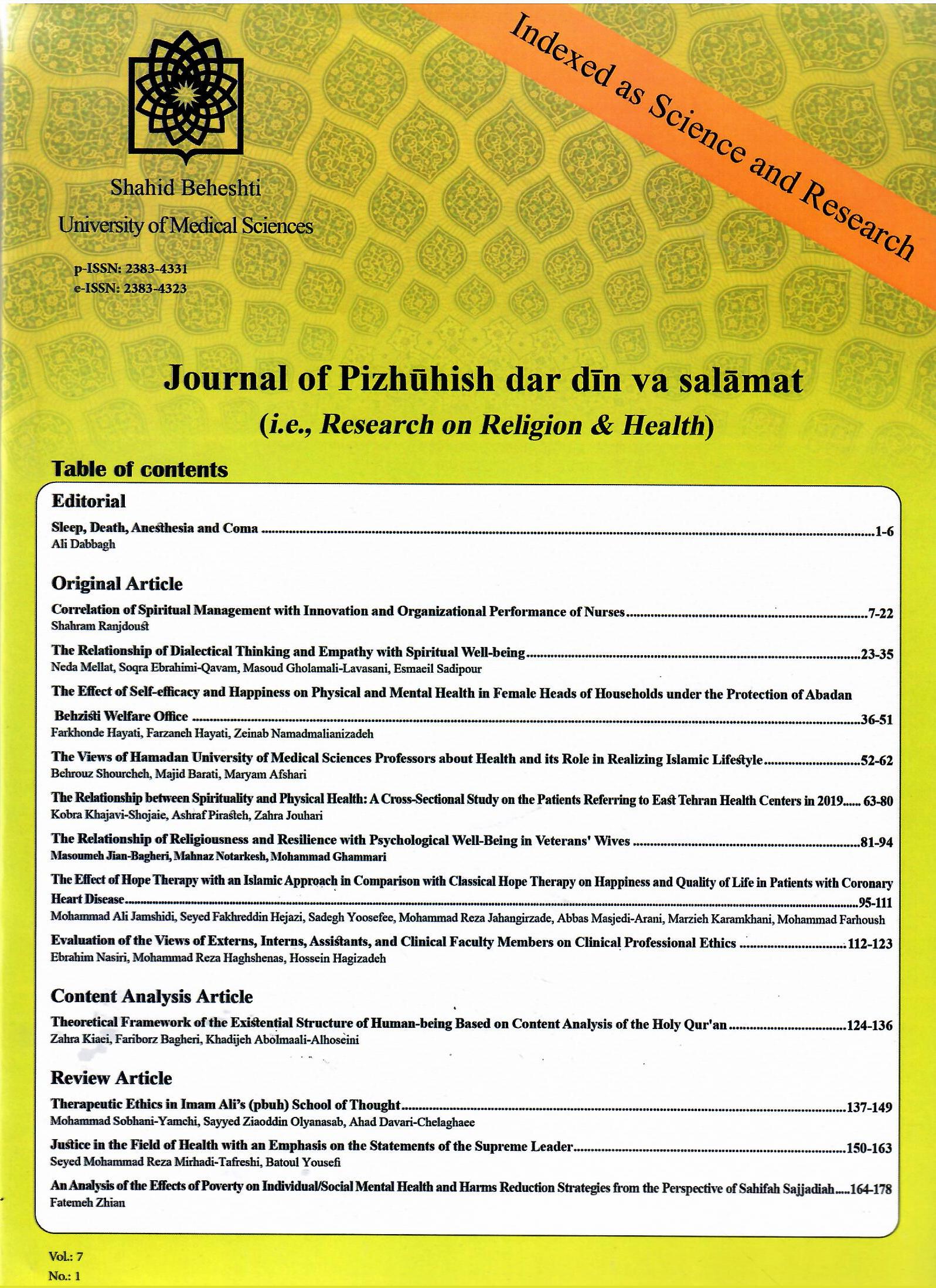
The Views of Hamadan University of Medical Sciences Professors about Health and its Role in Realizing Islamic Lifestyle
Journal of Pizhūhish dar dīn va Salāmat (i.e., Research on Religion & Health),
Vol. 7 No. 1 (2021),
14 March 2021
,
Page 52-62
https://doi.org/10.22037/jrrh.v7i1.27621
Abstract
Background and Objective: Lifestyle is the hallmark of any society's cultural and social identity. Islam and its concepts and doctrines constitute the best lifestyle. Although Islamic lifestyle produces health in different aspects, health or lack thereof can also be a facilitator of or obstacle to the realization of Islamic lifestyle. Therefore, the present study was conducted to investigate the views of Hamadan University of Medical Sciences professors regarding health and its role in the realization of Islamic lifestyle.
Methods: This qualitative study was conducted using content analysis approach. Data were collected through in-depth semi-structured interviews with 11 professors of Hamadan University of Medical Sciences selected through purposeful sampling with maximum variation in age and faculty status (Sciences). All the interviews were transcribed and finally analyzed using the conventional content analysis. The robustness and accuracy of the data were confirmed by the researchers and the researchers. In this study, all ethical considerations were observed and no conflict of interest was reported by the authors.
Results: Data analysis led to the extraction of the main concepts including the poor effect of physical health on the realization of Islamic lifestyle (with sub-themes of various definitions of physical health and the contradictory effects of physical health), the positive impact of mental health on the realization of Islamic lifestyle (with sub-themes of the strong relationship with mental health and the direct impact of mental health on the realization of the Islamic lifestyle), the mutual relationship between social health and the realization of Islamic lifestyle (with sub-themes of different definitions of social health, the two-way impact of social health, and governmental supervision and control over the dimension of social health) and the exponential impact of spiritual health on the realization of the Islamic way of life (with sub-themes of impossibility of the Islamic lifestyle without spiritual health), respectively.
Conclusion: Based on the findings, mental health is more important than physicla health and mental illnesses are more serious than physical ones. Therefore, mental and spiritual health can well explain the realization of the Islamic lifestyle, although there is also a need to eliminate physical ailments to help individuals achieve a better Islamic lifestyle.
Please cite this article as: Shourcheh B, Barati B, Afshari M. The Views of Hamadan University of Medical Sciences Professors about Health and its Role in Realizing Islamic Lifestyle. Journal of Pizhūhish dar dīn va salāmat. 2021;7(1):52-62. https://doi.org/10.22037/jrrh.v7i1.27621
- Health; Islamic lifestyle; Professors
How to Cite
References
Jenaabadi H. The study of the relationship between Islamic lifestyle and job satisfaction and social health of high school teachers in Zahedan. Biannual Journal of Applied Counseling. 2018;7(2):45-54.) Full Text in Persian(
Khajenoori B, Parnian L. Relationship between Cultural Globalization and Body Management (The
Case of Women in Kermanshah). Journal of Applied Sociology (1735-000X). 2014;55(3):35-38.
Rafat JM. Women’s human identity challenged by cosmetics and fashions. 2008; 10(38): 135-79. (Full text in Persian(
Mohammadi H, Mortazavi MA, Mousavi MR, Javanmard Q, Monfaredi A. Determination of the relationship between Religious commitment and mental health among engineering students of Bonab University. Journal of Research on Religion & Health. 2016;2(2): 44-53. ) Full Text in Persian(
Hatami H. The relationship between health and religion from the standpoint of divine religions, the ancestors' medical sources and some literary works. Journal of Research on Religion & Health. 2016;1(4): 1-3. (Full Text in Persian(
Soltanian A, Bahreiny F, Namazi S, Amiri M, Ghaedi H, Kohan G. Mental Health of high school students and its effective factors in Bushehr Province. Ṭibb-i junūb. 2005;7(2):173-82.) Full Text in Persian(
Asadi M, Barati Moghadam B, Naghavikoljahi M. The relationship between dimensions of Islamic lifestyle and happiness among the students of Kharazmi University. Islam Health J. 2015;2:33-8. )Full Text in Persian(
Fani M, Abdoljabbari M, Atashzadeh-Shoorideh F, Karamkhani M. The criteria of healthy humans from the perspective of religious texts. J Res Relig Health. 2017;4(1):104-17.) Full Text in Persian(
Salmabadi M, Farahbakhsh K, Zolfaghari S, Sadeghi M. Evaluation of the Relationship between Islamic Lifestyle and Studentsâ Mental Health at Birjand University. J Res Relig Health. 2015;3(1):1-10.) Full Text in Persian(
Speziale HS, Streubert HJ, Carpenter DR. Qualitative research in nursing: Advancing the humanistic imperative: Lippincott Williams & Wilkins; 2011.
Hosseini A, Shadmehri S, Kazemi N, Mosalaneghad A, Izadi A. Relation between health promotion behaviors life style and Islamic life style in Patients with acute coronary syndrome. Journal of Clinical Nursing and Midwifery. 2018;7(2):126-37. )Full Text in Persian(
Richards L, Morse JM. Readme first for a user's guide to qualitative methods: Sage; 2012.
Graneheim UH, Lundman B. Qualitative content analysis in nursing research: concepts, procedures and measures to achieve trustworthiness. Nurse education today. 2004;24(2):105-12.
Dalvandi A, Seyed Bagher Maddah S, Khankeh HR, Bahrami F, Parvaneh Sh, Hesam, et al. The Health-Oriented Lifestyle in Islamic Culture. J Qual Res Health Sci. 2013;1(4):332-43.) Full Text in Persian(
Johnston Taylor E, Hopkins Outlaw F, Bernardo TR, Roy A. Spiritual conflicts associated with praying about cancer. Psycho‐Oncology: Journal of the Psychological, Social and Behavioral Dimensions of Cancer. 1999;8(5):386-94.
- Abstract Viewed: 448 times