
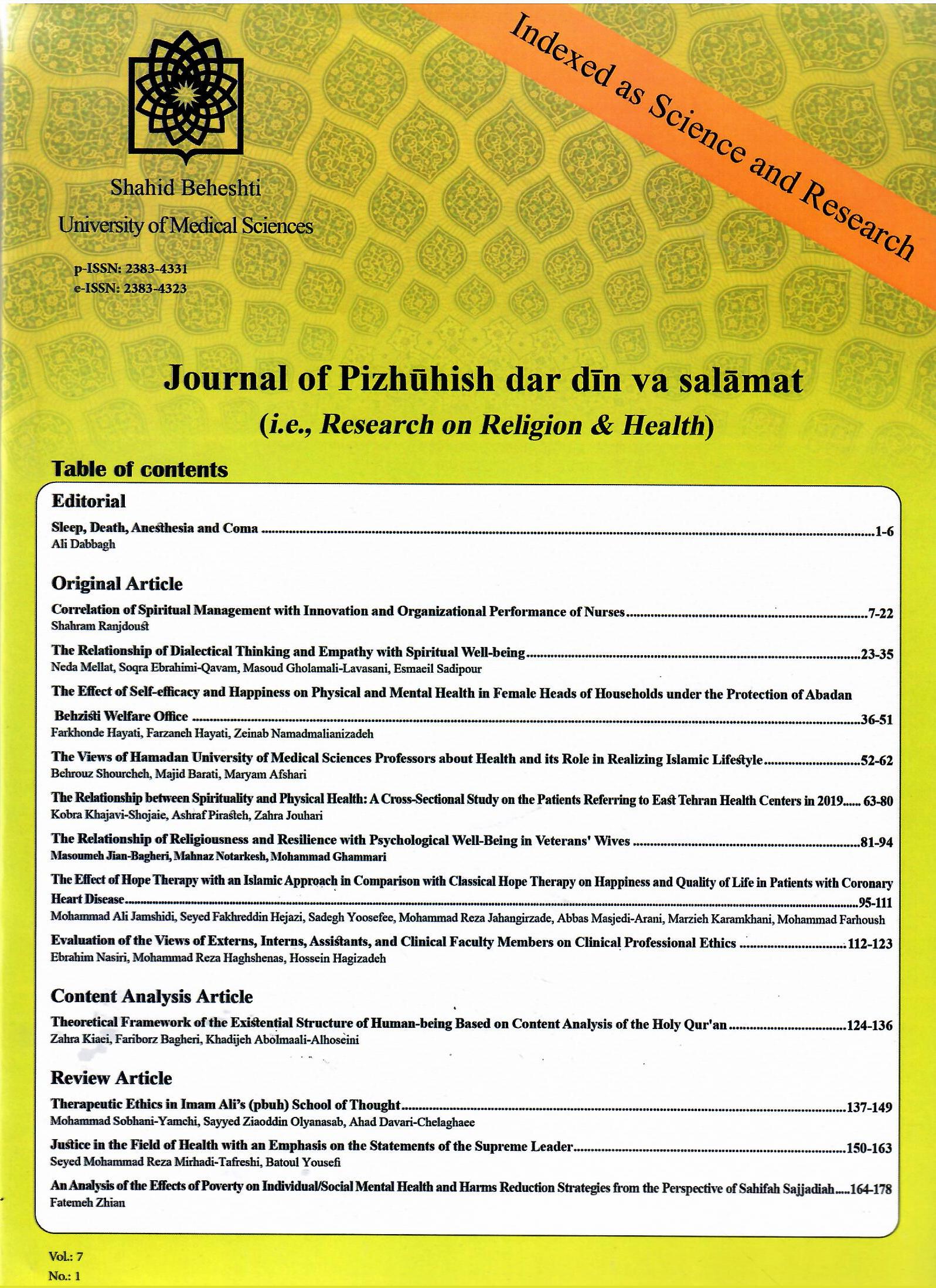
بررسی و تحليل آسیبهای فقر بر حوزۀ بهداشت روان و سلامت اجتماعی و راهکارهای کاهش آسیبها از منظر صحیفۀ سجادیه
پژوهش در دین و سلامت ,
دوره 7 شماره 1 (2021),
14 مارس 2021
,
صفحه 164-178
https://doi.org/10.22037/jrrh.v7i1.26660
چکیده
سابقه و هدف: از عصر شکلگیری تمدن بشری، برخورداری از امکانات رفاهی یکی از مهمترین دغدغههای انسان است که بر افکار، روان، رفتار و اجتماع افراد تأثیرگذار بوده است. همواره حکومتها و ایدهپردازان یکی از رسالتهایشان را تلاش در جهت براندازی فقر و یا دستکم کاهش آسيبهاي آن دانستهاند. در دين اسلام و بيانات ائمه (ع) آثار ناگوار فقر و توصیههایی در جهت کاهش چهرۀ فقر از جامعه مطرح شده است. در صحیفۀ سجادیه نیز پارهای از آسیبهای تنگدستي بر حوزۀ بهداشت روان و سلامت اجتماعی و راهکارهای برونرفت یا کاهش این آسیبها طرح شده است كه این پژوهش با کنکاش و تحلیل این موارد در صدد یافتن میزان اهمیت و توجه به ابعاد گوناگون سلامت بهویژه بهداشت روانی و سلامت اجتماعی افراد از منظر امام سجاد (ع) و دستيابي به جهتگيري توصيههاي ارائهشده در كاهش آثار نامطلوب فقر و تحليل اين سوگيريها بوده است.
روش کار: پژوهش پیشرو از نوع تحلیلی-کتابخانهای است که با بررسی ادعیۀ صحیفۀ سجادیه و آثاری در زمینۀ روانشناسی، علوم اجتماعی و اقتصاد، آسیبها و تهدیدهای فقر بر بهداشت روانی و سلامت اجتماعی و راهکارهای کاهش این آسیبها استخراج و به تحلیل آنها پرداخته شده است. مؤلف مقاله هیچگونه تضاد منافعی گزارش نکرده است.
یافتهها: از منظر امام سجاد (ع) فقر بهداشت روان و سلامت اجتماعي افراد را از جهات گوناگون در معرض خطر قرار میدهد اما راهکارها و توصيههايي براي آحاد جامعه در جهت کنترل و جلوگیری از گسترش فقر و کاهش این آسیبها وجود دارد.
نتیجهگیری: در صحیفۀ سجادیه با همهجانبهنگري به شخصیت، بهداشت روان و سلامت اجتماعی افراد نگریسته شده و راهکارهایی برای برونرفت از آسیبهای فقر و اقتصاد ناسالم مطرح شده است که بیشتر جنبۀ توصیههای فردی دارد تا توصیههایی به حکومتها. این امر نشاندهندۀ صلاحيتنداشتن حكومت عصر امام (ع) و ممکن بودن کنترل وضعیت نابهنجار اقتصادي و كاهش آسيبهاي فقر از سوی آحاد جامعه است.
استناد مقاله به این صورت است:
Zhian F. An Analysis of the Effects of Poverty on Individual/Social Mental Health and Harms Reduction Strategies from the Perspective of Sahifah Sajjadiah. Journal of Pizhūhish dar dīn va salāmat. 2021;7(1):164-178. https://doi.org/10.22037/jrrh.v7i1.26660
- امام سجاد (ع)؛ بهداشت روان؛ سلامت اجتماعی؛ صحیفۀ سجادیه؛ فقر
ارجاع به مقاله
مراجع
Erenson E. Social Psychology, Translated by Shokr-Kon, H.Tehran: Ministry of Guidance; 2002. p .50-52,142. (Full Text in Persian)
Rasekh AA. Mozo’e-Shenasi-e Feghh va Tovseah.Mashhadt: Khorasan Publications Office; 2001. Vo;1.p.8-25. (Full Text in Persian)
Ganji H. General Psychology: Tehran: Savalan Publishion; 2006.p. 8, 9, 243. (Full Text in Persian)
Sheikhavandi D. The Sociology of Deviations.Gonabad: Marandiz Publication; 1994. p.12, 15-17,120, 199, 200, 203. (Full Text in Persian)
Tabatabai MH. al-Mizan fi al-Qur'anic commentary.Qom: Jame'e Modaresin; 1997. p.248. (Full Text in Arabic)
Hakimi M. al-Hayat.Qom: Office of Islamic
Publication and Culture; 1989. p.380. (Full Text in Arabic)
Mazhari-Bidgoli SM. Naghsh-e Edalat-e Ejtemaei dar Pishgiri az Jorm. Qom: Noor al-Sajad; 2009. (Full Text in Persian)
Salimifar M, Dehnavi J. The Comparison of the Environmental Kuznets Curve in Developing and OECD Countries: A Panel Data Analysis. Monetary & Financial Economics. 2011;16(29):181-200. (Full Text in Persian)
Mehregan N, Rashid K, Ghasemifar S, Sohrabivafa H. Investigating the economic factors and policies affecting psychological health. The Journal of Economic Policy. 2016;8(15):117-36. (Full Text in Persian)
Mousavi-Asl SM. Faghr va Behdasht-e Ravani az Didghah-e Din va Ravanshenasi Ravanshenasi Va Din. 2008;1(4): 89-116. (Full Text in Persian)
Kadkhodaei Z, Aigoo T, Fazel M. Barresi-e Payamadhay-e Faghr dar Salamat-e Rooh va Ravan-e Afrad az Didgah-e Imam Ali (PBUH). Pazhohesh-Nameh-ye Hekmat-e Ahl-e Beit (PBUH) . 2013;1(1).p 62-74. (Full Text in Persian)
Thomas E. The Economics of Health, Translated by Nekooei Moghadam, A; Soleimani, B; Bi cha; 2007. p.510. (Full Text in Persian)
Rahimi-Pordanjani T, Mohamad-Zadeh-Ebrahimi A, Doostkam Z. Religious Attitudes and Psychological Hardiness as Predictors of Stress in Students’ Life. J Res Relig Health. 2018;4(4):21-32. (Full Text in Persian)
Zarei-Pour M, Sadeghi R, Abdolkarimi M, Ghasemi-Afshar N, Jadgal M. The relationship between religious attitudes and psychological symptoms in pregnant women referring to Urima health centers in 1395. J Res Relig Health. 2019;4(5):45-56. (Full Text in Persian)
Davari S, Rahimian BI, Talepasand S, Evazi M. The effect of spiritual/religious intervention on inner strength in women with breast cancer. J Res Relig Health. 2019;4(5):27-44. (Full Text in Persian)
Zahirikhah N, Maneei K, Sakhtsar M. Relationship of religious beliefs and coping styles with emotional intelligence among high school students in Shush. J Res Relig Health. 2018;4(3):83-92. (Full Text in Persian)
Mohsen-Zadeh F, Ghasemi Jobaneh R, Dargahi S, Jalili-Nikoo S. Spiritual Health,Family Hardiness and Family Satisfaction: A Comparisonbetween Addicts and Non-addicts. J Res Relig Health. 2018;4(4):33-43. (Full Text in Persian)
Rostami-Nasab-Dolat-Abadi Z, Ali-Zadeh N, Haghighat S, Sardar-Zadeh F. The Effectiveness of Spiritual-Religious Psychotherapy on Depression, Basic Psychological Needs and Life Satisfaction in Patients with HIV. J Res Relig Health. 2018; 4(4):12- 22. (Full Text in Persian)
Yarollahi N, Shairi MR, Hasan-Zadeh-Dastjerdi Z. Investigating the effect of a brief period of praying in emotional suppression situation on mood and ego depletion. J Res Relig Health. 2019; 5(1):52-63. (Full Text in Persian)
Sheykh-al-Eslami A, Parsa M. The Effectiveness of Prayer Training on Perceived Stress of Women Heading Households Supported by Imam Khomeini Relief Foundation. J Res Relig Health. 2019;4(5):17-26. (Full Text in Persian)
Fontana D. The Psychology of Religion and Spirituality Qom, Translated by Savar,A. Religious Publication; 2006. p 170,343. (Full Text in Persian)
Fatimeh Z. The Effectiveness of the Component of the Religious Belief of the Hadith Narrators in Jarh wa Ta'deel of Khulāṣat al-Aqwāl. Hadith Doctrines.2019;2(2):24-105. (Full Text in Persian)
Gholam-Ali A. Etebar-Sanji-ye al-sahifeh al-Sajadiyeh. Ulum-i Hadith; 2013;18(69):32-58. (Full Text in Persian)
Hadavi-Nia A. Raftar-Shenasi-ye Eghtesadi az Didgah-e Quran-e Karim. Tehran: Institute of Islamic Culture and Thought; 2016. p .3,72, 299. (Full Text in Persian)
Hakimi M. Padide-ye Faghr va Tovseeh. Mashhad: Khorasan Publications Office; 2001. (Full Text in Persian)
Sharifi M. An Introduction to the Islamic Approach to the Treatment of Depression, with Emphasis on Sahifa Sajjadiyyah. Marifat. 2012;21(3):43-60. (Full Text in Persian)
Imam Sajjad (PBUH). Sahife Sajjadieh, Translated by Ayati, AM. Tehran: Soroush Publication; 1996. p.6, 8, 13, 16, 20, 27, 29, 30, 35, 45, 47, 52. (Full Text in Arabic)
Kaviani M. Sabk-e Zendegi-e Islami va Abzar-e Sanjesh-e sn. Qom: Hawzah and University Publishing; 2013. p.4-72. (Full Text in Persian)
Imam Ali. Nahj al-Balaghah. Seyyed Razi (Ed.). Qom: Hajrat; 1994. (Full Text in Arabic)
Farhoush M, Mahkam R, Noori N. Psychometric Properties of Spiritual Self-esteem Questionnaire Adopting Islamic Approach. Pizhūhish dar dīn va salāmat. 2019;5(1):29- 46. (Full Text in Persian)
Argayel M. The Psychology of Happines. Tehran: Academic Jihad; 2004. p. 215. (Full Text in Persian)
Glaser B, Anselm L.The Discovery of Grounded Theory: Chicago: Aldine Publishing Company; 1967. p. 58-61.
Makarem-Shirazi N. Khotot-e Eghtesad-e Islami.Qom: Imam Ali School; 1981. p.5-14. (Full Text in Persian)
Afshari M. Hilgard General Psychology: Tehran: Culture Library; 2010. p.50,54, 234. (Full Text in Persian)
Zhian F. Ebrati az Ilal va Avamel-e Enherafat-e Yahood dar Quran. Hosna Journal. 2010;2(5):134-67. (Full Text in Persian)
Zhian F. Barresi-ye Vazhegan-e "Makr" va "Keid" dar Qoran ba Tavajoh be Asl-e Adam-e Taradof. Misagh. 2017;1(1):49-80. (Full Text in Persian)
Moghnieh MJ. Fi Zakar al-Sahifa al-Sajadiyyah: Dar al-Kutab al-Islam; 2003. p.9, 278, 299, 379. (Full Text in Arabic)
Witten V. General Psychology: Tehran: Psychological Publishing; 2016. p 178; 250-4. (Full Text in Persian)
Hosseini SH. Cultural Elements of Development: Khorasan Publications Office; 2001.p. 260-70. (Full Text in Persian)
Eshaghy M, Shahabi M, Ahangari E, Tahan M. The effectiveness of Nahjolbalagheh Teachings about mammonism damage on mental well-being of gastrointestinal patients. J Res Relig Health. 2019; 5(3):109-23. (Full Text in Persian)
Sadough M. Al-Tohid: Qom: Teachers' Association; 1978. p. 375. (Full Text in Arabic)
Asghari M. Ilal-e Farhangi-e Faghr. Mashhad: Khorasan Publications Office; 2001.p.210. (Full Text in Persian)
Amadi A. Ghorar al-Hikam and Dorar al-Kalim: Qom: Daftar Tablighat Publication; 1987.p.474; 391. (Full Text in Arabic)
Shojaee MS. Prayer and Mental Health: Qom: Center for Islamic Studies; 2009. (Full Text in Persian)
Asadouro L. Psychology, Translated by Sadeghi, J. Tehran: Samt Publication; 2011. p.3,19,486, 534. (Full Text in Persian)
Koleini M. Al-Kafi. Tehran: Islamia Publications; 1962. vol 1.p.542; vol 2.p.307. (Full Text in Arabic)
The holy Quran.al-Noor. Verse 33; al-Bagharah.Verse 274, al-Yasin.Verse 47, Translated by: Ayatollah Al-ozma Naser Makarem Shirazi. Qom: Imam Ali Ibne Abi Talib (Ya); 2010. (Full Text in Arabic)
Madani-Shirazi SA. Riyaz al-Salikin. Qom: Institute of Islamic Publishing; 1995. vol 4.p.136. (Full Text in Arabic)
Yousefi-Gharavi M. The Age of Imam Sajjad (PBUH) Politics and Society. Qom: al-majma' al-Alami le-Ahl al-Bayt; 2015. (Full Text in Arabic)
- چکیده مشاهده شده: 723 بار