
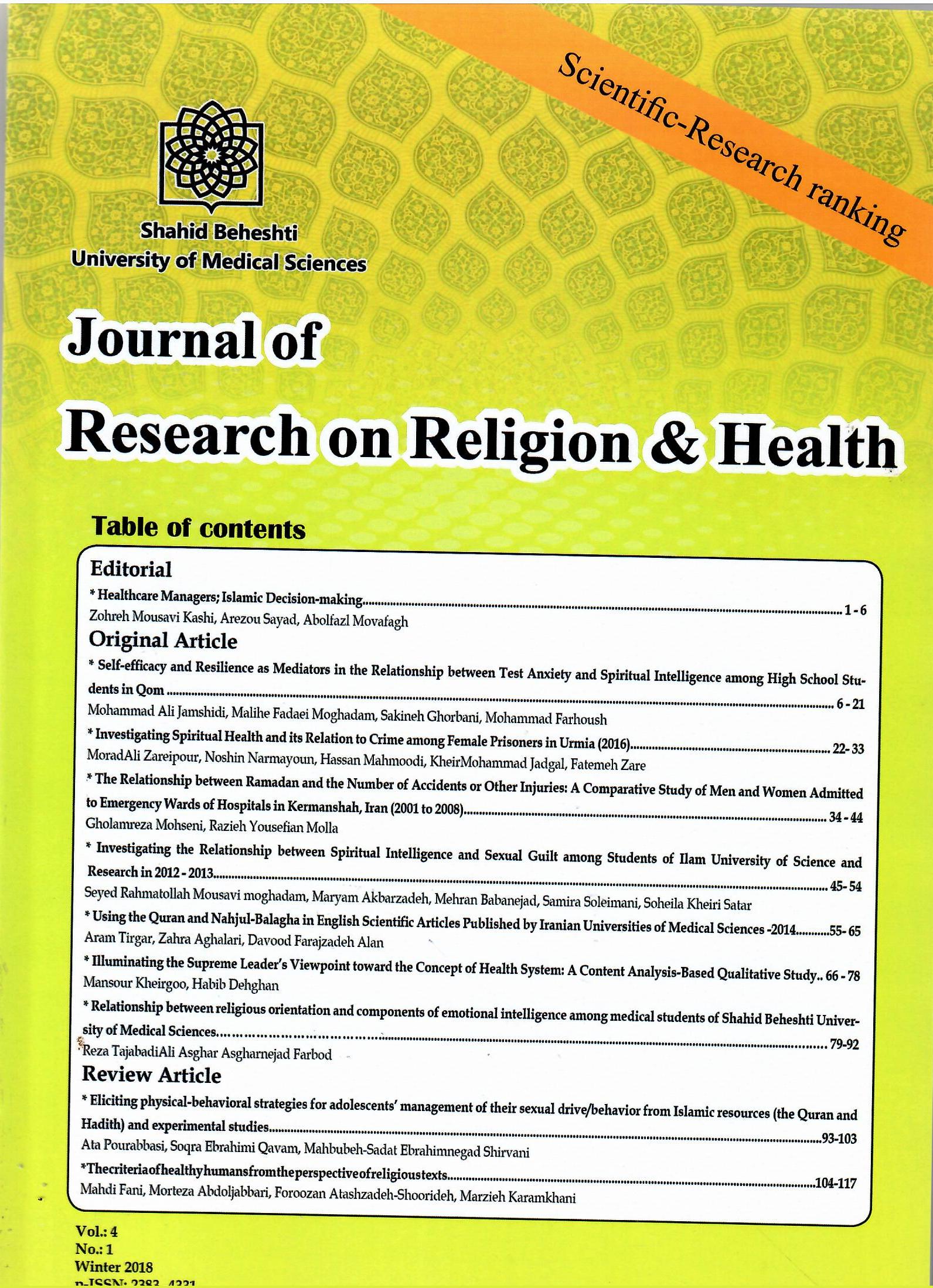
Investigating Spiritual Health and its Relation to Crime among Female Prisoners in Urmia (2016)
Journal of Pizhūhish dar dīn va Salāmat (i.e., Research on Religion & Health),
Vol. 4 No. 1 (2018),
30 December 2017
,
Page 22-33
https://doi.org/10.22037/jrrh.v4i1.16011
Abstract
Background and Objective: Spiritual health is an important aspect of health that can create hope and inner peace in individuals, giving meaning to life. The aim of this study was to evaluate spiritual health of female prisoners and its relation to the type of crime.
Method: This descriptive-analytical study was conducted on 150 female prisoners in 2016. To measure the spiritual health, the Palutzian and Ellison spiritual health questionnaire and a demographic questionnaire including demographic data, type of crime, and sentence length were used. The collected data were analyzed using Chi-square, ANOVA and Scheffe test. In this study, the ethical issues were all considered and the authors declared no conflict of interest.
Results: The results indicated 27 participants (18%) with poor spiritual health, 90 (60%) with moderate spiritual health, and 33 (22%) with high spiritual health. The results also showed that convicts of murder and accomplices in murder and those sentenced to death were at the lowest level of spiritual health. Overall, spiritual health relationship to type of crime and sentence length was statistically significant (P <0.05).
Conclusion: Given the low spiritual health of female prisoners and its relationship to the severity of the offense, it seems necessary that policies promoting spiritual health of the prisoners which are consistent with the evidence be taken so that not only other aspects of prisoners' health are improved but also crimes are prevented from recurring.
Please cite this article as:Zareipour MA, NarmayounN, MahmoodiH, JadgalKhM, ZareF. Investigating Spiritual Health and its Relation to Crime among Female Prisoners in Urmia. J Res Relig Health. 2018; 4(1) : 22- 33.DOI: https://doi.org/10.22037/jrrh.v4i1.16011
- Crime, Spiritual health, Women prisoners
How to Cite
References
HassanAbadi, H. the effectiveness of group therapy on self-religious spiritual prisoners in the Male prisoners of Central Prison Mashhad Research Consulting. 2006; 1(2): 49-69. ( Full Text in Persian)
Dixey R, Nyambe S, Foster S, Woodall J, Baybutt M. Health promoting prisons–An impossibility for women prisoners in Africa? Agenda. 2015; 29(4): 95-102.
World Health Organization . Women's health in prisons: correcting gender inequity in prison health. 2009.
Radi h, vaziri s, lotfi kf. The Effectiveness of Implementing the Project of Hope on Increasing Prisoners' Subjective Well-being. . Psychology and religion. 2014; 1(25): 71-80. ( Full Text in Persian)
Rimaz S, Ebrahimi-Kalan M, Gharibzadeh S, chehrehgosha M, Vasali S, Zandian E, et al. The mental health and its related factors in women prisoners. Rahavard Salamat Journal. 2016; 1(2): 1-15. ( Full Text in Persian)
Atabay T. Handbook for prison managers and policymakers on women and imprisonment: United Nations Publications. Available at: https://www.unodc.org/; 2008.
Plugge E, Douglas N, Fitzpatrick R. The health of women in prison study findings. Department of Public Health University of OxfordAvailable at: wwwbirthcompanionsorg. 2006.
Bahrainis SA MS, Ghodousi A. Prevalence and severity of crimes in patients with mental disorders. Research in Medicine. 2002; 26(3): 163-70. ( Full Text in Persian)
Jordan BK, Schlenger WE, Fairbank JA, Caddell JM. Prevalence of psychiatric disorders among incarcerated women: II. Convicted felons entering prison. Archives of General Psychiatry. 1996; 53(6): 513-9.
Cavendish R, Konecny L, Mitzeliotis C, Russo D, Luise BK, Medeíindt J, et al. Spiritual care activities of nurses using nursing interventions classification (NIC) labels. International Journal of Nursing Knowledge. 2003; 14(4): 113-24.
Amiri P, Abbasi M, Gharibzadeh S, Zarghani NH, Azizi F. Designation and psychometric assessment of a comprehensive spiritual health questionnaire for Iranian populations. Medical Ethics Journal. 2015; 9(30): 25-56. (Full Text in Persian)
Hosseini R, Alijanpour Agamaleki M, Mehrabi T, Ziraki Dana A, Dadkhah A. The Relationship between Existential Dimension of Spiritual Well-being and Quality of Life in Women with Infertility. Journal of Health And Care. 2014; 16(3): 53-60. (Full Text in Persian)
Osarrodi A, Golafshani A, Akaberi S. The Relationship between Spiritual Well-Being and Quality Of Life in Nurses. 2012. (Full Text in Persian)
Zareipour M, Khazir Z, Valizadeh R, Mahmoodi H, Ghelichi Ghojogh M. The Association between Spiritual Health and Blood Sugar Control in Elderly Patients with Type 2 Diabetes. Elderly Health Journal. 2016; 2(2): 67-72. (Full Text in Persian)
Marquart JW, Brewer VE, Simon P, Morse EV. Lifestyle factors among female prisoners with histories of psychiatric treatment. Journal of Criminal Justice. 2001; 29(4): 319-28.
Heydarzadegan A, Kochakzaei M. Study of the relationship between spiritual well-being and self-efficacy of students of faculty of engineering and psychology and educational sciences. Majallah-i Amuzih-i Muhandisi-i Iran. 2015; 17(65): 79. (Full Text in Persian)
Baljani E, Khashabi J, Amanpour E, Azimi N. Relationship between spiritual well-being, religion, and hope among patients with cancer. Journal of hayat. 2011; 17(3): 27-37. (Full Text in Persian)
Almasi M, Mahmoudiani S, Ghasemi T. Comparing Spiritual Health and Quality of Life among Fertile and Infertile Women. Iran Journal of Nursing. 2015; 28(93): 87-95. (Full Text in Persian)
Zareipour M, Abdolkarimi M, Asadpour M, Dashti S, Askari F. The Relationship between Spiritual Health and Self-efficacy in Pregnant Women Referred to Rural Health Centers of Uremia in 2015. Community Health Journal. 2016; 10(2): 52-61. (Full Text in Persian)
Ackabery S, Khazaei SA, Naderi Z, Assarroudi A, Kamranian H, et al. A new method to promote the quality of life based on spiritual wellbeing in health care workers: A predictive model. International Journal of Humanities and Cultural Studies (IJHCS) ISSN 2356-5926. 2016; 2(3): 1123-31. (Full Text in Persian)
Mehrabi T, Alijanpoor Aghamaleki M, Hosseiny RS, Ziraki dana A, Safaee Z. A study on the relationship between spiritual well-being and quality of life in infertile women referred to infertility centers in Isfahan. Journal of Urmia Nursing And Midwifery Faculty. 2014; 12(7): 562-7. (Full Text in Persian)
Gibbs JJ. Symptoms of psychopathology among jail prisoners: The effects of exposure to the jail environment. Criminal Justice and Behavior. 1987; 14(3): 288-310.
Hurley W, Dunne MP. Psychological distress and psychiatric morbidity in women prisoners. Australian and New Zealand Journal of Psychiatry. 1991; 25(4): 461-70.
Watson R, Stimpson A, Hostick T. Prison health
care: a review of the literature. International journal of nursing studies. 2004; 41(2): 119-28.
Delpasand k, Khani S, Mohammadi P. Social Support and Crime;The Comparative Study of Criminal and Non-Criminal Youth in Ilam. Quarterly of Social Studies and Research in Iran. 2012; 1(2): 89-120. (Full Text in Persian)
Organization World Health. Promoting mental health: Concepts, emerging evidence, practice: Summary report. Available at: http://wwwwhoint/mental_health. 2004.
Sharifi Nia MH GAA, Shams A. Psychology and counseling services in prisons in the context of integrated monotheistic therapy approach. 1389. (Full Text in Persian)
Poryayi MH. Sociological analysis of the value system of Islam. Journal of belief–Verbal. 2008;3(12):55-74.
- Abstract Viewed: 1149 times
- PDF (فارسی) Downloaded: 554 times