
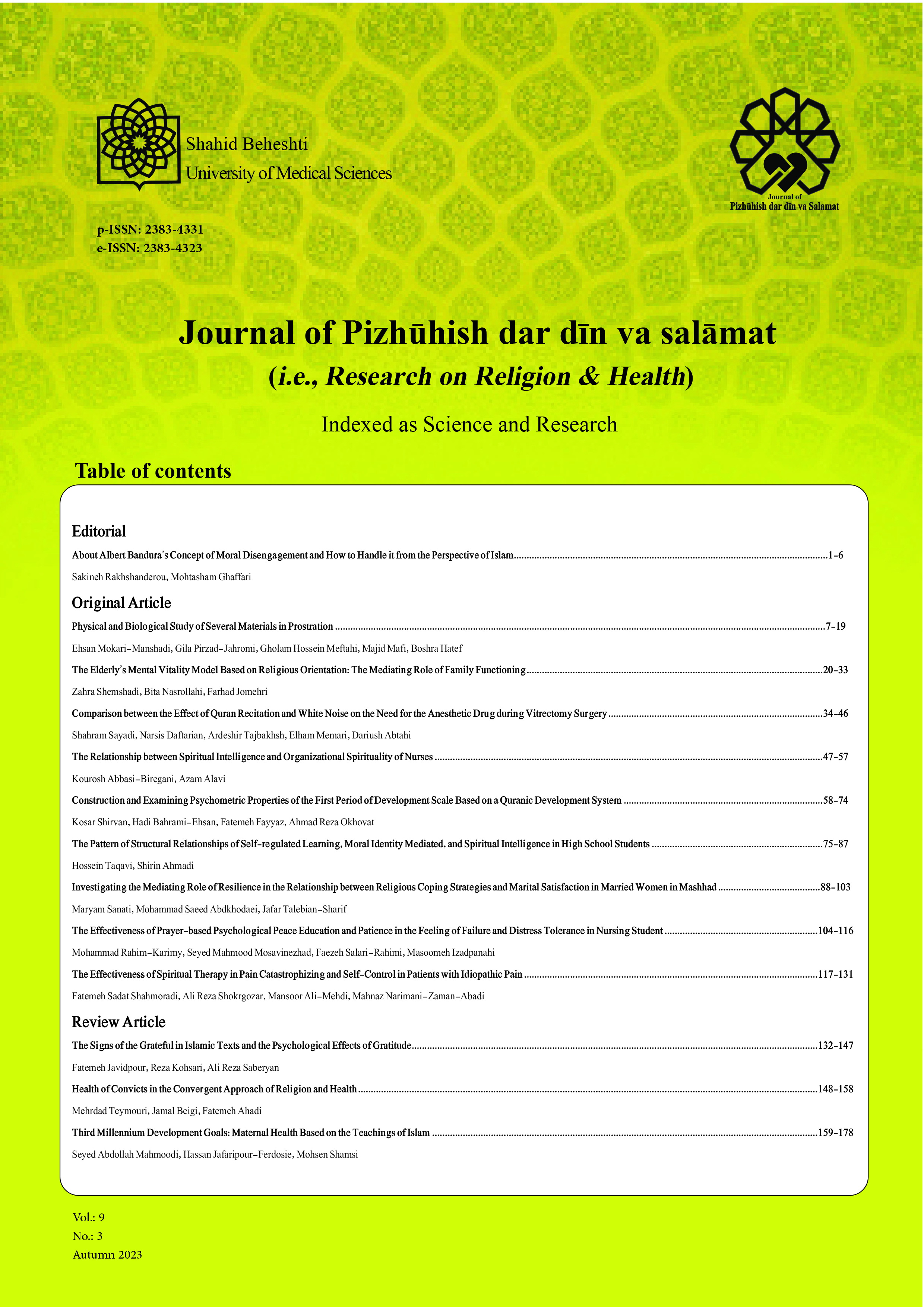
صفات الشاکرین في النصوص الإسلامیة وآثار هذه الصفات من منظور علم النفس
مجلة البحث في الدين و الصحّة,
مجلد 9 عدد 3 (2023),
11 تشرين الثاني 2025
,
الصفحة 132-147
https://doi.org/10.22037/jrrh.v9i3.37293
الملخص
خلفية البحث وأهدافه: الشکر هو فضیلة أخلاقیة ومن أهم التعالیم الإسلامیة، بحیث وردت في النص المقدس ونصّ علیها القرآن بوضوح. وقد حدّدت التعالیم الإسلامیة بعض الصفات للشاکرین یمکن تأطیرها في ثلاثة مجالات هي المجال المعرفي، والعاطفي، والعملي. وبما أن الشکر واستمراره یفرض معرفة هذه الصفات، وتبیین ثماره وآثاره یشحذ النزعة التحفیزیة ویبلور الدور المؤثر للفرد في الحفاظ علی صحته النفسیة وتکامله الإنساني والأخلاقي، فإن هذه الدراسة تسعی لبلورة هذه الصفات واستخراج آثارها النفسیة وتلقي الضوء علی نتائج الشکر علی نفسیة الفرد.
منهجية البحث: اعتمدت الدراسة المنهج الوصفي - التحلیلي وتسعی من خلال النزعة القرآنیة -الروائیة إلی استکشاف ومعرفة صفات الشاکرین ومعرفة تأثیره النفسي علی الإنسان الشاکر. وعلی هذا الأساس تسعی في الخطوة الأولی لمعرفة صفات الشاکرین في النصوص الإسلامیة وتعریف التراث من الفرد الشاکر وتقدم تعریفاً لمثل هذا الفرد في مصدري القرآن الکریم ومناجاة الشاکرین للإمام السجاد (ع). وبعدها تسعی عبر تحلیل مضمون الآیات والتفاسیر والروایات الواردة من المعصومین (ع)، لمعرفة الآثار النفسیة لهذه الصفات واستخراجها وشرحها بدقّة. إنّ مؤلفي البحث لم یشیر إلی أيّ تضارب في المصلاح.
المعطیات: الشکر عبارة عن معرفة النعمة ومن وهبها. والشاکر یشکر المنعم من خلال النظر إلی ما یملکه من نِعَم مادیة، وروحیة والإهتمام الواعي بهذه النعمات من حوله؛ ویسعی من خلال معرفة هذه النعم معرفة عاطفیة، أن یعوّض عن هذه النعمة التي وُهبت له تعویضاً عملیاً. وهذا التعویض المتمثل بالشکر یتجلی لدی المؤمن بالقرآن الکریم في إطار الإمتثال للأوامر الإلهیة والإلتزام بالأحکام وتغییر عقیدته نحو الأفضل وتقلیص أو السیطرة علی العواطف السقیمة والدعم الإجتماعي، لکي یقدم خدمة إنسانیة للمجتمع ویسعی لتربیة أنسان مؤمن، ومتواضع واجتماعي.
الاستنتاج: الشکر هو الحد الأدنی من شروط العبودیة لله والعقیدة الدینیة والإلتزام بالتعالیم الدینیة والسلوك الدیني الذي یراد منه لکي یکون شاکراً لنعمته، وتقلیص القلق، والإضطراب، والضیاع. وهذا سیؤول إلی سلامة النفس والروح البشریة وتربّي أفراداً مؤمنین ملتزمین بالدین وتعالیمه.
- الإسلام
- النفس
- الشکر
- النعم
كيفية الاقتباس
المراجع
Emmons RA, McCullough ME. The psychology of gratitude: Oxford University Press; 2004.
Peterson C, Seligman ME. Character Strengths and Virtues: A Handbook and Classification (New York: American Psychological Association & Oxford University Press, 2004). Reflective Practice: Formation and Supervision in Ministry. 2012.
The Holy Quran. Translated by Bahrampour, A. Tehran: Avaei Quran Publications; 2015.
Koleini MIY. Osul Al-Kafi, Resercher By Ghffari, A.A & Akhondi, M. Tehran: Dar al- Kotob al-Eslamiah; 1999. (Full Text in Persian)
Naraghi A. Mi'raj al-sa'ada. Qom: Hijrat Publications; 1999. (Full Text in Persian)
Mesbah Yazdi MT. Zaroorat-e Shokrgozari az Ne'mathay Ma'navi .Tehran: Marifat; 2011.(Full Text in Persian)
Lashani Z, Shaeiri MR, Asghari Moghadam MA, Golzari M. e effect weres of training strategies for gratitude increase (based on the Emmons, Seligman and Verbal-Action pattern) on the expansion of positive affectivity and happiness in normal subjects. Clinical Psychology Studies. 2012;1(4):134-51. (Full Text in Persian)
Asadi H, Kajbaf MB, Kolahdouzan SA, Godarzi S, Hoseinirazi S. Predictiveat the Risk of Mental DisordersPattern on the Based Religious Beliefs, Social Support, Coping Strategies and Record of Mental Disorders. Journal title. 2014;8(2):21-30. (Full Text in Persian)
Tabatabai SMH. al-Mizan fi Tafsir al-Qur'an. Qom: Daftar-e Entesharat-e Islami (Vabasteh be Jameh Modaresin-e Qom); 1994. (Full Text in Persian)
Ibn Manzur AH. Lisan al-Arab. Beirut: Dar al-Ahya al-Tarath al-Arabi; 1987. (Full Text in Arabic)
Mostafavi H. al-tahghigh fi Kalamat al-Qur'an al-Karim. Tehran: Ministry of Culture and Islamic Guidance; 1992. (Full Text in Persian)
Ragheb Isfahani AH. al-Mufradat fi Gharib al-Qur'an, Researcher Safwan Adnan Daud. 1 ed. Beirut: Dar Al-Alam Al-Dar Al-Shamiya; 1991. (Full Text in Arabic)
Farahidi K. Kitab al-Ain. Researcher by Makhzumi, Mehdi; Samaraei Ibrahim. Qom: Hijrat. (Full Text in Persian)
Sadr al-Din Shirazi M. Sharh-e Usul al-Kafi. 1 ed. Tehran: Institute of Cultural Studies and Research; 2004. (Full Text in Persian)
Qomi A. Mafatih al-Jannan. Mashhad: Astan Qods-e Razavi Publications; 2001. (Full Text in Persian)
Makaram Shirazi N. Tafsir-e Nemooneh. Tehran: Islamic Publication; 1995.
Seyyed Razi M. Nahj al-Balaghah, Translated by: Shahidi, S.J. 14 ed. Tehran: Scientific and cultural publishing company; 1999. (Full Text in Persian)
Shojaei MS. Tavakol be khoda:Rahi be Sooy-e Hormat-e Khod va Salamat-e Ravan. 3 ed. Qom: Imam Khomeini Educational Institute; 2008. (Full Text in Persian)
Majlesi MB. Biḥār al-ʾanwār al-jāmiʿat li-durar ʾakhbār al-ʾAʾimmat al-ʾAṫhār Beirut: al-Vafa Institute; 1982. (Full Text in Arabic)
Watkins PC, Woodward K, Stone T, Kolts RL. Gratitude and happiness: Development of a measure of gratitude, and relationships with subjective well-being. Social Behavior and Personality: an international journal. 2003;31(5):431-51.
Horr-e Ameli M. Vasail al-Shiah. Qom: al-Albeit Institute; 1988. (Full Text in Persian)
Schultz DP, Schultz SE. Theories of personality Translated by Seyyed Mohammadi,Y. Tehran: Virayesh; 2016.
Shahabian A, Yousefi F. The Relationship between selfactualization, Life Satisfaction and the Need for Recognition in Students with Brilliant Talents. Except Childr Sch. 2007;7(3):317-36. (Full Text in Persian)
Abdi H, Janbozorgi M, Gharavirad SM, Pasandideh A, Rasoulzadeh Tabatabaei SK. Introduction of a Pattern for Adjusting the Interest Based on the Islamic Piety and Making Comparisons between the Pattern and the Cognitive-Behavioral Therapy in Reducing the Anxiety. Studies in Islam and Psychology. 2015; 9(17):57-86. (Full Text in Persian)
Wood AM, Maltby J, Stewart N, Linley PA, Joseph S. A social-cognitive model of trait and state levels of gratitude. Emotion. 2008;8(2):281.
Froh JJ, Kashdan TB, Ozimkowski KM, Miller N. Who benefits the most from a gratitude intervention in children and adolescents? Examining positive affect as a moderator. The journal of positive psychology. 2009; 4(5):408-22.
McCullough ME, Emmons RA, Tsang J-A. The grateful disposition: a conceptual and empirical topography. Journal of personality and social psychology. 2002;82(1):112.
Clark A, Clemes H, Bean R. How to raise eenagers' self-steem, Translation: Parvin Alipour. 9 ted. Mashhad: Astan Quds Razavi.
Fani M, Abdoljabbari M, Atashzadeh-Shoorideh F, Karamkhani M. The criteria of healthy humans from the perspective of religious texts. Journal of Pizhūhish dar dīn va salāmat. 2017;4(1):104-17. (Full Text in Persian)
Khalili R, Kohsari R, Sotodehasl N. A Comparative Analysis of Indicators of Extroversion from the Perspective of Psychology and Islamic Texts. JOURNAL OF RESEARCH ON RELIGION AND HEALTH,[online]. 2020;6(3):139-56. (Full Text in Persian)
Namazi S, Karimkhani S, Setaiesh M, Rad FS. The Comparison of Neuroticism/Psychoticism, Introversion/Extroversion and Coping Styles in Students of Families with Religious and Non-Religious Attitude. Journal of Pizhūhish dar dīn va salāmat. 2017;3(2):53-65. (Full Text in Persian)
Rafieehonar H, Janbozorgi M. The relationship between religious orientation and self control. Journal of Ravanshenasi Va Din. 2010;3(1):31-42. (Full Text in Persian)
Kanfer R, Ackerman PL. Aging, adult development, and work motivation. Academy of management review. 2004;29(3):440-58.
Leythi Vaseti A. A Review of Uyun al-Hikam wa'l-Mawaiz Researcher By Hassani Birjandi, H. Qom: Daar Al-Hadith; 1997. (Full Text in Persian)
- الملخص المشاهدات: 307 الأوقات
- pdf (فارسی) التنزيلات: 58 الأوقات