
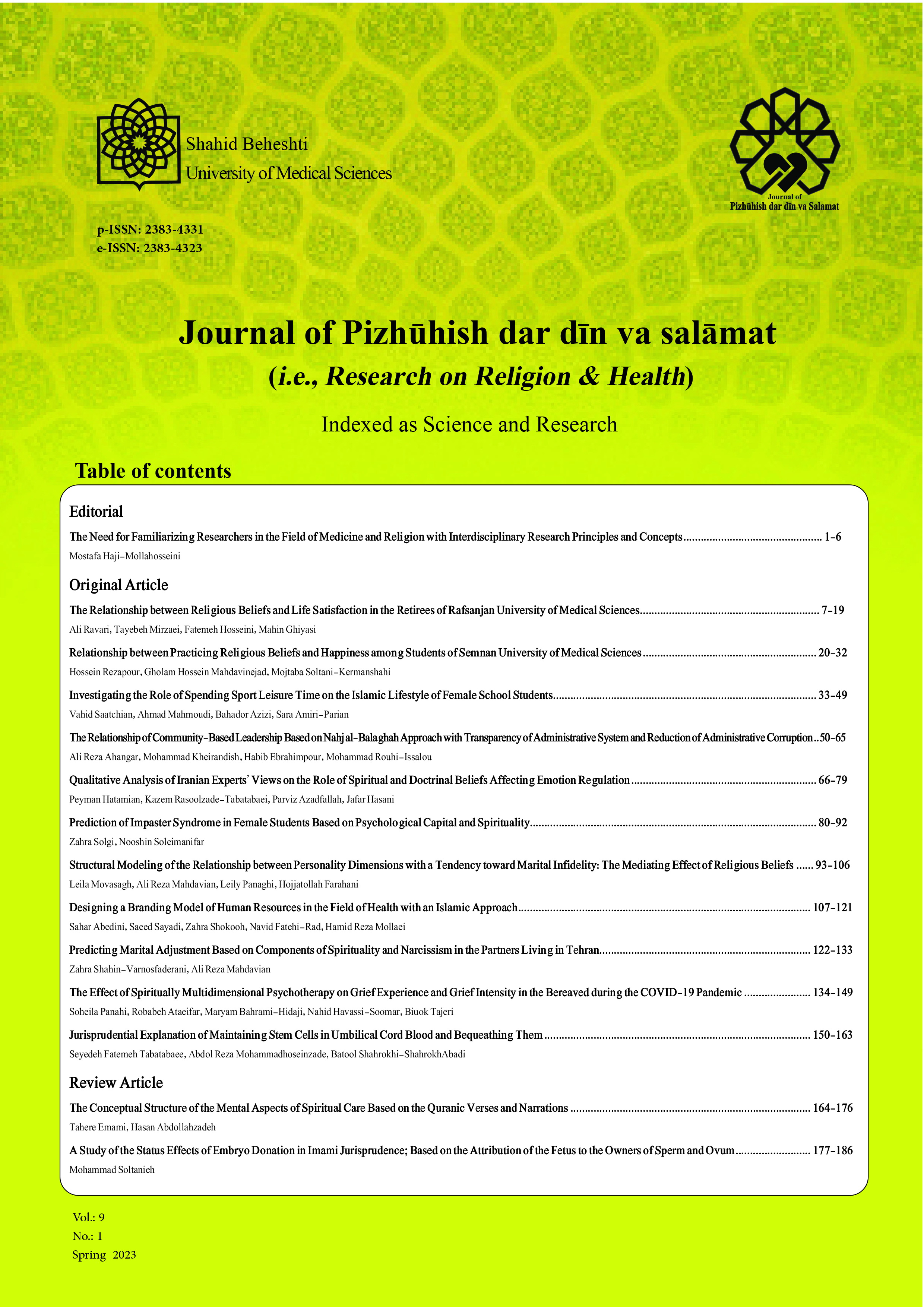
رهبری جامعهمحور با رویکرد نهجالبلاغه و ارتباط آن با شفافیت نظام اداری و کاهش فساد اداری بر اساس نظر مدیران ادارات دولتی استان اردبیل
پژوهش در دین و سلامت ,
دوره 9 شماره 1 (2023),
27 مهٔ 2025
,
صفحه 50-65
https://doi.org/10.22037/jrrh.v9i1.35942
چکیده
سابقه و هدف: فساد اداری یکی از بزرگترین نگرانیهای اجتماعی است که میتواند به هر گوشه و کنار یک کشور نفوذ کند و برای سلامت و رفاه آن مضر باشد. پژوهش حاضر با هدف بررسی نظر مدیران ادارات دولتی استان اردبیل دربارۀ رابطۀ بین رهبری جامعهمحور با رویکرد نهجالبلاغه، شفافیت نظام اداری و کاهش فساد اداری انجام شد.
روش کار: پژوهش حاضر کاربردی از نوع توصیفی-همبستگی است. جامعۀ آماری پژوهش تمامی مدیران و کارکنان سطوح عالی و میانی ادارات دولتی استان اردبیل در سال 1399 بود که از میان آنان تعداد 116 نفر بهصورت نمونهگیری خوشهای انتخاب شدند و در پژوهش شرکت کردند. ابزارهای جمعآوری اطلاعات پرسشنامههای رهبری جامعهمحور آهنگر و همکاران، شفافیت سازمانی راولینز و فساد اداری عبدالهی بود. درنهایت، نتایج با استفاده از آزمون روش حداقل مربعات تحلیل شد. در این پژوهش همۀ موارد اخلاقی رعایت شده است و مؤلفان مقاله تضاد منافعی گزارش نکردهاند.
یافتهها: نتایج نشان داد بین نظر مدیران در رابطۀ بین رهبری جامعهمحور با رویکرد نهجالبلاغه، شفافیت نظام اداری و کاهش فساد اداری رابطۀ معنیداری وجود داشت.
نتیجهگیری: با توجه به یافتههای بهدستآمده میتوان گفت آموزههای نهجالبلاغه میتواند مانع رشد بسیاری از جریانات توأم با فساد اداری گردد؛ همچنین از لحاظ کاربردی اجرای الگوی رهبری جامعهمحور و آموزش آن به مدیران و کارکنان سازمانهای دولتی توصیه میگردد.
- رهبری جامعهمحور؛ شفافیت نظام اداری؛ کاهش فساد اداری
ارجاع به مقاله
مراجع
Khan A, Krishnan S, Dhir A. Electronic government and corruption: Systematic literature review, framework, and agenda for future research. Technological Forecasting and Social Change. 2021; 167:120737.
Arayankalam J, Khan A, Krishnan S. How to deal with corruption? Examining the roles of e-government maturity, government administrative effectiveness, and virtual social networks diffusion. International Journal of Information Management. 2021;58:102203. (Full Text in Persian)
Khan A, Krishnan S. Conceptualizing the impact of corruption in national institutions and national stakeholder service systems on e-government maturity. International Journal of Information Management. 2019;46:23-36.
International T. Corruption Perceptions Index 2020 [Available from: https://www.transparency.org/en/cpi/2020.
Al-Jundi SA, Shuhaiber A, Augustine R. Effect of consumer innovativeness on new product purchase intentions through learning process and perceived value. Cogent Business & Management. 2019;6(1): 1698849.
Meijer A, Grimmelikhuijsen S. Responsible and accountable algorithmization: How to generate citizen trust in governmental usage of algorithms. The Algorithmic Society: Routledge; 2020. p. 53-66.
González CP. On Transparency, Good Governance and the Fight against Corruption: Some Lessons (and Questions) from an International Law Perspective. Span Yearb Int Law. 2015;19:143-65.
Derakhshan M, Ghanbari S, Zandi K. Factorial Structure and Internal Consistency of Organizational Transparency Questionnaire. Career and Organizational Counseling. 2018;10(37):147-64. (Full Text in Persian)
Guggisberg S. Transparency in the activities of the Food and Agriculture Organization for sustainable fisheries. Marine Policy. 2021:104498.
Petersson MT. Transparency in global fisheries governance: The role of non-governmental organizations. Marine Policy. 2020:104128.
Schnackenberg AK, Tomlinson EC. Organizational transparency: A new perspective on managing trust in organization-stakeholder relationships. Journal of Management. 2016;42(7):1784-810.
McAllister ST. The Convention on Access to Information, Public Participation in Decision-Making, and Access to Justice in Environmental Matters. Colo J Int'l Envtl L & Pol'y. 1999;10:187.
Harrison TM, Sayogo DS. Transparency, participation, and accountability practices in open government: A comparative study. Government information quarterly. 2014;31(4):513-25.
Guillamón M-D, Ríos A-M, Gesuele B, Metallo C. Factors influencing social media use in local governments: The case of Italy and Spain. Government Information Quarterly. 2016;33(3):460-71.
Lourenço I, Branco M. Principais consequências da adoção das IFRS: análise da literatura existente e sugestões para investigação futura. Revista Contabilidade & Finanças. 2015;10(26):26-39.
Kosack S, Fung A. Does transparency improve governance? Annual review of political science. 2014;17.
Matheus R, Janssen M, Janowski T. Design principles for creating digital transparency in government. Government Information Quarterly. 2021;38(1):101550.
Hajian Hosseinabadi R, Tehrani Nastafi D, Amini Hajiabadi MR. Areas of information transparency and economic justice from the perspective of Nahj al-Balaghah. Journal of Nahj al-Balaghah Research. 2017;16(4):81-102. (Full Text in Persian)
Karegar R, Ghaffari R, Ahmadi M. Providing A Model for Healthy Organization Against Bureaucratic Corruption According to Nahj Al-Balaghah. Nahjolbalagheh Research. 2020;19(1):11-36. (Full Text in Persian)
Rezaeiyan A, Asadullahzadeh H. The Factors contributing to the Prevention of Administrative Corruption according to Imam Ali's View. Islam va Pazuheshhay-e Modiriaty. 2015;4(1):57-76. (Full Text in Persian)
Marzoghi R, Tokrzadeh J, Peyravinezhad Z. Developing and Accrediating An Islamic Spiritual Leadership Framework in Organization From the Perspective of Nahj-al-Balaghe. Quarterly Journal of Nahj al-Balagha Research. 2016;3(12):43-70. (Full Text in Persian)
Fatehi A. Contingent Management in Imam Ali (AS) Management System: Quran and Hadith University; 2014. (Full Text in Persian)
Ijtihad M, ShahTalebi B. Components of value-based leadership and providing an appropriate framework for promoting this approach. knowledge and research in educational sciences. 2008;19:1-22. (Full Text in Persian)
Vaezi A, Assareh A. The relationship between divine sovereignty and human sovereignty In accepting or rejecting God's legislative will. Political Science. 2020;23(90):35-56. (Full Text in Persian)
Mousazadeh E, Zeyghamian FS. Leadership of The ISlamic State in The Epistles Dyny 1342-1357. Political Quarterly. 2018;48(1):221-35. (Full Text in Persian)
Nejatbakhsh Isfahani A, Bahareh S. Comparison of Management Characteristics from the Viewpoint of the Holy Quran with Management from the Viewpoint of Western Theories. Interdisciplinary Research of the Holy Quran. 2009;1(2):37-80. (Full Text in Persian)
Alavi M, Faghihi A, Moosa Khani M, NajafBeigi R. Studying the Roots of Administrative Corruption in Government Organizations of Iran. Iranian journal of management sciences. 2018;13(49):1-16. (Full Text in Persian)
Abbaszadeh Vaqhfi S, Delkhah J, Forouzandeh Dehkordi L. Shenasaei-e Elal-e Boomi-e Borooz-e Fesad-e Edari: Mowred-e Motalleeh Shahrdari-e Tehran. Audit Science. 2017;17(68):5-40. (Full Text in Persian)
Miandari K, Deyhimpour M, Najjari R, Abedijafari H. Designing a Model for Increasing Organizational Transparency with a Data Driven Approach in Governmental Organizations. Journal of Research on Management of Teaching in Marine Sciences. 2018;5(1):95-110. (Full Text in Persian)
Darvish H, Azimi Zachekani F. The effect on reducing corruption organization Transparency mediated by organizational trust studied Khordad hospital staff Varamin. Journal of Public Administration. 2016;8(1):153-66. (Full Text in Persian)
Vazin-e Karimian M, Kolahi B, Safari S. Shenasaei va Owlaviat-Bandi-e Avamel-e Moaser bar Shafafiat-e Nezam-e Edari-e Iran (Nazer bar Band-e 18 Siasathay-e Koli-e Nezam-e Edari). Public Administration Perspaective. 2015;6(3):83-105. (Full Text in Persian)
Ghorbani A, Nascimento L, Filatova T. Growing community energy initiatives from the bottom up: Simulating the role of behavioural attitudes and leadership in the Netherlands. Energy Research & Social Science. 2020;70:101782. (Full Text in Persian)
Shaaban M, Goehlert R. United Nations Documentation: A Basic Guide: Citeseer; 1992. (Full Text in Persian)
Delgado M. Social work practice in nontraditional urban settings: Oxford University Press, USA; 1999.
Islam MR, Abd Wahab H, ak Anggum L. The influence of leadership quality towards community cohesion in Iban community in Malaysia. Heliyon. 2020;6(2):e03370.
Sandfort JR, Bloomberg L. InCommons: supporting community-based leadership. Community Development. 2012;43(1):12-30.
Chung EY-h. Identifying evidence to define community-based rehabilitation practice in China using a case study approach with multiple embedded case study design. BMC health services research. 2019; 19(1):1-10.
Cleaver S, Nixon S. A scoping review of 10 years of published literature on community-based rehabilitation. Disability and Rehabilitation. 2014; 36(17): 1385-94.
WHO. Capturing the difference we make: community-based rehabilitation indicators manual. 2015.
Martiskainen M. The role of community leadership in the development of grassroots innovations. Environmental Innovation and Societal Transitions. 2017;22:78-89.
Wood J. To what extent does school leadership facilitate Community Cohesion for students in an English secondary school? : UCL (University College London); 2017.
Asnarulkhadi A. Pendayaupayaan komuniti melalui penglibatan: Satu penilaian umum terhadap pembangunan komuniti di Malaysia. Malays J Soc Pol Soc. 2005;2:75-91.
Sabran MS. Leadership in the success of community development projects in Malaysia: Two
case studies: University of Missouri-Columbia; 1999.
Hassan Z, Silong AD. Women leadership and community development. European Journal of Scientific Research. 2008;23(3):361-72.
Isham J, Kelly T, Ramaswamy S. Social capital and economic development: well-being in developing countries: Edward Elgar Publishing; 2002.
Morris AB, McDaid M, Potter H. Promoting community cohesion in England. School Leadership & Management. 2011;31(3):281-96.
Wu Y-C. Mechanisms linking ethical leadership to ethical sales behavior. Psychological Reports. 2017; 120(3):537-60.
Lythreatis S, Mostafa AMS, Wang X. Participative leadership and organizational identification in SMEs in the MENA Region: Testing the roles of CSR perceptions and pride in membership. Journal of Business Ethics. 2019;156(3):635-50.
Tahir AH, Tanveer A, Faheem F, Rahman A, Saeed Z. Influence of instrumental and participative leadership style on job performance. International Journal of Scientific Footprints. 2017;5(2):1-8.
Shin Y, Oh W-K, Sim C-HS, Lee J-Y. A multilevel study of supportive leadership and individual work outcomes: The mediating roles of team cooperation, job satisfaction, and team commitment. Journal of Applied Business Research (JABR). 2016;32(1):55-70.
Xu Q, Zhao Y, Xi M, Zhao S. Impact of benevolent leadership on follower taking charge: Roles of work engagement and role-breadth self-efficacy. Chinese management studies. 2018;12(4):741-55.
Veliu L, Manxhari M, Demiri V, Jahaj L. The influence of leadership styles on employee's performance. Management (16487974). 2017;31(2).
Tajmir Riahi J, Safari A, Shameli N. Explaining the Aspects of Organizational Leadership Based on the Islamic Value System Using Nahj Al-Balaghah Teachings. Scientific Journal of Islamic Management. 2017;25(2):93-113.
Vakilzadeh R. A study of the principles of Islamic management from the perspective of Nahj al-Balaghah. Productivity Management. 2008;2(3):201-34. (Full Text in Persian)
Rabipour MA, Samadivand M. Management policy and characteristics of managers in Nahj al-Balaghah. Productivity Management. 2009;3(1):119-40. (Full Text in Persian)
Azizabadi A, Mortazavi S, Ansari Avval M, Rahimnia F. An Introduction to Ethical Leadership in Nahjulbalaghah. Scientific Journal of Islamic Management. 2016;24(4):11-42. (Full Text in Persian)
Zakeri A, Hoveida R, Najafi M. Spiritual leadership with an Islamic approach. Islamic Studies in
Education. 2011;2(4):137-64. (Full Text in Persian)
Jove-Kar AA, Karimi O, Abdullahi S. Investigating Examining the role of organizational commitment in preventing corruption Case study: Government offices of Ilam city. Tehran: Payame Noor University; 2013.
Forouzandeh Junghani R, Tavakoli A. Investigating and analyzing the dark edge of organizational behaviors from the perspective of Amir al-Mo'menin (AS). Management in Islamic University. 2018; 7(16):293-310. (Full Text in Persian)
Taheri M, Arista MJ. A comparative study of the foundations of the principle of transparency from the perspective of Islam and the theory of good governance. Comparative Research in Islamic and Western Law. 2016;3(3):1-24. (Full Text in Persian)
Sayyed Razi AM. Nahj al-Balaghah, Translation by Shahidi,S.J. Tehran: Elmi va Farhangi; 1998. (Full Text in Persian)
Yaqubi A. Tarikh al-Yaqubi. Beirut: Dar sader; 1960.
Hosseini Nejad M. Modeling the Relationship between Religious BeliefsOrganizational Health and Mental Health. 11th International Conference on Psychology and Social Sciences; Tehran. 2018. (Full Text in Persian)
Alwani SM, Islam Panah M. Designing a model to prevent corruption based on the teachings of Nahj al-Balaghah. Management in Islamic University. 2018;7(15):147-62. (Full Text in Persian)
- چکیده مشاهده شده: 327 بار
- pdf دانلود شده: 123 بار