
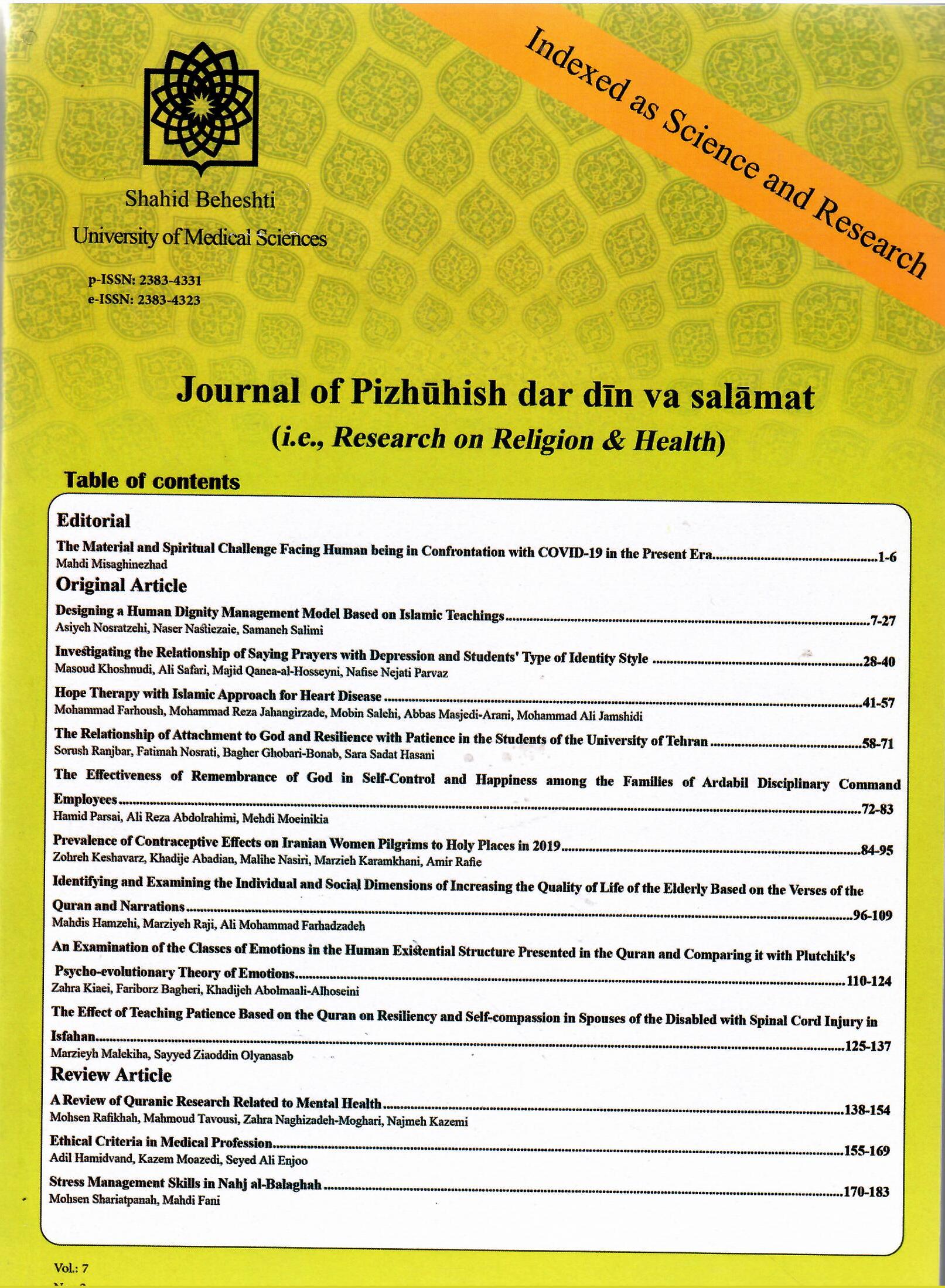
Prevalence of Contraceptive Effects on Iranian Women Pilgrims to Holy Places in 2019
Journal of Pizhūhish dar dīn va Salāmat (i.e., Research on Religion & Health),
Vol. 7 No. 2 (2021),
21 June 2021
,
Page 84-95
https://doi.org/10.22037/jrrh.v7i2.34661
Abstract
Background and Objective: The use of birth control pills, either arbitrarily and as prescribed by a doctor, to delay menstruation, has become very common in pilgrims on pilgrimages to the holy shrines in the past few years. On the other hand, few studies have been conducted to identify the prevalence and type of side effects of these pills. This study was conducted to evaluate the prevalent side effects of these drugs on Iranian women pilgrims to holy places in 2019.
Methods: This is a cross-sectional study. In this study, 123 women Tamattu’ Hajj pilgrims and pilgrims of the holy shrines in 2019, who met the desired conditions, were selected based on purpose. The data collection instrument was a two-part researcher-made questionnaire. The first part of the questionnaire was completed in the last days of the Hajj pilgrimage in the holy land of Arafat when the pilgrims referred to their tents and also in the last days of the pilgrimage to the holy shrines in interviews with the qualified people. The second part of the questionnaire collected the necessary information one month after returning from the Hajj and pilgrimage of the holy shrines. In this study, all the ethical considerations were observed and the authors declared no conflict of interest
Results: The results of the test for the frequency of drug side effects showed that spotting, bleeding, nausea and dizziness, anxiety and depression and irritability, chest pain and shortness of breath and lower extremity problems such as swelling, unilateral leg edema and leg pain were the most important complications. They were taking drugs and McNemar nonparametric test analysis showed that there was a significant difference between the occurrence of some complications during and after the trip (P<0.05).
Conclusion: Due to the side effects associated with taking the pills during and after the trip, pilgrims are recommended to use the least number of pills to create fewer side effects, and it is even better to start taking the pill just a few days before the expected time of menstruation.
Please cite this article as: Keshavarz Z, Abadian Kh, Nasiri M, Karamkhani M, Rafie A. Prevalence of Contraceptive Effects on Iranian Women Pilgrims to Holy Places in 1398. Journal of Pizhūhish dar dīn va salāmat. 2021;7(2):84-95. https://doi.org/10.22037/jrrh.v7i2.34661
- Contraceptives, Holy places, Iranian women
How to Cite
References
Durham SR, Emminger W, Kapp A, Colombo G, De Monchy JG, Rak S, et al. Long-term clinical efficacy in grass pollen–induced rhinoconjunctivitis after treatment with SQ-standardized grass allergy immunotherapy tablet. Journal of Allergy and Clinical Immunology. 2010;125(1):131-8. e7.
Wong CL, Farquhar C, Roberts H, Proctor M. Oral contraceptive pill as treatment for primary dysmenorrhoea. Cochrane database of systematic reviews. 2009(2.(
Harada T, Momoeda M, Taketani Y, Hoshiai H, Terakawa N. Low-dose oral contraceptive pill for dysmenorrhea associated with endometriosis: a placebo-controlled, double-blind, randomized trial. Fertility and sterility. 2008;90(5):1583-8.
Kulkarni J. Depression as a side effect of the contraceptive pill. Expert opinion on drug safety. 2007;6(4):371-4.
Hannaford PC, Iversen L, Macfarlane TV, Elliott AM, Angus V, Lee AJ. Mortality among contraceptive pill users: cohort evidence from Royal College of General Practitioners’ Oral Contraception Study. Bmj. 2010;340.
Ghorshi Z, Taleghani F, Shafiei M. Barresi-ye Mizan-e Shekast va Avarez-e Masraf-e Qors-Haye Zed-e Bardari be Manzoor-e Ta'khir dar Qaedegi dar Zaeran-e Karvanhay-e Haj-e Tamato'-e Ostan-e Kerman dar Sal-e 1379-80. Journal of Shahid Sadoughi University of Medical Sciences. 2005;12(4):65-70 .(Full Text in Persian)
Payne J, Maclean R, Hampton K, Baxter A, Makris M. Haemoperitoneum associated with ovulation in women with bleeding disorders: the case for conservative management and the role of the contraceptive pill. Haemophilia. 2007;13(1):93-7.
El-Hemaidi I, Gharaibeh A, Shehata H. Menorrhagia and bleeding disorders. Current Opinion in Obstetrics and Gynecology. 2007;19(6):513-20.
Shukla A, Jamwal R, Bala K. Adverse effect of combined oral contraceptive pills. Asian J Pharma & Clin Res. 2017;10:17-21.
Kiley J, Hammond C. Combined oral contraceptives: a comprehensive review. Clinical obstetrics and gynecology. 2007;50(4):868-77.
Littlejohn KE. “It’s those Pills that are Ruining Me” Gender and the Social Meanings of Hormonal Contraceptive Side Effects. Gender & Society. 2013;27(6):843-63.
Smulders B, van Oirschot SM, Farquhar C, Rombauts L, Kremer JA. Oral contraceptive pill, progestogen or estrogen pre‐treatment for ovarian stimulation protocols for women undergoing assisted reproductive techniques. Cochrane Database of Systematic Reviews. 2010(1).
Worly BL, Gur TL, Schaffir J. The relationship between progestin hormonal contraception and depression: a systematic review. Contraception. 2018;97(6):478-89.
Cooper DB, Mahdy H. Oral contraceptive pills. StatPearls [Internet]. 2020.
Davis TC, Fredrickson DD, Potter L, Brouillette R, Bocchini AC, Williams MV, et al. Patient understanding and use of oral contraceptive pills in a southern public health family planning clinic. Southern
medical journal. 2006;99(7):713-9.
Farquhar C, Brown J. Oral contraceptive pill for heavy menstrual bleeding. Cochrane Database of Systematic Reviews. 2009(4).
Minozzi M, Costantino D, Guaraldi C, Unfer V. The effect of a combination therapy with myo-inositol and a combined oral contraceptive pill versus a combined oral contraceptive pill alone on metabolic, endocrine, and clinical parameters in polycystic ovary syndrome. Gynecological Endocrinology. 2011; 27(11):920-4.
McKetta S, Keyes KM. Oral contraceptive use and depression among adolescents. Annals of epidemiology. 2019;29:46-51.
De Wit AE, Booij SH, Giltay EJ, Joffe H, Schoevers RA, Oldehinkel AJ. Association of use of oral contraceptives with depressive symptoms among adolescents and young women. JAMA psychiatry. 2020;77(1):52-9
- Abstract Viewed: 428 times