
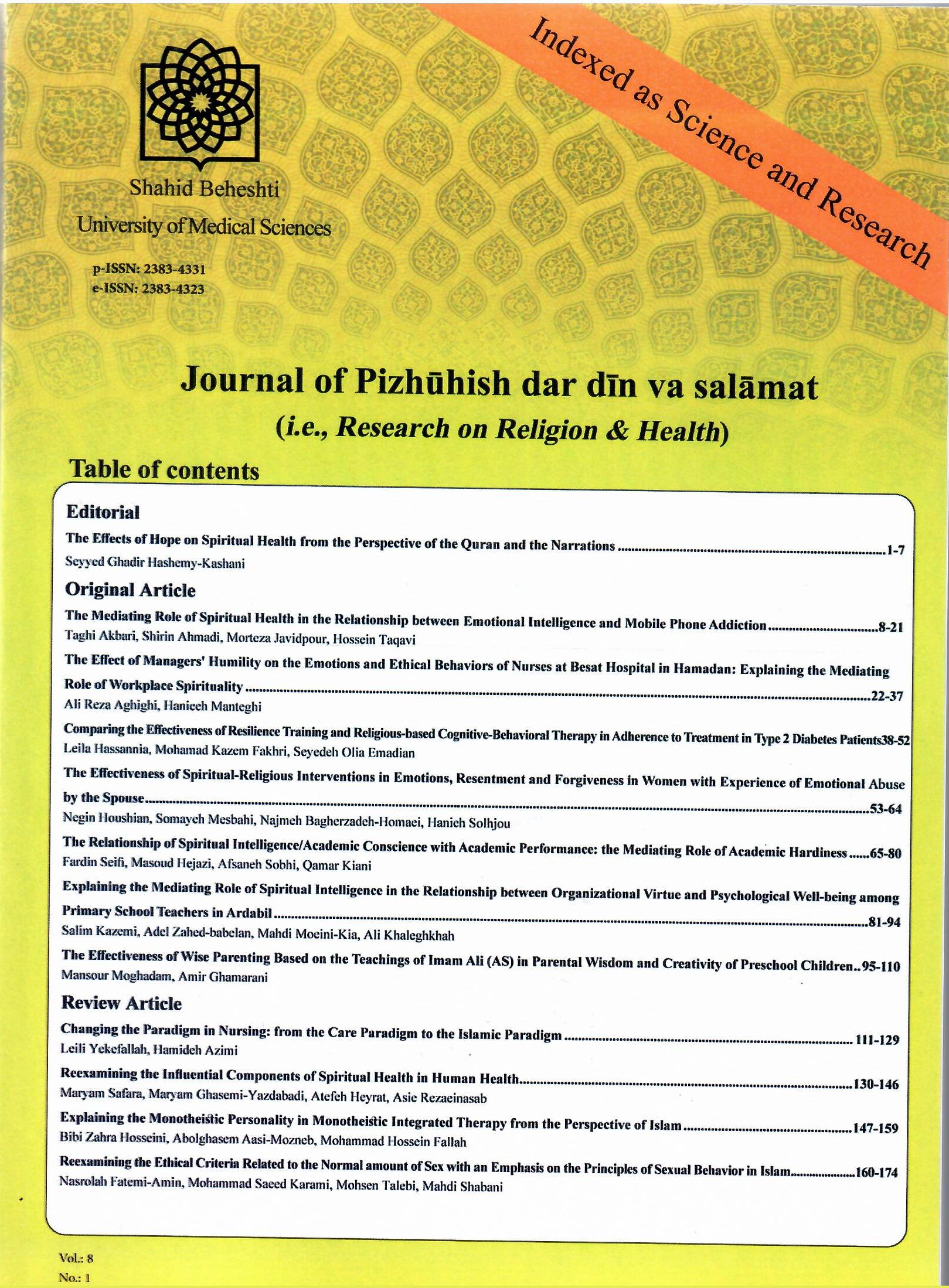
تغییر پارادایم در پرستاری: از پارادایم مراقبت به پارادایم اسلام
پژوهش در دین و سلامت ,
دوره 8 شماره 1 (2022),
19 اسفند 2022
,
صفحه 111-129
https://doi.org/10.22037/jrrh.v8i1.33802
چکیده
سابقه و هدف: نظريهپردازان پرستاري دانش پرستاري را در چارچوب فلسفههای حاکم تعریف کردهاند. نظریههای پرستاریِ متعلق به دوران مدرنیسم بر اساس مبانی فلسفۀ مدرنیسم طراحی شده بود. با بیان انتقادات به پیامدهای منفی مدرنیسم، دانشمندان پرستاری تصمیم به گذر از مدرنیسم به پستمدرنیسم و پارادایم مراقبت نشئتگرفته از پستمدرنیسم گرفتند. اما بیان انتقادات زیاد به مبانی پستمدرنیسم موجب شد که به کارایی پارادایم مراقبت نیز تردید شود. مطالعۀ حاضر با هدف بررسی پیامدهای پارادایمهای بیومدیکال و مراقبت بر پرستاری و ارائۀ پارادایمی توحیدی و جایگزین انجام شده است.
روش کار: مطالعۀ حاضر از نوع کتابخانهای است. در این پژوهش به بررسی مقالات و کتب مختلف دربارۀ مهمترین فلسفه و پارادایمهای پرستاری در محدودۀ زمانی سالهای 1950 تا 2020 در پایگاههای اطلاعاتی داخلی و خارجی با رویکردی توصیفی-تحلیلی پرداخته شده است. مؤلفان مقاله تضاد منافعی گزارش نکردهاند.
یافتهها: تکبُعدیانگاری و توجه صِرف به علائم عینی از جمله انتقادات وارد بر مدرنیسم و پارادایم بیومدیکال است. همچنین نبود معیار متقن خوبی یا بدی، نقض قانون اجتماع نقیضین با بیان قبول چندحقیقتی در جهان و انکار قواعد کلی از جمله انتقادات وارد بر پستمدرنیسم و پارادایم مراقبت است. پارادایم اسلامی ضمن داشتن نقاط قوت دو پارادایم گذشته، نقاط ضعف آنها را ندارد.
نتیجهگیری: با توجه به لزوم ارائۀ پارادایم پرستاری مبتنی بر فلسفۀ حاکم بر هر جامعه، پارادایم اسلامی راهکاری جهت برونرفت از چالشهای ایجادشده با پارادایم فعلی در پرستاری پیشنهاد میگردد.
- اسلام؛ پارادایم؛ پستمدرنیسم؛ مراقبت پرستاری
ارجاع به مقاله
مراجع
Meleis AI. Theoretical nursing: Development and progress: Lippincott Williams & Wilkins; 2011.
Moeta M, Ngunyulu RN, Peu MD, Gambu S, Sepeng N, Mulaudzi FM. The perspectives of nursing students regarding the incorporation of African traditional indigenous knowledge in the curriculum. African Journal of Primary Health Care and Family Medicine. 2020;12(1):1-8.
Nikfarid L. The Concept of human based on Iranian mysticism and wisdom: a step toward development of a nursing theory. Journal of Pizhūhish dar dīn va Salāmat. 2021;6(4):117-35. (Full Text in Persian)
Reed PG. The spiral path of nursing knowledge. Nursing knowledge and theory innovation: Advancing the science of practice. 2011:1-36.
Sadooghiasl A, Salsali M. Nursing knowledge development in the age of postmodernism. Iranian Journal of Nursing Research. 2014;9(2):38-45. (Full Text in Persian)
Rega ML, Telaretti F, Alvaro R, Kangasniemi M. Philosophical and theoretical content of the nursing discipline in academic education: A critical interpretive synthesis. Nurse Education Today. 2017;57:74-81. PMID: 28750250
Mayelafshar M, Khoshnavay-Fomani F, Golpira R, Bakhshandeh-Abkenar H, Momeni B, Khaleghparast S, et al. The most important nursing professional values: the perspectives of nurses who work at selected hospitals affiliated to Tehran University of medical sciences, Tehran, Iran. Nursing Practice Today. 2016;3(1):11-18. (Full Text in Persian)
Duckworth MP, O’Donohue WT. Behavioral medicine and integrated care: New York: Springer; 2018.
Rashidiyan A. From modernism to postmodernism. Tehran: Ney; 2016. (Full Text in Persian)
Sofla Y, Zakrof G. The survey of modernization process problems in contemporary of Iran and its effect on globalization. Political Science Quarterly. 2015;11(30):7-34. (Full Text in Persian)
Mazzotta CP. Biomedical approaches to care and their influence on point of care nurses: as coping review. Journal of Nursing Education and Practice. 2016;6(1):93-101.
Khosropanah A. Islam and modernism. Journal of Kalam Islami. 2013;22(86):125-44. (Full Text in Persian)
Sadat-Hosseini A. The need to replace the paradigm of wisdom with the paradigm of care in the Iranian Islamic model of health system development. Tehran: Pattern of Progress Publications affiliated with the Center for Iranian Islamic Pattern of Progress; 2017. (Full Text in Persian)
Mesbahi-Jamshid P, Sarmadi M, Farajollahi M, Mirdamadi S, Esmaeeli Z. The state of reason, religion and science in the postmodern era and its considerations in spiritual education with an anthropological approach. Scientific Journal of Islamic Education. 2017;24(33):95-126. (Full Text in Persian)
Yekefallah L, Azimi H. Professional dissection of nursing theories. Tehran: Jamee-Negar; 2019. (Full Text in Persian)
Daly J, Speedy S, Jackson D. Contexts of nursing: an introduction. New York: Elsevier Health Sciences; 2017.
Taylor C. The ethics of authenticity. New York: Harvard University Press; 2018.
Ghaderi Z. Critique of the philosophical discourse of modernism: Nietzsche and the transition to postmodernism. The rights of nations. 2016;24:419-45. (Full Text in Persian)
Palvish C, Hunt R. An exploratory study about meaningful work in acute care nursing. Nursing Forum. 2012;47(2):113-22. PMID: 22512769
Udo C, Danielson E, Melin-Johansson C. Existential issues among nurses in surgical care-a hermeneutical study of critical incidents. Journal of Advanced Nursing. 2012;69(3):5679-770. PMID: 22591004
Coffey R, Everett S, Miller S, Brown J. End of life in the Burn/Trauma unit: a nursing perspective. International Journal of Critical Illness and Injury
Science. 2011;1(2):129-31. PMID: 22229137
Asef-Muhseni M. The analysis and criticism of post- modernism's look at educating the values. Journal of Islam and Educational Research. 2013;5(1):25-52. (Full Text in Persian)
Forghani N, Keshtiaray N, Yousefy A. A critical examination of postmodernism based on religious and moral values education. International Education Studies. 2015;8(9):98-106.
Sadat-Hosseini A, Alhani F, Khosropanah A, Behjatpour A. Explanation of meta-paradigm of human in Islamic sources and nursing theories. Journal of Research Development in Nursing and Midwifery. 2013;9(2):36-48. (Full Text in Persian)
Tabatabaee MH. Nahayat ol-hikmah. Tehran: Markaze-Nashre-Daneshgahi; 2013. (Full Text in Arabic)
Yekefallah L, Ashktorab T, Manoochehri H, Alavi-Majd H. Futile care: why Intensive care nurses provide it? a phenomenologic study. Global Journal of Health Science. 2015;24(87):1-14. PMID: 25946928
Alimohammadi N, Taleghani F, Mohammadi E, Akbarian R. Nursing in Islamic thought: reflection on application nursing metaparadigm concept: a philosophical inquiry. Iran Nursing Inquiry. 2014;21(2):121-9.
Melise I. Theoretical nursing development and progress. Washington: Lippincott Williams & Walkins; 2007.
Rassool G. The crescent and Islam: healing, nursing and the spiritual dimension. Some considerations towards an understanding of the Islamic perspectives on caring. Journal of Advanced Nursing. 2000;32(6):1476-84. PMID: 11136416
Sadat-Hosseini A, Alhani F, Khosropanah A, Behjatpour A. Describing the Necessity of Using Islamic Concepts in Theorizing the Nursing. Akhlagh-e Zisti (i.e., Bioethics Journal). 2012;2(4):93-114. (Full Text in Persian)
Fawcett J. The metaparadigm of nursing: Present status and future refinements. Journal of nursing scholarship. 1984;16(3):84-7.
Ismail S, Hatthakit U, Chinnawong T. Islamic based caring in nursing science: a literature review. 3rd AASIC: Sustainable Development of Asian Community. 2015:100-6.
Sadat Hoseini AS. A proposed Islamic nursing conceptual framework. Nursing science quarterly. 2019;32(1):49-53.
Alhani F, Sadat-Hosseini A, Khosropanah A, Behjatpour A. A critical study of liberalism in nursing practice. Teb va Tazkieh. 2011;19(3):47-61. (Full Text in Persian)
Aghili S, Khosropanah A, Tayyeb-Taher A. Communication knowledge methodology; an introduction to Islamic methodology. Media Studies. 2011;6(2):9-25. (Full Text in Persian)
Khosropanah A, Baneshi A. Reflection on the foundations of Western theorizing and the Iranian Islamic model of progress and its necessity in the field of organizational leadership. Iranian Islamic Model of Progress Conference; Tehran. 2013. (Full Text in Persian)
Sadat-Hosseini A, Alhani F, Khosropanah A, Behjatpour A. Intellectual nursing. New theories in nursing based on Islamic document. Tehran: Andishe-Rafie; 2014. (Full Text in Persian)
Gifford F. Philosophy of Medicine. Amsterdam: Elsevier; 2011. (Full Text in Persian)
Larijani M. Critique of religiosity and modernism. Tehran: Etelaat; 2016. (Full Text in Persian)
Ghadeer-Danesh M. Features of modern science; with emphasis on humanities. Socio-Cultural Knowledge Journal. 2011;1(4):95-124. (Full Text in Persian)
Davabi H. A critique of the foundations of modernism. Karaj: Alborz Sarafrazan; 2017. (Full Text in Persian)
Mohammadi S, Yazdan N, Yousefy A, Arazi T. A glimpse in the challenges in Iranian academic nursing education. Iranian Journal of Medical Education. 2014;14(4):323-31. (Full Text in Persian)
Bayat A. Glossary. Tehran: Thought and religious culture; 2019. (Full Text in Persian)
Meshki M. An introduction of the foundations and process of modernism. Tehran: Imam Khomeini Educational and Research Institute; 2011. (Full Text in Persian)
Ahmadi B. Modernity and critical thinking. Tehran: Markaz; 2017. (Full Text in Persian)
Salasi M. The consequences of modernity. Tehran: Ney; 2014. (Full Text in Persian)
Ahmadian G, Noori M. Modernity as a media for exchange of thoughts. Quarterly Journal of Political Science. 2009;3(9):99-128. (Full Text in Persian)
Mokhber A. The rise and decline of western liberalism. Tehran: Center Publication; 2012. (Full Text in Persian)
Strategic Thoughts Meeting Mailroom. Andishe-haye Rahbordi-e Zan va Khanevadeh. Tehran: Payame-Edalat; 2011. (Full Text in Persian)
Karimi M, Naderi E, Seif-Naraghi M. Postmodern curriculum model and its application in the nursing
education system in Iran: design and evaluation of the model. Journal of Nursing Education. 2017;6(3):47-55. (Full Text in Persian)
Neishabory M, Raeisdana N, Ghorbani R, Sadeghi T. Nurses’ and patients’ viewpoints regarding quality of nursing care in the teaching hospitals of Semnan University of medical sciences. Koomesh. 2011;12(2):134-43. (Full Text in Persian)
Fatehi R, Motalebi A, Azh N. Nurses's and elderly's viewpoints regarding quality of nursing care in the educational hospitals of Sanandaj city. Nursing and Midwifery Journal. 2019;16(11):779-86. (Full Text in Persian)
Qorbani Q. The relation between human and truth in modern philosophers’ viewpoints. Religion Anthropology. 2014;10(30):27-48. (Full Text in Persian)
Motahhari M. An introduction to the Islamic worldview. Tehran: Sadra; 2013. (Full Text in Persian)
Riegel F, Crossetti M, Siqueira D. Contributions of Jean Watson’s theory to holistic critical thinking of nurses. Revista Brasileira De Enfermagem. 2018;71(4):2072-6. PMID: 30156699
Shafeati M, Zadahdi M. Studying the bio-psycho-social model of doctor-patient relationship: a transition over the biomedical model. Bioethics Journal. 2012;2(5):151-86. (Full Text in Persian)
Warelow P. Changing philosophies: a paradigmatic nursing shift from Nightingale. Australian of Advanced Nursing. 2014;31(1):36-45.
Ghorbani F, Salsali M. Concept of holistic in nursing: a review article. Journal of Education and Ethics in Nursing. 2018;7(3&4):23-30. (Full Text in Persian)
Zardosht R. Nursing care and postmodernism. Future of Medical Education Journal. 2020;10(2):56-7.
Sim S. Routledge companion to postmodernism. London: Routledge; 2011.
Motahhari M. Human social evolution in history (battle of right and wrong). Tehran: Sadra; 2016. (Full Text in Persian)
Nikfarid L, Rasouli M. Caring curriculum: a new paradigm in nursing education. Iran Journal of Nursing. 2011;24(70):61-71. (Full Text in Persian)
Motahhari M. Ensan-e kamel. Tehran: Sadra; 2013. (Full Text in Persian)
Edrisi A, Rahmani-Khalili E, Hosseini-Amin S. Social trust as a product of religious norms and ethical values. Journal of Cultural Sociology. 2012;3(1):1-23. (Full Text in Persian)
Khavas A, Hosseini-Qaleh-Bahman A, Dabiri A, HoseinSharifi A, Pakpoor A. Philosophy of ethics. Qom: Maaref; 2018. (Full Text in Persian)
Mesbah-Yazdi M. Philosophy of ethics. Tehran: Imam Khomeini Educational and Research Institute; 2012. (Full Text in Persian)
Emami A, Salsali M, Basiri H. Comparative survey between quantitative and qualitative paradigms (part II). Journal of Holistic Nursing and Midwifery. 2012;22(6):55-60. (Full Text in Persian)
Dehbani-Poor R, Khorram-Poor Y. Investigating the components of postmodernism and its related factors. Journal of Socio-Cultural Development Studies. 2017;4(4):53-77. (Full Text in Persian)
Taheri-Sarteshnizi E, Azizkhani A. A critical study on postmodern view of man with regard to religious teachings. Ensan Pajoohie Dini. 2011;8(25):35-57. (Full Text in Persian)
Motahhari M. Fetrat. Tehran: Sadra; 2020. (Full Text in Persian)
Motahhari M. Anthropology in the Quran. Tehran: Sadra; 2020. (Full Text in Persian)
Mahdavi-Azadboni R. The theological consequences of the postmodern epistemological system. Journal of Religious Thought of Shiraz University. 2012;11(41):187-204. (Full Text in Persian)
Motahhari M. Recognition issue. Tehran: Sadra; 2020. (Full Text in Persian)
Zarei-Mahmoodabadi M, Vahidi-Mehrjerdi S. Humanized religion or religious human. Journal of Religious Thought. 2018;18(67):93-112. (Full Text in Persian)
Sadat-Hosseini A. Defining wisdom as a nursing goal based on the definition of nursing concepts in Islamic texts. Iranian Journal of Nursing Research. 2013;13(4):44-9. (Full Text in Persian)
Maleki H, Hakimzadeh R, Khaleghinezhad S. Critique of postmodern viewpoint in curriculum based on philosophical foundations of Islamic education. Transformation Studies in the Humanities. 2016; 3(5):32-62. (Full Text in Persian)
Bashiriyeh H. Liberalism and conservatism (history of twentieth century political thought). Tehran: Ney; 2019. (Full Text in Persian)
Kjorasani-Sharaf S. Contemporary European philosophy. Tehran: Scientific and Cultural; 2020. (Full Text in Persian)
Zahed F. Postmodernism and the impact of nihilism on it. Journal of Epistemological Research. 2013;2(5):103-14. (Full Text in Persian)
Mohammadi E, Abbasi K, Saadati M. Barriers to implementation of nursing theories in clinical practice from the perspective of nurses. Iranian Journal of Nursing Research. 2015;10(1):13-24. (Full Text in Persian)
Sadeghi R. The nature of paradigm and its holistic aspects. Metaphysic. 2019;11(1):128-55. (Full Text in Persian)
Talkhabi M. Relation between philosophy and cognitive science: reflection on thagard’s thought. Advances in Cognitive Science. 2019;20(4):10-19. (Full Text in Persian)
Mohammdi-Pouya S, Goodarzi H, Rahmati-Najarkolaei F, Sanaeinasab H. Investigating the relationship between curriculum ideology and educational philosophy with the teachers' teaching approaches in a military medical university of Tehran. Journal of Military Medicine. 2018;19(5):460-7. (Full Text in Persian)
Mesbah-Yazdi M. Theology in the Quran. Tehran: Imam Khomeini Educational and Research Institute; 2011. (Full Text in Persian)
Ali-Norouzi A, Koohi-Esfahani H. Examining and explaining the concept of transcendent man from the perspective of the Holy Quran. Quranic Knowledge Research. 2014;4(14):101-29. (Full Text in Persian)
Javadi-Amoli A. Man from beginning to end. Qom: Asra; 2020. (Full Text in Persian)
Fani M, Abdoljabbari M, Atashzadeh-Shoorideh F, Karamkhani M. A study of the criteria for identifying healthy humans and healthy relationships from the perspective of religious texts. Journal of Research on Religion and Health. 2018;4(1):104-17. (Full Text in Persian)
Rabbani-Golpaygani A, Vaez-Hosseini S. The origin of infallibility. Journal of Kalam Islami. 2014;23(90):51-77. (Full Text in Persian)
Ali-Akbarzadeh H. Examining and criticizing the possibility and permission of interpreting the Qur'an in the school of separation. Journal of Sokhane-Jameeh. 2012;2(3&4):29-46. (Full Text in Persian)
Mirdamadi M, Arshad-Riahi A. The impact of mulla-sadra’s philosophical bases on his knowledge of Imam. Islamic Theology Studies. 2019;7(24):105-20. (Full Text in Persian)
Audi R. Epistemology contemporary introduction to the theory of knowledge. Oxfordshire: Routledge; 2011.
Kafi M. The purpose of science in the paradigm of Islamic sciences. Islam and Social Sciences. 2017;8(6):61-82. (Full Text in Persian)
Salsali M, Cheraghi M, Fakhr-Movahhedi A. Gronded theory in medical sciences. Tehran: Boshra; 2016. (Full Text in Persian)
Azram M. Epistemology - an Islamic perspective. IIUM Engineering Journal. 2011;12(5):179-87.
Boloorsaz-Mashhadi H, Aghaei M, Mohammadkhani M, Mahdavi A. Examining the effect
of teaching Islamic based coping strategies on indicators of chronic pain and quality of life among women with fibromyalgia. Journal of Research on Religion and Health. 2017;3(4):48-65. (Full Text in Persian)
Sadat-Hosseini A, Alhani F, Khosropanah A, Behjatpour A. Wise health, the concept of health based on Islamic texts in nursing. Journal of Medical Figh. 2012;4(11&12):47-96. (Full Text in Persian)
Mackenbach J. The persistence of health inequalities in modern welfare states: the explanation of a paradox. Social Science & Medicine. 2012;75(4):761-9. PMID: 22475407
Pakmehr H, Khandaghi M, Ghandili S, Saeidi-Rezvani M. The nature of discourse making of the Islamic revolutions doctrines and its characteristics in the curricula of the educational system of the Islamic Republic of Iran. Journal of Applied Issues in Islamic Education. 2017;2(3):7-40. (Full Text in Persian)
Negarandeh R, Mardani-Hamooleh M, Rezaee N. Concept analysis of palliative care in nursing: introducing a hybrid model. Journal of Mazandaran University of Medical Sciences. 2015;25(130):40-51. (Full Text in Persian)
Yazdi M. Philosophy teaching. Tehran: International Publishing Company; 2013. (Full Text in Persian)
- چکیده مشاهده شده: 426 بار
- pdf دانلود شده: 304 بار