
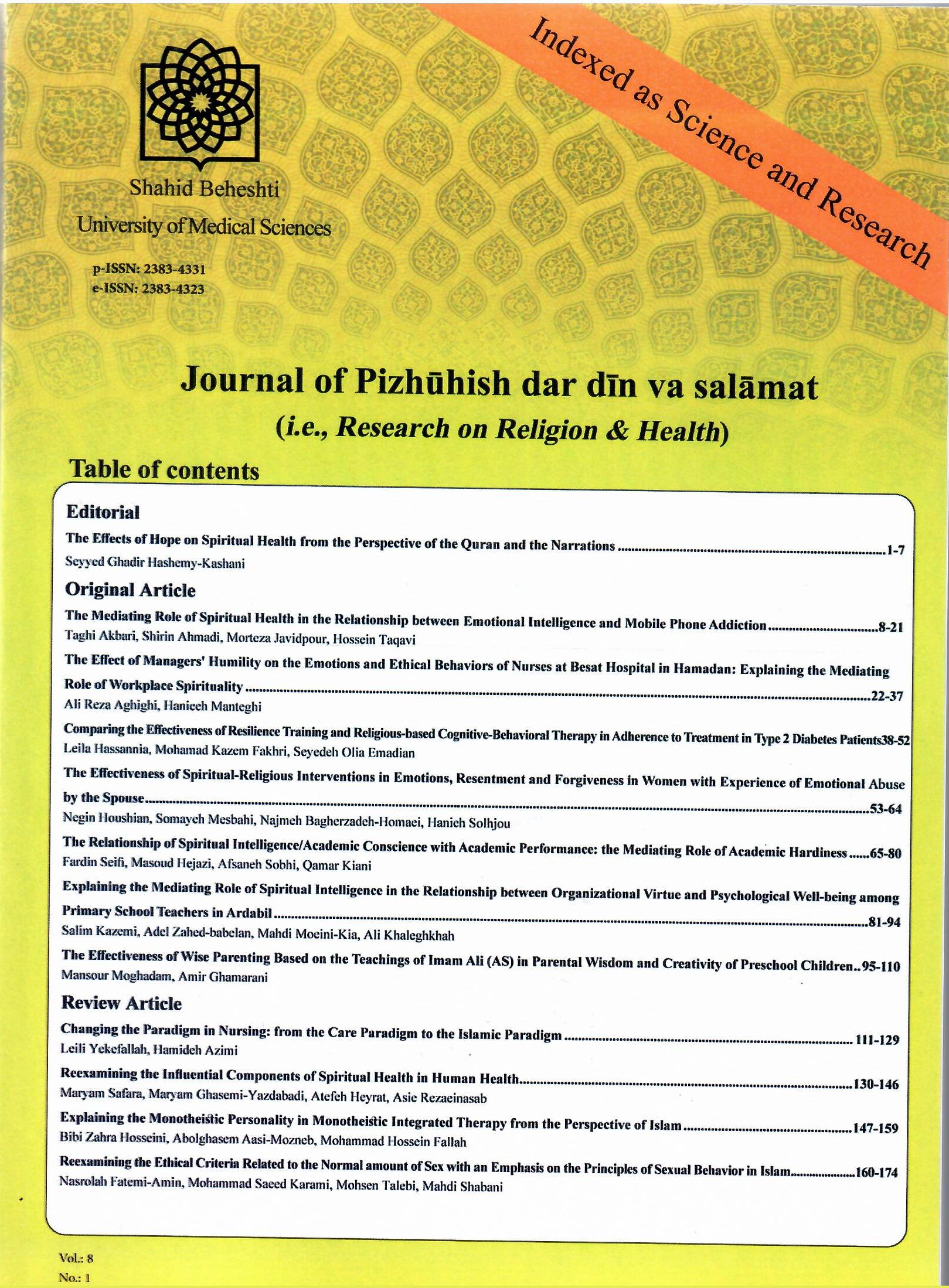
الدور الوسيط للصحة المعنوية في العلاقة بين الذكاء العاطفي والإدمان بالهواتف الذكية
مجلة البحث في الدين و الصحّة,
مجلد 8 عدد 1 (2022),
19 آذار 2022
,
الصفحة 8-21
https://doi.org/10.22037/jrrh.v8i1.33109
الملخص
خلفية البحث وأهدافه: ان الاستخدام المفرط للهواتف الذكية، قد غير العادات الفكرية للإنسان بشكل كبير كما انه قد اثر على التوافق السلوكي والنفسي-الاجتماعي. يقوم هذا البحث بدراسة الدور الوسيط للصحة الروحية في العلاقة بين الذكاء العاطفي والإدمان بالهواتف الذكية.
منهجية البحث: اجريت الدراسة الحالية بطريقة وصفية وترابطية. اشتمل المجتمع الاحصائي للدراسة، جميع التلاميذ الذكور في المرحلة المتوسطة في المدراس الحكومية بمدينة اردبيل عام 2019 حيث تم اختيار 250 عينة منهم بطريقة اخذ العينة العشوائية العنقودية ذات المراحل المتعددة وطُلب منهم الاجابة على استبيانات الادمان بالهواتف الذكية والذكاء العاطفي والصحة المعنوية. تم تحليل البيانات من خلال معايير الاحصاء الوصفي، ومعامل ارتباط بيرسون ونموذج العلاقات الهيكلية. تمت مراعاة جميع الموارد الاخلاقية في هذا البحث واضافة الى هذا، فإن مؤلفي البحث لم يشيروا الى اي تضارب في المصالح.
المعطیات: اظهرت نتائج معامل الارتباط ان هناك علاقة سلبية بين الادمان بالهواتف الذكية وبين الدرجة الكلية للذكاء العاطفي ومكوناته وبين الصحة المعنوية. كما أن هناك علاقة ايجابية بين الصحة المعنوية وبين الدرجة الكلية للذكاء العاطفي ومكونات الوعي والتحفيز الذاتي (001/0P<). اضافة الى هذا، اكدت مؤشرات توفیق النماذج ایضا علی تأثير الذكاء العاطفي على الادمان بالهواتف المحمولة مع وجود الصحة المعنوية كعامل وسيط.
الاستنتاج: تعزز نتائج البحث، الفرضية القائلة بأن الصحة المعنوية يمكن ان تكون عاملا وقائيا للمراهقين وتساعدهم على تقليل الاعراض السلبية لإستخدام الانترنت والهواتف الذكية. تعتبر اثار هذه النتائج مفيدة للوقاية من عدم التوافق النفسي المرتبط بالانترنت والاستخدام المفرط للهواتف الذكية عند المراهقين.
- الادمان بالهاتف الخلوي؛ الذكاء العاطفي؛ الصحة المعنوية
كيفية الاقتباس
المراجع
Jun S. The reciprocal longitudinal relationships between mobile phone addiction and depressive symptoms among Korean adolescents. Computers in Human Behavior. 2016;58:179-86.
Ng KC, Wu LH, Lam HY, Lam LK, Nip PY, Ng CM, et al. The relationships between mobile phone use and depressive symptoms, bodily pain, and daytime sleepiness in Hong Kong secondary school students. Addictive behaviors. 2020;101:105-975.
Liu Q-Q, Zhou Z-K, Yang X-J, Kong F-C, Niu G-F, Fan C-Y. Mobile phone addiction and sleep quality among Chinese adolescents: A moderated mediation model. Computers in Human Behavior. 2017;72:108-14.
Seo DG, Park Y, Kim MK, Park J. Mobile phone dependency and its impacts on adolescents’ social and academic behaviors. Computers in human behavior. 2016;63:282-92.
Liu Q-Q, Zhang D-J, Yang X-J, Zhang C-Y, Fan C-Y, Zhou Z-K. Perceived stress and mobile phone addiction in Chinese adolescents: a moderated mediation model. Computers in Human Behavior. 2018;87:247-53.
Lee SJ, Moon HJ. Effects of self-control, parent-adolescent communication, and school life satisfaction on smart-phone addiction for middle school students. Korean Journal of Human Ecology. 2013;22(6):587-98.
Hawi NS, Samaha M. To excel or not to excel: Strong evidence on the adverse effect of smartphone addiction on academic performance. Computers & Education. 2016;98:81-9.
Machimbarrena Garagorri JM, Gonzalez Cabrera J, Ortega Baron J, Beranuy Fargues M, Alvarez Bardon A, Tejero B. Profiles of Problematic Internet Use and Its Impact on Adolescents' Health-Related Quality of Life. 2019;16(20): 1-17.
Lin C-Y, Imani V, Broström A, Nilsen P, Fung XC, Griffiths MD, et al. Smartphone application-based addiction among Iranian adolescents: A psychometric study. International Journal of Mental Health and Addiction. 2019;17(4):765-80.
Do HN, Onyango B, Prakash R, Tran BX, Nguyen QN, Nguyen LH, et al. Susceptibility and perceptions of excessive internet use impact on health among
Vietnamese youths. Addictive behaviors. 2020; 101: 105-898.
Mak K-K, Lai C-M, Watanabe H, Kim D-I, Bahar N, Ramos M, et al. Epidemiology of internet behaviors and addiction among adolescents in six Asian countries. Cyberpsychology, Behavior, and Social Networking. 2014;17(11):720-28.
Zhang MW, Ho R. Smartphone applications for immersive virtual reality therapy for internet addiction and internet gaming disorder. Technology and Health Care. 2017;25(2):367-72.
Van der Linden D, Pekaar KA, Bakker AB, Schermer JA, Vernon PA, Dunkel CS, et al. Overlap between the general factor of personality and emotional intelligence: A meta-analysis. Psychological bulletin. 2017;143(1):36
Mayer JD, Caruso DR, Salovey P. The ability model of emotional intelligence: Principles and updates. Emotion review. 2016;8(4):290-300.
Jeong SH, Kim H, Yum JY, Hwang Y. What type of content are smartphone users addicted to?: SNS vs. Games. Computers in Human Behaviors. 2016; 1(54):10-7.
Casale S, Tella L, Fioravanti G. Preference for online social interactions among young people: Direct and indirect effects of emotional intelligence. Personality and Individual Differences. 2013;54(4): 524-29.
Cho K-S, Lee J-M. Influence of smartphone addiction proneness of young children on problematic behaviors and emotional intelligence: Mediating self-assessment effects of parents using smartphones. Computers in Human Behavior. 2017;66:303-11.
Sun J, Liu Q, Yu S. Child neglect, psychological abuse and smartphone addiction among Chinese adolescents: The roles of emotional intelligence and coping style. Computers in Human Behavior. 2019;90:74-83.
Arrivillaga C, Rey L, Extremera N. Adolescents’ problematic internet and smartphone use is related to suicide ideation: Does emotional intelligence make a difference? Computers in Human Behavior. 2020:106-375.
Hungelmann J, Kenkel-Rossi E, Klassen L, Stollenwerk RM. Spiritual well-being in older adults: Harmonious interconnectedness. Journal of religion and Health. 1985;24(2):147-53.
Chand P, Koul H. Workplace spirituality, organizational emotional ownership and job satisfaction as moderators in coping with job stress. Decision Making. 2012;9(10):225-9.
Song M-K, Paul S, Ward SE, Gilet CA, Hladik GA. One-year linear trajectories of symptoms, physical functioning, cognitive functioning, emotional well-being, and spiritual well-being among patients receiving dialysis. American Journal of Kidney Diseases. 2018;72(2):198-204.
Khojasteh S. The Relationship between Internet Addiction with Mental Health and Spiritual Health of High School Students. medical journal of mashhad university of medical sciences. 2019;61(1):58-68. (Full Text in Persian)
Shekarafshan N. The Relationship Between Social Anxiety, Spiritual Health and Life Satisfaction with Internet Addiction in students of Shahid Bahonar University of Kerman. Kerman: Shahid Bahonar University. 2014. (Full Text in Persian)
Shim JY. Christian spirituality and smartphone addiction in adolescents: A comparison of high-risk, potential-risk, and normal control groups. Journal of religion and health. 2019;58(4):1272-85.
Monterosso D, Kumar V, Zala K. Spiritual Practices in The Era of Smartphones & Social Networking: A Comparative Study. International Journal of Psychosocial Rehabilitation. 2019;22(2):45-57.
Akbari M, Hossaini S. The relationship of spiritual health with quality of life, mental health, and burnout: The mediating role of emotional regulation. Iranian journal of psychiatry. 2018;13(1):22-31. (Full Text in Persian)
Beauvais AM, Stewart JG, DeNisco S. Emotional intelligence and spiritual well-being: implications for spiritual care. Journal of Christian Nursing. 2014;31(3):166-71.
Koo HY. Development of a cell phone addiction scale for Korean adolescents. Journal of Korean Academy of Nursing. 2009;39(6):818-28.
Paloutzian RF, Ellison CW. Loneliness, spiritual well-being and the quality of life. Loneliness: A sourcebook of current theory, research and therapy. 1982:224-37.
Seyedfatemi N, Rezaie M, Givari A, Hosseini F. Prayer and spiritual well-being in cancer patients. Payesh. 2006;5(4):295-304.
Mansoori B. Standardization of Sabriashring Emotional Intelligence Test for Master's Degree Students of Public Universities Based in Tehran. Tehran: Allameh Tabatabai University; 2002. (Full Text in Persian)
Chiang Y-C, Lee H-C, Chu T-L, Han C-Y, Hsiao Y-C. The impact of nurses' spiritual health on their attitudes toward spiritual care, professional commitment, and caring. Nursing outlook. 2016;64(3): 215-24.
- الملخص المشاهدات: 586 الأوقات
- PDF (فارسی) التنزيلات: 446 الأوقات