
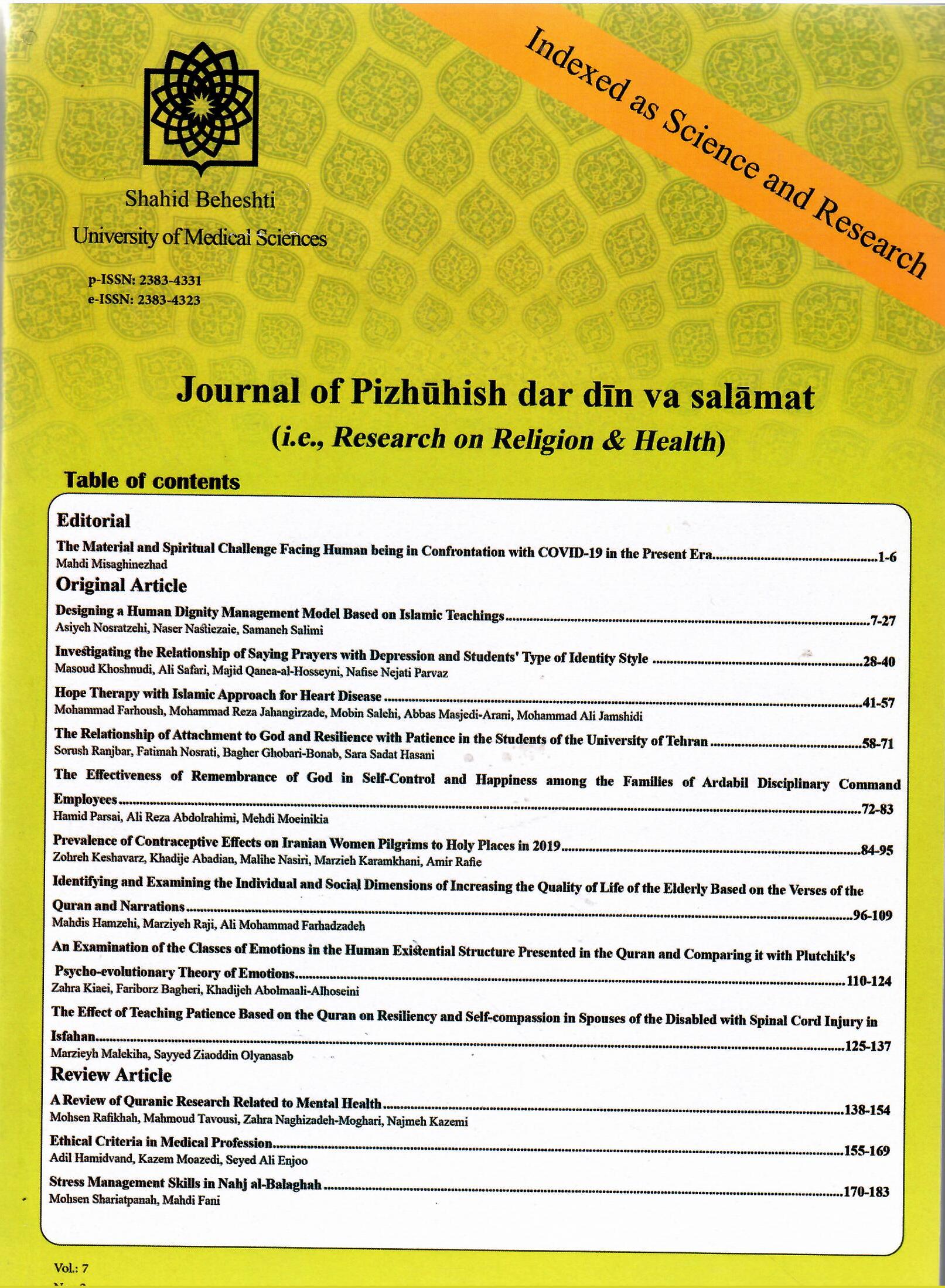
Hope Therapy with Islamic Approach for Heart Disease
Journal of Pizhūhish dar dīn va Salāmat (i.e., Research on Religion & Health),
Vol. 7 No. 2 (2021),
21 June 2021
,
Page 41-57
https://doi.org/10.22037/jrrh.v7i2.29715
Abstract
Background and Objective: Cardiovascular diseases are one of the most important chronic diseases with many psychological effects such as extreme fatigue, anxiety and depression, which reduce the quality of life of the patients. In the meantime, it is important to pay attention to the role of hope. Hope is a positive psychological construct that protects people in the face of adversities. Given the importance of hope, Snyder developed the hope construct and its questionnaire. Therefore, the purpose of this study was to develop a hope therapy program based on Islamic teachings and the achievements of classical psychology.
Methods: The research method used in the present study was text-based and content analysis. To this end, the content related to the theory of hope in psychology and Islamic teachings was collected and analyzed. Based on the results of content analysis, the Hope construct consisted of seven components of knowing the purpose of life and having a tendency toward it, setting goals, motivation and self-motivational skills, trust, thoughtfulness, effort and the skill of coping with the obstacles. Then, the Islamic Hope Therapy package was designed for patients with heart diseases and its content validity was evaluated. After gathering the experts' opinion, the Hope Therapy Program was formulated with the final Islamic approach. In this study, all ethical considerations were observed and no conflict of interest was reported by the authors.
Results: The findings of the present study showed that the Islamic Hope Therapy program for patients with heart diseases consisted of eight ninety-minute sessions, which involved 1) establishing a therapeutic relationship and presenting goals and rationale behind the treatment, 2) becoming familiar with the purpose and meaning of life in Islam and strengthening its Attitude and role in hope, 3) Teaching goal-setting skills in line with the Main goals of life and setting meaningful, transparent, and logical goals, 4) explaining motivation and its importance, strengthening one's self-awareness of motivations, 5) spiritual motivation skills, 6) Planning and choosing the right path, enhancing creativity and planning skills, 7) the skill of encountering the obstacles and flexibility skills, 8) increasing the remembrance of God and having trust in Him and drawing conclusions.
Conclusion: Hope Therapy with Islamic approach has positive spiritual and psychological dimensions and is different from the Classic Hope Therapy.
Please cite this article as: Farhoush M, Jahangirzade MR, Salehi M, Masjedi-Arani A, Jamshidi MA. Hope Therapy with Islamic Approach for Heart Disease. Journal of Pizhūhish dar dīn va salāmat. 2021;7(2):41-57. https://doi.org/10.22037/jrrh.v7i2.29715
- Hope Therapy, Hope, Heart Disease, Islam, Sense of meaning
How to Cite
References
Lucas C, Aly S, Touboul C, Sellami R, Guillaume X, Garcia G. Patient-Reported Outcome in Two Chronic Diseases: A Comparison of Quality of Life and Response Profiles in Severe Migraine and Severe Asthma. Patient Related Outcome Measures. 2020;11:27.
Benjamin EJ, Blaha MJ, Chiuve SE, Cushman M, Das SR, Deo R, et al. Heart disease and stroke statistics-2017 update: a report from the American Heart Association. Circulation. 2017;135(10):e146-e603.
Stoney CM, Kaufmann PG, Czajkowski SM. Cardiovascular disease: Psychological, social, and behavioral influences: Introduction to the special issue. American Psychologist. 2018;73(8):949-54.
Musallam E. Hospital Characteristics and Outcomes of Care Associated with Disease Specific Care Certification Programs 2015.
Huffman JC, Legler SR, Boehm JK. Positive psychological well-being and health in patients with heart disease: a brief review. Future cardiology. 2017;13(5):443-50.
Carvalho IG, Dos Santos Bertolli E, Paiva L, Rossi LA, Dantas RAS, Pompeo DA. Ansiedade, depressão, resiliência e autoestima em indivíduos com doenças cardiovasculares. Revista Latino-Americana de Enfermagem. 2016;24:1-10.
Rowley N, Mann S, Steele J, Horton E, Jimenez A. The effects of exercise referral schemes in the United Kingdom in those with cardiovascular, mental health, and musculoskeletal disorders: a preliminary systematic review. BMC public health. 2018;18(1):1-18.
Carney RM, Freedland KE. Depression and coronary heart disease. Nature Reviews Cardiology. 2017;14(3):145-59.
Sharma Dhital P, Sharma K, Poudel P, Dhital PR. Anxiety and Depression among Patients with Coronary Artery Disease Attending at a Cardiac Center, Kathmandu, Nepal. Nursing Research and Practice. 2018;20:1-6.
Alla F, Briançon S, Guillemin F, Juillière Y, Mertès PM, Villemot JP, et al. Self‐rating of quality of life provides additional prognostic information in heart failure. Insights into the EPICAL study. European Journal of Heart Failure. 2002;4(3):337-43.
Kordestani D, Ghamari A. Comparing the Resilience, Life Style and Life Quality Among Cardiovascular Patients and Normal Peopel. scientific magazine yafte. 2018;19(5):71-80. (Full Text in Persian)
Moryś JM, Pąchalska M, Bellwon J, Gruchała M. Cognitive impairment, symptoms of depression, and health-related quality of life in patients with severe stable heart failure. International Journal of Clinical and Health Psychology. 2016;16(3):230-8.
Comín-Colet J, Anguita M, Formiga F, Almenar L, Crespo-Leiro MG, Manzano L, et al. Health-related quality of life of patients with chronic systolic heart failure in Spain: results of the VIDA-IC study. Revista Española de Cardiología (English Edition). 2016;69(3):256-71.
Mojahed A, Bazi M, Azadi Ahmadabadi C, Abbasi Mendi A, Shahraki N. Comparisons of patients’ quality of life before and after coronary artery bypass graft surgery in Ali Ibn Abi Talib Hospital in Zahedan in 2016. Razi Journal of Medical Sciences. 2018;25(168):1-9. (Full Text in Persian)
Aspinwall LG, Tedeschi RG. The value of positive psychology for health psychology: Progress and pitfalls in examining the relation of positive phenomena to health. Annals of behavioral medicine. 2010;39(1):4-15.
Jason LA SE, Light JM. The relationship of sense of community and trust to hope. Journal of community psychology. 2016 Apr;44(3):334-41.
Feldman DB, Kubota M. Hope, self-efficacy, optimism, and academic achievement: Distinguishing constructs and levels of specificity in predicting college grade-point average. Learning and Individual Differences. 2015;37:210-6.
Duncan AR, Jaini PA, Hellman CM. Positive Psychology and Hope as Lifestyle Medicine Modalities in the Therapeutic Encounter: A Narrative Review. American Journal of Lifestyle Medicine. 2021;15(1):6-13.
Rafiepoor A. The Effectiveness of Hope Therapy on the Quality of Life of Mothers Children with Physical Disabilities. Journal of Educational Psychology Studies. 2018;15(32):117-34. (Full Text in Persian)
Hernandez SC, Overholser JC. A systematic review of interventions for hope/hopelessness in older adults. Clinical gerontologist. 2021;44(2):97-111.
Tomasulo DJ. A Happier Balance: Positive
Interventions for Intentional Well-Being in Psychotherapy. Scientific Concepts Behind Happiness, Kindness, and Empathy in Contemporary Society: IGI Global; 2019. 91-111.
Snyder CR. Handbook of hope: Theory, measures, and applications: Academic press; 2000.
Mirbagher-Ajorpaz N, Aghajani M, Morsaee F, Zabolian Z. The Relationship between Hope and Depression-Anxiety in Patients Undergoing Hemodialysis. Journal of Health and Care. 2016;18(1):55-62. (Full Text in Persian)
Badanfiroz A, Babamohamadi M, Sabahi P. Depression in Paramedical Students: The Predictive Role of Spiritual Well-being and Hope. Journal of Religion and Health. 2017;5(1):40-50. (Full Text in Persian)
Sadoughi M, Mehrzad V, MohammadSalehi Z. The relationship of optimism and hope with depression and anxiety among women with breast cancer. IJNR. 2017;12(2):16-21. (Full Text in Persian)
Stevens E, Guerrero M, Green A, Jason LA. Relationship of hope, sense of community, and quality of life. Journal of community psychology. 2018;46(5):567-74.
Li M-Y, Yang Y-L, Liu L, Wang L. Effects of social support, hope and resilience on quality of life among Chinese bladder cancer patients: a cross-sectional study. Health and quality of life outcomes. 2016;14(1):1-9.
Dorsett P, Geraghty T, Sinnott A, Acland R. Hope, coping and psychosocial adjustment after spinal cord injury. Spinal cord series and cases. 2017;3:17046.
Babakhanian M, Zarghami M. Effectiveness of Hope Therapy Protocol on Depression and Hope in Amphetamine Users, Int J High Risk Behav Addict. 2017 ; 6(3):e59537. doi: 10.5812/ijhrba.59537.
Khaledi Sardashti F, Ghazavi Z, Keshani F, Smaeilzadeh M. Effect of hope therapy on the mood status of patients with diabetes. Iranian journal of nursing and midwifery research. 2018;23(4):281-6. (Full Text in Persian)
Niemiec RM, Shogren KA, Wehmeyer ML. Character strengths and intellectual and developmental disability: A strengths-based approach from positive psychology. Education and Training in Autism and Developmental Disabilities. 2017;52(1):13-25.
Cheavens JS, Feldman DB, Woodward JT, Snyder CR. Hope in cognitive psychotherapies: On working with client strengths. Journal of cognitive Psychotherapy. 2006;20(2):135-45.
Yousefi A, Rafinia P, Sabahi P. The effectiveness of hope therapy on quality of life in wives of veterans with post traumatic stress disorder. Journal of Clinical Psychology. 2016;8(1):1-10. (Full Text in Persian)
Snyder CR, Cheavens J, Michael ST, Yamhure L, Sympson S. The role of hope in cognitive-behavior therapies. Cognitive therapy and Research. 2000;24(6):747-62.
Rahimipour M, Shahgholian N, Yazdani M. Effect of hope therapy on depression, anxiety, and stress among the patients undergoing hemodialysis. Iranian journal of nursing and midwifery research. 2015;20(6):694-9. (Full Text in Persian)
Bahramian J, Zahrakar K, Rasouli M. The effect of hope based group therapy approach on the severity of depression in multiple sclerosis patients. Iranian Journal of Rehabilitation Research in Nursing. 2014;1(1):12-22. (Full Text in Persian)
Sheykholeslami A, Ghamari Qivi H, Ramezani S. The Effectiveness of Hope Therapy on Happiness of Physical-Motor Disable Male. journal of counseling research. 2016;15(58):96-112. (Full Text in Persian)
Kim-Prieto C, Diener E. Religion as a source of variation in the experience of positive and negative emotions. The Journal of Positive Psychology. 2009;4(6):447-60.
Williams V. Exploring Religion and Spirituality in Psychological Therapy: School of Psychology; 2017.
Bagheri M, Chegeni ME, Negar FM. Reviews of the effectiveness of religious, spiritual and mental therapy on stress reduction, anxiety and depression in women with addicted spouse in Ilam city. Journal of Reaserch on Religion & Health. 2015;1(3):19-24. (Full Text in Persian)
Salehi M, Pasandideh A, Janbozorgi M, Rasoolzadeh Tabatabaei SK. The Model of Hope Based on Islamic Sources and Designing its Therapy Protocol. 2. 2018;1(3):7-34. (Full Text in Persian)
Sabry WM, Vohra A. Role of Islam in the management of psychiatric disorders. Indian journal of psychiatry. 2013;55 (Suppl 2):S205. (Full Text in Persian)
Binaei N, Moeini M, Sadeghi M, Najafi M, Mohagheghian Z. Effects of hope promoting interventions based on religious beliefs on quality of life of patients with congestive heart failure and their families. Iranian journal of nursing and midwifery research. 2016;21(1):77-83. (Full Text in Persian)
Rahmanian M, Moein Samadani M, Oraki M. Effect of spirituality group therapy on life expectancy and life style’s improvement of breath cancer patients. Biannual Journal of Applied Counseling. 2017;7(1):101-14. (Full Text in Persian)
Barton KS, Tate T, Lau N, Taliesin KB, Waldman ED, Rosenberg AR. “I'm not a spiritual person”. How hope might facilitate conversations about spirituality among teens and young adults with cancer. Journal of pain and symptom management. 2018;55(6):1599-608.
Asgari P, Roushani K, Mohri AM. The relationship between religious belief, optimism and spiritual well being among college students of Islamic Azad University. 2009. (Full Text in Persian)
Farhangi D. Relationship of Spiritual Experiences and Hope with Living in Present among Men with Cancer in Tehran. Journal of Pizhūhish dar dīn va salāmat. 2019;5(2):75-88. (Full Text in Persian)
The holy Quran. Sura al-Baghara. Verse 218. Translated by: Ayatollah Al-ozma Naser Makarem Shirazi. Qom: Imam Ali Ebne Abi Taleb (Ýa); 2015. (Full Text in Persian)
Majlesi MB. Bihar al-Anwar. Beirut: House of Revival of Arab Heritage; 1983.
The holy Quran. Sura Joseph. Verse 87. Translated by: Ayatollah Al-ozma Naser Makarem Shirazi. Qom: Imam Ali Ebne Abi Taleb (Ýa); 2015. (Full Text in Persian)
The holy Quran. Sura al-Hejr. Verse 55. Translated by: Ayatollah Al-ozma Naser Makarem Shirazi. Qom: Imam Ali Ebne Abi Taleb (Ýa); 2015. (Full Text in Persian)
The holy Quran. Sura al-Talaq. Verse 3. Translated by: Ayatollah Al-ozma Naser Makarem Shirazi. Qom: Imam Ali Ebne Abi Taleb (Ýa); 2015. (Full Text in Persian)
The holy Quran. Sura al-Kahf. Verse110. Translated by: Ayatollah Al-ozma Naser Makarem Shirazi. Qom: Imam Ali Ebne Abi Taleb (Ýa); 2015. (Full Text in Persian)
Salehi M, Pasandideh A, Janbozorgi M, Rasoolzadeh Tabatabaei SK. The model of hope based on islamic sources and designing its therapy protocol. The Interdisciplinary Quarterly of Applied Researches on IslamicHumanities. 2018;1(3):7-34. (Full Text in Persian)
Ahmarian FSF, Falsafinejad MR. The effects of group logo-therapy on life expectancy and sleep quality in elderlies of boarding center of Tehran city. Journal of Research on Religion & Health. 2015;1(3):11-8. (Full Text in Persian)
Sabki ZA, Sa’ari CZ, Muhsin SBS, Kheng GL, Sulaiman AH, Koenig HG. Islamic Integrated Cognitive Behavior Therapy: A Shari’ah-Compliant Intervention for Muslims with Depression. Malaysian Journal of Psychiatry. 2019;28(1):29-38. (Full Text in Persian)
Ahmadi M, Zaree K, Leily AK, Hoseini ASS. Efficacy of a written prayer technique on the anxiety of mothers of children with cancer. Palliative & supportive care. 2019;17(1):54-9. (Full Text in Persian)
Rashid T, Baddar MKA-H. Positive psychotherapy: Clinical and cross-cultural applications of positive
- Abstract Viewed: 727 times