
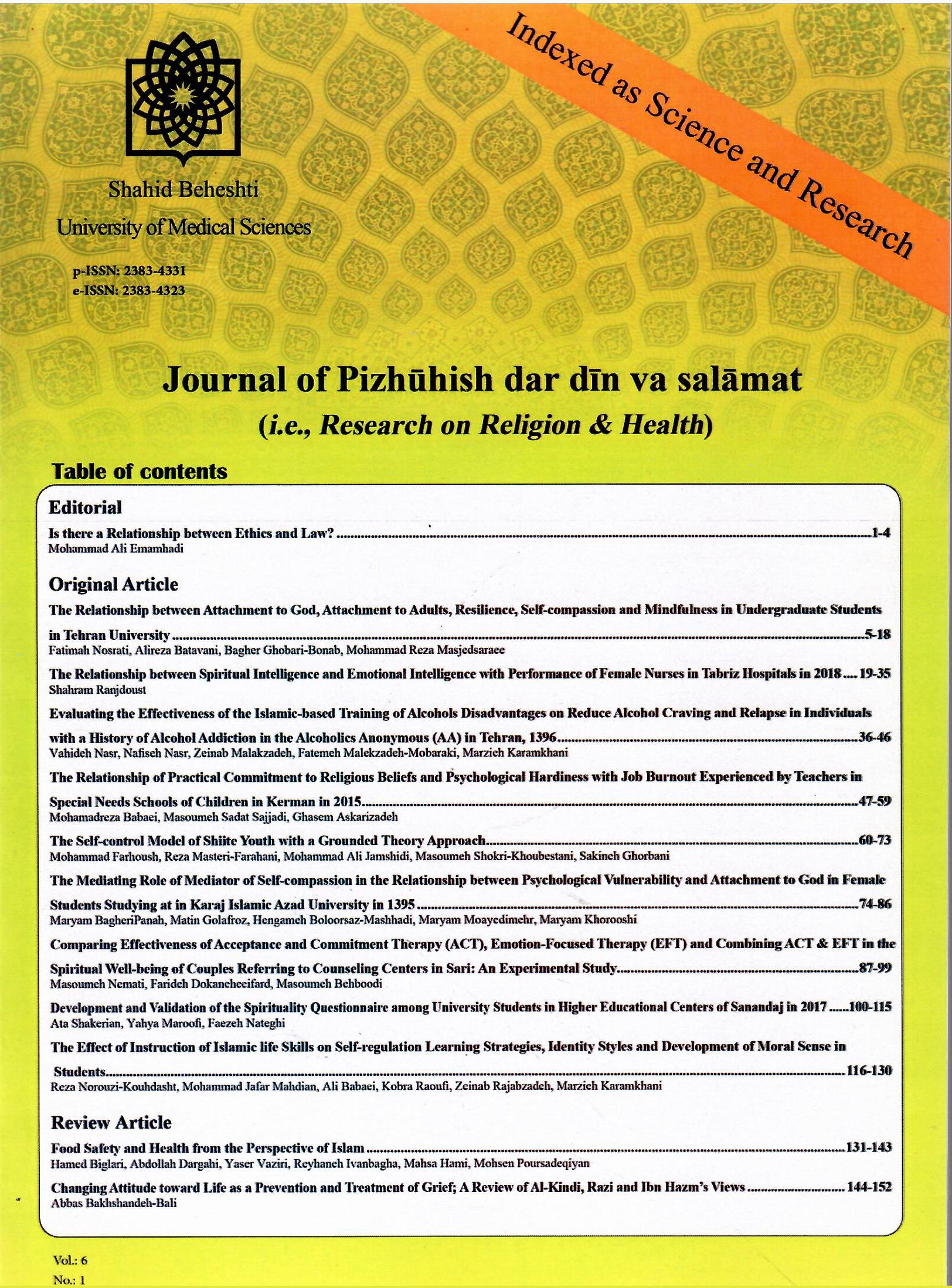
العلاقة بين الإلتزام العملي بالمعتقدات الدينية والعناد النفسي مع الإرهاق المهني عند المدرسين في المدارس الاستثنائية للأطفال بمدينة كرمان عام ٢٠١٥
مجلة البحث في الدين و الصحّة,
مجلد 6 عدد 1 (2020),
22 فرفردن 2020
,
الصفحة 47-59
https://doi.org/10.22037/jrrh.v6i1.17908
الملخص
خلفية البحث وأهدافه: ان الكحول هي واحدة من اكثر المواد شيوعاً بين الموادالتي تؤدي الى الإدمان في العالم. اليوم وبالرغم من وجود دراسات واسعة في هذا المجال، فإن علاجات المحافظة على المدمن من أجل منعه الى العودة مجددا بعد تركه للكحول لم تكن موفقة كما يجب. الدين والذي يعتبر واحدا من الأركان الرئيسية لثقافة شعب ما، لديه امكانية قوية للحد من الإضطرابات النفسية ويشكل عاملاً مؤثراً في منع العودة الى تعاطي الكحول. إن الهدف من هذا البحث، تحديد مدى تأثير التوعية على أضرار الكحول المرتكزة على التعاليم الاسلامية في إنخفاض الشغف بإستهلاكها والعودة عنها عند الأشخاص ذوي الإدمان على الكحول في جمعية مستهلكي الكحول المجهولين بمدينة طهران عام ٢٠١٧م.
منهجية البحث: تم هذا البحث بطريقة شبه إختبارية والخطة كانت من نوع الاختبار المسبق مع مجموعة المراقبة. تضمن المجتمع الإحصائي كافة اعضاء جمعية مستهلكي الكحول المجهولين بمدينة طهران عام ٢٠١٧ بحيث تم إختيار 30 شخصا منهم بطريقة أخذ العينة المتاحة والمرتكزة على الهدف و تم وضعهم بشكل عشوائي في مجموعتي التدخل والمراقبة. وكانت أدوات تجميع البيانات هي إستمارات قياس شغف استهلاك المواد الكحولية من بعد ترك إستعمالها. وأقيم التدخل على شكل ست جلسات تعليمية وكانت مدة كل جلسة ساعتين و موضوعها تبيان نظرة الدين الاسلامي تجاه استهلاك المواد الكحولية وإنطباقها مع الكشوفات العلمية و من أجل تحديد مدى تأثير التعليم تمت الاستفادة من إختبار تفسير التباين. تمت مراعاة جميع الموارد الأخلاقية في هذا البحث وإضافة إلى ذلك فإن مؤلفي البحث لم يشيروا الى اي تضارب في المصالح.
الكشوفات: إن كشوفات تأثير هذا النوع من التعليم على خفض الشغف باستهلاك المواد الكحولية والعودة عنها عند الاشخاص ذوي الإدمان المزمن كانت بحجم 05/0>P.
الاستنتاج: يبدو أن تعلم الأضرار المرتكزة على التعاليم الاسلامية يمكن ان يؤدي الى انخفاض الشغف بإستهلاك المواد الكحولية عند الأشخاص ذوي الإدمان المزمن. لهذا السبب، يوصى للأشخاص و المؤسسات المعنية و وسائل الاعلام بإتباع هذه الطريقة نظرا الى تأثيرها و توفرها بكلفة مقبولة و نظرا الى أهميتها.
يتم استناد المقالة على الترتيب التالي:
Nasr V, Nasr N, Malakzadeh Z, Malekzadeh-Mobaraki F, Karamkhani M. Evaluating the Effectiveness of the Islamic-based Training of Alcohols Disadvantages on Reduce Alcohol Craving and Relapse in Individuals with a History of Alcohol addiction in the Alcoholics Anonymous (AA) in Tehran, 1396. Journal of Pizhūhish dar dīn va salāmat. 2020;6(1):36-46. https://doi.org/10.22037/jrrh.v6i1.18829
- الإلتزام العملي بالمعتقدات الدينية؛ الإرهاق المهني؛ العناد النفسي؛ المدرسون
كيفية الاقتباس
المراجع
Khatiban M, Hosseini S, Beikmoradi A. Burnout in the Personnel of the Emergency Medical Services in Hamadan Province. Scientific Journal of Hamadan Nursing & Midwifery Faculty. 2012;20(2):5-15. (Full Text in Persian)
Alhani F, Anousheh M, Rouhi G. Burnout Levels and Some Related Factors in Nurses of Golestan Province. Preventive Care in Nursing & Midwifery Journal. 2011;1(1):43-54. (Full Text in Persian)
Yener M, Coşkun Ö. Using Job Resources and Job Demands in Predicting Burnout. Procedia-Social and Behavioral Sciences. 2013;99:869-76.
Argentero P, Dell’Olivo B, Santa Ferretti M, On Burnout WG. Staff Burnout and Patient Satisfaction with the Quality of Dialysis Care. American Journal of Kidney Diseases. 2008;51(1):80-92.
Beckstead JW. Confirmatory Factor Analysis of the Maslach Burnout Inventory among Florida Nurses. International Journal of Nursing Studies. 2002;39(8):785-92.
Lu JL. Organizational Role Stress Indices Affecting Burnout among Nurses. Journal of International Women's studies. 2008;9(3):63-78.
Bakker AB, Van Der Zee KI, Lewig KA, Dollard MF. The Relationship between the Big five Personality Factors and Burnout: A Study among Volunteer Counselors. The Journal of social psychology. 2006;
(1):31-50.
Woodard CR. Hardiness and the Concept of Courage. Consulting Psychology Journal: Practice and Research. 2004;56(3):173.
Klag S, Bradley G. The Role of Hardiness in Stress and Illness: An Exploration of the Effect of Negative Affectivity and Gender. British journal of health psychology. 2004;9(2):137-61.
Brannon L, Feist J, Updegraff JA. Health Psychology: An Introduction to Behavior and Health: Cengage Learning; 2013.
Shakeriniya I. The Relationship between Ethical Conflicts, Moral Distress, and Occupational Stress in Nurses. Journal of Medical Ethics and History of Medicine. 2011;4(1):56-69.
Schmitz N, Neumann W, Oppermann R. Stress, Burnout and Locus of Control in German Nurses. International Journal of Nursing Studies. 2000;37(2):95-9.
Chan DW. Hardiness and its Role in the Stress–burnout Relationship among Prospective Chinese Teachers in Hong Kong. Teaching and teacher Education. 2003;19(4):381-95.
Farahani A, Bastami H. The Effectiveness of Hardiness Components Training on Personnel Burnout of Olympic National Committee of the Islamic Republic of Iran. Scientific Hournal of Ilam University of Medical Sciences. 2015;23(2):78-89.
Krumboltz JD. Measuring Achievement Motivation: A Review. Journal of Counseling Psychology. 1957;4(3):191.
Haji Moradi A, Poursarrajian D, Alizadeh Naeeni A. The Relationship between Hardiness and Burnout among the Teachers of the Universities and Higher Educational Institutes-case Study. European Online Journal of Natural and Social Sciences. 2013;2(3 (s)):pp. 500-6.
Ball J, Armistead L, Austin B-J. The Relationship between Religiosity and Adjustment among African-American, Female, Urban Adolescents. Journal of Adolescence. 2003;26(4):431-46.
Kézdy A, Martos T, Boland V, Horváth-Szabó K. Religious Doubts and Mental Health in Adolescence and Young Adulthood: The Association with Religious Attitudes. Journal of Adolescence. 2011;34(1):39-47.
Musarezaie A, Naji- Esfahani H, Khosravi N, Momeni-Ghaleghasemi T, Masaeli N. Relationship between Commitment and Priority to Prayer with Depression and Some Demographic Parameters. Journal of Research in Behavioural Sciences. 2012;10(6):441-52. (Full Text in Persian)
Talai A, Moharri F, Tavakoli F, Ferdowsi A, Moghani M. The Relationship of Religious Basic Beliefs and God Attachment Style with Job Burnout in Employees of Mashhad University of Medical Sciences. Journal of Fundamentals of Mental Health. 2013;15 (59):216-24. (Full Text in Persian)
Baezzat F, Sharifzadeh H. Relationship between Spiritual Intelligence and Emotional Intelligence with Job Stress in University Employees. 2013. (Full Text in Persian)
Hoshmandja M. The Relationship between Organizational Spirituality and Spiritual Intelligence with Job Stress of Staffs of a Military University. Journal Mil Med. 2013;15(1):43-50. (Full Text in Persian)
Zareei Mahmoodabadi H, Sedrpooshan N. The Relationship between Spiritual Intelligence and Components of Burnout in Female Teachers. Occupational Medicine Quarterly Journal. 2015;6(4):66-74. (Full Text in Persian)
Refahi A, Ebadi AS, Yaqubi R, Pour-Ebrahim M. Evaluation of Spiritual Intelligence and Some Demographic Variables Associated with Job Burnout in Police Staff. Journal of Police Medicine. 2014;3(2):115-22. (Full Text in Persian)
Norouzi R, Dargahi S, Aeyadi N, Sarhaddi M. The Association between Workplace Spirituality and Job Stress with Occupational Ethics through Mediating Role of Job Enthusiasm among Nurses in Zahedan City, 2017. Journal of Occupational Health and Epidemiology. 2018;7(1):3-10. (Full Text in Persian)
Asgharpur M, Razaghi E, Hashemian E. The Relationship between Spirituality and Job Burnout Islamic Azad University, Science and Research Branch, Tehran". Journal of Future Studies Managment. 2014;25(1):91-113. (Full Text in Persian)
Kyriacou C. Teacher Stress: Directions for Future Research. Educational Review. 2001;53(1):27-35.
McDonnell JJ, Hardman ML, McDonell AP, Kiefer-O'Donnell R. An Introduction to Persons with Severe Disabilities: Educational and Social Issues. 1995.
Mehrabizadeh Honarmand M, Atashafrouz A, Rezaie SH. Comparison of General Health, Job Stress, and Burnout among Ordinary and Mental-retarded-student Schools’ Teachers. Scientific Journal of Clinical Psychology & Personality. 2014;2(9):53-64.
Navidi A, Abdollahi H. Barresi-ye Rabete-ye beyne Afsordegi va Eltezam-e Amali be E'teghadat-e Eslami dar mian-e Daneshamoozan-e Dowre-ye Motevasete-ye Shahr-e Tehran. Quarterly of Education. 2001;66:30-9. (Full Text in Persian)
Khoshtinat V. Impact of Adherence to Islamic Beliefs through Healthy Lifestyle on University Students. Tenden Drug Consump Heal Psychol. 2012;1(2):50-67. (Full Text in Persian)
Kiyamarati A, Najarian B, Mehrabizadeh
Honarmand M. Sakht va E'tebaryabi-ye Meghyasi baray-e Sanjesh-e Sarsakhti-ye Ravanshenasi. Majaleh Ravanshenasi Va Oloom Tarbiati. 1999;5(3-4):271-85. (Full Text in Persian)
Abolghasemi A, Moradisoroush M, Narimani M, Zahed A. The Relationship between Personal Initiative, Religious Orientation and Organizational Social Capital and Workers Job Performances in the Productive Centers. Knowledge & Research in Applied Psychology. 2011;12(1):86-94.
Maslach C. What Have We Learned about Burnout and Health? Psychology & health. 2001;16(5):607-11.
Chen C-F, Kao Y-L. Moderating Effects of Work Engagement and Job Tenure on Burnout–performance among Flight Attendants. Journal of Air Transport Management. 2012;25:61-3.
Amini F. Comparative Analysis of Life Satisfaction, Resilience and Burnout among Intensive and other Units Nurses. Quarterly Journal of Nursing Management. 2013;1(4):9-17.
Ahqar G. The Study of School Organizational Climate Role on Job Stress in Tehran secondary school consultants. Consulting News and Researches. 2007;23:25-40.
Noghani F, Mohtashemi J, Vasegh Rahimparvar F, Babaei G. Effect of Education of Religious Values on the Rate of Depression. Hayat. 2005;10(4):49-56. (Full Text in Persian)
Bahrami Chegeni Z. An Investigation into the Relationship between Religiosity and Mental Disorders of the University Students of Khorramabad Azad University. Ravanshenasi Va Din. 2010;3(2):91-102. (Full Text in Persian)
Narimani M, Abbasi M. Survey of Relationship between Psychological Hardiness and Self-toleration and Vocational Weariness. Productivity Management. 2009;3(1):75-92. (Full Text in Persian)
Nowack KM, Hanson AL. The Relationship between Stress, Job Performance, and Burnout in College Student Resident Assistants. Journal of College Student Personnel. 1983.
Shepperd JA, Kashani JH. The Relationship of Hardiness, Gender, and Stress to Health Outcomes in Adolescents. Journal of personality. 1991;59(4):747-68.
- الملخص المشاهدات: 815 الأوقات
- PDF (فارسی) التنزيلات: 591 الأوقات