
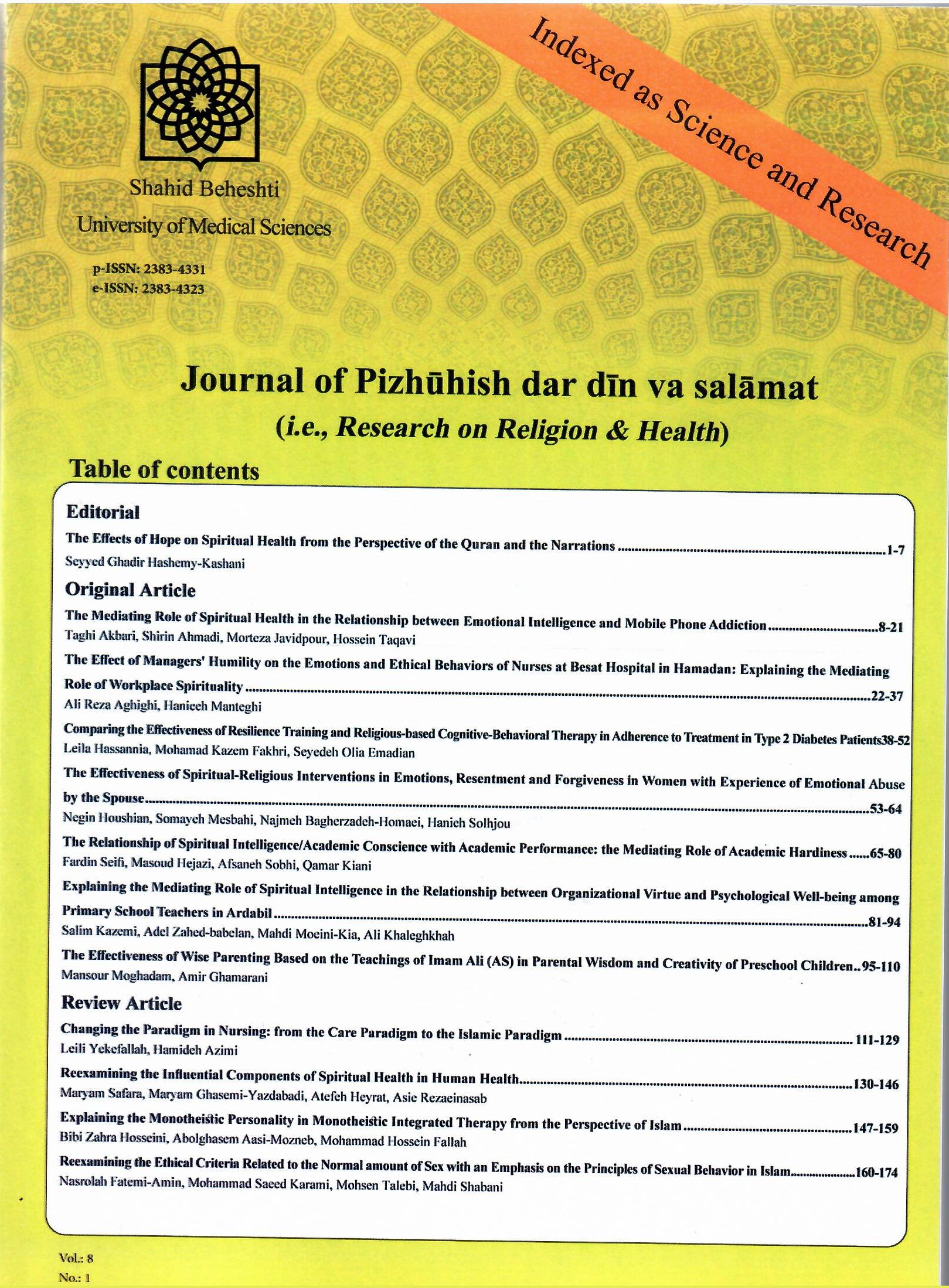
مقایسۀ اثربخشی درمان شناختی-رفتاری مذهبمحور و آموزش تابآوری در تبعیت از درمان بیماران مبتلا به دیابت نوع دو
پژوهش در دین و سلامت ,
دوره 8 شماره 1 (2022),
19 اسفند 2022
,
صفحه 38-52
https://doi.org/10.22037/jrrh.v8i1.33272
چکیده
سابقه و هدف: بیماری دیابت از جمله بیماریهای مزمن است که برای جلوگیری از عوارض آن تبعیت از درمان نقش بسزایی دارد. این پژوهش با هدف مقایسۀ اثربخشی درمان شناختی-رفتاری مذهبمحور (RCBT) و آموزش تابآوری در مؤلفههای تبعیت از درمان بیماران مبتلا به دیابت نوع دو انجام شده است.
روش کار: پژوهش حاضر از نوع نیمهآزمایشی با طرح پیشآزمون و پسآزمون و گروه کنترل است که از میان بیماران مبتلا به دیابت نوع دو مراجعهکننده به مراکز خدمات جامع سلامت با روش نمونهگیری هدفمند، تعداد 45 نفر نمونۀ نهایی در نظر گرفته و سپس بهطور تصادفی ساده در سه گروه 15 نفره شامل دو گروه آزمایش و یک گروه گواه گمارده شدند. یک گروه آزمایشی 10 جلسۀ 60 دقیقهای درمان شناختی-رفتاری مذهبمحور و گروه دیگر 9 جلسۀ 60 دقیقهای آموزش تابآوری دریافت کردند. دادهها با استفاده از تحلیل کوواریانس تکمتغیّره و آزمون توکی تجزیهوتحلیل شد. در این پژوهش همۀ موارد اخلاقی رعایت شده است و مؤلفان مقاله تضاد منافعی گزارش نکردهاند.
یافتهها: نتایج نشان داد که بین گروههای آزمایش و گروه گواه در پسآزمون تبعیت از درمان با کنترل پیشآزمون (001/0P= و 5/22F=) در سطح اطمینان 95 درصد (05/0P<) تفاوت وجود داشت؛ ولی در بین دو گروه درمان شناختی-رفتاری مذهبمحور و آموزش تابآوری (46/8F= و 2/0P=) در سطح 95 درصد (05/0P<) به لحاظ آماری تفاوت معنادار وجود نداشت.
نتیجهگیری: یافتهها نشان داد که درمان شناختی-رفتاری مذهبمحور و آموزش تابآوری هر دو در افزایش تبعیت از درمان بیماران مبتلا به دیابت مؤثر است. بنابراین از هر دو روش میتوان بهعنوان روشی کمکی در درمان بیماران مبتلا به دیابت جهت افزایش تبعیت از درمان بهره برد.
- آموزش تابآوری؛ تبعیت از درمان؛ درمان شناختی-رفتاری مذهبمحور؛ دیابت نوع دو
ارجاع به مقاله
مراجع
Naghavi M, Abajobir AA, Abbafati C, Abbas KM, Abd-Allah F, Abera SF, et al. Global, regional, and national age-sex specific mortality for 264 causes of death, 1980–2016: a systematic analysis for the Global Burden of Disease Study 2016. The Lancet. 2017;390(10100):1151-210.
Atlas D. International diabetes federation. IDF diabetes atlas. Brussels: International Diabetes Federation. 2019.
Ahmad NS, Ramli A, Islahudin F, Paraidathathu T. Medication adherence in patients with type 2 diabetes mellitus treated at primary health clinics in Malaysia. Patient preference and adherence. 2013;7:525-30.
Simpson FR, Pajewski NM, Nicklas B, Kritchevsky S, Bertoni A, Ingram F, et al. Impact of multidomain lifestyle intervention on frailty through the lens of deficit accumulation in adults with type 2 diabetes mellitus. The journals of gerontology: Series A. 2020;75(10):1921-7.
Meneilly GS, Berard LD, Cheng AY, Lin PJ, MacCallum L, Tsuyuki RT, et al. Insights into the current management of older adults with type 2 diabetes in the ontario primary care setting. Canadian journal of diabetes. 2018;42(1):23-30.
Tong A, Wang X, Li F, Xu F, Li Q, Zhang F. Risk of depressive symptoms associated with impaired glucose metabolism, newly diagnosed diabetes, and previously diagnosed diabetes: a meta-analysis of prospective cohort studies. Acta diabetologica. 2016;53(4):589-98.
Valenzuela MJ, Münzenmayer B, Osorio T, Arancibia M, Madrid E. Sintomatologia depresiva y control metabólico en pacientes ambulatorios portadores de diabetes mellitus tipo 2. Revista médica de Chile. 2018;146(12):1415-21.
Delevry D, Ho A, Le QA. Association between processes of diabetes care and health care utilization in patients with diabetes: Evidence from a nationally representative US sample. Journal of Diabetes. 2020.
Hamid N, Bashlideh K, Eidibiqi M. The Effectiveness of Cognitive-Behavioral Religious-Based Therapy On the Depression of Divorced Women. Family Consultation and Family Therapy. 2011(1):54-64. (Full Text in Persian)
Hosseini SH, Rafiei A, Gaemian A, Tirgari A, Zakavi A, Yazdani J, et al. Comparison of the effects of religious cognitive behavioral therapy (RCBT), cognitive behavioral therapy (CBT), and sertraline on depression and anxiety in patients after coronary artery bypass graft surgery: Study protocol for a randomized controlled trial. Iranian journal of psychiatry. 2017;12(3):206-13. (Full Text in Persian)
Karekla M, Constantinou M. Religious coping and cancer: Proposing an acceptance and commitment therapy approach. Cognitive and Behavioral Practice. 2010;17(4):371-81.
Ramos K, Erkanli A, Koenig HG. Effects of religious versus conventional cognitive–behavioral therapy (CBT) on suicidal thoughts in major depression and chronic medical illness. Psychology of Religion and Spirituality. 2018;10(1):79.
Kusnanto K, Arifin H, Widyawati IY. A qualitative study exploring diabetes resilience among adults with regulated type 2 diabetes mellitus. Diabetes & Metabolic syndrome: Clinical research & Reviews. 2020;14(6):1681-87.
Abolghasemi S, Mahmoudi G. The effectiveness of stress immunization teaching on reducing stressful psychological feelings and blood glucose control in patients with type 2 diabetes. World applied sciences journal. 2012;17(3):284-91.
Ryan AK, Pakenham KI, Burton NW. A pilot evaluation of a group acceptance and commitment therapy‐informed resilience training program for people with diabetes. Australian psychologist. 2020;55(3):196-207.
Modanloo M. Development and psychometric tools adherence of treatment in patients with chronic.
Iran: Iran university. 2013. (Full Text in Persian)
Tanharo D, Ghods R, Pourrahimi M, Abdi M, Aghaei S, Vali N. Adherence to reatment in diabetic patients and its affecting factors. Pajouhan scientific journal. 2018;17(1):37-44.
Hashemi Z. The Effectiveness of Cognitive Behavioral Therapy Based on Religious Attitudes and metacognitive Therapy in Students with Suicidal Thoughts. Journal of Modern Psychological Researches. 2020;15(59):14-29. (Full Text in Persian)
Hashemvarzi MR, Abbasi G, Hosseini SH. the Effectiveness of religion-based cognitive-behavioral therapy (RCBT) on quality of life and self-efficacy of colostomy patients. Middle eastern journal of disability studies;2020.
Nadi E, Saeedpoor F, Boland H. The effectiveness of religious-based cognitive-behavioral group therapy on increasing life expectancy and happiness in infertile women. Islamic Life Journal. 2020;3(3):361-70 .(Full Text in Persian)
Kaviani Z, Hamid N, Enayati MS. The effect of religious–based cognitive behavioral therapy on resiliency in couples knowledge & research in applied psychology. 2014;15(57):25-34. (Full Text in Persian)
Faghihi A, Ghobari Bonab B, Ghasemipoor Y. Comparing Islamic multifacets model with Beck's cognitive model in depression therapy. Studies in Islam and Psychology. 2008;1(1):69-86. (Full Text in Persian)
Possel P, Martin NC, Garber J, Banister AW, Pickering NK, Hautzinger M. Bidirectional relations of religious orientation and depressive symptoms in adolescents: A short-term longitudinal study. Psychology of religion and spirituality. 2011;3(1):24-34.
Henderson N, Milstein MM. Resiliency in schools: Making it happen for students and educators: Corwin Press; 2003.
Hoseini Beheshtian SM, Mirzazadeh R. Effectiveness of resilience training on emotion regulation strategies and life satisfaction among women-headed households. Sociological Cultural Studies. 2016;7(3):19-36 .(Full Text in Persian)
Khodabakhshi Koolaee A, Falsafinejad M, Navidian A. Evaluation of effectiveness of resilience training on psychological well-being of patients with type II diabetes. Journal of diabetes nursing. 2016;4(3):30-40. (Full Text in Persian)
Olokoba AB, Obateru OA, Olokoba LB. Type 2 diabetes mellitus: a review of current trends. Oman medical journal. 2012;27(4):269-73.
Ciechanowski PS, Katon WJ, Russo JE, Walker EA. The patient-provider relationship: attachment theory and adherence to treatment in diabetes. American Journal of Psychiatry. 2001;158(1):29-35.
Shahsavari A, Foroghi S. The effectiveness of telenursing on adherence to treatment in patients with type 2 diabetes. Iranian journal of endocrinology and metabolism. 2015;17(2):138-45.
Alipour LA, Akbari DM, Amini F, Hashemi JA. Relationship between perceived social support and adherence of treatment in diabetes mellitus type 2: mediating role of resillency and hope. 2016;10(2):53-67. (Full Text in Persian)
Aghayousefi A, Dehestani M, Salary S. The Role of Perceived Social Support and Resilience in Predicting the Quality of Life in patients with Type 2 Diabetes. Iranian Journal of Endocrinology and Metabolism. 2017;18(5):334-42. (Full Text in Persian)
Furniss D, Barber N, Lyons I, Eliasson L, Blandford A. Unintentional non-adherence: can a spoon full of resilience help the medicine go down? BMJ quality & safety. 2014;23(2):95-8.
Yeganeh T. Role of Religious Orientations in Determination of Hope and Psychological Well-being in Female Patients with Breast Cancer. Quarterly of Iran breast diseases. 2013;6(3).
Salimi S, Hajibabaeei HR, Rezazadeh-Asgari Z. The Effect of Faith in Divine Mercy on the Reduction of Cognitive Aspects of Mental Pressures from the Perspective of the Quran. Journal of Pizhūhish dar dīn va salāmat. 2020;6(3):157-69. (Full Text in Persian)
Hamid N, Ahmadian A, AkbariShaye Y. Effectiveness of cognitive behavior therapy based on religious believes on hope and quality of life in the patients suffering breast cancer. Hormozgan Medical Journal. 2012;16(3):213-21. (Full Text in Persian)
Akuchekian S, Jamshidian Z, Maracy MR, Almasi A, Jazi AHD. Effectiveness of religious-cognitive-behavioral therapy on religious oriented obsessive compulsive disorder and its co-morbidity. Journal of Isfahan medical school.2011;28(114):1-11. (Full Text in Persian)
Jani S, Molaee M, Jangi GS, Pouresmali A. Effectiveness of cognitive therapy based on religious believes on death anxiety, social adjustment and subjective well-being in the cancer patients.2014; 22(5):94-103. (Full Text in Persian)
Mehraban S, Khalilzadeh N, Sharifi M, Asmari-Bardezard Y. The effectiveness of group Spiritual therapy on facilitating the post-traumatic growth process in women with breast cancer. Journal of pizhuhish dar din va salamat. 2020;6(3):7-17. (Full Text in Persian)
Imanifar HR, Mahmoudi S. Comparing the effect of reality therapy and spiritual-religious psychotherapy based on islamic teachings on the quality and meaning of Life of divorced femaleheads of households in Fasa city. Journal of Pizhuhish dar din va salamat. 2020;6(3):74-88. (Full Text in Persian)
Foroghian-Yazdi F, Askarizadeh G, Pourmohammad-Ghouchani K. Effectiveness of Mindfulness Training with Islamic Approach on Spiritual Well-being and Loneliness in Women with Type 2 Diabetes. Journal of Pizhuhish dar din va salamat. 2021;6:32-44. (Full Text in Persian)
Dolat-Abadi ZR, Alizadeh N, Haghighat S, SardarZadeh F. The Effectiveness of spiritual-religious psychotherapy on depression, basic psychological needs and life satisfaction in patients with HIV. Journal of pizhuhish dar din va salamat. 2018;4(4):7-20. (Full Text in Persian)
- چکیده مشاهده شده: 595 بار
- PDF دانلود شده: 409 بار