
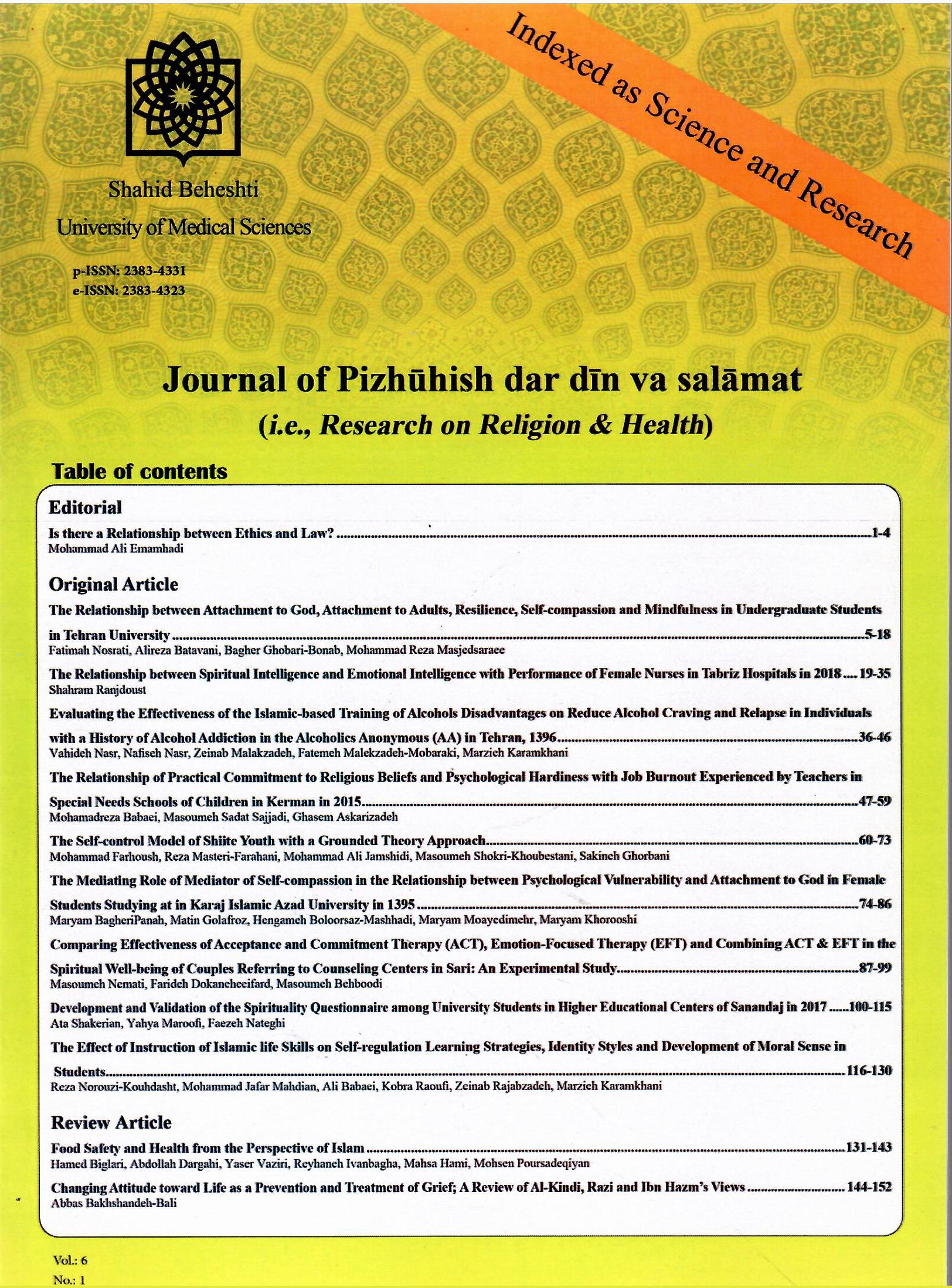
رابطۀ التزام عملی به اعتقادات مذهبی و سرسختی روانشناختی با فرسودگی شغلی در معلمان مدارس استثنایی کودکان شهر کرمان در سال 1394
پژوهش در دین و سلامت ,
دوره 6 شماره 1 (2020),
22 فروردین 2020
,
صفحه 47-59
https://doi.org/10.22037/jrrh.v6i1.17908
چکیده
سابقه و هدف: معلمان آموزش و پرورش استثنایی در شرایط کاری بسیار پراسترسی مشغول به کار هستند که زمینهساز ایجاد فرسودگی شغلی است؛ در این پژوهش به بررسی عوامل مؤثر بر آن پرداخته شده است. هدف از اين پژوهش تعیین رابطۀ بین التزام عملی به اعتقادات مذهبی و سرسختی روانشناختی با فرسودگی شغلی در معلمان مدارس کودکان استثنایی شهر کرمان در سال 1394 بود.
روش کار: این پژوهش مطالعهای توصیفی از نوع همبستگی است که برای اجرای آن 182 معلم شاغل در مدارس کودکان استثنایی شهرستان کرمان در سال 1394 بهصورت سرشماری انتخاب شدند. اطلاعات با استفاده از پرسشنامههای التزام عملی به اعتقادات مذهبی، سرسختی روانشناختی اهواز؛ و فرسودگی شغلی ماسلاچ جمعآوری؛ و دادهها با استفاده از ضریب همبستگی پیرسون و رگرسیون چندگانه تجزیه و تحلیل شد. در این پژوهش همۀ موارد اخلاقی رعایت شده است و مؤلفان مقاله هیچگونه تضاد منافعی گزارش نکردهاند.
یافتهها: نتایج نشان داد بین التزام عملی به اعتقادات مذهبی و سرسختی روانشناختی با فرسودگی شغلی معلمان در سه بُعد خستگی عاطفی، درگیری شغلی و مسخ شخصیت رابطۀ منفی معنیدار؛ و بین التزام عملی به اعتقادات مذهبی و سرسختی روانشناختی با فرسودگی شغلی معلمان در بُعد عملکرد شخصی رابطۀ مثبت معنیدار وجود داشت (05/0P<). همچنین، نتایج بهدستآمده از رگرسیون خطی چندگانه نشان داد که التزام عملی به اعتقادات مذهبی و سرسختی روانشناختی معلمان کودکان استثنایی توانست فرسودگی شغلی را بهصورت معنیداری پیشبینی کند.
نتیجهگیری: نتایج این پژوهش میتواند راهنمایی در جهت رشد و تعالي عملي اعتقادات و باورهاي مذهبی و همچنین گنجاندن مؤلفههای سرسختی روانشناختی در آموزشهای رسمی و غیررسمی معلمان مدارس کودکان استثنایی باشد تا آسیبپذیری آنان را در برابر استرس کاهش دهد و میزان فرسودگی شغلی را کنترل کند.
استناد مقاله به این صورت است:
Babaei MR, Sajjadi MS, Askarizadeh Gh. The Relationship of Practical Commitment to Religious Beliefs and Psychological Hardiness with Job Burnout Experienced by Teachers in Special Needs Schools of Children in Kerman in 2015. Journal of Pizhūhish dar dīn va salāmat. 2020;6(1):47-59. https://doi.org/10.22037/jrrh.v6i1.17908
- التزام عملی به اعقادات مذهبی؛ سرسختی روانشناختی؛ فرسودگی شغلی؛ معلمان
ارجاع به مقاله
مراجع
Khatiban M, Hosseini S, Beikmoradi A. Burnout in the Personnel of the Emergency Medical Services in Hamadan Province. Scientific Journal of Hamadan Nursing & Midwifery Faculty. 2012;20(2):5-15. (Full Text in Persian)
Alhani F, Anousheh M, Rouhi G. Burnout Levels and Some Related Factors in Nurses of Golestan Province. Preventive Care in Nursing & Midwifery Journal. 2011;1(1):43-54. (Full Text in Persian)
Yener M, Coşkun Ö. Using Job Resources and Job Demands in Predicting Burnout. Procedia-Social and Behavioral Sciences. 2013;99:869-76.
Argentero P, Dell’Olivo B, Santa Ferretti M, On Burnout WG. Staff Burnout and Patient Satisfaction with the Quality of Dialysis Care. American Journal of Kidney Diseases. 2008;51(1):80-92.
Beckstead JW. Confirmatory Factor Analysis of the Maslach Burnout Inventory among Florida Nurses. International Journal of Nursing Studies. 2002;39(8):785-92.
Lu JL. Organizational Role Stress Indices Affecting Burnout among Nurses. Journal of International Women's studies. 2008;9(3):63-78.
Bakker AB, Van Der Zee KI, Lewig KA, Dollard MF. The Relationship between the Big five Personality Factors and Burnout: A Study among Volunteer Counselors. The Journal of social psychology. 2006;
(1):31-50.
Woodard CR. Hardiness and the Concept of Courage. Consulting Psychology Journal: Practice and Research. 2004;56(3):173.
Klag S, Bradley G. The Role of Hardiness in Stress and Illness: An Exploration of the Effect of Negative Affectivity and Gender. British journal of health psychology. 2004;9(2):137-61.
Brannon L, Feist J, Updegraff JA. Health Psychology: An Introduction to Behavior and Health: Cengage Learning; 2013.
Shakeriniya I. The Relationship between Ethical Conflicts, Moral Distress, and Occupational Stress in Nurses. Journal of Medical Ethics and History of Medicine. 2011;4(1):56-69.
Schmitz N, Neumann W, Oppermann R. Stress, Burnout and Locus of Control in German Nurses. International Journal of Nursing Studies. 2000;37(2):95-9.
Chan DW. Hardiness and its Role in the Stress–burnout Relationship among Prospective Chinese Teachers in Hong Kong. Teaching and teacher Education. 2003;19(4):381-95.
Farahani A, Bastami H. The Effectiveness of Hardiness Components Training on Personnel Burnout of Olympic National Committee of the Islamic Republic of Iran. Scientific Hournal of Ilam University of Medical Sciences. 2015;23(2):78-89.
Krumboltz JD. Measuring Achievement Motivation: A Review. Journal of Counseling Psychology. 1957;4(3):191.
Haji Moradi A, Poursarrajian D, Alizadeh Naeeni A. The Relationship between Hardiness and Burnout among the Teachers of the Universities and Higher Educational Institutes-case Study. European Online Journal of Natural and Social Sciences. 2013;2(3 (s)):pp. 500-6.
Ball J, Armistead L, Austin B-J. The Relationship between Religiosity and Adjustment among African-American, Female, Urban Adolescents. Journal of Adolescence. 2003;26(4):431-46.
Kézdy A, Martos T, Boland V, Horváth-Szabó K. Religious Doubts and Mental Health in Adolescence and Young Adulthood: The Association with Religious Attitudes. Journal of Adolescence. 2011;34(1):39-47.
Musarezaie A, Naji- Esfahani H, Khosravi N, Momeni-Ghaleghasemi T, Masaeli N. Relationship between Commitment and Priority to Prayer with Depression and Some Demographic Parameters. Journal of Research in Behavioural Sciences. 2012;10(6):441-52. (Full Text in Persian)
Talai A, Moharri F, Tavakoli F, Ferdowsi A, Moghani M. The Relationship of Religious Basic Beliefs and God Attachment Style with Job Burnout in Employees of Mashhad University of Medical Sciences. Journal of Fundamentals of Mental Health. 2013;15 (59):216-24. (Full Text in Persian)
Baezzat F, Sharifzadeh H. Relationship between Spiritual Intelligence and Emotional Intelligence with Job Stress in University Employees. 2013. (Full Text in Persian)
Hoshmandja M. The Relationship between Organizational Spirituality and Spiritual Intelligence with Job Stress of Staffs of a Military University. Journal Mil Med. 2013;15(1):43-50. (Full Text in Persian)
Zareei Mahmoodabadi H, Sedrpooshan N. The Relationship between Spiritual Intelligence and Components of Burnout in Female Teachers. Occupational Medicine Quarterly Journal. 2015;6(4):66-74. (Full Text in Persian)
Refahi A, Ebadi AS, Yaqubi R, Pour-Ebrahim M. Evaluation of Spiritual Intelligence and Some Demographic Variables Associated with Job Burnout in Police Staff. Journal of Police Medicine. 2014;3(2):115-22. (Full Text in Persian)
Norouzi R, Dargahi S, Aeyadi N, Sarhaddi M. The Association between Workplace Spirituality and Job Stress with Occupational Ethics through Mediating Role of Job Enthusiasm among Nurses in Zahedan City, 2017. Journal of Occupational Health and Epidemiology. 2018;7(1):3-10. (Full Text in Persian)
Asgharpur M, Razaghi E, Hashemian E. The Relationship between Spirituality and Job Burnout Islamic Azad University, Science and Research Branch, Tehran". Journal of Future Studies Managment. 2014;25(1):91-113. (Full Text in Persian)
Kyriacou C. Teacher Stress: Directions for Future Research. Educational Review. 2001;53(1):27-35.
McDonnell JJ, Hardman ML, McDonell AP, Kiefer-O'Donnell R. An Introduction to Persons with Severe Disabilities: Educational and Social Issues. 1995.
Mehrabizadeh Honarmand M, Atashafrouz A, Rezaie SH. Comparison of General Health, Job Stress, and Burnout among Ordinary and Mental-retarded-student Schools’ Teachers. Scientific Journal of Clinical Psychology & Personality. 2014;2(9):53-64.
Navidi A, Abdollahi H. Barresi-ye Rabete-ye beyne Afsordegi va Eltezam-e Amali be E'teghadat-e Eslami dar mian-e Daneshamoozan-e Dowre-ye Motevasete-ye Shahr-e Tehran. Quarterly of Education. 2001;66:30-9. (Full Text in Persian)
Khoshtinat V. Impact of Adherence to Islamic Beliefs through Healthy Lifestyle on University Students. Tenden Drug Consump Heal Psychol. 2012;1(2):50-67. (Full Text in Persian)
Kiyamarati A, Najarian B, Mehrabizadeh
Honarmand M. Sakht va E'tebaryabi-ye Meghyasi baray-e Sanjesh-e Sarsakhti-ye Ravanshenasi. Majaleh Ravanshenasi Va Oloom Tarbiati. 1999;5(3-4):271-85. (Full Text in Persian)
Abolghasemi A, Moradisoroush M, Narimani M, Zahed A. The Relationship between Personal Initiative, Religious Orientation and Organizational Social Capital and Workers Job Performances in the Productive Centers. Knowledge & Research in Applied Psychology. 2011;12(1):86-94.
Maslach C. What Have We Learned about Burnout and Health? Psychology & health. 2001;16(5):607-11.
Chen C-F, Kao Y-L. Moderating Effects of Work Engagement and Job Tenure on Burnout–performance among Flight Attendants. Journal of Air Transport Management. 2012;25:61-3.
Amini F. Comparative Analysis of Life Satisfaction, Resilience and Burnout among Intensive and other Units Nurses. Quarterly Journal of Nursing Management. 2013;1(4):9-17.
Ahqar G. The Study of School Organizational Climate Role on Job Stress in Tehran secondary school consultants. Consulting News and Researches. 2007;23:25-40.
Noghani F, Mohtashemi J, Vasegh Rahimparvar F, Babaei G. Effect of Education of Religious Values on the Rate of Depression. Hayat. 2005;10(4):49-56. (Full Text in Persian)
Bahrami Chegeni Z. An Investigation into the Relationship between Religiosity and Mental Disorders of the University Students of Khorramabad Azad University. Ravanshenasi Va Din. 2010;3(2):91-102. (Full Text in Persian)
Narimani M, Abbasi M. Survey of Relationship between Psychological Hardiness and Self-toleration and Vocational Weariness. Productivity Management. 2009;3(1):75-92. (Full Text in Persian)
Nowack KM, Hanson AL. The Relationship between Stress, Job Performance, and Burnout in College Student Resident Assistants. Journal of College Student Personnel. 1983.
Shepperd JA, Kashani JH. The Relationship of Hardiness, Gender, and Stress to Health Outcomes in Adolescents. Journal of personality. 1991;59(4):747-68.
- چکیده مشاهده شده: 815 بار
- PDF دانلود شده: 591 بار