دانشگاه علوم پزشکی شهید بهشتی
  • Register
  • Login
  • English
    • فارسی
    • العربية
مجله پژوهش در دین و سلامت
  • Home
  • About
    • About the Journal
    • Aims and Scope
    • هیئت تحریریه
    • Indexing & Abstracting
    • Privacy Statement
    • Journal History
  • Issues
    • Current
    • Future issues
    • بایگانی‌ مقالات
  • Publication Ethical
  • Journal Policies
    • Open Access Policy
    • Copyright
    • Journal Archiving
    • Repository
    • Pre-print
    • financial policy
    • Advertising policy
    • Plagiarism Checking
    • Using Artificial Intelligence (AI)
  • Guidelines
    • Author Guidelines
    • Referee Guide
    • Article Review Process
    • تخلف حرفه‌ای
    • Consideration of authors’ appeals
    • Forms
  • Announcements
  • Support
    • FAQ
    • Suggestion and criticism
    • Contact
  • Submit Your Article
Advanced Search
  1. Home
  2. Archives
  3. Vol. 6 No. 2 (2020): Summer
  4. Editorial

Vol. 6 No. 2 (2020)

June 2020

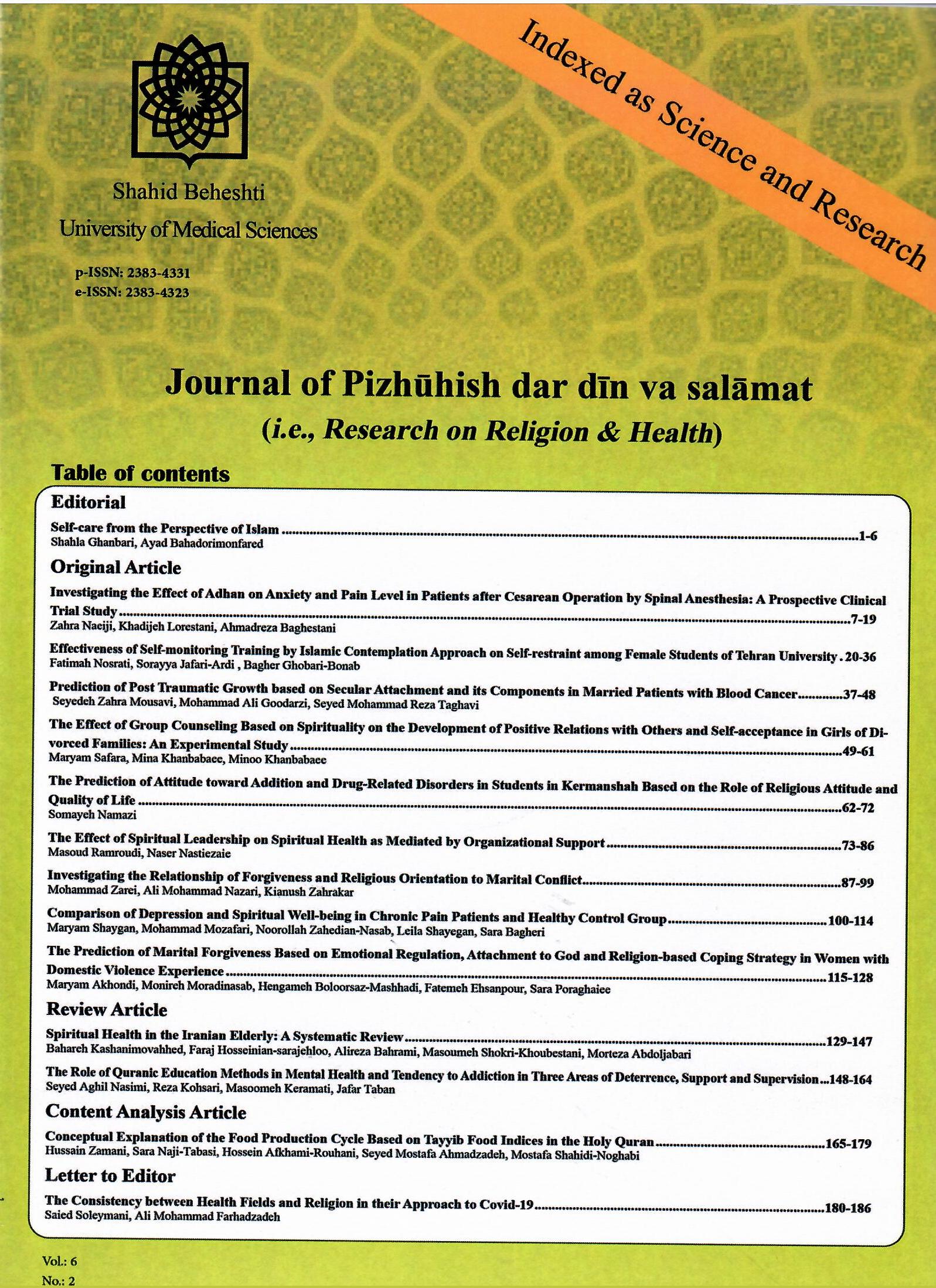
Self-care from the Perspective of Islam

  • Shahla Ghanbari
  • Ayad Bahadorimonfared

Journal of Pizhūhish dar dīn va Salāmat (i.e., Research on Religion & Health), Vol. 6 No. 2 (2020), 13 June 2020 , Page 1-6
https://doi.org/10.22037/jrrh.v6i2.29917 Published: 2020-06-13

  • View Article
  • Download
  • Cite
  • References
  • Statastics
  • Share

Abstract

Self-care includes acquired, conscious and purposeful actions people take for themselves, their children and family to stay healthy, protect their physical, mental and social health, prevent diseases, manage chronic diseases, and ensure their health after discharge from hospital


Please cite this article as: Ghanbari Sh, Bahadorimonfared A. Self-care from the Perspective of Islam. Journal of Pizhūhish dar dīn va salāmat. 2020;6(2):1-6. https://doi.org/10.22037/jrrh.v6i2.29917


Keywords:
  • Health; Islam; Self-care
  • PDF (فارسی)

How to Cite

1.
Ghanbari S, Bahadorimonfared A. Self-care from the Perspective of Islam. JRRH [Internet]. 2020 Jun. 13 [cited 2026 Jul. 8];6(2):1-6. Available from: https://journals.sbmu.ac.ir/jrrh/article/view/29917
  • ACM
  • ACS
  • APA
  • ABNT
  • Chicago
  • Harvard
  • IEEE
  • MLA
  • Turabian
  • Vancouver
  • Endnote/Zotero/Mendeley (RIS)
  • BibTeX

References

Rafiefar S, Solimanian A, Sarbandi F, Ardestani M, Javadi M, Nasiri A. National self-care program executive instructions. Tehran: Mojassameh; 2015. (Full Text in Persian)

Zakavi AA, Marzband R. The meaning of spiritual care and its ways to achive the spiritual health according to Quran and Hadith's teachings. Medical History Journal. 2015;6(21):103-29. (Full Text in Persian)

Amedi AV. Ghorar Al-hikam.Translator:Mohammad Ali Ansari. Qom: Imam Asr Publicatin; 2006. (Full Text in Persian)

Ibn Al-fatal MBH. Rouzah Al-vaezin va Baseerat Al-mottaezeen.Editor: Seyyed Mohammad Mahdi Khorsan. Qom: Manshoorat Al-Razee Publication. (Full Text in Persian)

Al-Maghribi N. Daaem Al-Islam. Qom: Ahl Al-Beyt

Institute; 1965. (Full Text in Arabic)

Rezaeian A. Fundamentals of Organizational Behavior Management. 7th Edition, Tehran, Sazman Motale’eh va Tadvin Kotob Olum-e Ensani (SMT);2006. (Full Text in Persian)

Ghorbanian M, Fesharaki. Self-care motivations from the perspective of verses and traditions (Hadith). Journal of Islamic and Iranian Traditional Medicine. 2015;(6)3:187-97. (Full Text in Persian)

Noncommunicable Diseases (NCDs). Available at: HYPERLINK "https://www.who.int/news-room/fact-sheets/detail/noncommunicable-diseases https://www.who.int/news-room/fact-" sheets/detail/noncommunicable-diseases

Omidvar Sh. Self-care according to Quran and Islam and its compatibility with modern medical science. Islam and Health Journal. 2016;3(1):38-46. (Full Text in Persian)

  • Abstract Viewed: 1110 times
  • PDF (فارسی) Downloaded: 618 times

Download Statastics

  • Linkedin
  • Twitter
  • Facebook
  • Google Plus
  • Telegram

Language

  • فارسی
  • English
  • العربية
  • Home
  • Archives
  • Submissions
  • About the Journal
  • Editorial Team
  • Contact

Creative Commons Attribution 4.0 International License

Postal Address: Office of “Religion & Health Studies Center”, 7th floor,Bulding No. 2, Shahid Beheshti University of Medical Sciences, Parvaneh St., Daneshjoo Blvd. Velenjak, Chamran Highway, Tehran, Iran.

Postal Code: 1985717443                                                    

Phone: (+98)-21-23872343/ (+98)-21-22439850

Email: jrrh@sbmu.ac.ir                                                   

Website: www.journals.sbmu.ac.ir/jrrh

All the rights of this website belong to the Journal of Pizhūhish dar dīn va salāmat. ‎

Powered by OJSPlus