
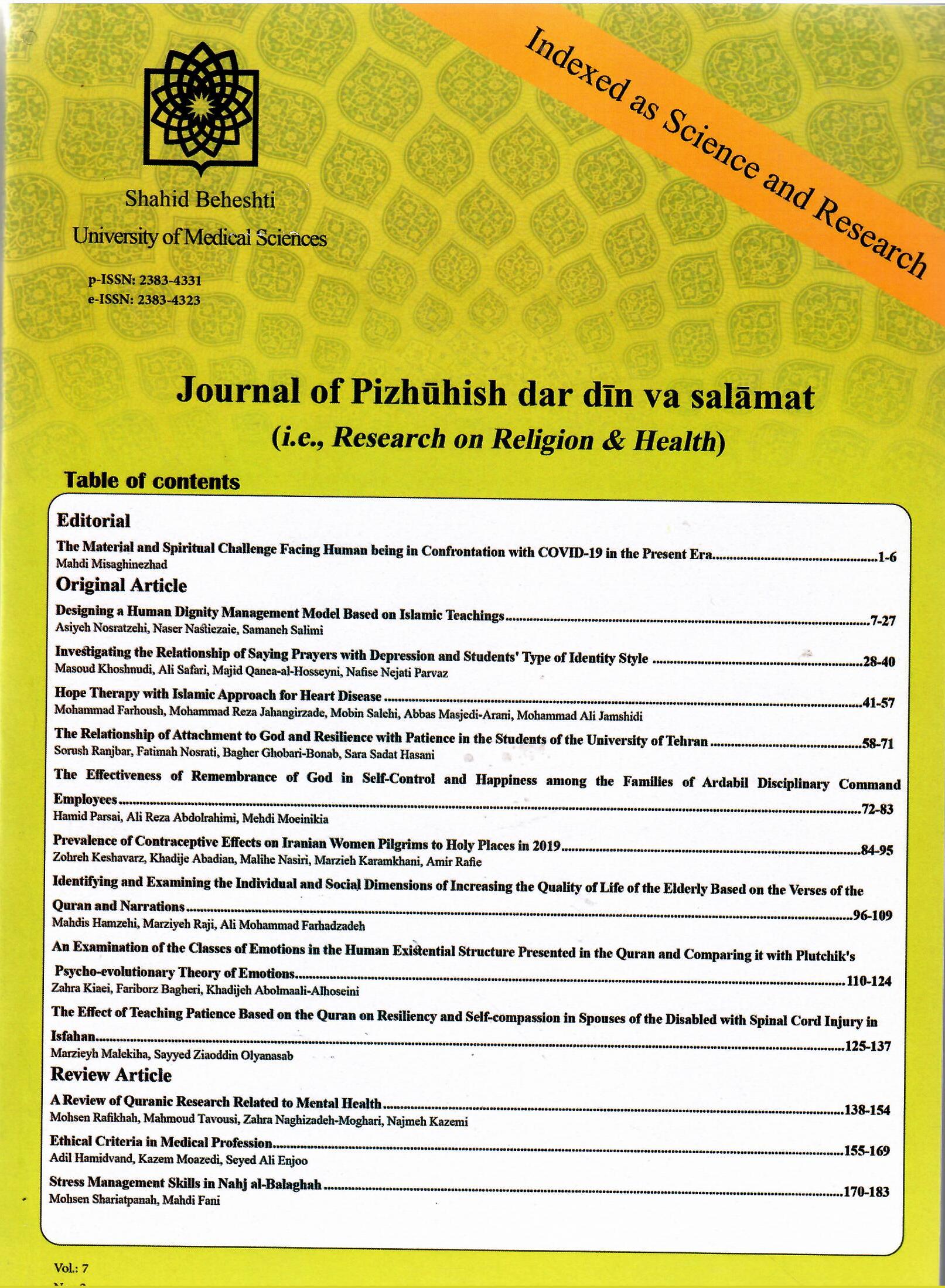
مروری بر پژوهشهای قرآنی مرتبط با سلامت روان
پژوهش در دین و سلامت ,
دوره 7 شماره 2 (2021),
21 خرداد 2021
,
صفحه 138-154
https://doi.org/10.22037/jrrh.v7i2.27180
چکیده
سابقه و هدف: بررسی وضعیت موجود پژوهش در هر کشوری بهجهت هدایت و تعیین مسیر پژوهشهای آتی از اهمیت زیادی برخوردار است. در پژوهش حاضر به بررسی وضعیت پژوهشهای قرآن و سلامت روان پرداخته شده و اهداف جزئی این پژوهش به سه دستۀ موضوعی، روششناسی و جامعۀ محققان تقسیم شده است.
روش کار: این پژوهش از نوع مروری است که واحدهای آن را مقالات فارسیزبان منتشرشده در مجلات معتبر (با نشر الکترونیک) تشکیل میدهد. مقالات از طریق پایگاههای معتبر علمی و با جستوجوی کلیدواژههای تعیینشده انتخاب و پس از چند مرحله غربالگری گزینش شد. درمجموع، 141 مقاله جهت بررسی و تحلیل انتخاب شد. مؤلفان مقاله هیچگونه تضاد منافعی گزارش نکردهاند.
یافتهها: نتایج در سه بُعد موضوعی، روششناسی و جامعۀ محققان تحلیل شد. در بُعد موضوعی مشخص شد که مقالات تفسیری (47/35 درصد) بیشترین فراوانی را داشت. در زمینۀ روششناسی نیز تحقیقات کمّی، کیفی و آمیخته بهترتیب 35/50 درصد، 10/46 درصد و 55/3 درصد از حجم مقالات را دربرمیگرفت. همچنین در بررسی جامعۀ محققان مشخص شد که پژوهشگرانی که رشتههایی غیر از علوم قرآنی داشتند درصد بیشتری از مقالات حوزۀ قرآن و سلامت را منتشر کرده بودند (83/63 درصد).
نتیجهگیری: منطبق با یافتههای پژوهش تحلیلهایی دربارۀ روند انتشار پژوهشها و جهتدهی به پژوهشهای آتی بهسوی مسیر مطلوبتر ارائه شده است.
استناد مقاله به این صورت است:
Rafikhah M, Tavousi M, Naghizadeh-Moghari Z, Kazemi N. A Review of Quranic Research Related to Mental Health. Journal of Pizhūhish dar dīn va salāmat. 2021;7(2):138-154. https://doi.org/10.22037/jrrh.v7i2.27180
- سلامت، سلامت روان، قرآن، مطالعۀ مروری
ارجاع به مقاله
مراجع
Rahimi G. World Health organization (WHO). Aja journal of Paramedical Sciences. 2009;5(1):53-6.
Mohammadi K, Ahmadi K, Fathi-Ashtiani A, AzadFallah P, Ebadi A. Development of Mental Health Indicators in Iran. Journal of Health Education and Health Promotion.2014;2(1):37-48. (Full Text in Persian)
Sharifi V, Rahimi Movaghar A, Mohammadi MR, Rad Goudarzi R, Sahimi Izadian E, Farhoudian A, et al. Analysis of Iran's Mental Health Research Over 3 Decades: A Scientometric Study. Advances in Cognitive Science. 2003;5(3):1-16. (Full Text in
Persian)
Atef Vahid K. Mental Health in Iran: Accomplishments and Challenges. Social Welfare. 2005;4(14):41-58. (Full Text in Persian)
Noorbala A, Asadi-Lari M, Vaez Mahdavi M. Mental health status of people aged 15 and older in 2006 in Tehran. Iranian Journal of Psychiatry and Clinical Psychology. 2010;4:56-66. (Full Text in Persian)
Parvizifard A, Shakeri J, Sadeqhi K, Ameri M, Nezhadjafar P. Psychiatric Disorders in First Year Students of Kermanshah University of Medical Sciences (2002). J Kermanshah Univ Med Sci. 2006;10(2):120-9.
Miryan S, Hassanzadeh R, Hosseini S, Sakhaie S. The Relationship between Quranic Intimacy and Psychological Health. JBUMS. 2013;15(1):66-71. (Full Text in Persian)
Yadollahpor MH, Seyedi-Andi J, Rezaee R, Borhani M, Bakhtiari A. Reviewing the verses of the Holy Quran in the context of three major dimensions of health (physical, mental and social). Islam and Health Journal. 2015;2(3):48-56. (Full Text in Persian)
Roshan F, Khazaee M. Mental healthfrom the viewpoint of the Quran. Quarterly Sabzevaran Fadak. 2012;3(12):79-97. (Full Text in Persian)
Ebrahimi A, Nazari A, Hasani J. Psychopathology from the perspective of Quran: Thematic analysis. Islam and Health Journal. 2015;2(3):15-24. (Full Text in Persian)
Ekhtiary-Sadegh M, Imani-Naeini M, Mirza-Mohammadi M. The Effect of Life Skills Training Based on the Holy Quran on the Negative Emotions, Life Quality and Life Orientation of Patients with Breast Cancer in Tehran. Journal of Pizhūhish dar dīn va salāmat. 2020;5(4):7-19. (Full Text in Persian)
Rafiei-Mohammadi N, Jahangiri M. The Effect of Logic Therapy Combined with Quran Recitation and Prayer on Depression Symptoms in Women with Major Depressive Disorder Journal of Pizhūhish dar dīn va salāmat. 2020;5(4):88-98. (Full Text in Persian)
Safara M, Salmabadi M. The Moderating Role of Religiosity in Relationship between Number of Children and Anxiety of Mothers with a Single Child and two or more Children. Journal of Pizhūhish dar dīn va salāmat. 2019;5(1):7-18. (Full Text in Persian)
Esmaeili Sadrabadi M, Jadadi M, Rafikhah M, Naghizadeh Z. Investigating Effectiveness of Contemplating the Quran on Mental Health. Interdisciplinary Quranic studies J. 2016;7(1):51-64. (Full Text in Persian)
Aghajani M, Mirbagher N. The relationship between familiarity with the Quran and mental health in nursing students. Islam and Health Journal. 2015;1(4):7-13. (Full Text in Persian)
Ramazanzade K, Miri M, Hashemi SM. Familiarity with Quran and Its Relationship with Mental Health among University Students. Religion and Health. 2016;3(2):41-8. (Full Text in Persian)
Fayyaz F, Bahrami Ehsan H, Okhovat AR. The Elementary Making of a Scale for Diagnosing the Depression Based on Some Quranic Verses. Studies in Islam and Psychology. 2015;9(17):153-80. (Full Text in Persian)
Abolmaali Alhosseini K, Mousazadeh Z. Provision and Standardization of Mental Health Questionnaire Based on Islamic Teachings. Religion and Health. 2018;5(2):1-12. (Full Text in Persian)
Abbasi Moghaddam M, Tamanaiefar MR, Kashi E. Comparison of Mental Health and Its Components in Memorizers of the Quran and Non-memorizers. Islamic Life Style. 2018;2(2):105-12. (Full Text in Persian)
Lakzaei J, Sanagoo A, Kavosi A, Jouybari L, Kavosi A, Haghdost Z, et al. A Comparison of Quran-Memorizers and Non-Memorizers’ Mental Health in Gorgan. J Res Relig Health. 2019;4(5):57-66. (Full Text in Persian)
Esmaeili Sadrabadi M, Rafikhah M, Ostadi A, Naghizadeh Z, Ganjoor M. References and Bibliography of Interdisciplinary Studies of Quran and Health. Interdisciplinary Quranic studies J. 2018;17:71-84. (Full Text in Persian)
Mansouri N, Sharifi V, Farhoodian A, Goodarzi Rad A, Rahimi Movaghar A, Mohammadi M, et al. Barresi Maghalat-e Pajuheshi Keshvar dar Khosoos-e Behdasht-e Ravan-e Madares-e Tey-e Salhay-e 1352-1381. Journal of Psychology & Education. 2009;38(4):101-22. (Full Text in Persian)
Javidrouzi M, Bagherinejad S, Hoseinpour A. Research on national health needs and prioritization. Tehran; Andishmand. 2002. (Full Text in Persian)
Owlia P, Bahreini FS, Baradaran Eftekhar M, Ghanei M, Forouzan As, Farahani M. Health research priority setting in Iran. Journal of School of Public Health and Institute of Public Health Research. 2011;9(2):9-20.
Ghanbari A, Heydarzade A, Farmanbar R, Taiefeh N, Moaddab F. Research Priorities Setting for Health Domain in Guilan Province. Journal of Guilan University of Medical Sciences. 2017;26(102):30-6. (Full Text in Persian)
Farhoudian A, Rad Goodarzi R, Rahimi Movaghar A, Sharifi V, Mohammadi MR, Sahimi Izadian E, et al. Trend of Researches in the Field of Psychiatric Disorders in Iran. Iranian Journal of Psychiatry and Clinical Psychology. 2007;12(4):327-36. (Full Text in Persian)
Majidpour A, Adalatkhah H, Sezavar S, Aminisani N, Shabani M, Nemati A. Research Priorities in Health Field in Ardabil Province: An Experience. J Ardabil Univ Med Sci. 2003;3(3):7-22. (Full Text in Persian)
Goodarzi Rad R, Sharifi V, Rahimi-Movaghar A, Farhoudian A, Sahimi E, Mohammadi MR, et al. Trend of Iran’s mental health research over three decades. Journal of School of Public Health and Institute of Public Health Research. 2006;4(3):1-14. (Full Text in Persian)
Ahmadi K, Habibi M, Shahi R, Khoshkam S, Moradi A, Akhavan Rad S, et al. Research Findings, Limitations, and Orientations in the Field of Veterans’ Mental Health. Journal of Military Medicine. 2013;14(4):251-60.
Malek Afzali H, Bahreini F, Alaedini F, Setareh Foruzan A. Health system priorities based on needs assessment & stakeholders’ participation in I.R. Iran. Hakim Health Systems Research Journal. 2007;10(1):13-9. (Full Text in Persian)
Fava GA, Montanari A. National trends in behavioral sciences (1981–1996). Psychotherapy and Psychosomatics. 1998;67(6):281-301.
Okasha A, Karam E. Mental health services and research in the Arab world. Acta psychiatrica scandinavica. 1998;98(5):406-13.
Sahimi Izadian E, Rahimi Movaghar A, Sharifi V, Mohamadi M, Rad Goodarzi R, Farhoudian A, et al. Status of Mental Health Research Concerning Women In Iran Over the Past 3 Decades. Social Welfare. 2006;5(21):165-84. (Full Text in Persian)
Rafikhah M, Naghizadeh Z, Esmaeili Sadrabadi M, Kazemi N. Identifying and Ranking the Research Fields in Interdisciplinary Studies of Quran and Health. Interdisciplinary Quranic studies J. 2017;8(1):49-66. (Full Text in Persian)
Mahram B, Tavanaee Shahroudi E. Content analysis of iranian psychological journals:research topics and methods. Scientific Journal Management System. 2009;6(22):109-18. (Full Text in Persian)
Sarmad Z, Bazargan A, Hejazi E. Research Methods in Behavioral Sciences. Agah. 2012:79.
Noorbala AA, Bagheri Yazdi SA, Asadi Lari M, Vaez Mahdavi MR. Mental Health Status of Individuals Fifteen Years and Older in Tehran-Iran (2009). Iranian Journal of Psychiatry and Clinical Psychology. 2011;16(4):479-83. (Full Text in Persian)
- چکیده مشاهده شده: 777 بار