
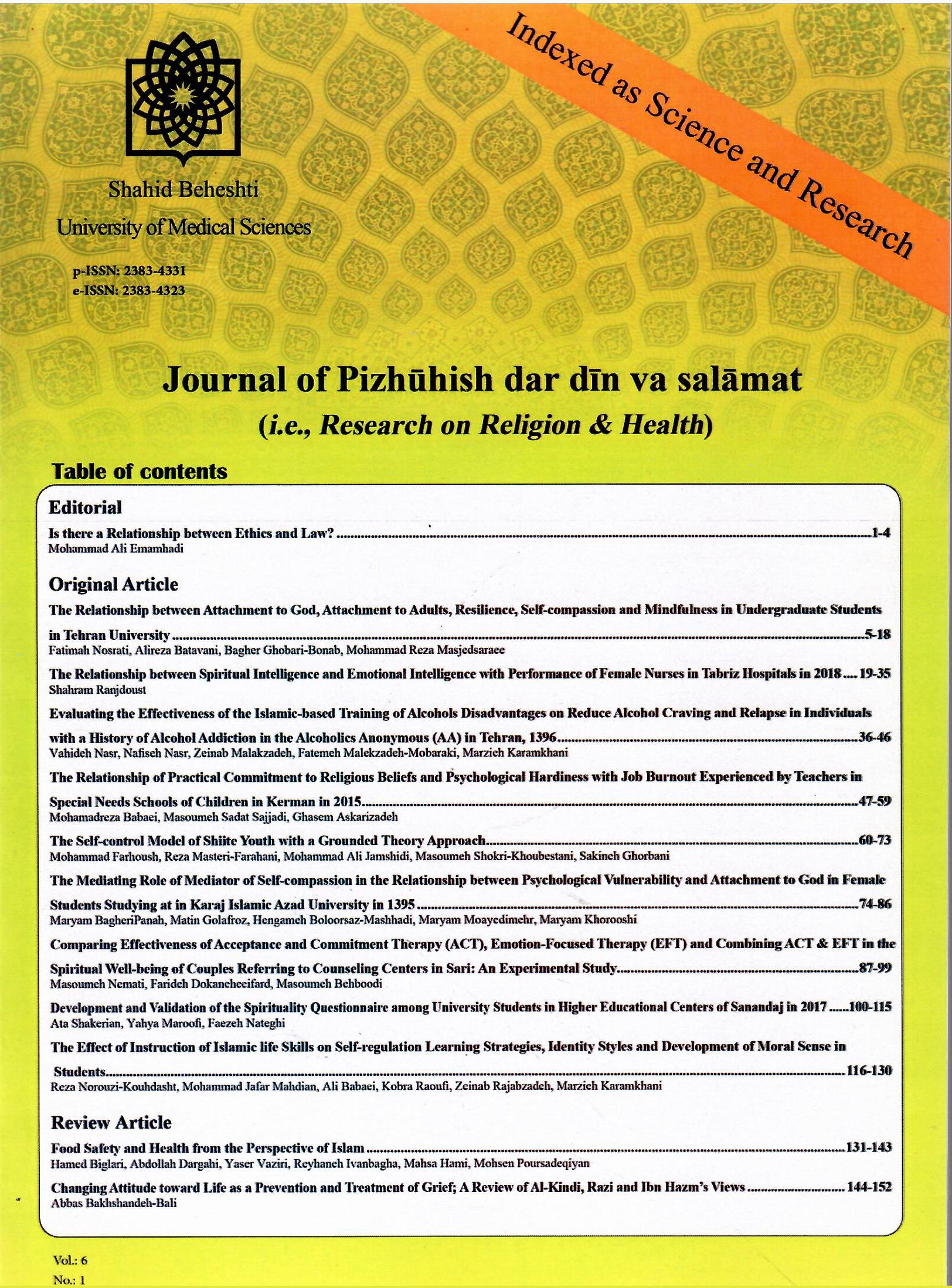
بررسی رابطۀ هوش معنوی و هوش هیجانی با عملکرد پرستاران زن بیمارستانهای شهر تبریز در سال 1396
پژوهش در دین و سلامت ,
دوره 6 شماره 1 (2020),
22 فروردین 2020
,
صفحه 19-35
https://doi.org/10.22037/jrrh.v6i1.19852
چکیده
سابقه و هدف: مهمترین هدف هر سازمانی دستیابی به بهرهوری بهینه است. یکی از عوامل کارآمدی در بهرهوری، نیروی انسانی است. عملکرد شغلی پرستاران، که یکی از مهمترین منابع انسانی بیمارستانها محسوب میشوند، متأثر از عوامل متعددی ازجمله هوش معنوی و هوش هیجانی است که موجب افزایش کیفیت خدمات و بهرهوری میشود. این پژوهش با هدف بررسی رابطۀ هوش معنوی و هوش هیجانی با عملکرد پرستاران زن شهر تبریز در سال 1396 صورت گرفته است.
روش کار: پژوهش حاضر از نظر هدف کاربردی و از نظر روش توصیفی-همبستگی است. جامعۀ آماری پژوهش شامل همۀ پرستاران زن شهر تبریز بود که از میان آنان 360 نفر با استفاده از جدول مورگان به شیوۀ نمونهگیری تصادفی خوشهای چندمرحلهای برای نمونه انتخاب شدند. بهمنظور گردآوری دادهها از پرسشنامههای هوش هیجانی سیبریا شرینگ، هوش معنوی کینگ و عملکرد پیترسون؛ و برای تحلیل دادهها از همبستگی پیرسون و رگرسیون استفاده شد. در این پژوهش همۀ موارد اخلاقی رعایت شده و مؤلف مقاله هیچگونه تضاد منافعی گزارش نکرده است.
یافتهها: یافتهها نشان داد كه بین مؤلفههای هوش معنوی و هوش هيجاني با عملکرد پرستاران؛ و همچنین بین مؤلفههای هوش هیجانی با مؤلفههای هوش معنوی پرستاران رابطۀ معنادار وجود داشت (05/00>P). بر اساس نتایج رگرسیون، هوش هیجانی 18/19 درصد از واریانس هوش معنوی؛ و مؤلفههای هوش هیجانی 8/5 درصد و مؤلفههای هوش معنوی 2/1 درصد از واریانس عملکرد را پیشبینی کردند (05/00>P).
نتیجهگیری: با توجه به نتایج این پژوهش میتوان گفت که از طریق هوش هیجانی و هوش معنوی میتوان عملکرد پرستاران را افزایش داد؛ زیرا برخورداری پرستاران از مهارتهای هوش معنوی و هیجانی تأثیرات چشمگیری در افزایش عملکرد شغلی آنان خواهد داشت و کیفیت خدمترسانی به بیماران را بهبود خواهد بخشید. بنابراین، لازم است مدیران بیمارستانها برای ارتقای هوش معنوی و هیجانی پرستاران تدابیر لازم را اتخاذ نمایند.
استناد مقاله به این صورت است:
Ranjdoust Sh. The Relationship between Spiritual Intelligence and Emotional Intelligence with Performance of Female Nurses in Tabriz Hospitals in 2018. Journal of Pizhūhish dar dīn va salāmat. 2020;6(1):19-35. https://doi.org/10.22037/jrrh.v6i1.19852
- بهرهوری؛ پرستاران؛ هوش؛ هوش هیجانی
ارجاع به مقاله
مراجع
Joo BK, Jeung CW, Yoon HJ. Investigating the influences of core self‐evaluations, job autonomy, and intrinsic motivation on in‐role job performance. Human Resource Development Quarterly. 2010;21(4):353-71.
Rothmann S, Scholtz PE, Rothmann JC, Fourie M. The relationship between individual variables and work-related outcomes. International Conference of the Council for Small Business. 2002:16-9.
Whittle R, Shelton Sh. Outcome from intensive care and measuring performance. Surgery (Oxford). 2015;333(4):180-5.
Singaram M, Udhayakumar RK. Prevalence, pattern, etiology, and management of maxillofacial trauma in a developing country: a retrospective study. Journal of the Korean Association of Oral and Maxillofacial Surgeons. 2016;42(4):174-81.
Reader TW, Flin R, Cuthbertson BH. Communication skills and error in the intensive care unit. Current opinion in critical care. 2007; 13(6):732-6.
Arnold EC, Boggs KU. Interpersonal Relationships-E-Book: Professional Communication Skills for
Nurses. Elsevier Health Sciences; 2015;8.
Petrovici A, Dobrescu T. The Role of Emotional Intelligence in Building Interpersonal Communication Skills. Procedia-Social and Behavioral Sciences. 2014;116:1405-10.
Golman D. Destructive emotions & how we can overcome them. The Bantam Publishing Groups.2003.
Benson G, Ploeg J, Brown B. A cross-sectional study of emotional intelligence in baccalaureate nursing students. Nurse Education Today. 2010;30:49-53.
Freshwater D, Stickley T. The heart of the art: emotional intelligence in nurse education. Nursing Inquiry. 2004; 11(2):91-8.
Chan M. Mental health and development: targeting people with mental health conditions as a vulnerable group. World Health Organization. 2010;3(1):111-21.
Gardner H. A case against spiritual intelligence. The international journal for the psychology of religion. 2000;1;10(1):27-34.
Kouchakzadeh M, Sohrabi Z, Mosadegh Rad AM. The Relationship of Emotional Intelligence and its Dimensions on Communication Skills among Emergency Unit Nurses. jhosp. 2015;14(3):67-74. (Full Text in Persian)
Niazi M, Menati R, Delpisheh A, Menati S, Kassani A. The Association between General Health and Emotional Intelligence in the Nurses of Ilam Province. Sadra Med Sci J. 2015;3(3):179-90. (Full Text in Persian)
Van Leeuwen R, Cusveller B. Nursing competencies for spiritual care. Journal of Advanced Nursing. 2004;48:234-46.
Elkins M, Cavendish R. Developing a plan for pediatric spiritual care. Holistic Nursing Practice. 2004;18(4):179-84.
Hosseinpoor MH, Younesian A, Khosravi A, Sabbagh Y, Kolahdozan S. Relationship between General Health with Emotional Intelligence and Spiritual Intelligence in Students. Journal of Knowledge and Health. 2015; 10(2):11-7. (Full Text in Persian)
Emmons RA. Is spirituality an intelligence? Motivation, cognition, and the psychology of ultimate concern. The International Journal for the psychology of Religion. 2000;10(1):3-26.
Amram Y, Dryer C. The development and preliminary validation of the Integrated Spiritual Intelligence Scale (ISIS). Unpublished manuscript.
Zohar D, Marshall I. SQ: Spiritual intelligence, the ultimate intelligence.London: Bloomsburg.2000.
Wolman RN. Thinking with your soul: Spiritual
intelligence and why it matters. New York: Harmony Books; 2000.
Vaughan F. What is spiritual intelligence? Journal of humanistic psychology. 2002;42(2):16-33.
Nasel D. Spiritual orientation in relation to spiritual intelligence: A consideration of traditional Christianity and New Age/individualistic spirituality (Doctoral dissertation, University of South Australia).
King DB. The spiritual intelligence project. Trent University, Canada. 2007. www. Dbking./ spiritualintelligence.
Pesut B, Reimer-Kirkham S. Situated clinical encounters in the negotiation of religious and spiritual plurality: A critical ethnography. International Journal of Nursing Studies. 2010;47(7):815-25.
Smith AR. Using the synergy model to provide spiritual nursing care in critical care settings. Critical Care Nurse. 2006;26(4):41-7.
Khawaja SF. Impact of spiritual intelligence on employee task performance and OCB, mediating role of self-efficacy, moderating role of collectivevist culture of Pakistan. Jinnah Business Review.2017;5(1):34-45.
Sobhi Garamaleki N, Porzor P. A comparison of spiritual intelligence and emotional intelligence of college students and religious students. 2015;2(11):297-318. (Full Text in Persian)
George M. Practical application of spiritual intelligence in the workplace. Human resource management international digest. 2006;14(5):3-5.
Ker-Dincer M. Educators role as spiritually intelligent leaders in educational institutions. Journal of Human Sciences. 2007;4(1):125-40.
Dipidip C, Cas-ing R, San Luis K. Bridging Health Promotion with Emotional Intelligence: A Nursing Perspective.
Sunaryo H, Nirwanto N, Manan A. The Effect of Emotional and Spiritual Intelligence on Nurses‟ Burnout and Caring Behavior. International Journal of Academic Research in Bussines and Social Sciences. 2017;7(12):1211-27.
Heydari Gorji A, Darabinia M, Ranjbar M. Emotional and Spiritual Intelligence Among Medical Students in Iran. Iranian Journal of Psychiatry and Behavioral Sciences. 2017;11(4):95-109. (Full Text in Persian)
Pekaar Keri A, Van der Linden D, Bakker AB, Born MP. Emotional intelligence and job performance: The role of enactment and focus on others’ emotions. Human Performance. 2017; 27;30(2-3):135-53.
Givaki E, Davoudi H, Manzari AR, Alipour Katigarie S. Job Satisfaction Prediction based on Job Motivation and Emotional Intelligence of Managers
and Employees. Iranian journal of educational sociology. 2018;1(7):112-8.
Khandan M, Eyni Z, Koohpaei A. Relationship between spiritual intelligence and job performance: A case study of Nurses and Nursing aids in the main university hospital of Qom, Iran, Health. Spirituality and Medical Ethics.2017;4(3):8-14. (Full Text in Persian)
Gillian M, Lewis CH, Neal M. Emotional intelligence and affective events in nurse education: A narrative review. Nurse Education Today.2017; 10(1):40-52.
Kulshrestha S, Singhal TK. Impact of spiritual intelligence on performance and job satisfaction: A study on school teachers. International Journal of Human Resource & Industrial Research. 2017;4(2):1-6.
Kanu M, Kaur B. A correlational study to assess the effect of emotional intelligence on job perfornace among staff nurses working in selexted hospital of Jalandhar, Punjab. International Journal of Development Research. 2017;7(9): 15044-7.
Hosinian S, Shoa Kazemi M, Chabokinezhad Z. Barresi-ye Rabete-ye Hoosh-e Ma'navi ba Hoosh-e Hayajani dar bein Dokhtaran-e Daneshjooye Daneshgah-e Alzahra. Journal Farhangi-Defaei Zanan va Khanevadeh. 2011;5(17):7-26. (Full Text in Persian)
Hajian A, Sheikhuleslami M, Homaei R, Rahimi F, Aminoroaia M. Relationship between spiritual and emotional intelligence. Research of Behavioral sciences. 2011;10(5):500-8. (Full Text in Persian)
Sotoodeh H, Shakerinia I, Kheyrati M, Dargahi S, Ghasemi Jobaneh R. Surveying the relationship between spiritual and moral intelligence and the psychological well-being of nurses. ijme. 2016; 9(1):63-73. (Full Text in Persian)
Yektaee MR, Alipoor M, Khosravi A, Bazrafshan H. Effect of Spiritual Intelligence on Individual Performance (Case: Department of Education and Training of the Region 6). Organizational Culture Management. 2016;13(4):1267-87. (Full Text in Persian)
Ghobary Bonab B, Salimi M, Soleimani L, Nouri Moqaddam S. Hoosh-e Ma'navi. Quarterly Journal. Research of Andishe Novin Dini. 2007; 3(10): 125-47. (Full Text in Persian)
King DB, DeCicco TL. A viable model and self-report measure of spiritual intelligence. International journal of transpersonal studies. 2009;28(1):70-1.
Paterson DG. The scott company graphic rating scale. Journal of Personnel Research. 1922; 1(8): 361-7.
Amram Y, editor. The seven dimensions of spiritual intelligence: An ecumenical, grounded theory. 115th annual conference of the American psychological association, San Francisco, CA; 2007.
Bar-On R. The Bar-On model of emotional-social intelligence (ESI) 1. Psicothema. 2006 Dec 31;18:13-25.
Moradi M, Afshar Emani YS. The relationship between spiritual intelligence, emotional intelligence and auditor performance. Pajuheshhaye Hesabdari-ye Mali va Hesabresi. 2017;9(35):41-64. (Full Text in Persian)
- چکیده مشاهده شده: 960 بار
- PDF دانلود شده: 839 بار