
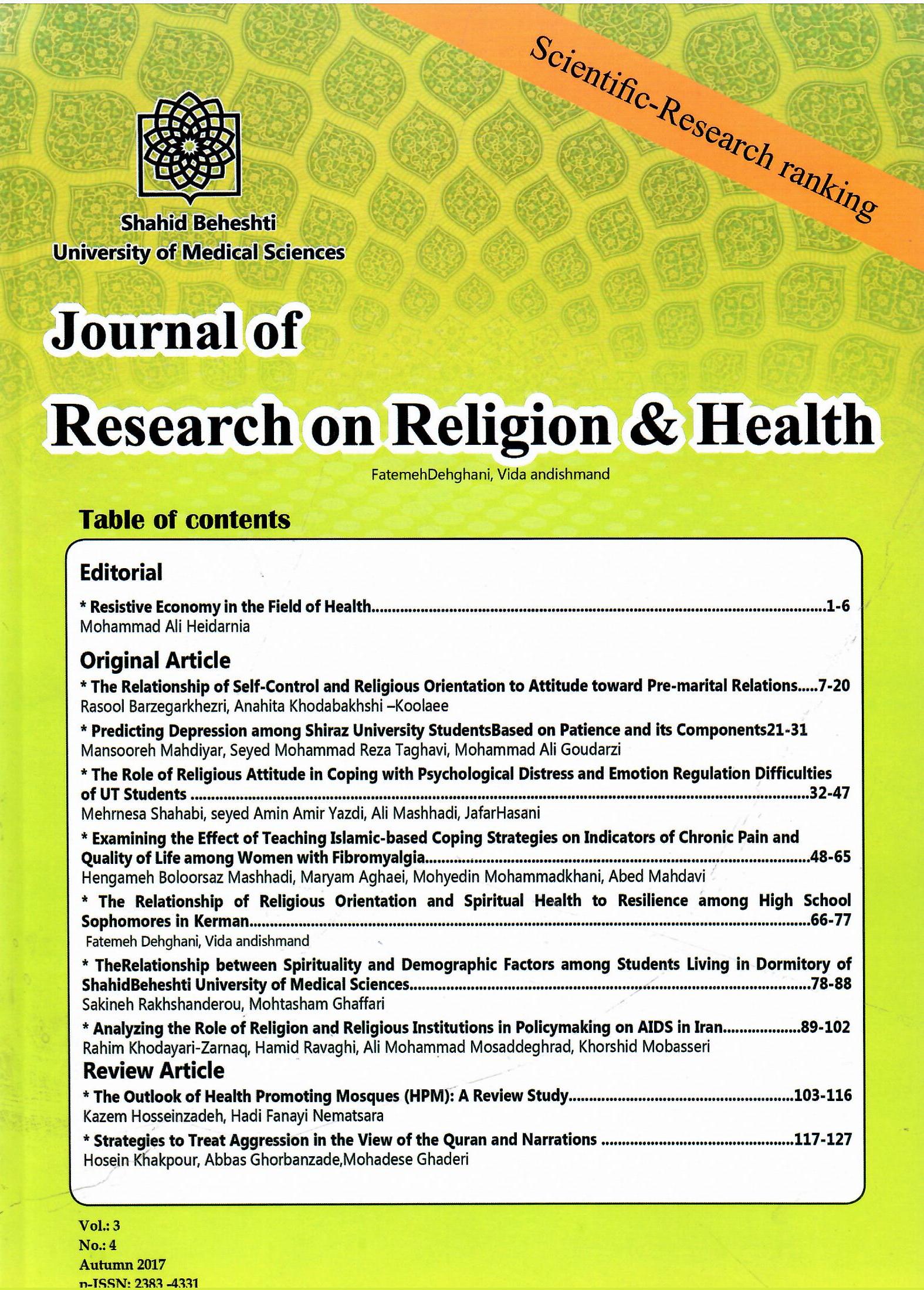
نقش نگرش مذهبی در تحمل پریشانی روانشناختی و دشواری نظمجوییهیجان دانشجویان دانشگاه تهران
پژوهش در دین و سلامت ,
دوره 3 شماره 4 (2017),
18 شهریور 2017
,
صفحه 32-47
https://doi.org/10.22037/jrrh.v3i4.15558
چکیده
سابقه و هدف: با توجه به شواهد موجود مبنی بر اثرهای منفی پریشانی روانشناختی و مشکلات نظمجویی هیجانی در طول زندگی، تلاش برای یافتن فرایندهای زیربنایی آن، اهمیت بسیاری پیدا کرده است. ازآنجاییکه مذهب یکی از عواملی است که ارتباطی تنگاتنگ با نظمجویی هیجان و سلامت روان دارد، پژوهش حاضر با هدف بررسی نقش نگرش مذهبی در تحمل پریشانی روانشناختی و دشواری نظمجویی هیجان صورت گرفته است.
روش کار: این پژوهش ازنوع توصیفی - همبستگی و جامعهی آماری آن شامل تمامی دانشجویان دانشگاه تهران در سال تحصیلی94 - 95 است که بر اساس روش نمونهگیری خوشهیی چندمرحلهیی، تعداد 211 نفر از آنان (120 زن و 91 مرد) از دانشکدههای مختلف انتخاب شدند و پرسشنامههای نگرشسنج مذهبی (RAS-R)، دشواری نظمجویی هیجان (DERS-16) و پریشانی روانشناختی (DASS-21) را تکمیل کردند. دادههای بهدست آمده با استفاده از ضریب همبستگی پیرسون و رگرسیون چندگانه تجزیه و تحلیل شد. در این پژوهش همهی موارد اخلاقی رعایت شده است. علاوهبراین، نویسندگان مقاله هیچگونه تضاد منافعی گزارش نکردهاند.
یافتهها: یافتهها نشان میدهد که بین ابعاد نگرش مذهبی با اضطراب و برخی از مؤلفههای دشواریهای نظمجویی هیجانی رابطهی معنادار وجود دارد. بهطوریکه از بین زیرمقیاسهای پریشانی روانشناختی؛ زیرمقیاس اضطراب با ابعاد نگرش مذهبی (معنویت درونی، عبادات و اخلاقیات) ارتباط منفی معناداری دارد و بُعد اخلاقیات میتواند مشکل اضطراب را پیشبینی کند. علاوهبراین، بُعد اخلاقیات، مؤلفههای کنترل نکردن تکانه و دسترسی محدود به راهبردهای نظمجویی هیجانی؛ و بُعد معنویت درونی نیز مؤلفهی نپذیرفتن هیجانی را پیشبینی میکند.
نتیجهگیری: بر اساس نتایج پژوهش حاضر میتوان چنین استنباط کرد که ابعاد نگرش مذهبی میتواند بهصورت منفی بر دشواریهای نظمجویی هیجانی و اضطراب تأثیرگذار باشد؛ بنابراین، توجه به نگرش مذهبی در آسیبشناسی اختلالات اضطرابی و متعاقب آن دستورالعملهای درمانی ضروری بهنظر میرسد.
استناد مقاله به این صورت است:
Shahabi M, Amir Yazdi S A, Mashhadi A, Hasani J. The Role of Religious Attitude in Coping with Psychological Distress and Emotion Regulation Difficulties of UT Students. J Res Relig Health. 2017; 3(4): 32- 47.https://doi.org/10.22037/jrrh.v3i4.15558
- اضطراب؛ افسردگی؛ پریشانی روانشناختی؛ دانشجویان؛ نظمجویی هیجان؛ نگرش مذهبی
ارجاع به مقاله
مراجع
Garnefski N, Kraaij V, Spinhoven P. Negative life events, cognitive emotion regulation and emotional problems. Personality and Individual differences. 2001; 30(8): 1311-27.
Gratz KL, Roemer L. Multidimensional assessment of emotion regulation and dysregulation: Development, factor structure, and initial validation of the difficulties in emotion regulation scale. Journal of psychopathology and behavioral assessment. 2004; 26(1): 41-54.
Sheppes G, Suri G, Gross JJ. Emotion regulation and psychopathology. Annu Rev Clin Psychol. 2015; 11: 379-405.
Amstadter A. Emotion regulation and anxiety disorders. Journal of anxiety disorders. 2008; 22(2): 211- 21.
Campbell-Sills L, Simmons AN, Lovero KL, Rochlin AA, Paulus MP, Stein MB. Functioning of neural systems supporting emotion regulation in anxiety-prone individuals. Neuroimage. 2011; 54(1): 689- 96.
Eftekhari A, Zoellner LA, Vigil SA. Patterns of emotion regulation and psychopathology. Anxiety, Stress, & Coping. 2009; 22(5): 571-86. (Full Text in Persin)
McLaughlin KA, Hatzenbuehler ML, Mennin DS, Nolen-Hoeksema S. Emotion dysregulation and
adolescent psychopathology: A prospective study. Behaviour research and therapy. 2011; 49(9): 544-54.
Tull MT, Barrett HM, McMillan ES, Roemer L. A preliminary investigation of the relationship between emotion regulation difficulties and posttraumatic stress symptoms. Behavior Therapy. 2007; 38(3): 303-13.
Samimi Z, Mirdoraghi F, Hasani J, Zakeri MM. The Role of Cognitive Emotion Regulation Strategies and Distress Tolerance in High-Risk Behaviors among Students. 2016; 14(1): 92-102. (Full Text in Persin)
Bjureberg J, Ljótsson B, Tull MT, Hedman E, Sahlin H, Lundh L-G, et al. Development and Validation of a Brief Version of the Difficulties in Emotion Regulation Scale: The DERS-16. Journal of psychopathology and behavioral assessment. 2016; 38(2): 284-96.
Gratz KL, Tull MT. Emotion regulation as a mechanism of change in acceptance-and mindfulness-based treatments. Assessing mindfulness and acceptance processes in clients: Illuminating the theory and practice of change. 2010:107-33.
Drapeau A, Marchand A, Beaulieu-Prévost D. Epidemiology of psychological distress. Mental illnesses-understanding, prediction and control: InTech; 2012.
Mirowsky J, Ross CE. Measurement for a human science. Journal of Health and Social Behavior. 2002: 152-70.
Hassani J, Shahmoradifar F. The Effectiveness of Procedural Emotion Regulation Strategies Training on Psychological Distress. J Personality & Individual Differences. 2015; 4(10): 65-80. (Full Text in Persin)
Ford BQ, Mauss IB. Culture and emotion regulation. Curr Opin Psychol. 2015; 3:1-5.
Mesquita B, Albert D. The cultural regulation of emotions. 2007.
Cohen AB. Many forms of culture. American psychologist. 2009; 64(3): 194.
James W. The varieties of religious experience: A study in human nature: Collier Books; 1967.
Vishkin A, Bigman Y, Tamir M. Religion, emotion regulation, and well-being. Religion and spirituality across cultures: Springer; 2014. p. 247-69.
Carter E, McCullough M. Waiting, tolerating, and cooperating. Did religion evolve to prop up human’s self-control abilities. Handbook of self-regulation: research, theories, and applications (2nd ed, pp 422–437) New York: Guilford. 2010.
Mohammadei H, Mazidy M. The role of Religiosity in Predicting of students Cognitive Emotion Regulation. Culture in the Islamic University. 2015; 4(13): 605-20. (Full Text in Persin)
Gomes NS, Farina M, Dal Forno C. Spirituality,
Religion and Religion: Concepts Reflection in Psychological Articles. Revista de Psicologia da IMED. 2014; 6(2): 107-12.
Flannelly KJ, Ellison CG, Strock AL. Methodologic issues in research on religion and health. Southern Medical Journal. 2004; 97(12): 1231-41.
Koenig HG. Religion and medicine II: Religion, mental health, and related behaviors. The International Journal of Psychiatry in Medicine. 2001; 31(1): 97-109.
Koenig HG. Religion and medicine IV: religion, physical health, and clinical implications. The International Journal of Psychiatry in Medicine. 2001; 31(3): 321-36.
Panzini RG, Rocha NSd, Bandeira DR, Fleck MPdA. Qualidade de vida e espiritualidade. Revista de psiquiatria clínica São Paulo Vol 34, supl1 (2007), p 105-115. 2007.
Koenig HG. Religion, spirituality, and medicine: research findings and implications for clinical practice. South Med J. 2004; 97(12): 1194-200.
Khazaei H, Rezaei M, Ghadami MR, Tahmasian M, Mobarra AG, Shiri E. Relationship between religious values and anxiety among Kermanshah University of Medical Sciences students. . Journal of Kermanshah University of Medical Sciences (J Kermanshah Univ Med Sci). 2010; 44(1): 66-72. (Full Text in Persin)
Miller WR. Researching the spiritual dimensions of alcohol and other drug problems. Addiction. 1998; 93(7): 979-90.
Ghobari Bonab B, Khodayarifard M, Shokoohi Yekta M, Faghihi I. Inter relationship among reliance on God, anxiety, patience and hopefulness in Tehran university students. Proceeding of the First International Congress of Religion and Mental Health; Tehran: Iran 2001. p. 97-8. (Full Text in Persin)
Ebrahimi A. The relationship between depression and religions attitude and performances in adults. Research in medical sciences. 2003; 8(1): 94-6. (Full Text in Persin)
Sargolzaei MR, Behdani F, Ghorbani E. Can religious activities prevent depression, anxiety and substance abuse in the university student? In Proceeding of the First International Congress of Religion and Mental Health2001. p. 16-9.
Kim-Prieto C. Religion and spirituality across cultures: Springer; 2014.
Safara M, Bhatia M. Relationship of Religious Beliefs with Anxiety and Depression. 2008.
Khodayarifard MMD. Report preparation and Normalization Assessment Scale religiosity in the student community. Tehran: Tehran University, School of Psychology and Educational Sciences; 2006. (Full Text in Persian)
Mostafavi H. Altahghigh1980. (Full Text in Arabic)
The holy Quran.Al-Fath.verse 4. Translated by: Ayatollah Al-ozma Naser Makarem Shirazi. Qom: Imam Ali Ebne Abi Taleb (Ýa); 2010. (Full Text in Arabic)
Khodayarifard M, Shokouhi YM, Ghobari BB. Preparing a scale to measure religious attitudes of college students. J of Psychology. 2000; 4(3): 269-85. (Full Text in Persian)
Ebrahimi A, Neshatdoost T, Kalantari H, Molavi M, Asadollahi Ghorbanali H. Factor structure, Validity and Reliability of the religious attitiude scale (RAS-R). The Quarterly J of Fundamentals of Mental Health. 2008; 10(2): 107-16. (Full Text in Persian)
Shahabi M. The comorbidity of generalized anxiety disorder and depression: drawing of psychlogical profile and investigation of efficacy of emotion regulation therapy School of Educational Sciences and Psychology, Ferdowsi University of Mashhad. Mashhad, Iran2017. (Full Text in Persian)
Samani S, Jokar B. Investigation reliability & validity of short form of depression, anxiety and distress. Jl of Humanities and Social Sciences of Shiraz University. 2007; 26(3): 65-76. (Full Text in Persian)
Vasegh S, Mohammadi M-R. Religiosity, anxiety, and depression among a sample of Iranian medical students. The International Journal of Psychiatry in Medicine. 2007; 37(2): 213-27.
Fountoulakis KN, Siamouli M, Magiria S, Kaprinis G. Late-life depression, religiosity, cerebrovascular disease, cognitive impairment and attitudes towards death in the elderly: Interpreting the data. Medical hypotheses. 2008; 70(3): 493-6.
Moridi H, Farsi F, Yousefi Z, Farsi M. Analysis of the relationship between emotional intelligence and entrepreneurial characteristics of students through structural equation modeling (case study: students of Islamic Azad University, South Tehran Branch). Advances in Environmental Biology. 2014;20:287-97. (Full Text in Persian)
Fagan PF. Why religion matters even more: The impact of religious practice on social stability. Backgrounder. 2006;1992:1-19.
Sayadi Touranloo H, Jamali R, Mirghafoori SH. Investigates the relationship between Islamic religious instruction and emotional intelligence in students of faculty. Andishe Novin Dini(A Quarterly Research Journal). 2008; 3(11). (Full Text in Persian)
Koole SL, McCullough ME, Kuhl J, Roelofsma PH. Why religion’s burdens are light: From religiosity to implicit self-regulation. Personality and Social Psychology Review. 2010; 14(1): 95-107.
McCullough ME, Willoughby BL. Religion, self-regulation, and self-control: Associations, explanations, and implications. Psychological bulletin. 2009; 135(1): 69.
Koenig HG. Religion, spirituality, and medicine: Application to clinical practice. Jama. 2000; 284(13): 1708.
Yang K-P, Mao X-Y. A study of nurses’ spiritual intelligence: A cross-sectional questionnaire survey. International journal of nursing studies. 2007; 44(6): 999- 1010.
Corsini KD. Examining the relationship between religious coping strategies, attachment beliefs and emotion regulation in a mixed sample of college students attending an evangelical university in central Virginia: Liberty University; 2009.
Hebert RS, Dang Q, Schulz R. Religious beliefs and practices are associated with better mental health in family caregivers of patients with dementia: Findings from the REACH study. The American journal of geriatric psychiatry. 2007; 15(4): 292-300.
Lim C, Putnam RD. Religion, social networks, and life satisfaction. American sociological review. 2010; 75(6): 914-33.
- چکیده مشاهده شده: 1486 بار
- PDF دانلود شده: 861 بار