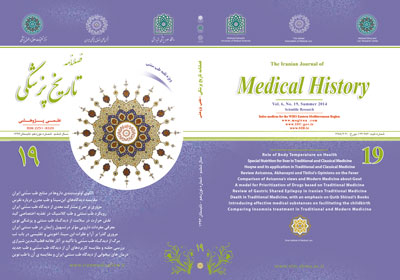
Editorial


Editorial

Mahmood Abbassi

Tārīkh-i pizishkī i.e., Medical History, Vol. 6 No. 19 (1393), 3 February 2015, Page 7-10
https://doi.org/10.22037/mhj.v6i19.8122

Undoubtedly, the ultimate goal of medical sciences is the realization of human health and the health of human society; Because today, healthy human beings are recognized as the main factor in the development and progress of societies. One of the ways to achieve sustainable health is to use all the capacities based on experience and reason and to organize the findings and experiences of different medical schools and different medical sciences in the world health system. Benefiting from the successful teachings of medical schools, which are the result of centuries of effort, research and experience, is considered an important way to achieve this goal.

Due to the luck of the people and relevant officials in most countries of the world and the special attention of some international medical authorities such as the World Health Organization and the formation of some new trends and approaches in the world health system such as learning to accept the theory of comprehensive medicine, a new wave of formation Movements such as complementary medicine, alternative medicine, traditional medicine and other topics have been launched. The re-emergence of many physicians, thinkers and people in the world of complementary medicine schools also highlights the value of Iranian medicine.

....

Review Article


Introducing a model for prioritization of drugs, based on Iranian Traditional Medicine references

Seyyed Ali Mozaffarpur, Mahmoud Khodadust, Hoda Shirafkan, Mehdi Yousefi, Mohadeseh Mirzapor

Tārīkh-i pizishkī i.e., Medical History, Vol. 6 No. 19 (1393), 3 February 2015, Page 11-28
https://doi.org/10.22037/mhj.v6i19.7545


In the medical world today, the searching process to find a new drug (drug discovery) is very expensive and time consuming.

Although the principles of Iranian Traditional Medicine (ITM) differs from conventional medicine, including the viewpoints to drugs and its mechanisms of effectiveness, but it seems that it is possible to find ideas to produce new drugs matching with basics of conventional medicine.

In this paper, we have tried to introduce a logical and repeatable manner to find the most effective material medica in ITM references for a definite disease or sign and symptom.

This manner is explained in 9 steps including: accommodation of subject, arrange keywords, determine resources, giving a score to each book, search in the references, find synonyms and classification, re-monitoring, scoring and setting priorities. After setting priority based on literature review, recommendation of each materia medica for clinical trials should be done regarding to factors such as: availability, cost, being native, fewer complications, better tasting, easy to prepare and availability to maintain long-time.

Role of body temperature on health: traditional and conventional

Majid Nimrouzi, Maryam Bemani, Manijeh Zare, Samaneh Zazerani, Najmeh Soltanabadi, Maryam Fathi, Marzieh Firouzpour

Tārīkh-i pizishkī i.e., Medical History, Vol. 6 No. 19 (1393), 3 February 2015, Page 29-44
https://doi.org/10.22037/mhj.v6i19.7546

In modern science, heat is a quality that enhances the movement of molecules. Maintenance of instinctive temperature in a normal range is vital for healthy organs' function and survival. In the Traditional Persian Medicine, the heat comprised to instinctive that is related to animal spirit and hands the animal life; and stout heat that is related to natural spirit. Instinctive which derived from main spiritual heat has no burning, decay and infection. In traditional medicine, the physician determines the body hotness and coldness of the patient with palpation. However further than palpation, the physician should evaluate the function of main body organs (heart, brain and liver) to estimate instinctive heat. The physician should be moderate in mezaj (temperament) or knows the normal moderate human's mezaj. The maintenance of instinctive heat and humidity plays vital role in healthy life style and longevity. The weather, food and drink, sleep and wake, motion and stillness, retention and evacuation and at last mood are the six main basics for maintaining instinctive temperature.

Despite the differences between the definitions and terminology of both traditional and modern perspectives on the heat, the importance of body temperature in metabolism and health is mentioned in both schools.

This study is about to provide a context for further attention of the researchers to basic concepts of traditional medicine.

Hoqne, Its History, Method and Indications and its application in Iranian Traditional Medicine Compared with Classical Medicine

Mojgan Tansaz, Maryam Bahman, Razieh Nabi Meybodi

Tārīkh-i pizishkī i.e., Medical History, Vol. 6 No. 19 (1393), 3 February 2015, Page 45-71
https://doi.org/10.22037/mhj.v6i19.7547

Introduction: one of the Iranian traditional medicine`s treatment method is hoqne which means sending fluids into body via anus and vaginal route. This technique has a history spanning thousands of years and has been used since Hippocrates and galen. In modern medicine, hoqne, which used in treatment of some diseases, has been called enema.

The purpose of this paper is survey of hoqne, its methods, its history & its indications in traditional medicine`s view point. Present research also compares hoqne`s uses, in traditional and modern medicine.

Methods: this study is a review in which used some reference books of the Iranian traditional medicine, like canon, kholasat-al-hekmah, exir-e-azam and akbari teb (medicine). Some keywords “vasti, basti, enema” also has been searched in modern medicine databases. Finally, these data was collected and classified.

Results: after studies, it was concluded that hoqne is widely used in traditional medicine in various organs` diseases, such as headache, dizziness, stroke, seizures, kidney and bladder pain, joint pain, sciatica, constipation, intestinal ulcers, expelling the waste material, fever, poisoning and so on. Moreover, in traditional Chinese medicine and Indian traditional medicine, hoqne is used in the treatment of the various diseases like, skeletal system, and kidney, genital and metabolic diseases. In modern medicine, enema is used for diagnosis and treatment of some diseases such as intussusception and gastrointestinal cancers.

Conclusion: comparing the use of hoqne in modern medicine and traditional medicine shows that this method is more widely used in traditional medicine rather than modern medicine for treatment of local and systemic diseases which some part of them have been approved by new researches. It seems, other indications in traditional medicine can be discussed further.

According to the negligible side effects of this treatment and its high success rate in the studied cases, hoqne can be suggested as an alternative method for the aggressive and complicated treatments.

Principle nutrition for liver in both healthiness and illness: Approach of Allopathic Medicine and Iranian Traditional Medicine

Faezeh Askary, Marzieh B. Siahpoosh, Fatemeh Nejatbakhsh

Tārīkh-i pizishkī i.e., Medical History, Vol. 6 No. 19 (1393), 3 February 2015, Page 73-90
https://doi.org/10.22037/mhj.v6i19.7548

Theme: According to Allopathic medicine, liver is introduced as a place for substances metabolism, glycogen storage, hematopoiesis, and production of biliary salts. Liver is considered as a place for production of blood and some other substances in Iranian Traditional Medicine too. These obligations are so important in both Allopathic and Traditional Medicine and any disorder among them may result to serious complications in whole body organs’ functions. Nutrition and table manners play the most important role to make an enough protection for liver both in healthiness and during illness.

Aim: Investigation into the viewpoints of ancient Iranian physicians about principle and appropriate nutrition for liver in both healthiness and illness, and finally, a brief comparison with dominated viewpoints in Allopathic medicine, are the aims of study.

Methods: Reviewing of valid Iranian Traditional Medicine references, part of “principle nutrition for liver”, and also two valid allopathic texts in liver diseases and nutrition with specifying their differences and similarities in first step, and then, content analysis of findings is the method of study.

Results: According to principles, both ideologies have presented some appropriate diets for liver; however they are different with together, they are not contradictory.

Conclusion: Specific diets recommended for liver in both healthiness and illnesses in Iranian Traditional Medicine are more extensive than allopathic medicine, which are not so difficult to be ordered so that after enough studies and investigations, they could be used by any non-specialist physicians.

The comparison of Avicenna’s view and modern medicine about gout

Amir Hossein Babaei, Majid Nimrouzi, Moinuddin Abedinirad

Tārīkh-i pizishkī i.e., Medical History, Vol. 6 No. 19 (1393), 3 February 2015, Page 91-109
https://doi.org/10.22037/mhj.v6i19.7550

Gout is a common disease. Iranian traditional physician and on top of them Avicenna suggested various treatment method for gout. Avicenna believes that the most common cause of arthritis is gout. He classified gout by the causing agent to hot and cold dystemperament. Diagnosis is base on patient's condition, type and pattern of pain, joint swelling and dietary habits. Treatment is base on type of dystemperament of patients. Many methods of Avicenna for prevention and treatment of gout are similar with modern medicine. For example, dietary regimen and meat abstinence in conventional medicine are similar to Avicenna's recommendations in “Canon of Medicine”.

Reviewing the Opinions of Avicenna, Tbilisi, and Akhaveayne on the Role of Fever in the Diagnosis of Illnesses and Comparing Them with Modern Medicine

Saeed Changizi Ashtiyani, Mohsen Shamsi, Ali Asghar Farazi

Tārīkh-i pizishkī i.e., Medical History, Vol. 6 No. 19 (1393), 3 February 2015, Page 111-137
https://doi.org/10.22037/mhj.v6i19.7551

Background: Since olden times, fever and its diagnostic features have been always paid attention to. The aim of this study was to investigate the views of Iranian Islamic scholars, Avicenna, Tbilisi and Akhaveayne on fever and their compatibility with modern sciences.

Methods: The authors tried to refer to authentic and reliable sources for fever in traditional medicine and compare them with modern medicine and arrange their findings into a descriptive article. To collect valid data a comprehensive library search as well as an electronic one, using appropriate keywords, were carried out.

Results: Based on the data collected and according to Iranian traditional medicine the root of fever lay in the disorders of other organs which could be helpful in the diagnosis of illnesses. In traditional medicine, fever was divided into different types like sanguine (of blood), melancholic, phlegmatic, daily fever, and so on.In Iranian traditional medicine careful examination of the patient as well as the background leading to fever were of utmost importance and a lot of foods prescribed for the treatment of fever were consistent with the standards of modern medicine.

Conclusion: Given that in modern medicine many causes of fever are still unknown, a new approach to the traditional diagnostic and therapeutic views on fever can compensate for the insufficiencies of modern medicine in this regard.

Review of Gastric Shared Epilepsy in Iranian Traditional Medicine

Somayeh Ahmadbegi, Aliakbar Jafarian, Fataneh Hashem dabaghian, Jale Aliasl, Seyed Ahmad Vaezi

Tārīkh-i pizishkī i.e., Medical History, Vol. 6 No. 19 (1393), 3 February 2015, Page 139-152
https://doi.org/10.22037/mhj.v6i19.7552

Epilepsy is a chronic disease, with overall incidence of 0.5% to 1%. Despite numerous treatments and antiepileptic drugs in allopathic medicine, 30% of epileptics suffer from uncontrolled seizures. In today's medicine, epilepsy is classified into generalized and focal seizures, due to symptoms and signs and brain involvement level. Abdominal seizure is a kind of focal seizure. Iranian traditional medicine as a rich source provides different categories and treatments for this disease. In this study, we addressed viewpoints of Iranian traditional medicine physicians on gastric shared epilepsy. This kind of epilepsy appears because of gastric problems and its seizures could be controlled by treating these problems. This study provides a comparison between gastric shared epilepsy and abdominal seizure, according to their causes, symptoms and treatments. In gastric shared epilepsy in Iranian traditional medicine, treatment is focused on stomach and strengthening the brain is also attended to. According to this study, in some epileptics, treating gastric problems has noticeable impacts on the process of disease therapy, about which clinical trial is suggested.

Introducing medical substances (materia medica) which are effective on facilitating the childbirth in Iranian traditional medicine

Sakineh Moayed Mohseni, Mohsen Naseri, Maryam Yargholi

Tārīkh-i pizishkī i.e., Medical History, Vol. 6 No. 19 (1393), 3 February 2015, Page 153-166
https://doi.org/10.22037/mhj.v6i19.7554

Childbirth means the complete removal of placenta and fetus from the uterus to the outside of the mother's body. Natural childbirth process is usually very difficult and painful, and this causes pregnant mothers and delivery teams to tend to avoid this process, and to be attracted to Cesarean delivery. Complications of Cesarean delivery are twice more than natural delivery, and in addition, it imposes a lot of expense to the treatment section. If a method could be found to make the natural delivery easier and acceptable, its popularity can be increased. Unfortunately, due to the lack of exact specification of childbirth physiology and its effective factors, their facilitation and expedition procedures are also limited. In Iranian traditional medicine, many medical substances which are effective on childbirth are mentioned; this study introduces some of them. This research is a library study, and is based on a literature review.

In this study medical substances which are effective on facilitating the childbirth are searched in four traditional medicine pharmacology reference books (The Canon of Medicine, Ekhtiyarat Badi‘i, Tohfat-ul-Mo'menin, Makhzan-ul-Advia). This work was done in 7 steps (finding keywords, searching in the resources, preparing a single list, finding synonyms, conclusion, and scoring, and sorting according to the scores achieved), and 19 single-medicine medical substances were found which were being discussed in childbirth facilitating. All these obtained substances are herbal based. The highest scores achieved, belong to Aristolochia, Juniper, Chamomile, Ferula, and Hedera helix.  The list of medical substances (materia medica) achieved in this study, can be used as a base for conducting clinical studies to produce new medicines which are effective on delivery facilitating.

Death in the perspective of Iranian traditional medicine, with an emphasis on AllamaQutb al-DinShirazi's books

Mahdieh Haji Monfarednejad, Mojtaba Heidari

Tārīkh-i pizishkī i.e., Medical History, Vol. 6 No. 19 (1393), 3 February 2015, Page 167-184
https://doi.org/10.22037/mhj.v6i19.7555

AllamaQutb al-DinShirazi (634-710 AH) was a physician, philosopher, astronomer, mathematician, scholar and musician in Islamic golden age. He was one of the most famous students of KhwajaNasirToosi and the most famous interpreter of IbnSina's Canon of Medicine. Most of his theories were a detailed and comprehensive form of his predecessor's theories. Among these cases, his theory about the meaning of "death" is discussed here.

He made detailed discussions about death. He focused on the definition of death initially, and then described its physiopathology from the perspective of Iranian traditional medicine. He also talked about life span, its usual rate, and the maximum of lifetime experimentally. Finally, he discussed about association between health recommendation and delaying death.

Allama's medical explanation of the death is greatly influenced by the Aristotelian philosophical approach to the concept of life and death. Most of the physiological explanation of death is based upon concepts that living organism ware defined; Concepts such as spirit, natural heat and moisture, chief organs, medical spirits, pulse, and breathing.

Comparing Insomnia Treatment in Iranian traditional Medicine and Modern Medicine

Zohre Feyzabadi, Roghieh Javan, Roshanak Mokaberinejad, Jale Aliasl

Tārīkh-i pizishkī i.e., Medical History, Vol. 6 No. 19 (1393), 3 February 2015, Page 185-208
https://doi.org/10.22037/mhj.v6i19.8120

Background: Insomnia is one of the most prevalent sleep disorders which affect the quality of life. Due to high prevalence of this disease and the side effects of sedative drugs and an increase in people tend to use herbal remedies, this study was designed. This study aims at investigating various treatments for insomnia in Iranian traditional medicine and comparing them with current therapies in modern medicine.

Materials and methods: This study is reviews Iranian traditional medicine textbooks and their contents about insomnia and its treatments which are separately expressed and explained. In addition, new articles are reviewed as well to be able to compare modern and traditional treatments.

Results: In the viewpoint of Iranian traditional physicians, sleep hygiene is essential to treat insomnia. For this purpose, they suggest some special foods, simple and complex drugs and soma activities. They prescribe different types of drug use, such as intranasal and topical drug consumption. In addition, they suggest anointing the forehead or feet, and foot massage as treatments of insomnia. Reviewing modern treatments of insomnia with In Iranian traditional medicine’s treatment revealed that in Iranian traditional medicine, both topical methods and oral medication are suggested, whereas in modern medicine often oral therapy and cognitive-behavioral therapy are used and topical treatments are rarely adopted.

Conclusions: It seems that topical application of drug in insomnia treatment which is suggested in Iranian traditional medicine can reduce the side effects are caused by oral consumption of the drugs. This study can be helpful to remove some of the side effects of modern medicine and we hope that by combining traditional and modern therapies, a more helpful treatment for insomnia is achieved.