Investigating Antibacterial Effects of Nano-Ag/titanium dioxide on Polylactic Acid Nanocomposites Produced Using Extrusion Method
Applied Food Biotechnology,
Vol. 11 No. 1 (2024),
18 November 2023
,
Page e28
https://doi.org/10.22037/afb.v11i1.45932
Abstract
Background and Objective: Biodegradable polymers generally do not include antibacterial characteristics. This study investigated effects of various concentrations of nano-titanium dioxide containing silver on polylactic acid nanocomposites for their microscopic, chemical, roughness of the coatings and antibacterial characteristics against Staphylococcus aureus and Escherichia coli.
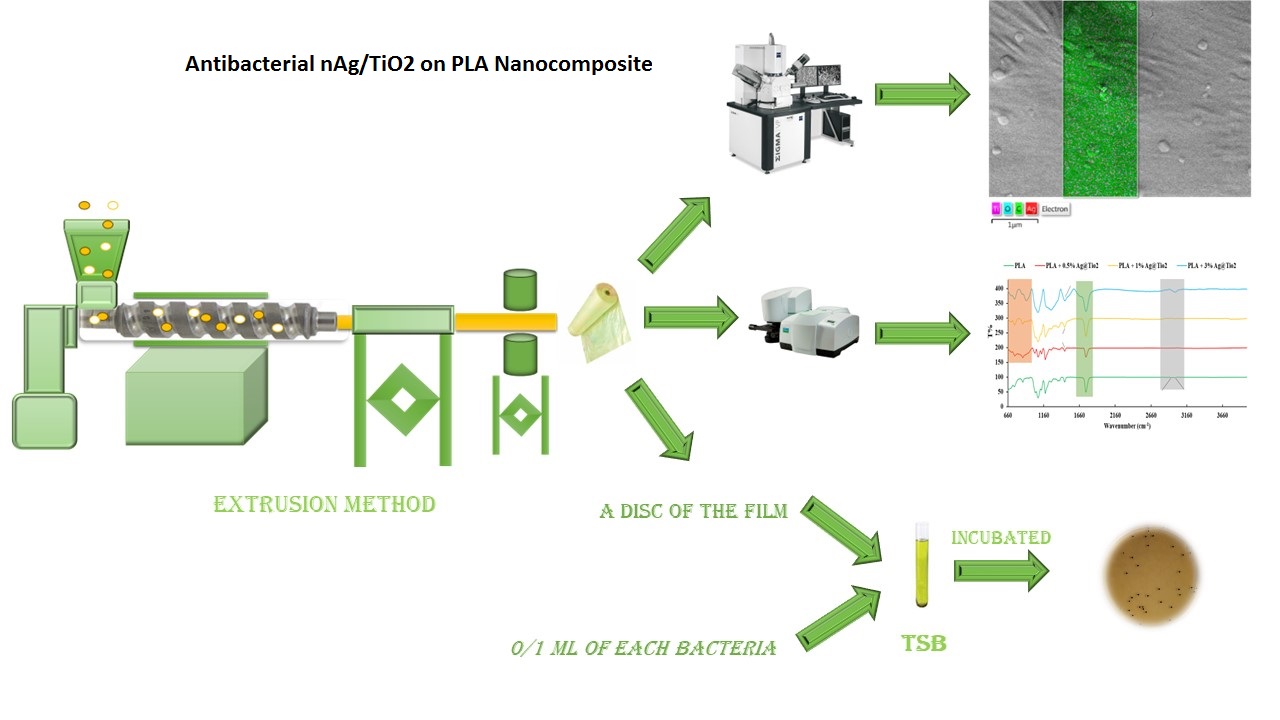
Material and Methods: Nanometric structure of the coatings was assessed through multiple steps. First, films containing 0.5, 1 and 3% wt% concentrations were produced using extrusion method and then analyzed and compared using scanning electron microscope and energy dispersive spectroscopy. Then, Fourier transform infrared spectroscopy and atomic force microscope were used to investigate functional groups, types of bonds, peak intensity variations and roughness characteristics of the films. Moreover, antimicrobial effects of the coatings was assessed on Staphylococcus aureus and Escherichia coli.
Results and Conclusion: Results of the scanning electron microscope indicated that the accumulation of nanoparticles in the films increased with increasing concentration of the nanoparticles. This increase affected energy dispersive spectroscopy, resulting in higher levels of titanium and silver nanoparticles. Fourier transform infrared spectroscopy revealed changes in intensity and position of the peaks due to the presence of nanoparticles. Bacterial growth assessments demonstrated that addition of nano-titanium dioxide containing silver to polylactic acid significantly decreased the growth of Staphylococcus aureus and Escherichia coli bacteria (p < 0.05). Based on the results, coatings containing 3 wt% of nano-titanium dioxide with silver showed the greatest decrease in bacterial growth.
Conflict of interest: The authors declare no conflict of interest.
- Atomic force microscope
- Fourier transform infrared
- Spectroscopy
- Nanoparticles
- Packaging
- Polymers
How to Cite
References
Nayak JK, Behera L, Jali BR. TiO2 strengthened PLA nanocomposites: A prospective material for packaging application. J Mol Struct. 2024; 1316: 138892. https://doi.org/10.1016/j.molstruc.2024.138892
Zibaei R, Ebrahimi B, Rouhi M, Hashami Z, Roshandel Z, Hasanvand S, de Toledo Guimaraes J, Mohammadi R. Development of packaging based on PLA/POE/SeNPs nanocomposites by blown film extrusion method: Physicochemical, structural, morphological and antioxidant properties. Food Packag Shelf Life. 2023; 38: 101104. https://doi.org/10.1016/j.fpsl.2023.101104
Liza TZ, Tusher MMH, Anwar F, Monika MF, Amin KF, Asrafuzzaman FNU. Effect of Ag-doping on morphology, structure, band gap and photocatalytic activity of bio-mediated TiO2 nanoparticles. Resul Mater. 2024; 22: 100559. https://doi.org/10.1016/j.rinma.2024.100559
Bailey EJ, Winey KI. Dynamics of polymer segments, polymer chains and nanoparticles in polymer nanocomposite melts: A review. Progr Poly Sci. 2020; 105: 101242. https://doi.org/10.1016/j.progpolymsci.2020.101242
Feng S, Zhang F, Ahmed S, Liu Y. Physico-mechanical and antibacterial properties of PLA/TiO2 composite materials synthesized via electrospinning and solution casting processes. Coatings. 2019; 9(8): 525. https://doi.org/10.3390/coatings9080525
Deghiche A, Haddaoui N, Zerriouh A, Fenni SE, Cavallo D, Erto A, Benguerba Y. Effect of the stearic acid-modified TiO2 on PLA nanocomposites: Morphological and thermal properties at the microscopic scale. J Environ Chem Eng. 2021; 9(6): 106541. https://doi.org/10.1016/j.jece.2021.106541
Wang Y, Ju J, Diao Y, Zhao F, Yang Q. The application of starch-based edible film in food preservation: a comprehensive review. Crit Rev Food Sci Nutr. 2024: 1-34. https://doi.org/10.1080/10408398.2024.2349735
Herniou C, Mendieta JR, Gutiérrez TJ. Characterization of biodegradable/non-compostable films made from cellulose acetate/corn starch blends processed under reactive extrusion conditions. Food Hydrocol. 2019; 89: 67-79. https://doi.org/10.1016/j.foodhyd.2018.10.024
Iacovone C, Yulita F, Cerini D, Pena D, Candal R, Goyanes S, Pietrasanta LI, Guz L, Fama L. Effect of TiO2 nanoparticles and extrusion process on the physicochemical properties of biodegradable and active cassava starch nanocomposites. Polymer. 2023; 15(3): 535. https://doi.org/10.3390/polym15030535
Pusnik Cresnar K, Aulova A, Bikiaris DN, Lambropoulou D, Kuzmic K, Fras Zemljic L. Incorporation of metal-based nanoadditives into the PLA matrix: Effect of surface properties on antibacterial activity and mechanical performance of PLA nanoadditive films. Molecule. 2021; 26(14): 4161.https://doi.org/10.3390/molecules26144161
Li L, Chen W, Zheng J, Wang L, Chen Y. Characterization of silver nanoparticles thin films with various thicknesses by AFM. J Mater Sci Chem Eng. 2016; 4(1): 34-39. http://doi.org/10.4236/msce.2016.41007
Ahmadi N, Ahari H, Anvar A, Khosravi-Darani K, Gharachorloo M. Polycaprolactone (PCL)-based films integrated with hairy cellulose nanocrystals and silver nanoparticles for active Tilapia packaging applications. Food Chem X. 2024; 22: 101490. https://doi.org/10.1016/j.fochx.2024.101490
Rahma AJ, Oleiwi HF, Abbas HA. Synthesis of TiO2 nanoparticles using spin-coating and Drop-casting techniques for antibacterial application. J Nanostruct. 2023; 13(3): 673-684.
Salimi F, Ahari H, Anvar SA, Motallebi Moghanjoghi A. A comparative study on the anti‐bacterial properties of three types of silver nano packaging based on (PLA, TiO2, PE) on Husinae Acipenseridae (Huso huso). SPE Polymers. 2024: 1-20. https://doi.org/10.1002/pls2.10148
Trotta F, Da Silva S, Massironi A, Mirpoor SF, Lignou S, Ghawi SK, Charalampopoulos D. Silver bionanocomposites as active food packaging: Recent advances & future trends tackling the food waste crisis. Polymers. 2023; 15(21): 4243.https://doi.org/10.3390/polym15214243
Gonzalez EAS, Olmos D, Lorente MA, Velaz I, Gonzalez-Benito J. Preparation and characterization of polymer composite materials based on PLA/TiO2 for antibacterial packaging. Polymers. 2018; 10(12). https://doi.org/10.3390%2Fpolym10121365
Li W, Zhang C, Chi H, Li L, Lan T, Han P, Chen H, Qin Y. Development of antimicrobial packaging film made from poly (lactic acid) incorporating titanium dioxide and silver nanoparticles. Molecules. 2017; 22(7): 1170. https://doi.org/10.3390/molecules22071170
Buddhakala M, Buddhakala N. Physical, mechanical and antibacterial properties of biodegradable bioplastics from polylactic acid and corncob fibers with added nano titanium dioxide. Trends Sci. 2023; 20(4): 6473-. https://doi.org/10.48048/tis.2023.6473
Barani S, Ahari H, Bazgir S. Increasing the shelf life of pikeperch (Sander lucioperca) fillets affected by low-density polyethylene/Ag/TiO2 nanocomposites experimentally produced by sol-gel and melt-mixing methods. Int J Food Prop. 2018; 21(1): 1923-1936. https://doi.org/10.1080/10942912.2018.1508162
Zandi M, Almasi H, Dardmeh N. Evaluation of nanocomposite packaging containing Tio2 and ZnO on shelf life and quality changes of apple and grape. Innovative Food Technologies. 2020; 8(1): 63-82. https://doi.org/10.22104/jift.2020.4206.1974
Dong Y, Zhu H, Shen Y, Zhang W, Zhang L. Antibacterial activity of silver nanoparticles of different particle size against Vibrio Natriegens. PloS one. 2019; 14(9): e0222322. https://doi.org/10.1371/journal.pone.0222322
Jafroudi ZT, Ahari H, Haghdoost NS, Shabani S. Production of nanocomposite silver packaging using solution blending method for the supplement of antibacterial coating. Appl Food Biotechnol. 2024; 11(1): e16-e. https://doi.org/10.22037/afb.v11i1.43876
Xing Y, Li X, Guo X, Li W, Chen J, Liu Q, Xu Q, Wang Q, Yang H, Shui Y. Effects of different TiO2 nanoparticles concentrations on the physical and antibacterial activities of chitosan-based coating film. Nanomaterials. 2020; 10(7): 1365. https://doi.org/10.3390%2Fnano10071365
Sallak N, Moghanjoughi AM, Ataee M, Anvar A, Golestan L. Antimicrobial biodegradable film based on corn starch/Satureja khuzestanica essential oil/Ag–TiO2 nanocomposites. Nanotechnology. 2021; 32(40): 405703.
Evcin A, Arlı E, Baz Z, Esen R, Sever E. Characterization of Ag-TiO₂ powders prepared by sol-gel process. Acta Physica Polonica A. 2017; 132(3): 608-611. http://doi.org/10.12693/APhysPolA.132.608
Shankar S, Wang L-F, Rhim J-W. Incorporation of zinc oxide nanoparticles improved the mechanical, water vapor barrier, UV-light barrier and antibacterial properties of PLA-based nanocomposite films. Materials Science and Engineering: C. 2018; 93: 289-298. https://doi.org/10.1016/j.msec.2018.08.002
Sheikh K, Shahrajabian H. Experimental study on mechanical, thermal and antibacterial properties of hybrid nanocomposites of PLA/CNF/Ag. Int J Eng. 2021; 34(2): 500-507. https://doi.org/10.5829/ije.2021.34.02b.23
Azizi-Lalabadi M, Alizadeh-Sani M, Divband B, Ehsani A, McClements DJ. Nanocomposite films consisting of functional nanoparticles (TiO2 and ZnO) embedded in 4A-Zeolite and mixed polymer matrices (gelatin and polyvinyl alcohol). Food Res Int. 2020; 137: 109716. https://doi.org/10.1016/j.foodres.2020.109716
Singha SK, Hoque SM, Das H, Alim MA. Evaluation of chitosan-Ag/TiO2 nanocomposite for the enhancement of shelf life of chili and banana fruits. Heliyon. 2023; 9(11). https://doi.org/10.1016/j.heliyon.2023.e21752
Desiati RD, Taspika M, Sugiarti E. Effect of calcination temperature on the antibacterial activity of TiO2/Ag nanocomposite. Mater Res Express 2019; 6(9): 095059. https://doi.org/10.1088/2053-1591/ab155c
- Abstract Viewed: 586 times
- pdf Downloaded: 290 times