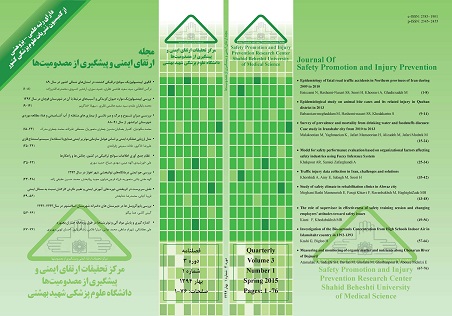
Investigation of the Bio-aerosols Concentration from High Schools Indoor Air in Islamshahr County in 1392-1393
Irtiqa Imini Pishgiri Masdumiyat (Safety Promotion and Injury Prevention),
Vol. 3 No. 1 (2015),
1 July 2015
,
Page 66 - 57
https://doi.org/10.22037/meipm.v3i1.9321
Abstract
Background and Objective: Due to susceptible pupil population to airborne diseases, it is important that monitoring of indoor and ambient air quality in schools. The number of bioaerosols is related to spreading diseases in pupils that spend 6 hours in schools. The aim of this research is to determine type and number of bioaerosols in indoor and ambient air in schools, geographical situation and season effects on number of bioaerosols.
Materials and Methods: This descriptive-analytical study is carried out in Adalat and Payam ghoran girl high schools in Slamshahr in a period of 22/10/2013 to 21/5/2014. The air sampling for assessing of bioaerosols number in indoor and ambient air is carried out by microbial air direct sampler (Quick Take-30) at 28.3 L/min flow rate. The results are compared with European Guide to Good Manufacturing Practice (EU GMP) standard and specified pollution level of station.
Results: The mean bacterial and fungal number of indoor air is higher than ambient air in classes. Also, the mean airborne bacterial and fungal number in the second floor is the most. The presence of Aspergillus and Penicillum is tangible both of environments.
Conclusion: The findings indicate that higher bioaerosols number in class with higher pupils number may be resulted in respiratory disorders and aeroallergen acute symptoms in long term.
How to cite this article: Kashi G, Bigloo H. Investigation of the Bio-aerosols Concentration from High Schools Indoor Air in Islamshahr County in 1392-1393. Irtiqa Imini Pishgiri Masdumiyat (Safety Promotion and Injury Prevention).2015; 3(1):57-66.
- Air pollution
- Bioaerosols
- High school
- Islamshahr.
How to Cite
References
REFERENCES:
Chan P, Yu P, Cheng Y, Chan C, Wong P. Comprehensive characterization of indoor airborne bacterial
profile. Journal of Environmental Sciences. 2009;21(8):1148-52.
Paula CR, Krebs VL, Auler ME, Ruiz LS, Matsumoto FE, Silva EH, et al. Nosocomial infection in newborns by Pichia anomala in a Brazilian intensive care unit. Medical mycology. 2006;44(5):479-84.
Hwang GB, Jung JH, Jeong TG, Lee BU. Effect of hybrid UV-thermal energy stimuli on inactivation of S. epidermidis andB. subtilis bacterial bioaerosols. Science of the total environment. 2010;408(23):5903-9.
Khan AAH, Karuppayil SM. Potential natural disinfectants for indoor environments. International Journal of Clinical Aromatherapy. 2010; 7(1): 1-5.
Chen F, Yang X, Mak HK, Chan DW. Photocatalytic oxidation for antimicrobial control in built environment: A brief literature overview. Building and Environment. 2010;45(8):1747-54.
Lee SJ, Park JS, Im HT, Jung H-I. A microfluidic ATP-bioluminescence sensor for the detection of airborne microbes. Sensors and Actuators B: Chemical. 2008;132(2):443-8.
Griffiths W, Bennett A, Speight S, Parks S. Determining the performance of a commercial air purification system for reducing airborne contamination using model micro-organisms: a new test methodology. Journal of hospital infection. 2005;61(3):242-7.
Taheri S, Golbabaei F. The study of aerosol and bioaerosol in home carpet weaving workshops rural Isfahan. Journal of Health Researching. 2011; 6 (2): 351-56.
Dehghani M, Saeedi Aboueshaghi A, Zamanian Z. A study of the relationship between indoor and outdoor particle concentrations in Hafez Hospital in Shiraz, Iran. Journal of Health Ressearching. 2013;8(7):1348-55
Hoseinzadee A, samarghandi MR, Gheiaseian Seed A, Alikhanee MY, Roshanae Gh, Moghadam Shakeeb M. Investigation of bioaerosols quantity and qualitative in wards inside air in state hospitals in Hamedan in 2011.Quaternary Research Journal of Lorestan of Medical Sciences. 2012;14(4): 29-39.
Kim K-Y, Kim H-T, Kim D, Nakajima J, Higuchi T. Distribution characteristics of airborne bacteria and fungi in the feedstuff-manufacturing factories. Journal of hazardous materials. 2009;169(1):1054-60.
Gangneux J-P, Robert-Gangneux F, Gicquel G, Tanquerel J-J, Chevrier S, Poisson M, et al. Bacterial and fungal counts in hospital air: comparative yields for 4 sieve impactor air samplers with 2 culture media. Infection Control. 2006;27(12):1405-8.
Yanawar VB, Mushtaq A, Bhosle AB, Turukmane KL, Gaikwad MN, Kharat VV, Narwade KB. Determination of culturable indoor airborne fungi in campus areas of SRTM university Nanded, India. Journal of Applied Science in Environmental Sanitation. 2014; 9 (1): 73-8.
Khodarahmee F, Godarzee Gh, Hashemee Shahrakee A, Alavi Bakhteiarvand NA, Ahmadi Angali K,
Dehghanee M. Investigation of environmental parameters effects on suspended particles and bacteria concentration in air in different seasons in Ahvaz. New Cellular-Molecular Biotechnology Journal. 1913; 3(11): 83-90.
Kermani M, Farzadkia M, Yousefi Z, Ghandali R. Investigating the Environmental Health and Safety Status among Primary Schools. Journal of Mazndaran University of Medical Sciences. 2012;22(95):93-7.
Jo W-K, Seo Y-J. Indoor and outdoor bioaerosol levels at recreation facilities, elementary schools, and homes. Chemosphere. 2005;61(11):1570-9.
Zhang X, Zhao Z, Nordquist T, Larsson L, Sebastian A, Norback D. A longitudinal study of sick building syndrome among pupils in relation to microbial components in dust in schools in China. Science of the total environment. 2011;409(24):5253-9.
Saijo Y, Nakagi Y, Ito T, Sugioka Y, Endo H, Yoshida T. Dampness, food habits, and sick building syndrome symptoms in elementary school pupils. Environmental Health Preview Medicine. 2010; 15: 276-84.
Vacher S, Hernandez C, Bärtschi C, Poussereau N. Impact of paint and wall-paper on mould growth on plasterboards and aluminum. Building and Environment. 2010;45(4):916-21.
Lee LD, Berkheiser M, Jiang Y, Hackett B, Hachem RY, Chemaly RF, et al. Risk of bioaerosol contamination with Aspergillus species before and after cleaning in rooms filtered with high-efficiency particulate air filters that house patients with hematologic malignancy. Infection Control. 2007;28(09):1066-70.
Ekhaise F, Ighosewe O, Ajakpovi O. Hospital indoor airborne microflora in private and government owned hospitals in Benin City, Nigeria. World Journal of Medical Sciences. 2008;3(1):19-23.
Fang Z, Ouyang Z, Zheng H, Wang X, Hu L. Culturable airborne bacteria in outdoor environments in
Beijing, China. Microbial Ecology. 2007;54(3):487-96.
Obbard JP, Fang LS. Airborne concentrations of bacteria in a hospital environment in Singapore. Water, Air, and Soil Pollution. 2003;144(1-4):333-41.
Sautour M, Sixt N, Dalle F, L'Ollivier C, Fourquenet V, Calinon C, et al. Profiles and seasonal distribution of airborne fungi in indoor and outdoor environments at a French hospital. Science of the total environment. 2009;407(12):3766-71.
Pegas P, Nunes T, Alves C, Silva J, Vieira S, Caseiro A, et al. Indoor and outdoor characterisation of
organic and inorganic compounds in city centre and suburban elementary schools of Aveiro, Portugal. Atmospheric Environment. 2012;55:80-9
- Abstract Viewed: 488 times
- PDF Downloaded: 1743 times