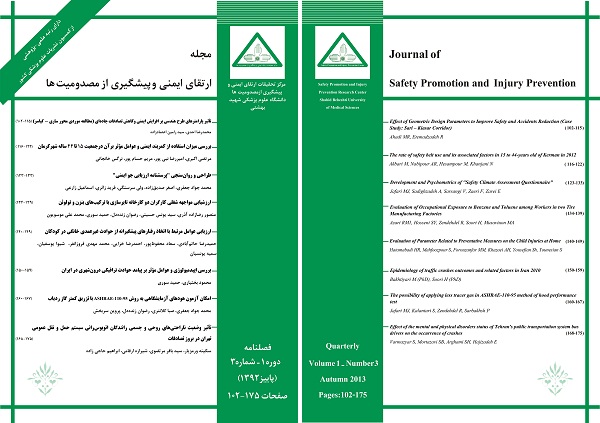
The possibility of applying less tracer gas in ASHRAE-110-95 method of hood performance test
Irtiqa Imini Pishgiri Masdumiyat (Safety Promotion and Injury Prevention),
Vol. 1 No. 3 (2013),
17 December 2013
,
Page 160-167
https://doi.org/10.22037/meipm.v1i3.5451
Abstract
Background and Objective: A considerable amount of sulfur hexafluoride is applied to evaluate the performance of each laboratory hood according to ASHRAE–110-95 method. SF6 is extremely hostile to environment and expensive. In present work, the possibility of conducting this method of hood performance test with less volume of SF6 was investigated.
Material and Methods: The performance of a laboratory hood was evaluated using ASHRAE110-95 standard method at three different ventilation capacity as well as three different volumetric flow rates of injected SF6 while a mannequin was located at the front of hood. Face velocity was measured 180 times using a thermal anemometer TA-2 model. Air flow was visualized through injecting low and high volume of smokes at 18 tests. Sulfur hexafluoride was injected at three different volumetric flow rates of 2, 3 and 4 lit/min. The occupational exposure of a hypothetic hood operator was determined 27 times through direct reading.
Results: The average and standard deviation of face velocity at hood inlet were 0.42±0.04, 0.6±0.07, 0.7±0.11 m/s respectively, ranging from 0.36-1.1 m/s. the studied hood did not have an acceptable performance when tested with high volumes of smoke, but it did have an acceptable performance while it was tested with low volumes of smoke.
Conclusion: The application of ASHRAE 110-95 hood performance test with smaller volume of tracer sulfur hexafluoride gas is not recommended.
How to cite this article: Jafari MJ, Kalantari S, Zendehdel R, Sarbakhsh P. The possibility of applying less tracer gas in ASHRAE-110-95 method of hood performance test. Irtiqa Imini Pishgiri Masdumiyat (Safety Promotion and Injury Prevention).2013; 1(3):160-167.
- laboratory hood
- tracer gas
- sulfur hexafluoride
- Hood performance
- volumetric flow rate
- injected gas.
How to Cite
References
Esmaeilzadeh A, Golbabaee F, Shahtaheri S. Evaluation of laboratory fume-hoods performance in a petrochemical industry based on ASHRAE 110 Standard. Journal of School of Public Health and Institute of Public Health Research. 2008;6(3-4):111-7.
Fk.T. Chemical Fume Hood Safety Protecting the Health of Laboratory Workers. eScholarship University of California. 2000:p.8.
Karimi Zare A. Evaluation of laoratory hoods in Tehran Water and Waste water Co. Tehran: Islamic Azad university; 2000.
Rydock JP. Tracer performance testing of installed fume hoods: One European perspective. Chemical Health and Safety. 2002;9(4):7-9.
Ivany RE, First MW, Diberardinis LJ. A new method for quantitative, in-use testing of laboratory fume hoods. The American Industrial Hygiene Association Journal. 1989;50(5):275-80.
Hitchings DT. Laboratory fume hood and exhaust fan penthouse exposure risk analysis using the ANSI/ASHRAE 95 -110 and other tracer gas methods. Transactions-American Society of Heating Refrigerating aqnd Air Conditioning Engineers. 1997;863:72-103.
Guffey EJ. Nitrous oxide as a substitute for sulfur hexafluoride in the ANSI/ASHRAE 110 Method of hood performance evaluation. Massachusetts Institute of Technology. 2011:1-44
Occupational Safety & Health Administration. 2012 [2 dec]; Available from: www.oshagov/dts/chemicalsampling/data/CH_268600html/Accessed.
Jacobs PJ. Laboratory fume hood performance. 2009; p:20-50.
Taylor S, Initiative TC. Fume Hood Study: Tufts University. 2044; p: 1-40.
Roni v. Choosing less environmentally damaging gases for fume hood tracer gas testing. Alternative gases to meet. 2007; p: 2.
Kalantari S. Ethylene as a Substitute for Sulfur Hexafluoride in the ASHRAE 95-110 Method of Hood Performance Evaluation. Tehran: Shahid Beheshti University of Medical Science; 2013.
Bell G, Sartor D, Mills E. The Berkeley hood: development and commercialization of an innovative high-performance laboratory fume hood Lawrence Berkeley National Laboratory, Berkeley. California2003.
Dale T, Maupins K. Using the ASHRAE 110 Test as a TQM tool to improve laboratory fume hood performance. ASHRAE Transactions. 1997;14:851-62.
Crawley LH. Application of non-dispersive infrared (NDIR) spectroscopy to the measurement of atmospheric trace gases. 2008.
Industrial Ventilation a manual of practice for designe 27th ed. American Conference of Governmental Industrial Hyginiests (ACGIH); Cincinnati: ACGIH; 2010.
Ojima J. Tracer gas evaluations of push-pull ventilation system performance. Industrial health. 2009;47(1):94-6.
- Abstract Viewed: 420 times
- PDF Downloaded: 186 times